Working Capital Model Example
Corporate Finance Financial Model (Free Excel Download)
Forecast receivables, inventory, payables, and cash conversion using operating drivers to identify funding needs and release working capital from the business.



professionals from Deloitte
Used by professionals from






About this model
Track the cash conversion cycle (CCC) using Days Sales Outstanding (DSO), Days Inventory Outstanding (DIO), and Days Payable Outstanding (DPO) to forecast working capital needs and optimize cash flow. AR balance is calculated as (Revenue / 365) × DSO; inventory balance as (COGS / 365) × DIO; AP balance as (COGS / 365) × DPO. The CCC measures how many days elapse between paying suppliers and collecting from customers; negative CCC (customers pay before suppliers are due) is a source of cash.
The workbook includes a roll-forward schedule for each working capital component, calculates the cash impact of changes in AR/Inventory/AP on the cash flow statement, and expresses working capital as a percentage of revenue. Sensitivity tables show how 5-day improvements in DSO, 10-day reductions in DIO, or extended DPO terms impact free cash flow and cash conversion efficiency. Typical manufacturing CCC ranges from 30–90 days; subscription businesses often achieve negative CCC (10–30 days).
Key metrics: CCC trends (positive = cash tied up, negative = cash generated), cash impact quantification, and optimization levers ranked by impact (DIO improvement typically yields largest cash release). This model is essential for working capital optimization, supply chain finance programs, and cash flow forecasting in operating businesses.
What every model includes
Live formulas, no hardcoded values
Outputs are driven by live formulas, so the workbook updates from its assumptions instead of relying on hardcoded results.
All assumptions in one tab
Inputs are clearly marked in the Assumptions tab and separated from calculations, making it clear what to change and what to leave intact.
Statements always balancing
For integrated-statement models, the balance sheet, cash flow, and supporting schedules tie through properly.
Distinct schedules for clarity
Debt, working capital, taxes, and cash flow can get messy quickly. We group calculations in clear schedules, not across disconnected tabs.
No hidden macros or external links
There are no unexplained external workbook links or macros to undermine auditability or portability.
Changes flow through the model
Update a key driver and see the impact carry through the forecast, financing, and return outputs. We never use hardcoded numbers in formulas.
What's inside the Working Capital Model Example
- DSO, DIO, and DPO driver-based forecasting
- Cash conversion cycle and operating cycle analysis
- Accounts receivable ageing and bad debt modelling
- Inventory safety stock and lead-time calculations
- Supply chain finance and receivables factoring impact analysis
- Days sales outstanding (DSO), days inventory outstanding (DIO), and days payable outstanding (DPO)
- Accounts receivable (AR), inventory, and accounts payable (AP) calculations
- Working capital as a percentage of revenue
Working Capital Model: How the Template Works
This working capital model is a five-year management tool for a mid-market wholesale distributor funded by an asset-based revolver. It answers how much facility the business needs, when, and against what collateral, by linking operating drivers to net working capital, borrowing-base availability and cash flow.
The public download is a values-only preview.
Operating drivers behind the working capital balances
The model is built around the operating choices that tie up cash rather than a simple P&L forecast. Revenue growth, COGS percentage, and three day-count levers — DSO, DIO and DPO — drive the trade balances.
- Those levers are split between opening actuals and plan bases, so improving DSO does not reduce the opening balance and the cash release is not self-cancelling. A settlement-discount blend adjusts applied days: customer discount uptake pulls days out of DSO, while supplier discount participation reduces DPO.
- The receivables ageing mix and per-bucket loss rates feed an allowance and bad debt charge, so net receivables, not gross, drive net working capital. This structure makes the balance sheet the binding constraint.
From operating drivers to borrowing-base availability
The model converts gross receivables and inventory into a collateral-backed borrowing base. Receivables are aged into buckets, with haircuts for past-due, cross-age and concentration excess, then an advance rate.
- Inventory is adjusted for slow-moving and in-transit stock, then valued at NOLV and an advance rate, capped by a sublimit. Reserves for dilution — write-offs plus settlement discounts over revenue — and rent are deducted.
- Availability is the lower of the net borrowing base and the facility commitment. This is the cap on drawdown, so the model sizes the facility against eligible collateral rather than the commitment alone.
A seasonal peak block then tests intra-year needs against year-end availability.
Calculation flow and the circularity break
The model records a five-year P&L, a working capital schedule with a Year 0 opening column, a borrowing base, a cash conversion analysis, a funding analysis, and a summary. A key design choice is breaking the revolver circularity structurally rather than with iterative calculation.
- Cash flow before financing uses pre-tax working capital movement, depreciation, capex and EBIT struck above the financing line, so interest cost never feeds back into the cash need. Interest is then charged on an average facility balance derived from an indicative draw, which is determined before financing.
- This keeps the workbook acyclic and avoids iterative settings, while still charging interest on a realistic average balance.
Outputs and practical use
Outputs include net working capital and its change, DSO, DIO, DPO and the cash conversion cycle, borrowing-base availability and drawn revolver, free cash flow, liquidity ratios, and covenant tests such as FCCR and leverage.
- A terms-sensitivity block prices one day of each metric in cash and interest against programme targets, and a settlement-discount decision compares the implied APR of a supplier discount with the revolver rate. The seasonal peak block exposes the intra-year facility need that annual balances hide.
- A dashboard, summary and validation checks support review. The model is best used to explore how operating terms and collateral shape funding needs, not to promise live formulas in the public preview.
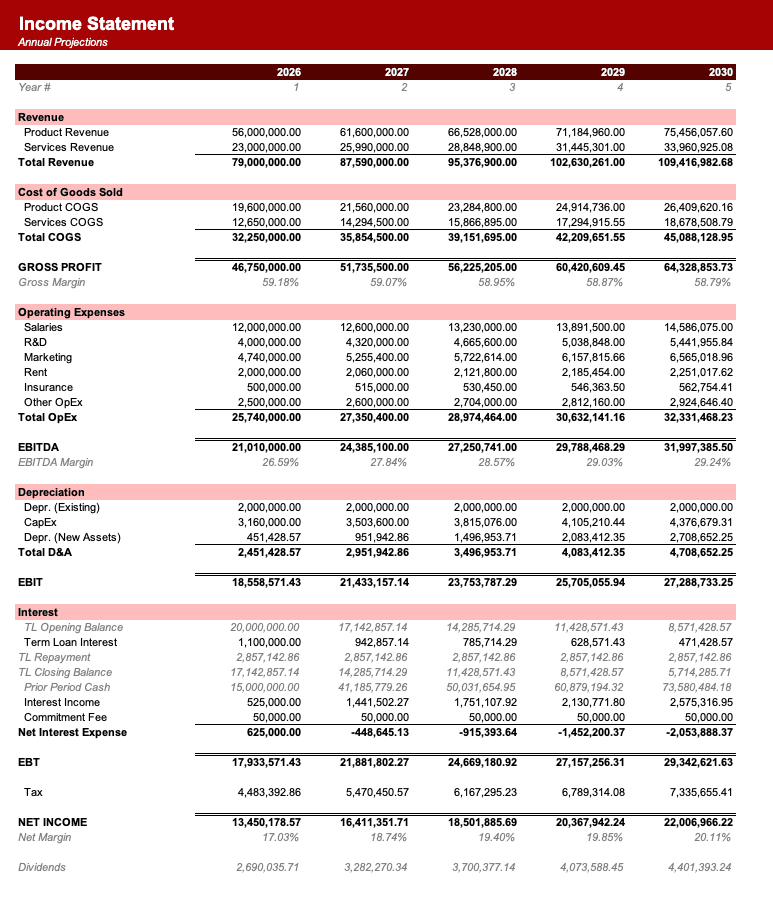
Formatted to IB standards
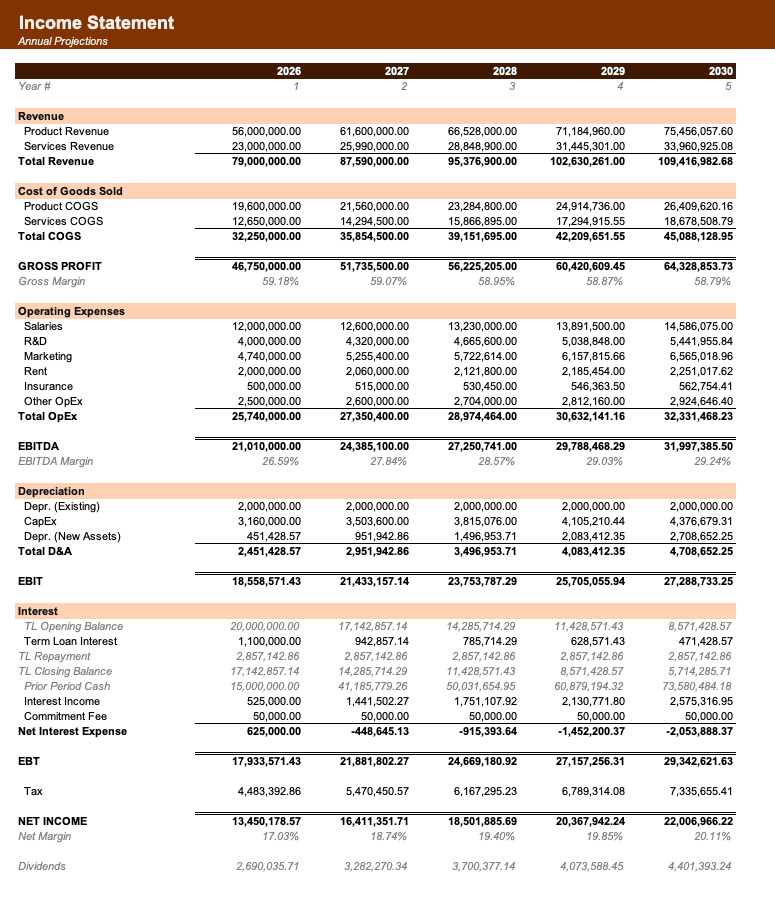
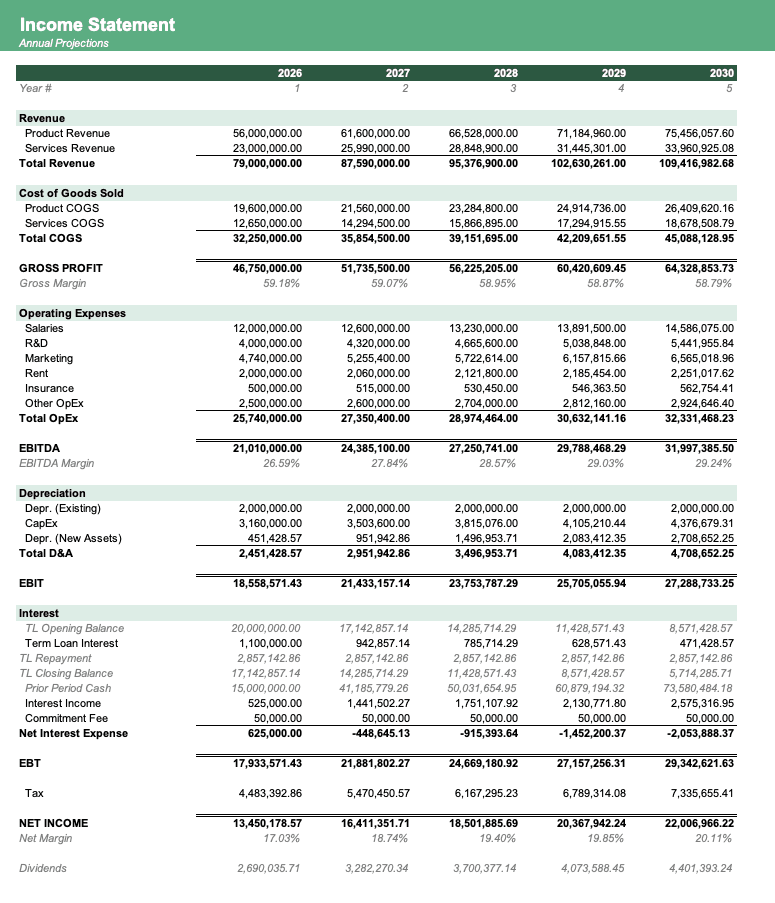
Named theme colors repaint the whole workbook in one click, on top of an investment-banking structure with clear input, output, and cross-sheet reference styling - brand-ready, institutional-grade, and fully auditable.

Created by ex-finance professionals
Hey, I’m Alex and I created Finamodel.
Over my years in the finance industry I kept building the same models over and over again. Same structure, same assumptions, different logo. So I started building frameworks to turn them into clean, reusable templates.
Every model here is one I’d actually use for a client, and I personally vet each one before it goes up.
I’m not an expert in every industry, but I’ve built enough models to know what belongs in one. And when something is completely foreign to me, I reach out to my network for experts to work on our models with us.
Having a template library on hand cuts a first build from hours to minutes.
Need help finding your model? You’ll find me in the Finamodel app!
Frequently asked
What is a working capital model?+
It is a model focused on the efficiency of operating assets and liabilities, analysing DSO, DIO, DPO, and the cash conversion cycle to identify liquidity improvement opportunities.
Who uses working capital models?+
CFOs, treasurers, private equity operating partners, and financial controllers use them for liquidity management and transaction due diligence.
What should a working capital model include?+
It should include receivables, inventory, and payables analysis, cash conversion cycle outputs, and scenario testing for supply chain or credit policy changes.
Can I evaluate early payment discounts?+
Yes. The model includes ROI calculations for dynamic discounting, helping you determine whether early payment is more cost-effective than alternative uses of cash.
Does it support segmented analysis?+
Yes. You can assign different DSO, DIO, and DPO assumptions to different business units or product categories to reflect diverse operating realities.
Have more financial modelling questions? Contact us
Related templates
3 Statement Model
Integrated income statement, balance sheet, and cash flow forecasts.
Cashflow Model
Detailed monthly and annual cash flow projections with sweep and liquidity mechanics.
Unit Economics Dashboard
Track customer acquisition cost, lifetime value, payback period, and margins by customer segment.
M&A Modeling & Valuation
Comprehensive M&A valuation with DCF, comparable companies, and precedent transactions analysis.