 Fabric Financial Model
Dev Tools Startup Financials (Free Excel Download)
Headless commerce SaaS platform enabling multi-channel retailers, D2C brands, B2B sellers, and developers to launch and scale commerce experiences without legacy replatforming.



professionals from Deloitte
Used by professionals from






About this model
Fabric is a headless commerce platform providing APIs and applications for retailers, D2C brands, and B2B sellers. Its cloud-native stack covers product, pricing, orders, search, promotions, checkout, shipping, payments, and commerce operations without requiring a legacy replatform.
The company processes substantial merchant GMV and sells a simple monthly platform subscription rather than a legacy percentage-of-GMV fee. Add-on applications such as OMS, POS, PIM, and dropship create expansion opportunities for customers growing their digital commerce operations.
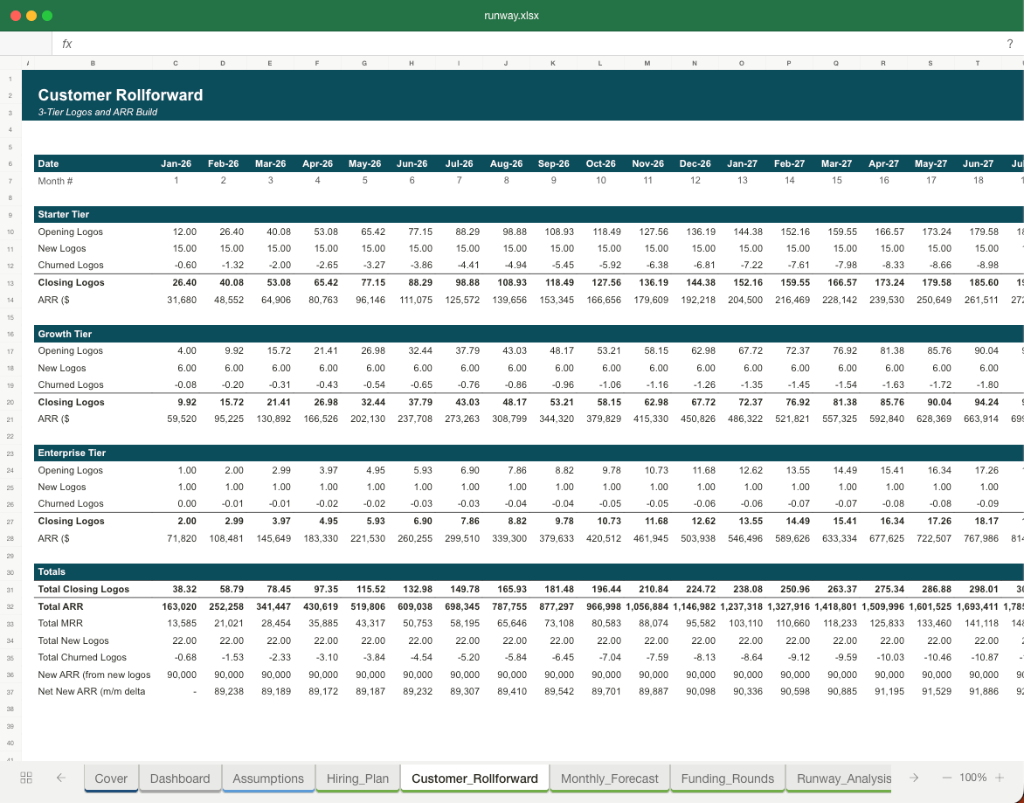
The model is a B2B SaaS ARR forecast with GMV as a customer-health metric. Merchant wins, core subscription price, module attach, expansion, churn, and contract size build revenue. Implementation support, cloud costs, sales efficiency, merchant GMV growth, and add-on adoption determine retention and margin.
A turnkey financial model
Live formulas, no hardcoded values
Outputs are driven by live formulas, so the workbook updates from its assumptions instead of relying on hardcoded results.
All assumptions in one tab
Inputs are clearly marked in the Assumptions tab and separated from calculations, making it clear what to change and what to leave intact.
Statements always balancing
For integrated-statement models, the balance sheet, cash flow, and supporting schedules tie through properly.
Distinct schedules for clarity
Debt, working capital, taxes, and cash flow can get messy quickly. We group calculations in clear schedules, not across disconnected tabs.
No hidden macros or external links
There are no unexplained external workbook links or macros to undermine auditability or portability.
Changes flow through the model
Update a key driver and see the impact carry through the forecast, financing, and return outputs. We never use hardcoded numbers in formulas.
About Fabric
meetfabric.com
How to build a detailed financial model for Fabric
A complete walkthrough of the business, drivers, and assumptions behind the downloadable Fabric model - distilled from its pitch deck and publicly available information.
Product & value proposition
- Headless commerce platform: full suite of APIs covering Customer, Search, Product, Price, Promotion, Workflow, Shipping, Payments, Tax, Order, Event Bridge, Integrations
- Experience Platform layer: Storefront + Headless CMS, Experience Manager (XM)
- CoPilot Applications layer: OMS, POS, PIM, Member Offers (Pricing & Promos), Dropship
- Single-tenant SaaS, cloud-native, no maintenance burden on customer
- Pre-integrated with 30+ leading vendors
- Serves 4 verticals: Multi-channel Retail, D2C/DNVB/CPG, B2B Commerce, Developers
- Key differentiators vs. legacy (Oracle ATG, SAP Hybris, Magento): modular APIs, launch in weeks vs. 12–16 months, sub-1-sec page speed, simple monthly subscription vs. 5–7% of GMV
- Claimed customer outcomes: +23% growth, -2.30% ownership cost, 10X (metric unlabelled but shown alongside growth/cost curves)
Revenue model
- Simple monthly subscription - exact pricing tiers not disclosed
- Positioned against legacy pricing of 5–7% of GMV; fabric's subscription model implies flat/tiered MRR rather than GMV take-rate
- Revenue streams implied: platform subscription (core APIs), CoPilot application add-ons (OMS, POS, PIM, Dropship), potentially professional services (dedicated launch and growth managers mentioned)
- No ARR, ACV, or pricing tier figures disclosed in deck
Traction & metrics
- Founded: 2017
- Platform GMV processed: $750M
- Team commerce leadership background: $10B+ GMV at 3 Fortune 500 companies
- Engineering & Product headcount: 55
- Named customers: ABC Carpet & Home, Eddie Bauer, BuildDirect
- ABC Carpet & Home outcome quote: "conversion and revenue run rates increased by nearly 3x" within months of implementation
- No ARR, revenue, customer count, or growth rate figures disclosed
Unit economics
- Legacy platform TCO: 5–7% of GMV (competitive context, not fabric's own economics)
- Ownership cost reduction for customers: -2.30% (customer benefit claim, methodology not shown)
Competition / moat
- Named legacy competitors: Oracle ATG, SAP Hybris, Magento, Shopify, Salesforce Commerce Cloud
- Competitive framing: legacy platforms are pre-cloud monoliths requiring 12–16 months to implement, expensive specialised developers, 1–2 releases/month, 5–7% GMV TCO
- Moat claims: headless/API-first architecture; single-tenant SaaS (isolation + scale); 30+ pre-integrated vendor ecosystem; modular - customers pick tools they need; dedicated growth managers as managed onboarding differentiator
- Team pedigree: Amazon, Google, eBay, Staples, Groupon commerce leadership
Team & funding ask / use of funds
- CEO Faisal Masud: Amazon, Google, eBay, Staples
- Co-founder & CRO Ryan Bartley: Fortune 500 eCommerce executive
- CPO Luke Shardlow: Staples, eBay
- Investors shown: Expo Capital, Redpoint, Sierra Ventures
Recommended financial model
- Archetype + why: B2B SaaS ARR model with GMV-correlated expansion layer. Fabric sells subscription SaaS but its commercial positioning (vs. GMV-% legacy pricing) and customer success metrics are GMV-linked. Model should track ARR/MRR at the contract level with upsell from add-on CoPilot modules, but also carry a GMV-processed metric as a health/retention signal.
- Forecast horizon & granularity: 5-year annual model (2020–2025) with monthly build for Years 1–2 given early-stage; consolidate to annual for Years 3–5. Monthly useful for cash-burn and hiring ramp.
- Key drivers & assumptions:
| Driver | Value |
|---|---|
| Platform GMV processed (base) | $750M |
| Founding year | 2017 |
| Customers (named) | 3 disclosed |
| Avg. subscription ACV | $150K–$300K |
| New logo adds per year (Year 1) | 8–12 |
| New logo growth rate | 40–60% YoY |
| Gross revenue churn | 5–8% annually |
| Net revenue retention | 110–125% |
| Gross margin | 70–75% |
| S&M % of revenue (Year 1–2) | 50–60% |
| R&D % of revenue (Year 1–2) | 35–45% |
| G&A % of revenue | 10–15% |
| Headcount growth | 20–30% YoY |
| Take-rate displacement | 5–7% GMV (legacy) → flat subscription |
- Scenarios (Base / Bull / Bear - which variables flex):
- Base: 50% new logo growth, 115% NRR, 72% gross margin
- Bull: 70% new logo growth (team pedigree accelerates enterprise deals), 125% NRR (full module adoption), margin expansion to 78% by Year 3
- Bear: 25% new logo growth (longer enterprise sales cycles), 105% NRR, 68% gross margin (higher single-tenant infra + PS costs), elevated churn if customers resist mid-market ACV
- Required sheets / outputs:
- Assumptions - all drivers in one tab
- ARR Bridge - new logo, expansion, churn, net new ARR per period
- P&L - Revenue, COGS, Gross Profit, OpEx (S&M, R&D, G&A), EBITDA, Net Income
- Headcount Plan - by function, linked to OpEx
- Cash Flow & Runway - monthly burn, ending cash, months of runway (requires funding input)
- GMV Dashboard - platform GMV processed as KPI tracker (not revenue, but key health metric)
- Scenario Toggle - Base / Bull / Bear switch driving key outputs
- KPIs Summary - ARR, MRR, customers, NRR, LTV/CAC (once CAC data available), gross margin
Frequently asked
Is the Fabric financial model free?+
Yes. The Fabric model is a free Excel (.xlsx) download with live formulas. Sign up with your email and the workbook is yours to keep, review, and edit.
What's included in the model?+
A 5-year monthly forecast with P&L, cash flow and runway, valuation (exit multiple plus a DCF cross-check), MOIC/IRR returns, and unit economics, with live formulas throughout.
How was this model built?+
It was built from Fabric's pitch deck and publicly available information, then structured to investment-banking standards as a fully editable Excel model.
Can I change the assumptions?+
Yes. You can change assumptions and the live formulas will recalculate in the downloadable Excel model.
Have more financial modelling questions? Contact us

Created by ex-finance professionals
Hey, I’m Alex and I created Finamodel.
Over my years in the finance industry I kept building the same models over and over again. Same structure, same assumptions, different logo. So I started building frameworks to turn them into clean, reusable templates.
Every model here is one I’d actually use for a client, and I personally vet each one before it goes up.
I’m not an expert in every industry, but I’ve built enough models to know what belongs in one. And when something is completely foreign to me, I reach out to my network for experts to work on our models with us.
Having a template library on hand cuts a first build from hours to minutes.
Need help finding your model? You’ll find me in the Finamodel app!
Other Dev Tools Startup Financial Models
Browse another startup in the same category.

8base
Low-code/no-code platform providing backend and frontend development tools for building digital products, internal apps, and SaaS.
Ably
Enterprise realtime messaging infrastructure (pub/sub) delivered as a cloud-native platform, enabling developers to build scalable live experiences without managing complex realtime infrastructure.

Amplitude
Mobile analytics SaaS platform giving app developers real-time behavioral analytics, funnel/retention analysis, and raw data warehouse access at scale.
Anima
Automated design-to-code platform - designers export production-ready code from their design tools with one click.

Apollo
Apollo builds and sells an enterprise "data graph" platform (powered by GraphQL) that sits as a unified API layer between frontend apps and backend microservices.
BrowserStack
Cloud-based cross-browser and mobile app testing platform used by 50,000+ customers across 135 countries.
CodeSandbox
Cloud-native collaborative web IDE that lets entire product teams (not just developers) code, review, and iterate together in the browser.
CommandBar
SaaS SDK that embeds a search-based command bar into web apps, improving UX, onboarding, and retention for B2B software companies.