KNKnime Financial Model
Dev Tools Startup Financials (Free Excel Download)
Open-source, low-code data science and analytics platform for enterprises, monetised via commercial hub/server subscriptions.



professionals from Deloitte
Used by professionals from






About this model
KNIME is an open-source, low-code data-science platform for analytics, AI, and workflow automation. Its free desktop product serves a large user community, while Business Hub and Community Hub provide collaboration, governance, deployment, and enterprise controls.
The company reported approximately €30 million of ARR, about 400 customers, €80,000 ARPA, 110% net revenue retention, and 500,000 open-source active users. Its open-core model uses the desktop product as a product-led funnel into annual organization subscriptions.
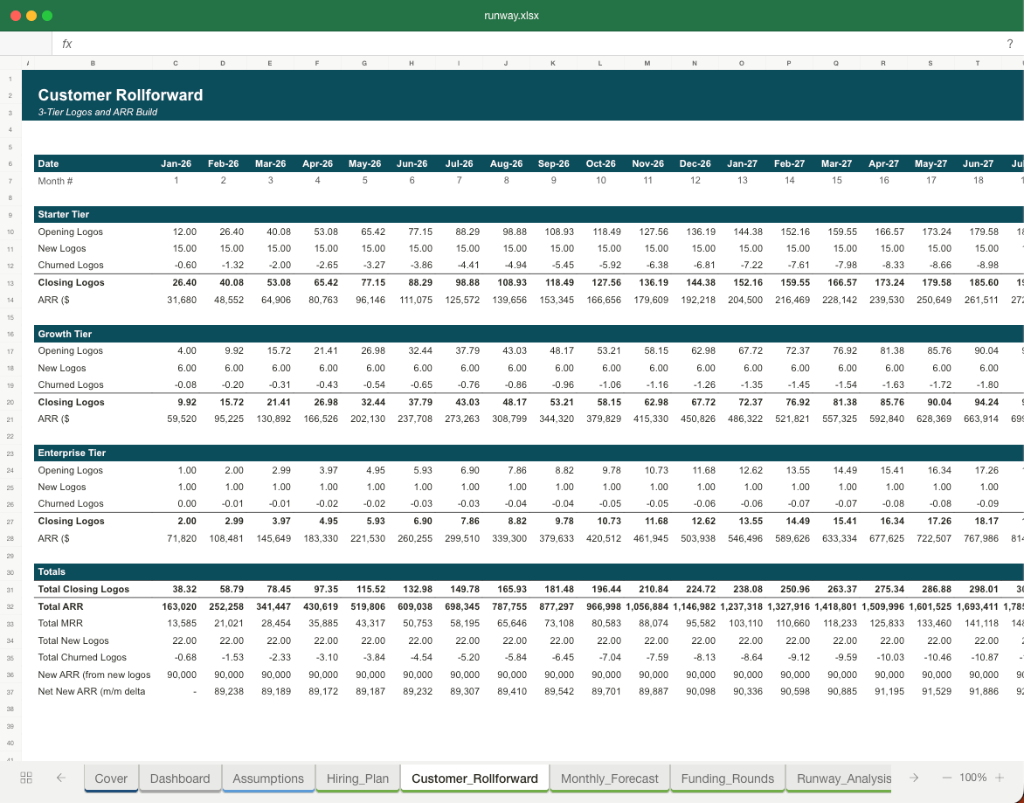
The model is an enterprise ARR build with an OSS conversion funnel. Community users, qualified accounts, customer additions, ARPA, expansion, and churn determine recurring revenue. Direct sales capacity, product-led conversion, hosting and support costs, and net retention drive the path toward cash break-even.
A turnkey financial model
Live formulas, no hardcoded values
Outputs are driven by live formulas, so the workbook updates from its assumptions instead of relying on hardcoded results.
All assumptions in one tab
Inputs are clearly marked in the Assumptions tab and separated from calculations, making it clear what to change and what to leave intact.
Statements always balancing
For integrated-statement models, the balance sheet, cash flow, and supporting schedules tie through properly.
Distinct schedules for clarity
Debt, working capital, taxes, and cash flow can get messy quickly. We group calculations in clear schedules, not across disconnected tabs.
No hidden macros or external links
There are no unexplained external workbook links or macros to undermine auditability or portability.
Changes flow through the model
Update a key driver and see the impact carry through the forecast, financing, and return outputs. We never use hardcoded numbers in formulas.
About Knime
knime.com
How to build a detailed financial model for Knime
A complete walkthrough of the business, drivers, and assumptions behind the downloadable Knime model - distilled from its pitch deck and publicly available information.
Product & value proposition
- Low-code / no-code visual workflow environment for the full data science lifecycle: data access & transformation, analytics & GenAI, visualisation & reporting, deployment and orchestration.
- Two core products:
- KNIME Analytics Platform - open-source desktop tool (free). Entry point for 500k+ active users.
- KNIME Business Hub / Community Hub - commercial server product for team collaboration, governance, CI/CD delivery of data science, AI governance, audit logs.
- Key differentiators:
- Complete analytic depth (stats, ML, GenAI) in a single low-code environment.
- End-to-end platform (build → deploy → monitor) with no integration friction.
- Open-source core ensures future-proofing and community trust; 12,000+ analytics blueprints.
- Enterprise-grade governance: customisable LLM approval lists, bias/hallucination guardrails, audit logs.
- Built-in AI assistant (K-AI) for upskilling end users.
Market
- Total addressable market (data analytics / data science tools + adjacent low-code): $90–100bn in 2023 → $500–600bn by 2030.
- Implied CAGR ~26–29% (2023–2030) per deck chart; deck summarises as market CAGR ~20%.
- Key drivers cited: growing data volume/complexity; AI/ML/IoT/5G adoption; demand for productivity-boosting data insights; cloud subscription models lowering adoption barriers; low-code expanding addressable audience.
- Sources: Allied Market Research, Precedence Research, Polaris Market Research, Prescient & Strategic Intelligence.
Revenue model
- Open-core subscription: free open-source desktop (KNIME Analytics Platform) acts as a top-of-funnel lead generation engine; commercial revenue from KNIME Business Hub (team / enterprise tier) and KNIME Community Hub.
- Pricing unit: Annual recurring subscription per organisation (ARPA basis). No per-seat or usage pricing explicitly disclosed.
- Channels: Direct enterprise sales (SVP Revenues US, VP Revenues Eur roles visible in org chart); community-led self-serve / product-led growth via open-source user base.
- Geography: ~2/3 Europe, ~1/3 US.
- Deployment: on-prem or cloud - flexible.
Traction & metrics
- ARR: ~€30m
- ARR CAGR 2017–2024: >35%
- Customers: ~400
- ARPA: ~€80k
- NRR: 110%
- Open-source active users: ~500k ("1/2M")
- Cash break-even target: 2025 at positive working capital
- Blue-chip customer logos include: JYSK, Canadian Tire, REWE, Intersport, Truata, AIG, BDO, Kasasa, Fidelity, ING, Bosch, Siemens, P&G, Seagate
- Customer outcome examples:
- $300M incremental revenue (Retail - Canadian Tire / JYSK / REWE / Intersport, promotional analytics)
- $4M per incident risk reduction (Insurance - AIG/BDO/Truata, NLP for regulatory compliance)
- 70% time savings for auditors (Financial Services - Kasasa/Fidelity/ING, anomaly detection & ETL)
- 10,000+ citizen data scientists created (Manufacturing - Bosch/Siemens/P&G/Seagate, data literacy)
Unit economics
- ARPA: ~€80k
- NRR: 110% - net expansion exceeds churn
- Burn / cash efficiency: Described as "highly cash efficient" with positive working capital and path to cash break-even by 2025. Specific burn figure not disclosed.
- Headcount mix (indirect cost structure read): 46% Customer Care & Marketing, 30% R&D, 9% Customer Support, 15% G&A.
Competition / moat
- Primary "competition" framed as white space: Spreadsheets (Excel, BI tools) and scripting (Python, R) - not dedicated software vendors.
- Named competitive categories:
- Spreadsheets & BI
- Low-code / no-code (limited overlap)
- Legacy players (e.g. Altair, which acquired RapidMiner in Sep 2022)
- Scripting languages & ML libraries
- Cloud vendors (AWS, Azure, GCP data science services)
- Moat: open-source community (500k users, 12,000+ blueprints), depth of analytic capability, and enterprise governance layer that alternatives lack.
Team & funding ask / use of funds
- Co-founders: Michael Berthold (CEO), Bernd Wiswedel (CTO), Peter Ohl (Compliance).
- Key hires: Jim Falgout (GM US, 2017), Jennifer Ostyn (SVP Revenues US, 2022), Swantje Schulze (VP Revenues Eur, 2024), Sasha Rezvina (VP Marketing, 2022), Rosaria Silipo (VP Evangelism, 2014), Ralf Gruesshaber (CFO, 2022), Christian Birkhold (VP Product, 2017).
- Headcount distribution: Konstanz 27%, Berlin 32%, Remote EU 16%, Remote US 12%, Austin/US 9%, Zurich 4%.
- Implied use from team build-out: continued GTM scale in US (SVP Revenues US hired 2022), product investment (30% R&D headcount).
Recommended financial model
- Archetype + why: SaaS ARR model (open-core / enterprise subscription). Revenue is annual recurring, customer-count × ARPA driven, with strong NRR expansion. Open-core PLG funnel (500k OSS users → ~400 paying customers) is a key conversion driver to model. A 3-statement wrapper should be added given the proximity to cash break-even and the need to show the profitability path.
- Forecast horizon & granularity: 5 years (2024–2028), annual; with monthly granularity for 2024–2025 to bridge to the stated cash break-even milestone.
- Key drivers & assumptions:
- Starting ARR: €30m
- ARR growth rate: step-down from historical >35% CAGR - model Base at 30% YoY (2024), declining ~3pp/yr to ~18% by 2028 as base grows. Bull: flat 35%. Bear: 20% declining.
- New customer adds: ~80–100/yr net new at current ARPA, based on ~400 customers and 7-year history.
- ARPA: ~€80k starting; ~3–5% annual uplift from upsell (supported by 110% NRR).
- NRR: 110%; holds in Base; 115% Bull (stronger expansion); 105% Bear (macro pressure).
- Gross margin: 70–75% (typical enterprise open-core SaaS at this scale; no deck data).
- Headcount: grow in line with ARR growth, skewing toward Sales (US expansion) and R&D.
- Opex: currently running near cash break-even at ~€30m ARR → implied total opex ~€20–22m; model as % of ARR declining.
- Cash break-even: 2025; achieved at ~€35–38m ARR.
- OSS → paid conversion funnel: 500k active OSS users, ~0.08% conversion to paying customers (400 customers / 500k users); model conversion rate as a sensitivity lever.
- US mix: ~1/3 of ARR; US share grows to ~40% by 2028 (active US GTM investment).
- FX: EUR/USD rate ~1.08; track EUR-denominated ARR, present USD equivalent.
- Scenarios (Base / Bull / Bear - which variables flex):
- Base: 30% ARR CAGR, 110% NRR, 72% gross margin, break-even 2025.
- Bull: 35% ARR CAGR, 115% NRR, 75% gross margin, break-even H1 2025 - faster US ramp + GenAI tailwind accelerates enterprise deal velocity.
- Bear: 20% ARR CAGR, 105% NRR, 70% gross margin, break-even pushed to 2026 - macro pressure slows enterprise budgets; OSS-to-paid conversion softens.
- Required sheets / outputs:
- Assumptions - all drivers, colour-coded inputs.
- ARR Bridge - opening ARR, new ARR, expansion (NRR), churn, closing ARR by year.
- Customer Cohort Schedule - cohort by year, ARPA expansion, churned ARR.
- P&L - revenue, COGS, gross profit, Opex (S&M, R&D, G&A), EBITDA, path to break-even.
- Headcount Plan - by team (Customer Care & Marketing, R&D, Customer Support, G&A) with cost.
- Cash Flow - simplified operating CF; highlight 2025 break-even crossover.
- PLG Funnel - OSS active users → trial/pipeline → converted paying customers (conversion rate sensitivity).
- Scenario Toggle - Base / Bull / Bear switcher tied to key assumption cells.
- Dashboard - ARR, NRR, customer count, ARPA, gross margin, EBITDA margin KPIs charted over time.
Frequently asked
Is the Knime financial model free?+
Yes. The Knime model is a free Excel (.xlsx) download with live formulas. Sign up with your email and the workbook is yours to keep, review, and edit.
What's included in the model?+
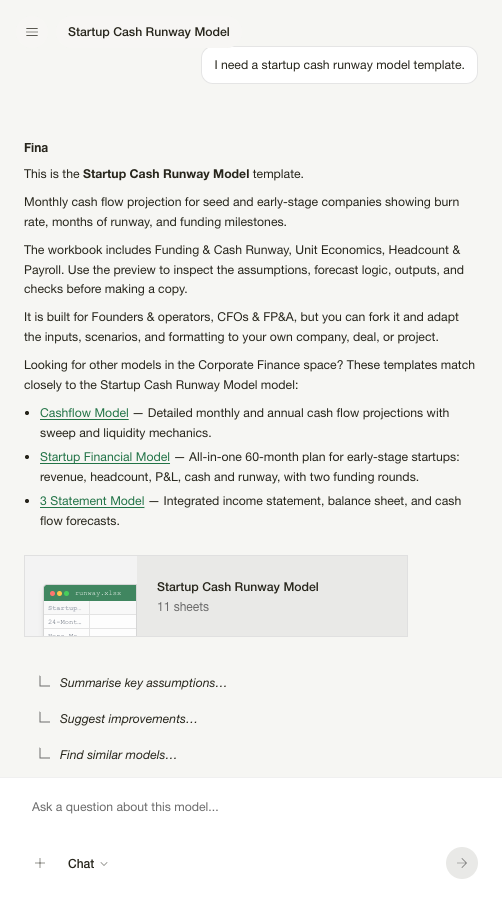
A 5-year monthly forecast with P&L, cash flow and runway, valuation (exit multiple plus a DCF cross-check), MOIC/IRR returns, and unit economics, with live formulas throughout.
How was this model built?+
It was built from Knime's pitch deck and publicly available information, then structured to investment-banking standards as a fully editable Excel model.
Can I change the assumptions?+
Yes. You can change assumptions and the live formulas will recalculate in the downloadable Excel model.
Have more financial modelling questions? Contact us

Created by ex-finance professionals
Hey, I’m Alex and I created Finamodel.
Over my years in the finance industry I kept building the same models over and over again. Same structure, same assumptions, different logo. So I started building frameworks to turn them into clean, reusable templates.
Every model here is one I’d actually use for a client, and I personally vet each one before it goes up.
I’m not an expert in every industry, but I’ve built enough models to know what belongs in one. And when something is completely foreign to me, I reach out to my network for experts to work on our models with us.
Having a template library on hand cuts a first build from hours to minutes.
Need help finding your model? You’ll find me in the Finamodel app!
Other Dev Tools Startup Financial Models
Browse another startup in the same category.

8base
Low-code/no-code platform providing backend and frontend development tools for building digital products, internal apps, and SaaS.
Ably
Enterprise realtime messaging infrastructure (pub/sub) delivered as a cloud-native platform, enabling developers to build scalable live experiences without managing complex realtime infrastructure.

Amplitude
Mobile analytics SaaS platform giving app developers real-time behavioral analytics, funnel/retention analysis, and raw data warehouse access at scale.
Anima
Automated design-to-code platform - designers export production-ready code from their design tools with one click.

Apollo
Apollo builds and sells an enterprise "data graph" platform (powered by GraphQL) that sits as a unified API layer between frontend apps and backend microservices.
BrowserStack
Cloud-based cross-browser and mobile app testing platform used by 50,000+ customers across 135 countries.
CodeSandbox
Cloud-native collaborative web IDE that lets entire product teams (not just developers) code, review, and iterate together in the browser.
CommandBar
SaaS SDK that embeds a search-based command bar into web apps, improving UX, onboarding, and retention for B2B software companies.