VSVue Storefront Financial Model
Dev Tools Startup Financials (Free Excel Download)
Frontend-as-a-Service (FEaaS) platform for composable/headless eCommerce, reducing frontend implementation cost and time-to-market for mid-market and enterprise retailers.



professionals from Deloitte
Used by professionals from






About this model
Vue Storefront is a frontend-as-a-service platform for composable commerce, orchestrating APIs and integrations with Shopify, commercetools, Magento, CMSs, search, and payments. Retailers can modernise the frontend first and migrate the underlying backend later, reducing frontend implementation cost by a claimed 60%.
The business sells FEaaS subscriptions to larger mid-market and enterprise e-commerce companies through direct sales and implementation partners. Revenue is inferred to include platform subscriptions, onboarding or services, and partner referrals, but the deck does not disclose pricing, ACV, ARR, or contract structure.
Vue Storefront had more than 2,200 e-commerce customers and 100 employees, including 37 in go-to-market and 40 in product and engineering. Named customers include Zadig & Voltaire, Aroma-Zone, Brompton, LoveCrafts, and PriceSmart. The model should forecast logos, ACV, integrations, partner pipeline, expansion, renewal, churn, and margins.
A turnkey financial model
Live formulas, no hardcoded values
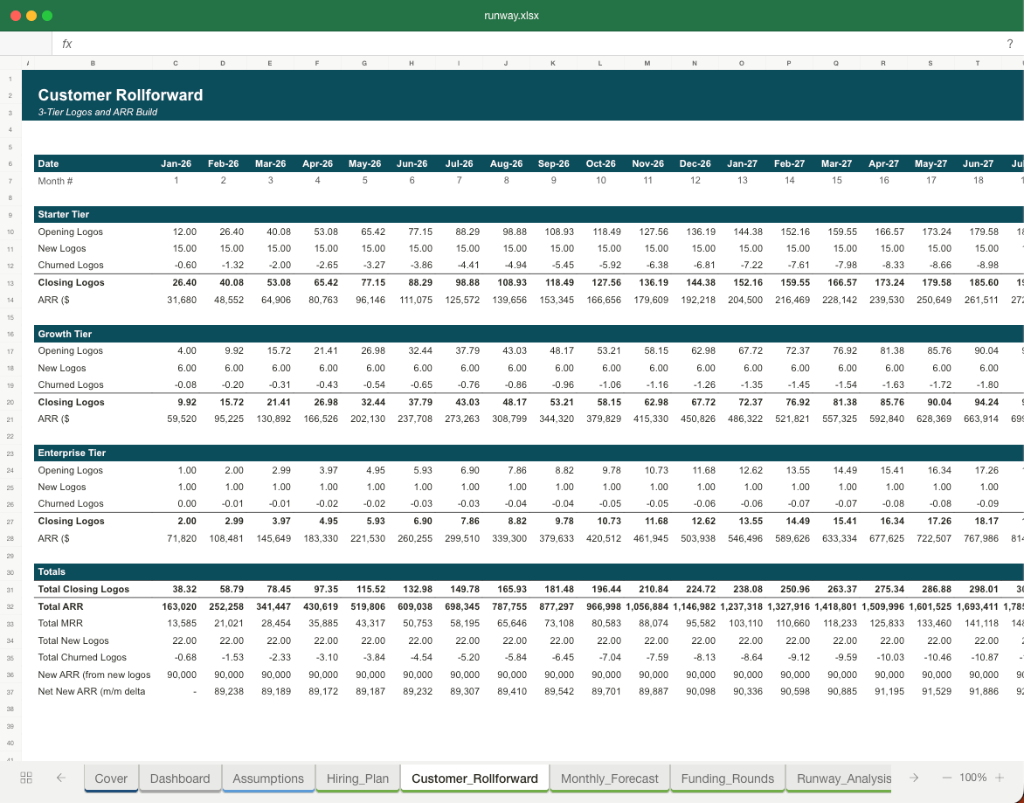
Outputs are driven by live formulas, so the workbook updates from its assumptions instead of relying on hardcoded results.
All assumptions in one tab
Inputs are clearly marked in the Assumptions tab and separated from calculations, making it clear what to change and what to leave intact.
Statements always balancing
For integrated-statement models, the balance sheet, cash flow, and supporting schedules tie through properly.
Distinct schedules for clarity
Debt, working capital, taxes, and cash flow can get messy quickly. We group calculations in clear schedules, not across disconnected tabs.
No hidden macros or external links
There are no unexplained external workbook links or macros to undermine auditability or portability.
Changes flow through the model
Update a key driver and see the impact carry through the forecast, financing, and return outputs. We never use hardcoded numbers in formulas.
About Vue Storefront
How to build a detailed financial model for Vue Storefront
A complete walkthrough of the business, drivers, and assumptions behind the downloadable Vue Storefront model - distilled from its pitch deck and publicly available information.
Product & value proposition
- Frontend as a Service (FEaaS): a single application that provides API orchestration, out-of-the-box integrations with leading backends (Shopify, commercetools, Magento, etc.), CMSes, search, and payments.
- Key differentiator: fits into any migration scenario - customers can swap out the frontend first without touching the backend, then migrate backend later.
- Claims 60% reduction in frontend implementation cost.
- Full lifecycle coverage: Design → Connect → Build → Deploy → Monitor → Analyze → Improve.
- Positioning: category-creator for FEaaS, analogous to what Hybris/Demandware/ATG did for backend monoliths.
- Target customer: larger mid-market and enterprise eCommerce companies.
Market
- TAM defined as FEaaS for composable commerce (EU + US + Emerging Markets):
- Today: $4.4B
- 2025: $6.1B
- 2030: $8.9B
- Breakdown (Today → 2025 → 2030):
- US + EU: $3.9B → $5.1B → $7.1B
- Emerging Markets: $520M → $990M → $1.8B
- Implied CAGR from $4.4B to $8.9B over ~8 years ≈ 9%
- Potential expansion markets cited (not core TAM): Enterprise Content Management ($21.5B→$53.2B, 9.8% CAGR), Online Travel ($354B→$1.8T, 14.8%), Digital Insurance ($96B→$279B, 11.3%), Online Banking ($11.4B→$31.8B, 13.6%)
Revenue model
- Business model described as FEaaS subscription - software platform for eCommerce businesses.
- Specific pricing tiers, ACV, or ARR not disclosed in deck.
- Channel: direct enterprise sales (CRO, VP Partnerships roles shown) + implementation partner channel (BORN Group mentioned as VP Partnerships background).
- Integrations with 3rd-party backends/CMSes/search/payments suggest a platform model where breadth of integrations drives lock-in and expansion.
- Revenue streams inferred: platform subscription fee (likely per-seat or usage-based) + professional services / onboarding + partner referral / reseller channel. Rationale: enterprise SaaS with partner-led GTM typically blends these.
Traction & metrics
- 2,200+ eCommerce businesses worldwide as customers.
- 100 total employees.
- 37 Go-to-Market, 16 Operations, 7 Community, 40 Product & Engineering.
- Named enterprise customers include: Zadig & Voltaire, Aroma-Zone, BabyBunting, Berlin Brands Group, Brompton, LoveCrafts, EGO, Likewize, M.J. Bale, MKM, Oberalp, ORGILL, PAWS, pflege.de, PriceSmart, Pukka, SensoPur, TAMRON, Tally Weijl, Tarkett, VLISCO, White Stuff, ZENNI, WS NL.
Competition / moat
- Primary competitor framed as "custom-built eCommerce frontend" (build vs. buy).
- Named niche FEaaS competitors (smaller/mid-market/single-backend focus): Shogun Frontend, Frontastic, Instant Commerce, Magento PWA Studio.
- Historical analogues (backend monolith era): Hybris (acquired SAP 2013, $1.5B), Demandware (acquired Salesforce 2016, $2.8B), ATG (acquired Oracle 2011, $1B).
- Moat claims: breadth of backend/CMS/search/payment integrations; category-education/brand (Official Vue.js Community Partner); open-source community roots; advisor network including Hybris founder, Demandware ex-CEO, Magento ex-CEO, Vue.js creator.
Team & funding ask / use of funds
- Founders:
- Patrick Friday, CEO & Co-Founder - 10 yrs B2B Sales, entered eCommerce 2012, early employee Vivino, mobile apps for eCommerce 6 yrs, ran own eCommerce (sold).
- Filip Rakowski, CTO & Co-Founder - Technical Founder, frontend architect, international speaker, community builder, Official Vue.js Community Partner, Author of Storefront UI, early advisor to SAP Spartacus.
- Bart Roszkowski, COO & Co-Founder - 15 yrs building companies, serial entrepreneur (3 companies, all sold), experience as VC, CMO, CPO, COO, CEO.
- Leadership team additions: Gordana (CRO, ex-Contentstack $0→$20M ARR), Tim (CTO, ex-SendCloud/Costo), Jeffrey (VP Partnerships, ex-BORN Group/True Fit).
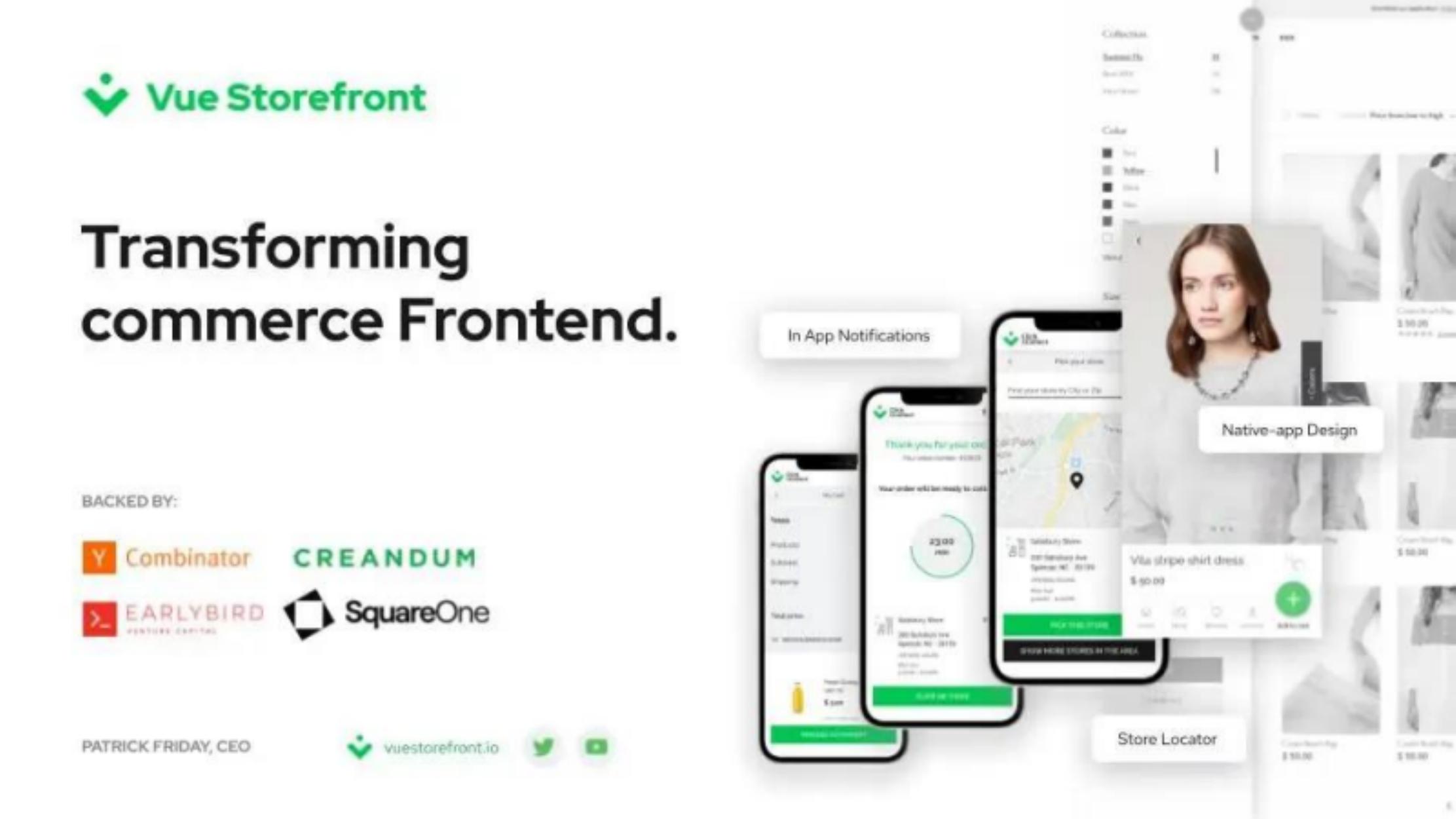
- Investors: Y Combinator, Creandum, Earlybird Venture Capital, SquareOne.
- Angel advisors: Carsten Thoma (Founder SAP Hybris), Heini Zachariassen (Founder Vivino), Mark Lavelle (ex-CEO Magento/Adobe), Jeff Barnett (ex-CEO Demandware/Salesforce), Paul St John (VP Enterprise Sales GitHub), Evan You (Founder Vue.js).
Recommended financial model
- Archetype + why: SaaS ARR model (enterprise subscription). VSF sells annual platform subscriptions to mid-market/enterprise eCommerce brands. The business fits a classic B2B SaaS ARR build: new logo adds, expansion ARR, churn, headcount-driven opex, and a partner-channel overlay. The 2,200+ customer count suggests a broad base but enterprise focus implies a smaller high-ACV cohort driving the bulk of revenue.
- Forecast horizon & granularity: 5-year annual model (Year 1–5); monthly for Year 1 to capture sales hiring ramp. Quarterly or annual thereafter.
- Key drivers & assumptions:
- Starting customer count: 2,200+ - split into SMB (open-source/community, likely low/no revenue) vs. paying enterprise/mid-market accounts.
- Average ACV (Annual Contract Value): ~$30K–$80K for mid-market, $100K–$300K for enterprise - rationale: comparable FEaaS/headless commerce platforms in 2022 range here; deck positions against Hybris-tier enterprise.
- New logo growth rate: 30–50% YoY for Years 1–3, decelerating to 20% by Year 5 - rationale: early-stage SaaS with strong brand/community; 2,200 installs is a strong top-of-funnel.
- Net Revenue Retention (NRR): 115–125% - rationale: enterprise SaaS with expansion motions (more seats, more integrations); no churn data disclosed.
- Gross margin: 70–80% - rationale: pure SaaS software; professional services may dilute slightly.
- CAC / Sales efficiency: Magic number ~0.7–1.0 in early years - rationale: partner-channel (BORN Group-type SIs) should lower blended CAC vs. direct-only.
- Headcount: 100 employees; GTM 37, Eng/Product 40, Ops 16, Community 7. Model headcount adds per function as ARR scales.
- TAM penetration: current ~$4.4B TAM; model SOM as small % capture (0.5–2% by Year 5).
- Scenarios (Base / Bull / Bear - which variables flex):
- Base: 35% new logo growth, 115% NRR, 75% gross margin.
- Bull: 50% new logo growth, 125% NRR, 78% gross margin; faster enterprise up-market.
- Bear: 20% new logo growth, 105% NRR (churn from SMB tail), 70% gross margin (services drag).
- Required sheets / outputs:
- Assumptions - all drivers, toggleable Base/Bull/Bear.
- ARR Bridge - beginning ARR, new logo, expansion, churn/contraction, ending ARR.
- P&L - Revenue (subscription + services), COGS, Gross Profit, S&M, R&D, G&A, EBITDA.
- Headcount Plan - by department; links to personnel costs.
- Cash / Runway - cash burn, months of runway, implied next raise timing.
- Unit Economics - CAC (blended + by channel), LTV, LTV/CAC, payback period.
- Dashboard - ARR, NRR, gross margin %, burn multiple, employee count.
Frequently asked
Is the Vue Storefront financial model free?+
Yes. The Vue Storefront model is a free Excel (.xlsx) download with live formulas. Sign up with your email and the workbook is yours to keep, review, and edit.
What's included in the model?+
A 5-year monthly forecast with P&L, cash flow and runway, valuation (exit multiple plus a DCF cross-check), MOIC/IRR returns, and unit economics, with live formulas throughout.
How was this model built?+
It was built from Vue Storefront's pitch deck and publicly available information, then structured to investment-banking standards as a fully editable Excel model.
Can I change the assumptions?+
Yes. You can change assumptions and the live formulas will recalculate in the downloadable Excel model.
Have more financial modelling questions? Contact us

Created by ex-finance professionals
Hey, I’m Alex and I created Finamodel.
Over my years in the finance industry I kept building the same models over and over again. Same structure, same assumptions, different logo. So I started building frameworks to turn them into clean, reusable templates.
Every model here is one I’d actually use for a client, and I personally vet each one before it goes up.
I’m not an expert in every industry, but I’ve built enough models to know what belongs in one. And when something is completely foreign to me, I reach out to my network for experts to work on our models with us.
Having a template library on hand cuts a first build from hours to minutes.
Need help finding your model? You’ll find me in the Finamodel app!
Other Dev Tools Startup Financial Models
Browse another startup in the same category.

8base
Low-code/no-code platform providing backend and frontend development tools for building digital products, internal apps, and SaaS.
Ably
Enterprise realtime messaging infrastructure (pub/sub) delivered as a cloud-native platform, enabling developers to build scalable live experiences without managing complex realtime infrastructure.

Amplitude
Mobile analytics SaaS platform giving app developers real-time behavioral analytics, funnel/retention analysis, and raw data warehouse access at scale.
Anima
Automated design-to-code platform - designers export production-ready code from their design tools with one click.

Apollo
Apollo builds and sells an enterprise "data graph" platform (powered by GraphQL) that sits as a unified API layer between frontend apps and backend microservices.
BrowserStack
Cloud-based cross-browser and mobile app testing platform used by 50,000+ customers across 135 countries.
CodeSandbox
Cloud-native collaborative web IDE that lets entire product teams (not just developers) code, review, and iterate together in the browser.
CommandBar
SaaS SDK that embeds a search-based command bar into web apps, improving UX, onboarding, and retention for B2B software companies.