Balance Sheet Model
Corporate Finance Financial Model (Free Excel Download)
Build a balance sheet that ties through working capital, PP&E, debt, retained earnings, cash flow, and balance checks for dependable financial forecasting.



professionals from Deloitte
Used by professionals from






About this model
This model gives you a complete five-year balance sheet with an opening balance sheet column, built so the statement balances because of how it is constructed rather than because a figure was forced. Working capital runs off days-based ratios, fixed assets and debt roll forward, and cash is derived from an explicit roll-forward of every flow that moves the business.
Use it to project financial position alongside a profit forecast, to plan working capital and liquidity, or to test leverage. Change the collection and payment days, the capex plan or the repayment schedule and watch cash, equity and the leverage ratios respond.
What every model includes
Live formulas, no hardcoded values
Outputs are driven by live formulas, so the workbook updates from its assumptions instead of relying on hardcoded results.
All assumptions in one tab
Inputs are clearly marked in the Assumptions tab and separated from calculations, making it clear what to change and what to leave intact.
Statements always balancing
For integrated-statement models, the balance sheet, cash flow, and supporting schedules tie through properly.
Distinct schedules for clarity
Debt, working capital, taxes, and cash flow can get messy quickly. We group calculations in clear schedules, not across disconnected tabs.
No hidden macros or external links
There are no unexplained external workbook links or macros to undermine auditability or portability.
Changes flow through the model
Update a key driver and see the impact carry through the forecast, financing, and return outputs. We never use hardcoded numbers in formulas.
What's inside the Balance Sheet Model
- Trading base: opening-year revenue, revenue growth, cost of sales, net margin, dividend payout
- Working capital: days sales outstanding, days inventory on hand, days payable outstanding, prepaid expenses and accrued liabilities as % of revenue
- Fixed assets: opening net PP&E, capital expenditure as % of revenue, depreciation rate on the opening balance
- Capital structure: opening debt, scheduled repayment, share capital, opening cash
- Working_Capital sheet: receivables, inventory and prepayments on days and ratios, payables and accruals, and net working capital
- Fixed_Assets sheet: opening net PP&E, capex, MIN-guarded depreciation, closing net PP&E
- Debt_Equity sheet: opening equity derivation, the amortising debt schedule, and the retained-earnings roll-forward
- Cash_Flow sheet: opening cash, net income, depreciation, each working-capital movement, capex, debt repayment, dividends, closing cash
Balance Sheet Template: How the Five-Year Model Balances by Construction
This balance sheet template builds a five-year forecast with an opening column, so the statement balances through a cash roll-forward rather than a plug. It captures working capital, fixed assets, debt and equity relationships, allowing you to see how operating drivers and funding decisions affect cash, leverage and the overall financial position.
Operating Drivers and Assumptions
The model runs on a compact trading base. Opening-year revenue compounds at a growth rate, cost of sales is a share of revenue, and net income follows a net margin.
- Working capital is driven by days: receivables from days sales outstanding, inventory from days inventory on hand against cost of sales, and payables from days payable outstanding. Prepaid expenses and accrued liabilities are geared to revenue as percentages.
- Fixed assets depend on opening net PP&E, capex as a percentage of revenue, and a depreciation rate on the opening balance. Funding assumptions include opening cash, opening debt, scheduled repayment, share capital and dividend payout.
These inputs feed each schedule and keep the forecast internally consistent.
Calculation Flow and Balance Mechanism
The balance sheet balances by construction, not by a balancing entry. A dedicated cash roll-forward derives closing cash as opening cash plus net income plus depreciation, adjusted for movements in receivables, inventory, prepaid expenses, payables and accruals, then less capex, debt repayment and dividends.
- Separately, fixed assets roll forward from opening net PP&E plus capex less depreciation, with depreciation capped so it cannot exceed the carrying value. Debt amortises through a repayment schedule, and retained earnings accumulates net income less dividends.
- Because the cash roll captures every flow that moves the business, the change in assets matches the change in liabilities and equity each period, and the balance check reads zero across all columns.
Outputs, Ratios and the Opening Column
The model presents a full balance sheet: current assets including cash, receivables, inventory and prepaid expenses; net fixed assets; current liabilities such as payables and accruals; long-term debt; total liabilities; and shareholders' equity made up of share capital and retained earnings. Three ratios summarise position: current ratio, debt to equity and equity ratio.
- A dashboard adds headline balances, funding mix, liquidity and an assets-to-equity bridge, plus trend charts. Uniquely, the opening column is built from explicit day-zero assumptions—opening cash, PP&E, debt and share capital—with receivables, inventory, payables and accruals computed on the same day-count formulas used in forecast years.
- Opening retained earnings is solved as the residual so the opening column ties at day zero.
Practical Use for Planning and Testing
Use this model to project financial position alongside a profit forecast, to plan working capital and liquidity, or to test leverage. Because the statement balances mechanically, changing collection and payment days, the capex plan or the repayment schedule immediately shows the effect on cash, equity and the leverage ratios.
- The days-based working capital approach is more realistic than percentage-of-sales because gearing inventory and payables to cost of sales avoids distortions when gross margin changes. The opening column provides a sanity-checkable starting point, and the cash roll-forward makes the source of cash transparent.
- The public download is a values-only preview; the underlying model contains the live formulas and roll-forwards described here.
Formatted to IB standards
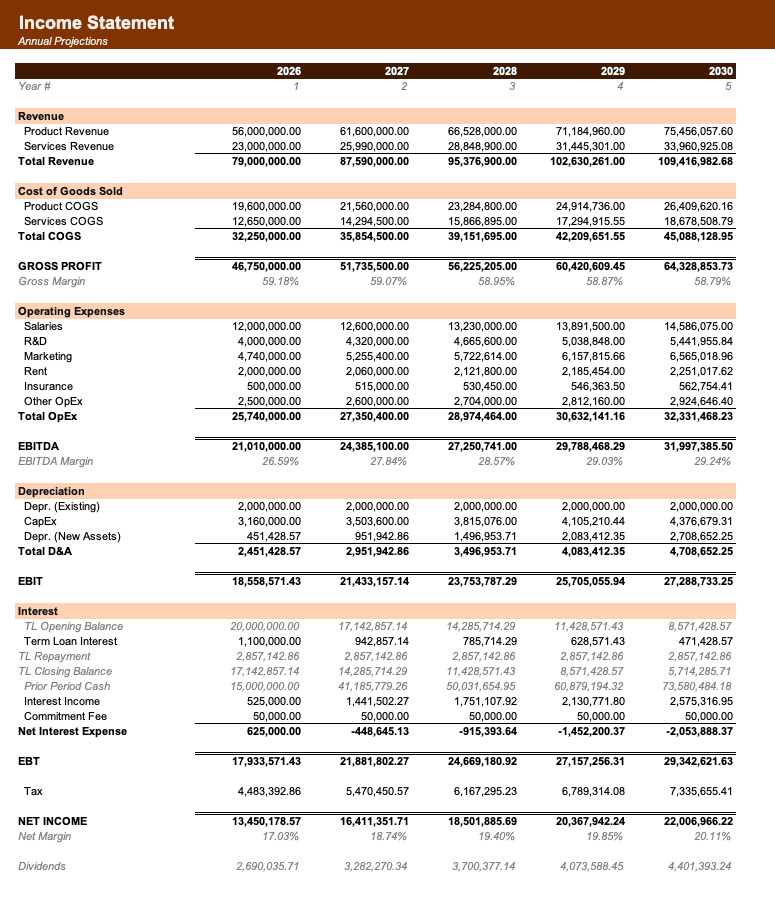
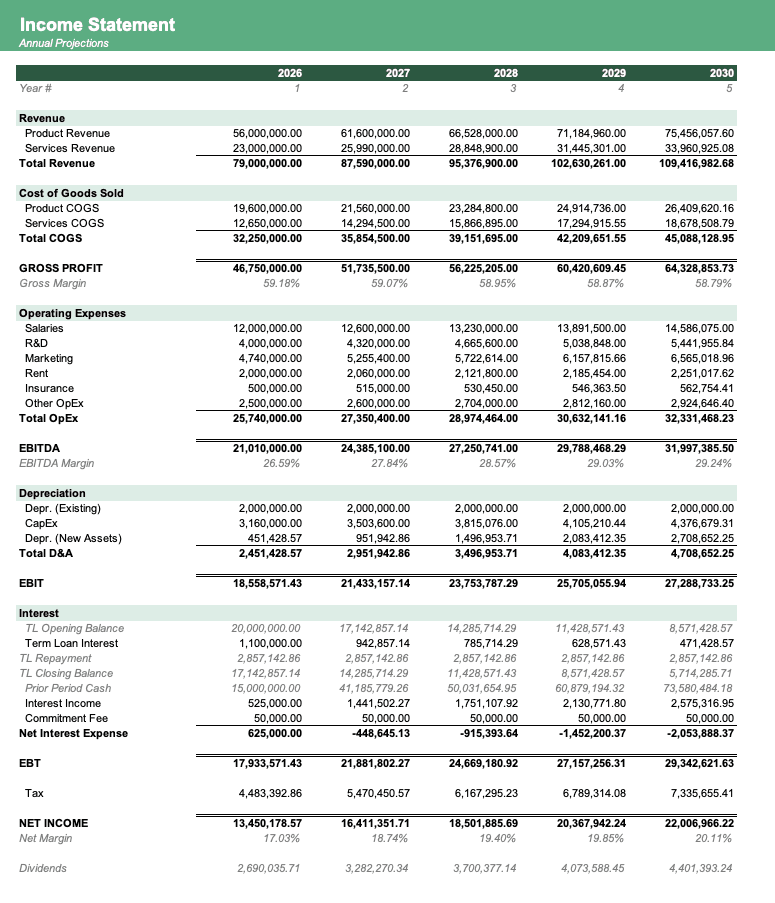
Named theme colors repaint the whole workbook in one click, on top of an investment-banking structure with clear input, output, and cross-sheet reference styling - brand-ready, institutional-grade, and fully auditable.

Created by ex-finance professionals
Hey, I’m Alex and I created Finamodel.
Over my years in the finance industry I kept building the same models over and over again. Same structure, same assumptions, different logo. So I started building frameworks to turn them into clean, reusable templates.
Every model here is one I’d actually use for a client, and I personally vet each one before it goes up.
I’m not an expert in every industry, but I’ve built enough models to know what belongs in one. And when something is completely foreign to me, I reach out to my network for experts to work on our models with us.
Having a template library on hand cuts a first build from hours to minutes.
Need help finding your model? You’ll find me in the Finamodel app!
Frequently asked
What is a balance sheet model?+
A balance sheet model projects what a company owns and owes at a series of points in time - cash, receivables, inventory and fixed assets against payables, accruals, debt and equity. This template does it over five years plus an opening balance sheet, driving working capital from days-based ratios, rolling fixed assets and debt forward, and deriving cash from an explicit roll-forward so the statement balances in every period.
Why does a balance sheet have to balance?+
Because every asset is funded by either a liability or equity - that is the accounting identity the statement is named after. In a model it balances only if the cash figure is derived from the same flows that move every other line. This template does exactly that, so the balance check row reads zero in all six columns without any balancing entry.
How is cash calculated in this model?+
Cash is a roll-forward, not a plug. Opening cash plus net income plus depreciation, less the increase in receivables, inventory and prepayments, plus the increase in payables and accruals, less capital expenditure, debt repayment and dividends, gives closing cash. Because that is the same identity that ties the two sides of the balance sheet together, the statement balances by construction.
Where do opening retained earnings come from?+
They are derived, not assumed. Opening assets less opening liabilities gives net assets, and net assets less share capital gives the reserves the company must have accumulated to arrive at that position. That makes the opening balance sheet internally consistent at day zero, and gives the user a figure they can sanity-check against the business's history.
Have more financial modelling questions? Contact us
Related templates
Income Statement Model
Five-year P&L forecast with revenue, costs, operating expenses and margins.
3 Statement Model
Integrated income statement, balance sheet, and cash flow forecasts.
Working Capital Model
Model cash conversion cycle with DSO, DIO, and DPO to forecast working capital needs.
M&A Modeling & Valuation
Comprehensive M&A valuation with DCF, comparable companies, and precedent transactions analysis.