Bike Shop Model
Consumer Financial Model (Free Excel Download)
Forecast bike-shop performance through unit sales, service jobs, accessories, seasonal demand, inventory turns, supplier terms, labor, and store cash flow.



professionals from Deloitte
Used by professionals from






About this model
A seven-year operating model and unlevered DCF for a single-location independent bicycle dealer, covering new bike sales, a parts, accessories and apparel attach, and a service department fed by the shop's own installed base. Bikes are committed to a pre-season book order months before demand can be observed, and the model's first signature mechanic is what happens to the units that miss: a three-vintage markdown cascade in which unsold current-model-year stock ages to prior model year at a 22% markdown, then to clearance at 45% off, then is written off entirely, with every unit costed at the booked unit cost of the year it was ordered rather than the year it was sold. Carry-over stock peaks at 526 units and the aged share of units sold climbs from 7.4% to 32.5% while bike gross margin compresses from 35.6% to 25.4%, without a single list price changing. The second mechanic is the supplier pre-season program tier: the size of the book-order commitment relative to last year's units sold sets both the wholesale unit cost and the payment dating terms, so cutting orders to clear the backlog raises unit cost by 5.5 percentage points and collapses blended dating from 150 days to 30 in the same year, swinging net working capital from a source of cash to a use and turning a positive-EBITDA year into negative free cash flow. Working capital is built from a real vintage-valued inventory balance and tier-driven payables rather than a percent-of-revenue plug.
What every model includes
Live formulas, no hardcoded values
Outputs are driven by live formulas, so the workbook updates from its assumptions instead of relying on hardcoded results.
All assumptions in one tab
Inputs are clearly marked in the Assumptions tab and separated from calculations, making it clear what to change and what to leave intact.
Statements always balancing
For integrated-statement models, the balance sheet, cash flow, and supporting schedules tie through properly.
Distinct schedules for clarity
Debt, working capital, taxes, and cash flow can get messy quickly. We group calculations in clear schedules, not across disconnected tabs.
No hidden macros or external links
There are no unexplained external workbook links or macros to undermine auditability or portability.
Changes flow through the model
Update a key driver and see the impact carry through the forecast, financing, and return outputs. We never use hardcoded numbers in formulas.
What's inside the Bike Shop Model
- Demand and pricing: Year-1 bike unit demand, demand growth, average selling price, price growth
- Book-order policy: a per-year over/under-book buffer against unit demand, prior-year unit sales seed
- Supplier program tiers: ratio thresholds, wholesale cost as % of price, and dating days for each tier
- At-once reorders: unit cost, dating days, and the fill rate on an in-season shortfall
- Vintage ladder: prior-year and clearance markdowns, sell-through rates, opening stock and its booked cost
- Installed base and service: Year-0 base, attrition, repair orders per bike, average ticket, parts cost
- Parts and accessories: attach spend per bike sold, replenishment per bike in the base, gross margin
- Cost structure: mechanic and sales headcount and wages, owner salary, rent, freight and assembly per bike received, marketing, merchant fees, software, insurance, utilities, G&A
Inside the Bike Shop Financial Model: Pre-Season Orders, Vintage Markdowns and Supplier Tiers
This bike shop financial model explains how pre-season ordering, vintage markdowns and supplier program tiers interact. It shows an independent bicycle dealer where committing to a book order months before demand is known ties up cash and later forces aged inventory through a three-vintage price ladder.
A single procurement decision also sets both unit cost and payment terms, so correcting a glut raises costs and removes supplier financing at the same time. Rates and financial results described here reflect illustrative model settings, not industry benchmarks.
How Pre-Season Ordering Works
Bike unit demand grows at a steady rate, but the shop orders against that demand well before the selling season. The book-order buffer is the main decision lever: it sets the committed quantity above expected demand.
- Unsold units then age through a three-step roll-forward: current model year becomes next year's prior model year, which becomes clearance, and any clearance stock still unsold is written off. Aged stock clears at fixed sell-through rates, while current-model-year units fill the rest.
- If the book order falls short, at-once reorders cover part of the shortage, but at the worst unit cost, and any unfilled demand is lost.
The Vintage Markdown and Cost Cascade
Each model-year vintage carries its own price and cost. Current model year sells at the full average selling price, prior model year at a 22% markdown, and clearance at a 45% markdown.
- Importantly, every unit is costed at the booked unit cost of the year it was ordered, not the year it was sold. So a clearance unit sold in a later year carries a much older, higher program tier cost.
- That mismatch can push clearance gross margin negative. Over the horizon, the carry-over backlog peaks, aged units reach their highest share of sales, and write-offs rise.
Bike gross margin compresses without any list price change, because the swing comes entirely from vintage mix and vintage cost.
Supplier Program Tiers and the Cash Trap
The commitment ratio, calculated as book order units divided by prior-year units sold, maps to one of three supplier program tiers. Tier 1 offers the best wholesale unit cost and 150-day payment dating when the ratio is at least 100%.
- Tier 2 gives slightly worse cost and 90-day dating at a 75% threshold. Tier 3, below that, has the worst cost and only 30-day dating.
- At-once reorders sit outside all tiers at the worst cost and 30-day terms. This means a single procurement choice directly sets both a profit-and-loss rate and a balance-sheet term.
If the shop tries to correct an inventory glut by cutting orders, it can fall into a worse tier, which raises unit cost and sharply reduces the accounts payable funding that supported inventory. The result is a working-capital swing that can turn positive EBITDA into negative unlevered free cash flow.
Outputs and How to Use the Model
The model builds revenue from three bike lines priced off one ASP, plus parts, accessories and apparel that depend on units sold and an installed base rolling forward with attrition. Service revenue comes from that installed base through repair orders and average ticket.
- The P&L flows from vintage-costed bike COGS and write-offs through operating expenses to EBITDA, EBIT, tax and net income. An unlevered free-cash-flow bridge nets NOPAT, depreciation, capex and working-capital changes, then discounts to enterprise value, equity value and value per share.
- This model is useful for an owner, buyer or lender who wants to flex the book-order buffer and see how margin, inventory and cash move together, rather than viewing each statement in isolation.
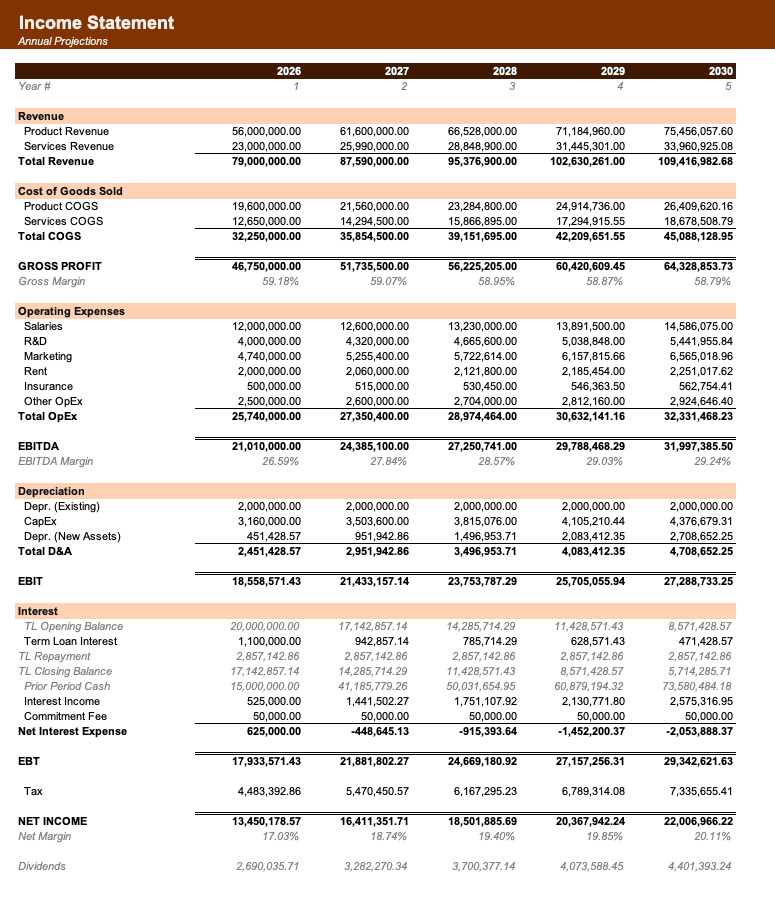
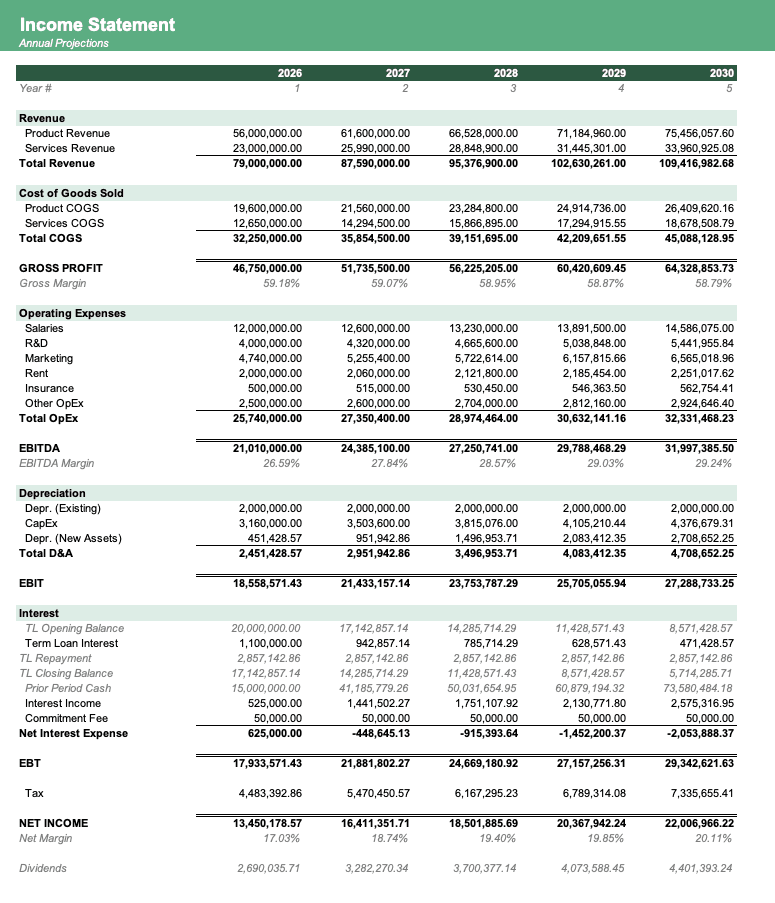
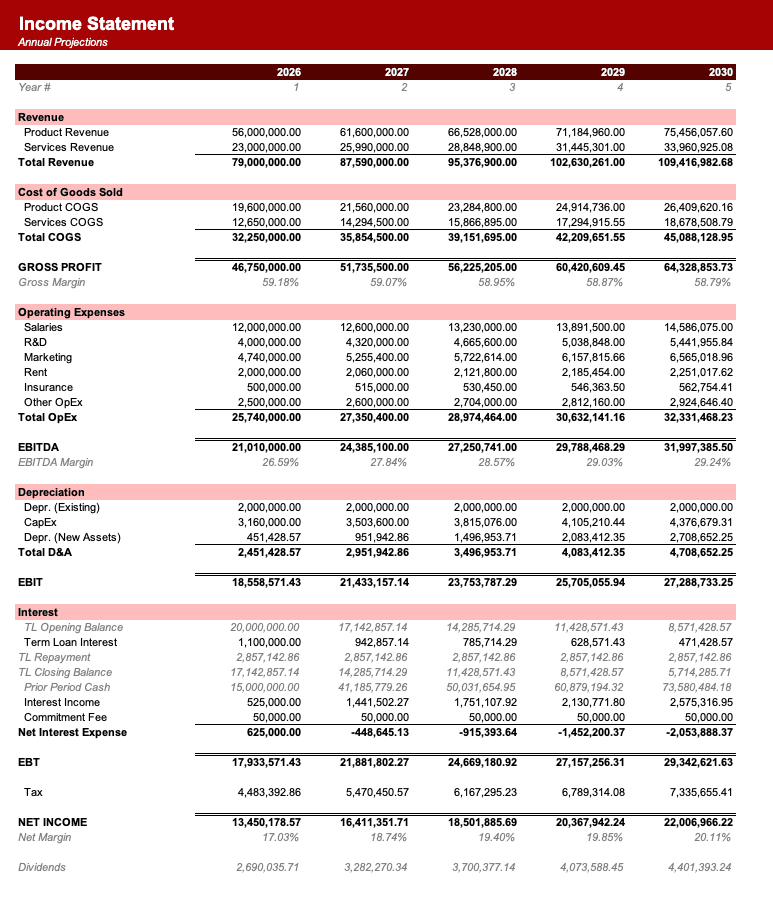
Formatted to IB standards
Named theme colors repaint the whole workbook in one click, on top of an investment-banking structure with clear input, output, and cross-sheet reference styling - brand-ready, institutional-grade, and fully auditable.

Created by ex-finance professionals
Hey, I’m Alex and I created Finamodel.
Over my years in the finance industry I kept building the same models over and over again. Same structure, same assumptions, different logo. So I started building frameworks to turn them into clean, reusable templates.
Every model here is one I’d actually use for a client, and I personally vet each one before it goes up.
I’m not an expert in every industry, but I’ve built enough models to know what belongs in one. And when something is completely foreign to me, I reach out to my network for experts to work on our models with us.
Having a template library on hand cuts a first build from hours to minutes.
Need help finding your model? You’ll find me in the Finamodel app!
Frequently asked
What is a bike shop financial model?+
A bike shop financial model captures the seven-year operating economics and intrinsic value of an independent bicycle dealer selling new bikes, parts, accessories and apparel, and service labour. It commits a pre-season book order against uncertain demand, ages unsold stock through a three-vintage markdown ladder, keys the wholesale cost and payment terms to the size of that commitment, drives service revenue off an installed base of bikes previously sold, and discounts an unlevered free-cash-flow stream to enterprise value, equity value, and value per share.
Why does the model book orders against total demand?+
Because that is the behavioural error that creates a glut, and the model discloses it rather than smoothing it away. A dealer forecasting next season typically sizes the order against expected demand and forgets the stock already sitting on the floor, so carry-over compounds. Setting the buffer against demand net of carry-over is a one-cell change if you want to test the disciplined alternative.
What is dating, and why does it matter so much?+
Dating is extended payment terms a bicycle brand grants on a pre-season order, under which payment is not expected until well after the season opens. At 150 days the supplier is financing essentially the whole floor, so working capital is a source of cash. Fall out of the program to 30-day terms and that financing disappears in a single year, which is a far larger cash event than the wholesale cost penalty that comes with it.
Why an unlevered DCF instead of an EBITDA multiple?+
Because the working-capital swing is the story. This business can post positive EBITDA and materially negative free cash flow in the same year purely from a change in inventory and payment terms, so an EBITDA multiple would value the correction year at roughly the wrong number. The model bridges to unlevered free cash flow, discounts it at a WACC with a Gordon-growth terminal value, and reports the implied EV/EBITDA as a sanity check rather than as the input.
Have more financial modelling questions? Contact us
Related templates
Hardware Store Model
Plan and value an independent hardware store using DIY retail foot traffic, contractor trade accounts, inventory turns, and a DCF.
Retail Store Model
Plan and value a retail-store chain using new stores, customer traffic, sales, inventory, and operating costs.
Auto Repair Chain Model
Plan and value an auto repair shop network using bay capacity, repair order size, parts margins, technician wages, and a DCF.
E-Commerce Unit Economics
P&L model for e-commerce business with CAC, LTV, gross margin, and unit economics.


