Cash Pooling and Intercompany Netting Tracker
Treasury & Cash Financial Model (Excel Download)
Turn agreed intercompany invoices into one net transfer per entity, then sweep cash to target balances. The workbook checks each transfer and sweep against bank evidence.



professionals from Deloitte






About this model
A settlement workbook for group treasury. It runs one multilateral netting cycle and one cash pool sweep for a single USD netting group. The shipped case is a fictional group with four entities and a hub, settling at the end of October 2026.
Only invoices that both parties accept count. Each entity's agreed offset is the smaller of its eligible payables and receivables, and the rest becomes one transfer to or from the hub. Actual bank transfers go in Executions, and the pool then uses executed netting to work out each sweep to target cash.
On the shipped case, 619,000 of eligible invoices settle with 161,000 of cash transfers. One disputed invoice of 17,000 stays excluded. East has paid 49,000 of its 50,000, so the Finish queue flags 1,000 to verify. Group cash is conserved at 1,355,000 and all pool sweeps match bank evidence.
What every model includes
Live formulas, no hardcoded values
Outputs are driven by live formulas, so the workbook updates from its assumptions instead of relying on hardcoded results.
All assumptions in one tab
Inputs are clearly marked in the Assumptions tab and separated from calculations, making it clear what to change and what to leave intact.
Statements always balancing
For integrated-statement models, the balance sheet, cash flow, and supporting schedules tie through properly.
Distinct schedules for clarity
Debt, working capital, taxes, and cash flow can get messy quickly. We group calculations in clear schedules, not across disconnected tabs.
No hidden macros or external links
There are no unexplained external workbook links or macros to undermine auditability or portability.
Changes flow through the model
Update a key driver and see the impact carry through the forecast, financing, and return outputs. We never use hardcoded numbers in formulas.
What's inside the Cash Pooling and Intercompany Netting Tracker
- Intercompany invoice set with a party agreement flag
- Disputed invoices excluded from the netting run
- Agreed offset and net receipt for each entity
- Transfer instructions with direction, amount and authorizer
- Executions sheet for dated, signed bank transfers, including partial payments
- Signed and gross residual for each entity
- Finish queue with the next action and instruction gate
- Cash pool sweeps to target balances using executed netting



Formatted to IB standards
Named theme colors repaint the whole workbook in one click, on top of an investment-banking structure with clear input, output, and cross-sheet reference styling - brand-ready, institutional-grade, and fully auditable.

Created by ex-finance professionals
Hey, I’m Alex and I created Finamodel.
Over my years in the finance industry I kept building the same models over and over again. Same structure, same assumptions, different logo. So I started building frameworks to turn them into clean, reusable templates.
Every model here is one I’d actually use for a client, and I personally vet each one before it goes up.
I’m not an expert in every industry, but I’ve built enough models to know what belongs in one. And when something is completely foreign to me, I reach out to my network for experts to work on our models with us.
Having a template library on hand cuts a first build from hours to minutes.
Frequently asked
What is multilateral netting?+
Multilateral netting offsets intercompany payables and receivables across a group. Each entity then pays or receives one net amount through a hub, in place of settling every invoice. This cuts the number and value of bank transfers.
How does the workbook calculate each transfer?+
It adds the agreed payables and receivables for each entity. The agreed offset is the smaller of the two, and the difference is the net receipt. A positive net receipt means the hub pays the entity, and a negative one means the entity pays the hub.
How are netting and pool sweeps kept apart?+
They are separate flows with separate bank evidence. The pool uses executed netting, not the planned amount, to find pre-pool cash. A positive sweep moves cash from the entity to the hub.
What is not included?+
The case is a single USD netting group. It does not cover FX conversion or the legal enforceability of netting. It does not send payments to a bank.
Can I add more entities or invoices?+
Yes. Add rows to the input sheets and extend the fixed ranges in lookups, controls and totals in the same way. Then change one input and check that the result moves as expected.
Have more financial modelling questions? Contact us
Related templates
Intercompany Balance Matching Register
Match intercompany receivables and payables by entity pair, currency and reference, and track each difference to agreement.
Daily Cash Position Reconciliation
Reconcile bank balances, transit items and restricted cash each day to find the cash you can actually use today.
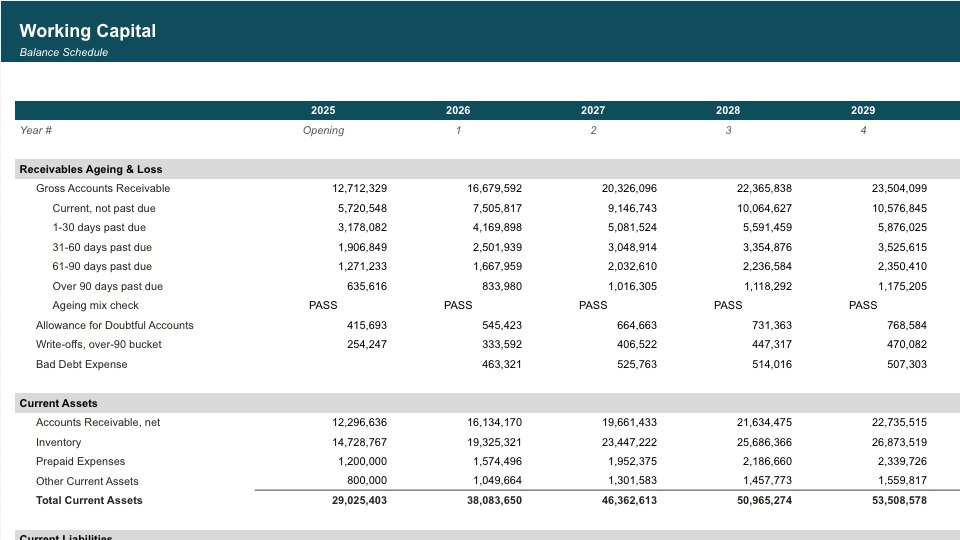
Working Capital Model
Model cash conversion cycle with DSO, DIO, and DPO to forecast working capital needs.
Three-Way Invoice Matching Workpaper
Match supplier invoices to purchase orders and goods receipts, hold exceptions and control payment release.







