Credit Valuation Adjustment (CVA) Excel Model
Capital Markets Financial Model (Excel Download)
Price the credit risk of a derivatives counterparty. The model builds expected exposure from trade scenarios, applies collateral and default risk, and tests which collateral threshold is acceptable.



professionals from Deloitte






About this model
A unilateral credit valuation adjustment (CVA) model for one derivatives netting set. The starting case is a fictional bank facing one counterparty with three trades: a pay-fixed swap, a receive-fixed swap and a basis swap. The risk-free value of the set is $4.2m, and all amounts are in USD millions.
For each of twelve quarters there are five weighted scenarios of signed trade values. The model nets the trades, applies either fixed collateral or a threshold with a haircut, and averages positive exposure only after that step. Quarterly hazard rates give survival and marginal default probability, and loss is exposure times loss given default, discounted. A sensitivity sheet stresses hazard, recovery and collateral, and a threshold sheet tests five CSA thresholds against limits.
In the case CVA is about $0.162m, so the credit-adjusted value is $4.038m, a 3.86% reduction. Against a $0.085m CVA cap and an $8m collateral limit, the loosest feasible threshold is $2m. Each quarter's scenario probabilities must sum to one before the loss engine runs.
What every model includes
Live formulas, no hardcoded values
Outputs are driven by live formulas, so the workbook updates from its assumptions instead of relying on hardcoded results.
All assumptions in one tab
Inputs are clearly marked in the Assumptions tab and separated from calculations, making it clear what to change and what to leave intact.
Statements always balancing
For integrated-statement models, the balance sheet, cash flow, and supporting schedules tie through properly.
Distinct schedules for clarity
Debt, working capital, taxes, and cash flow can get messy quickly. We group calculations in clear schedules, not across disconnected tabs.
No hidden macros or external links
There are no unexplained external workbook links or macros to undermine auditability or portability.
Changes flow through the model
Update a key driver and see the impact carry through the forecast, financing, and return outputs. We never use hardcoded numbers in formulas.
What's inside the Credit Valuation Adjustment (CVA) Excel Model
- Sixty weighted scenarios of signed trade values over twelve quarters
- Netting of three trades in one netting set
- Fixed collateral or threshold collateral with a haircut
- Expected positive exposure averaged after collateral
- Quarterly hazard rates, survival and marginal default probability
- Discounted loss by quarter with recovery
- Unilateral CVA and credit-adjusted value
- Stresses for higher hazard, lower or higher recovery and collateral cases



Formatted to IB standards
Named theme colors repaint the whole workbook in one click, on top of an investment-banking structure with clear input, output, and cross-sheet reference styling - brand-ready, institutional-grade, and fully auditable.

Created by ex-finance professionals
Hey, I’m Alex and I created Finamodel.
Over my years in the finance industry I kept building the same models over and over again. Same structure, same assumptions, different logo. So I started building frameworks to turn them into clean, reusable templates.
Every model here is one I’d actually use for a client, and I personally vet each one before it goes up.
I’m not an expert in every industry, but I’ve built enough models to know what belongs in one. And when something is completely foreign to me, I reach out to my network for experts to work on our models with us.
Having a template library on hand cuts a first build from hours to minutes.
Frequently asked
What is a credit valuation adjustment?+
CVA is the reduction in a derivative's value to reflect the risk that the counterparty defaults. It equals expected exposure times the chance of default times loss given default, discounted. Banks report it and charge it in pricing.
How is exposure measured?+
For each quarter the model takes five weighted scenarios of trade values. It nets the trades, subtracts collateral and keeps only positive amounts. It averages after that step, which is why expected exposure is higher than expected value less collateral.
How does the threshold test work?+
Each threshold changes how much collateral the counterparty must post. A lower threshold cuts CVA but raises collateral demand. The model shows which thresholds meet both the CVA cap and the collateral limit.
What does the model not include?+
It is unilateral, so it ignores your own default risk. Scenarios are a synthetic fixture, not a Monte Carlo simulation. Market, liquidity and operational risk are not included, and all data are fictional.
Can I use my own netting set?+
Yes. Enter trade scenarios, probabilities, collateral, hazard rates and recovery in the blue cells. Each quarter needs five unique scenarios with probabilities that sum to one.
Have more financial modelling questions? Contact us
Related templates
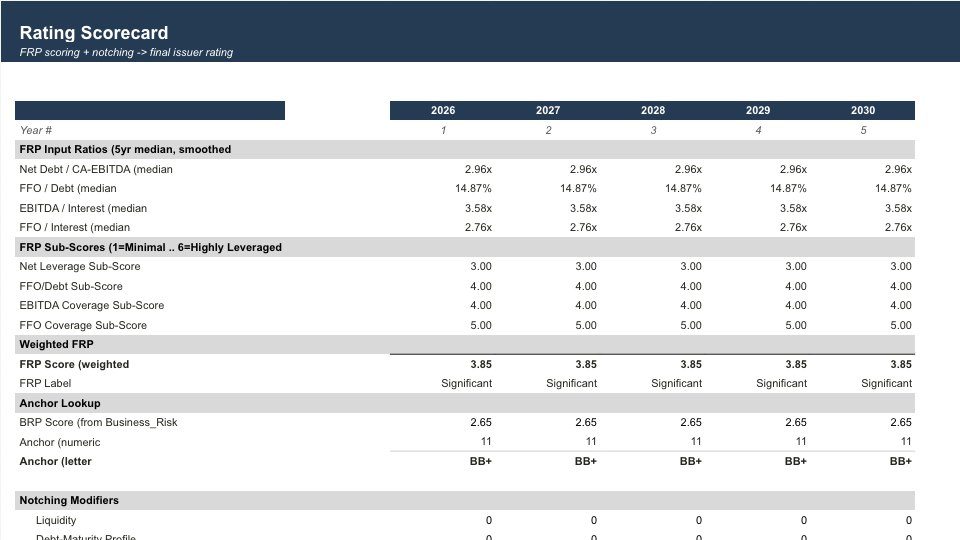
Credit Rating Model
Calculate credit metrics and probability of default to estimate debt ratings.
CDS-Implied Default Probability Model
Bootstrap a default probability curve from CDS spreads and compare risk-neutral and physical default rates.
Interest Rate and Cross-Currency Swap Valuation Model
Mark an interest rate swap and a cross-currency swap to market from dated cash flows, curves and spot FX.
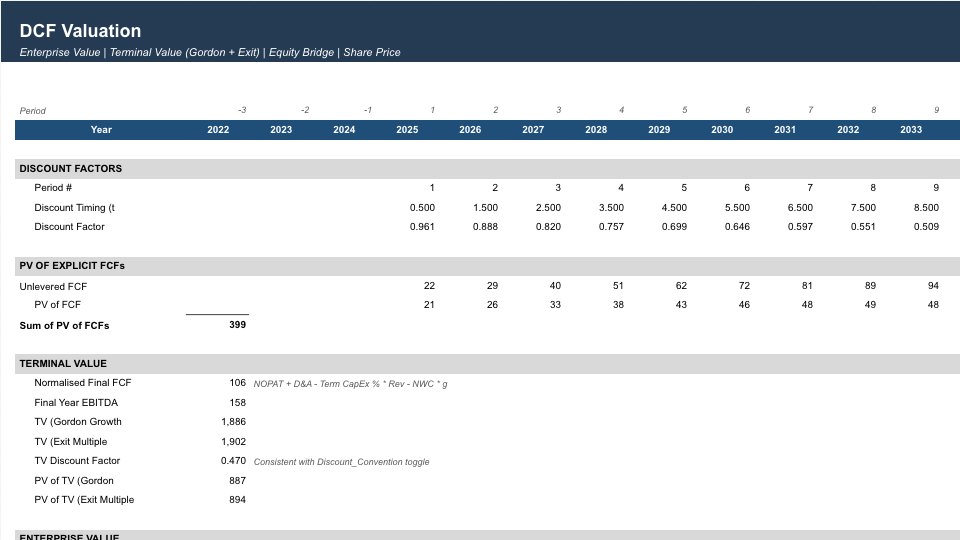
DCF Model
Discounted cash flow valuation model with explicit forecast, terminal value, and WACC.







