Enterprise Risk Scenario Library Tracker
Corporate Finance Financial Model (Excel Download)
Keep a governed library of stress scenarios that stays current. The register calibrates shocks to observed data, flags drift and stale approvals, and compares each loss with your risk limit.



professionals from Deloitte






About this model
A scenario library and calibration register for risk and model governance teams. It holds approved stress scenarios with full version history. The shipped case is a fictional manufacturer with four scenario families and six stored versions, covering domestic demand, FX and rates, supplier outage and a combined proposal.
Forty-eight monthly observations calibrate each driver at an empirical 95th percentile, scaled and kept within a floor and cap. The candidate is compared with the approved shock, and drift beyond a set tolerance calls for recalibration. A version is usable only if it is approved, in date, on the current calibration set and backed by current scoped evidence. Stored shocks never change silently when data updates.
On the shipped case three selected versions are eligible and one draft is blocked. The worst eligible loss is $1,050,000 for domestic demand. Against a $750,000 pre-tax loss limit, two stresses are above the limit and one is within it. Losses are alternatives and are never summed.
What every model includes
Live formulas, no hardcoded values
Outputs are driven by live formulas, so the workbook updates from its assumptions instead of relying on hardcoded results.
All assumptions in one tab
Inputs are clearly marked in the Assumptions tab and separated from calculations, making it clear what to change and what to leave intact.
Statements always balancing
For integrated-statement models, the balance sheet, cash flow, and supporting schedules tie through properly.
Distinct schedules for clarity
Debt, working capital, taxes, and cash flow can get messy quickly. We group calculations in clear schedules, not across disconnected tabs.
No hidden macros or external links
There are no unexplained external workbook links or macros to undermine auditability or portability.
Changes flow through the model
Update a key driver and see the impact carry through the forecast, financing, and return outputs. We never use hardcoded numbers in formulas.
What's inside the Enterprise Risk Scenario Library Tracker
- Scenario families with versioned shocks, scope flags and predecessors
- Version log with owner, approver, approval date and review dates
- Monthly observation history for four risk drivers
- Empirical percentile calibration with scale, floor and cap
- Drift test of calibration candidate against approved shocks
- Evidence register with scope, window, receipt and reviewer
- Eligibility rules that block unapproved, stale or out-of-scope versions
- Financial impact by driver for demand, FX, interest and outage



Formatted to IB standards
Named theme colors repaint the whole workbook in one click, on top of an investment-banking structure with clear input, output, and cross-sheet reference styling - brand-ready, institutional-grade, and fully auditable.

Created by ex-finance professionals
Hey, I’m Alex and I created Finamodel.
Over my years in the finance industry I kept building the same models over and over again. Same structure, same assumptions, different logo. So I started building frameworks to turn them into clean, reusable templates.
Every model here is one I’d actually use for a client, and I personally vet each one before it goes up.
I’m not an expert in every industry, but I’ve built enough models to know what belongs in one. And when something is completely foreign to me, I reach out to my network for experts to work on our models with us.
Having a template library on hand cuts a first build from hours to minutes.
Frequently asked
What is a risk scenario library?+
It is a controlled set of stress scenarios that a company uses to test its exposure to events like falling demand, currency moves or supplier outages. Each scenario has approved shocks, an owner and a review date.
How are the shocks calibrated?+
Each driver uses 48 monthly observations. The 95th empirical percentile is scaled and kept within a floor and cap. This candidate is compared with the approved shock, and drift beyond the tolerance flags the version for recalibration.
Is this a value-at-risk model?+
No. Monthly percentiles are used as committee-chosen sustained stress levels, not annual VaR or a joint probability. Impacts are linear and ignore correlation and second-order effects. Scenario losses are alternatives and must not be summed.
When can a scenario version be used?+
It must be approved with a named approver and date, within its effective and review dates, on the current calibration set, backed by current scoped evidence and within drift limits. Otherwise its impact shows as unavailable.
How do I add a new version?+
Append a successor version, keep the predecessor and its shocks, record the change, attach current evidence and obtain a dated approval. Do not link stored shocks to live percentile formulas.
Have more financial modelling questions? Contact us
Related templates
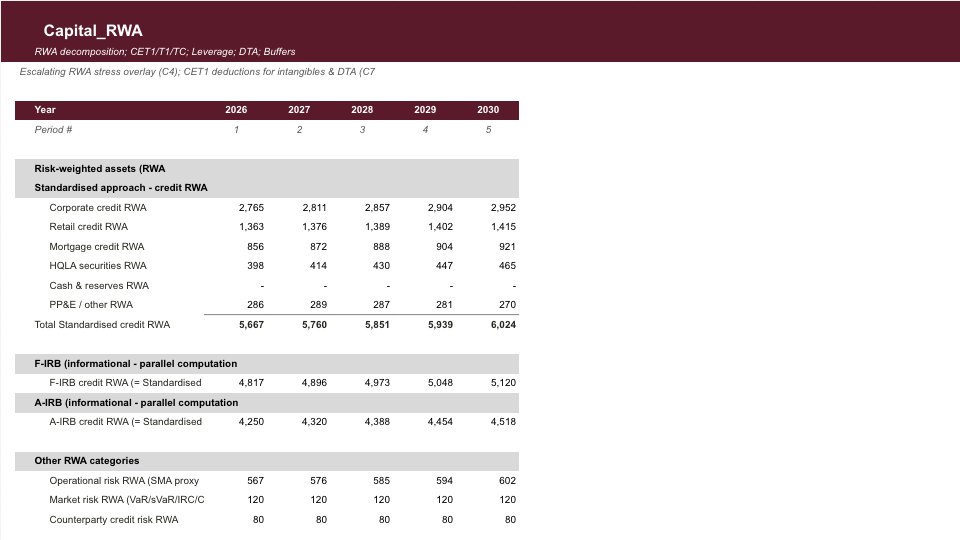
Credit Stress Testing Framework
Stress test credit portfolios across default probabilities, loss severities, and adverse macroeconomic scenarios.
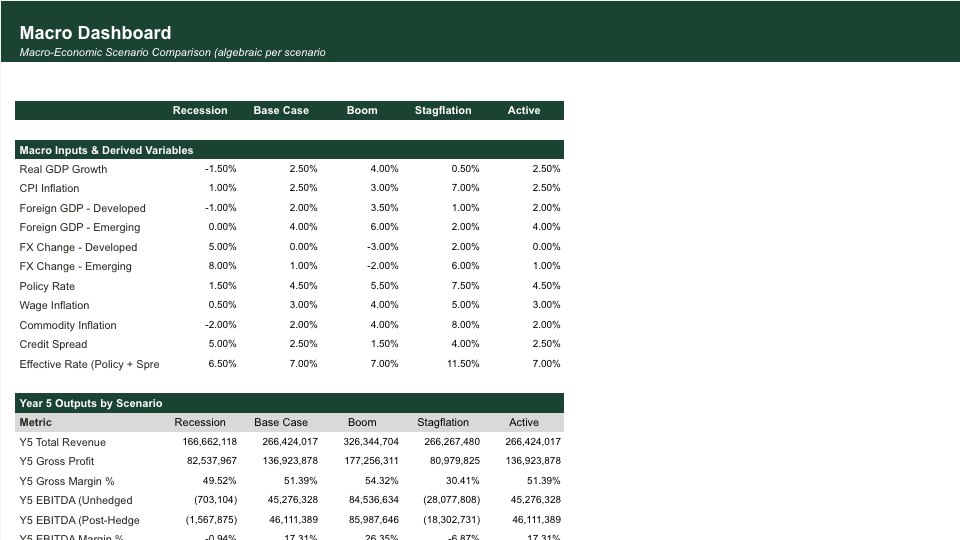
Macroeconomic Scenario Model
Multi-scenario financial model with GDP, inflation, employment, and sector-specific economic drivers.
Monte Carlo Cash Risk and Hedge Simulation
Simulate correlated volume, cost and FX risk to estimate cash shortfall odds and compare hedge policies on the same draws.
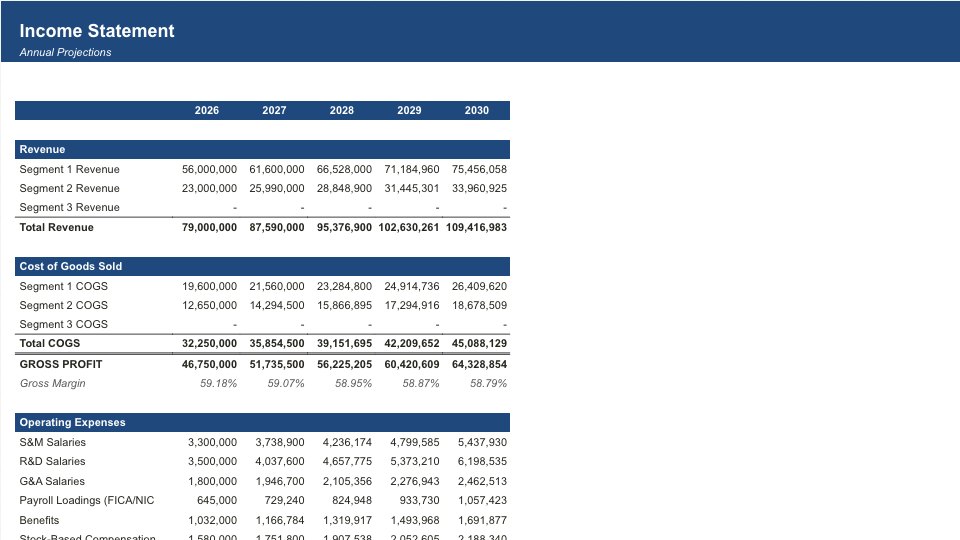
3 Statement Model
Integrated income statement, balance sheet, and cash flow forecasts.







