Loan Payment Allocation Ledger Tracker
Credit Financial Model (Excel Download)
Keep a dated ledger of each borrower's payments, fees and reversals. The ledger splits every receipt into fees, interest and principal, shows arrears and gives a payoff quote on any date.



professionals from Deloitte






About this model
A loan servicing ledger for a lender that manages real borrower accounts. It is a record of what happened, not a forecast of loan amortization. The shipped case has three fictional borrowers with receipts, a returned receipt, a partial payment, fees, arrears and an early payoff with a credit balance.
Each receipt pays fees first, then accrued interest, then principal, and any excess stays as unapplied credit. Interest is simple daily interest on actual outstanding principal, on an ACT/365 basis. A reversal must point to one prior receipt and undoes that receipt's original split. Arrears compare scheduled principal due with net principal received, plus interest and fees due.
At the March statement date the portfolio holds $26,181 of principal and $3,349 of total arrears, and one loan has a $42 refund due. A payoff quote for April 15 adds $78.86 of interest for a quote of $16,159.10. Checks flag cash and principal breaks, date order, reversal links, duplicate IDs and a missing statement accrual.
What every model includes
Live formulas, no hardcoded values
Outputs are driven by live formulas, so the workbook updates from its assumptions instead of relying on hardcoded results.
All assumptions in one tab
Inputs are clearly marked in the Assumptions tab and separated from calculations, making it clear what to change and what to leave intact.
Statements always balancing
For integrated-statement models, the balance sheet, cash flow, and supporting schedules tie through properly.
Distinct schedules for clarity
Debt, working capital, taxes, and cash flow can get messy quickly. We group calculations in clear schedules, not across disconnected tabs.
No hidden macros or external links
There are no unexplained external workbook links or macros to undermine auditability or portability.
Changes flow through the model
Update a key driver and see the impact carry through the forecast, financing, and return outputs. We never use hardcoded numbers in formulas.
What's inside the Loan Payment Allocation Ledger Tracker
- Loan accounts with start date, opening principal, rate and day basis
- Postings for receipts, fees, reversals and statement accruals
- Allocation of each receipt to fees, then interest, then principal
- Unapplied credit and refund due when a borrower overpays
- Simple daily interest on actual outstanding principal
- Reversals linked to one prior receipt that undo its original split
- Contractual principal due schedule and arrears by loan
- Borrower statement for any selected loan



Formatted to IB standards
Named theme colors repaint the whole workbook in one click, on top of an investment-banking structure with clear input, output, and cross-sheet reference styling - brand-ready, institutional-grade, and fully auditable.

Created by ex-finance professionals
Hey, I’m Alex and I created Finamodel.
Over my years in the finance industry I kept building the same models over and over again. Same structure, same assumptions, different logo. So I started building frameworks to turn them into clean, reusable templates.
Every model here is one I’d actually use for a client, and I personally vet each one before it goes up.
I’m not an expert in every industry, but I’ve built enough models to know what belongs in one. And when something is completely foreign to me, I reach out to my network for experts to work on our models with us.
Having a template library on hand cuts a first build from hours to minutes.
Frequently asked
What is a loan payment allocation ledger?+
It is a subledger that records each loan's actual payments, fees and adjustments by date. For each payment it decides how much goes to fees, interest and principal. The result is an accurate balance, arrears figure and statement for each borrower.
In what order are payments applied?+
Each receipt pays outstanding fees first, then accrued interest, then principal. Any amount left over stays on the account as unapplied credit. A negative closure balance means the lender owes the borrower a refund.
How are returned payments handled?+
A reversal must point to exactly one prior receipt for the same loan. It undoes that receipt's original split of fees, interest and principal. It does not run the reversed cash through the payment order again.
What does the ledger not do?+
It does not forecast amortization or compound unpaid interest. It does not pay out credits or apply retained credit by itself, and it has no KYC or approval features. It ships with three loan slots, thirteen postings and nine due records.
How do I add loans and postings?+
Enter contract terms on Accounts and postings in one date-ordered block per loan. End each block with an Accrue posting at the statement date. To add more records, extend the source ranges and the group logic.
Have more financial modelling questions? Contact us
Related templates
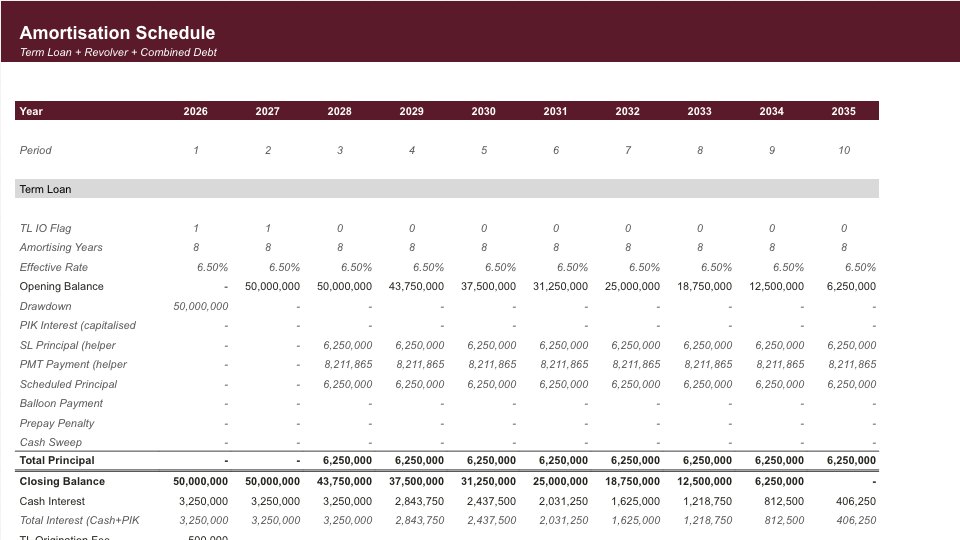
Bank Loan Analysis Model
Commercial bank loan origination and portfolio underwriting.
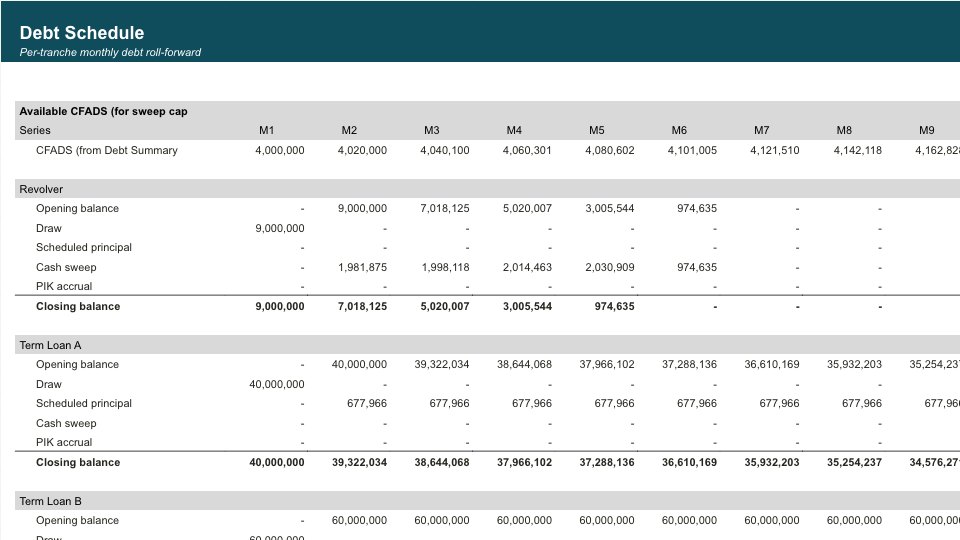
Debt Schedule
60-month multi-tranche corporate debt register with cash and PIK interest, scheduled and sweep principal, and TTM covenant tests.
Cash Application Reconciliation
Match customer bank receipts to remittance advice and invoices, isolate unapplied cash and approve new allocations.
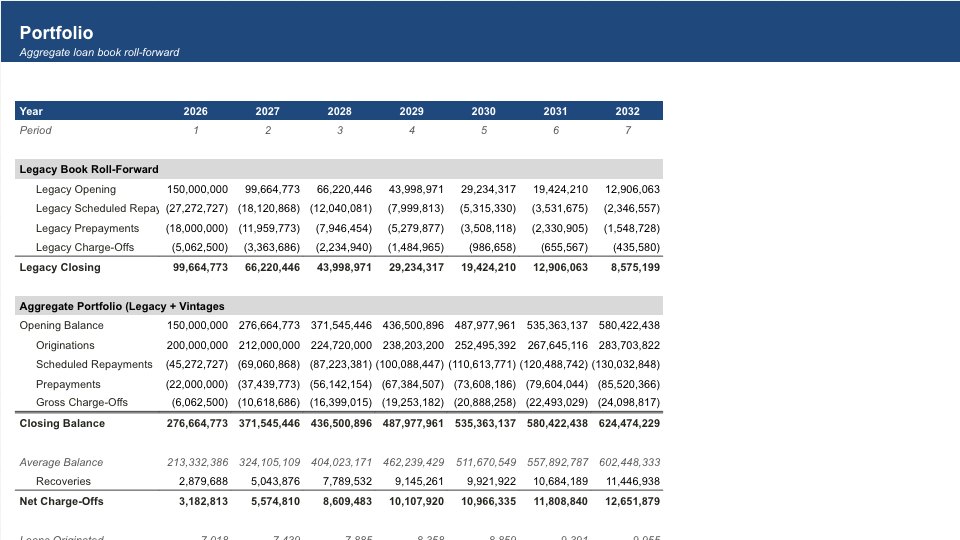
Auto Loan Portfolio Model
Automotive loan securitization and portfolio analysis.







