Precedent Transaction Valuation Excel Model
Valuation Financial Model (Excel Download)
Value a company from the prices paid in past acquisitions. The model screens deals, normalizes their earnings and applies the multiples to your company, with a clear record of each choice.



professionals from Deloitte






About this model
A precedent transaction model for valuing a company from past control acquisitions. The shipped case values a fictional industrial services business against six fictional transactions, with all amounts in USD millions.
Each deal is screened by sector, date range, voting stake, deal size and source match, and the reason for each exclusion is shown. LTM revenue and EBITDA are built from the full year plus the current stub less the prior stub, with addbacks and one-time gains. Stake prices scale to a 100% equity value, and local currency converts to USD.
On the shipped case three deals qualify, with a median of 8.06x EBITDA and a midpoint equity value of $163.61m. At $30m of EBITDA the value rises to $203.94m. Checks cover source matching, terms, the equity bridge, future financials and a minimum deal count, and a robustness sheet removes each deal in turn.
What every model includes
Live formulas, no hardcoded values
Outputs are driven by live formulas, so the workbook updates from its assumptions instead of relying on hardcoded results.
All assumptions in one tab
Inputs are clearly marked in the Assumptions tab and separated from calculations, making it clear what to change and what to leave intact.
Statements always balancing
For integrated-statement models, the balance sheet, cash flow, and supporting schedules tie through properly.
Distinct schedules for clarity
Debt, working capital, taxes, and cash flow can get messy quickly. We group calculations in clear schedules, not across disconnected tabs.
No hidden macros or external links
There are no unexplained external workbook links or macros to undermine auditability or portability.
Changes flow through the model
Update a key driver and see the impact carry through the forecast, financing, and return outputs. We never use hardcoded numbers in formulas.
What's inside the Precedent Transaction Valuation Excel Model
- Subject inputs for LTM revenue, adjusted EBITDA, debt and cash
- Deal screen by sector, date range, control stake and EV range
- Deal terms and financials matched by a unique evidence ID
- LTM build from full year plus current stub less prior stub
- EBITDA bridge with addbacks and one-time gain removals
- Stake price scaled to 100% equity and currency conversion to USD
- Low, median and high EV/EBITDA and EV/revenue multiples
- Full, recent and near-size pricing cohorts



Formatted to IB standards
Named theme colors repaint the whole workbook in one click, on top of an investment-banking structure with clear input, output, and cross-sheet reference styling - brand-ready, institutional-grade, and fully auditable.

Created by ex-finance professionals
Hey, I’m Alex and I created Finamodel.
Over my years in the finance industry I kept building the same models over and over again. Same structure, same assumptions, different logo. So I started building frameworks to turn them into clean, reusable templates.
Every model here is one I’d actually use for a client, and I personally vet each one before it goes up.
I’m not an expert in every industry, but I’ve built enough models to know what belongs in one. And when something is completely foreign to me, I reach out to my network for experts to work on our models with us.
Having a template library on hand cuts a first build from hours to minutes.
Frequently asked
What is a precedent transaction analysis?+
It values a company from the prices buyers paid for similar companies in past acquisitions. You find the multiple of each deal, such as EV to EBITDA, and apply the typical multiple to your company. Because buyers took control, the result includes a control premium.
How are deals selected?+
Each deal must match the sector, fall inside the date range, buy a controlling stake and sit inside the EV range. Its terms and financials must also match by evidence ID. The Selection review sheet shows why each excluded deal was dropped.
Why is the acquisition premium only descriptive?+
Precedent multiples already include the price of control. Adding the observed premium on top would count it twice, so the model shows the mean premium for context only.
What are the limits?+
The workbook is set up for six deal records. To add more, extend the builder ranges and the checks. It assumes a partial stake price scales to a 100% equity value, so add any contingent consideration to the stated price first.
How do I use my own deals?+
Replace the fictional extracts on Deal terms and Financials, using the same short evidence ID on both tabs. Enter your company's figures and filters on Inputs, then read the Checks tab before you use the value.
Have more financial modelling questions? Contact us
Related templates
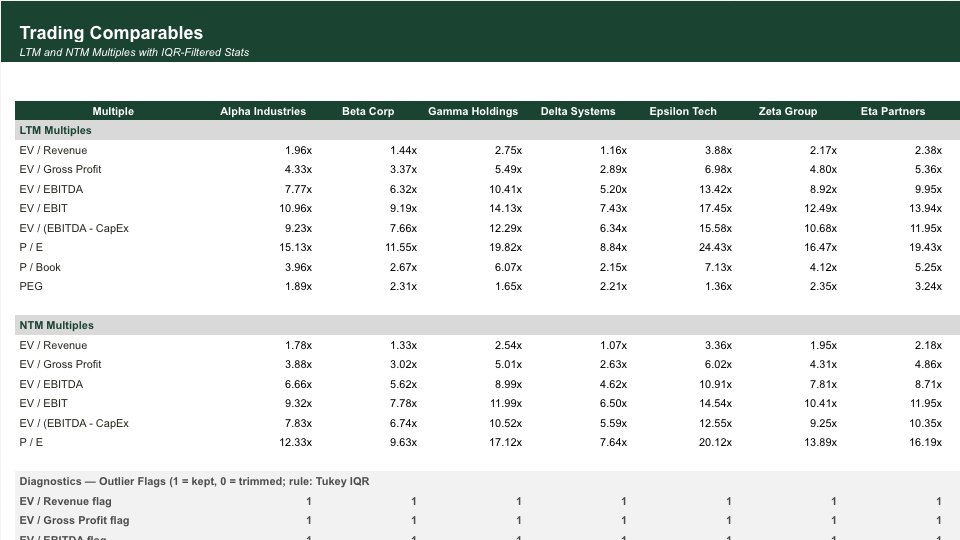
Comparable Companies Analysis
Pull trading multiples from peer companies and calculate implied valuation ranges.
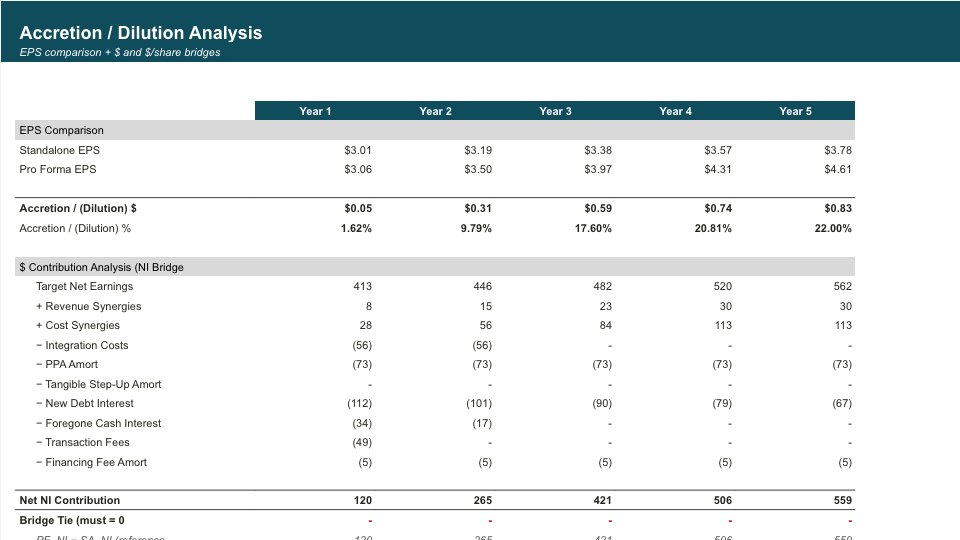
M&A Modeling & Valuation
Comprehensive M&A valuation with DCF, comparable companies, and precedent transactions analysis.
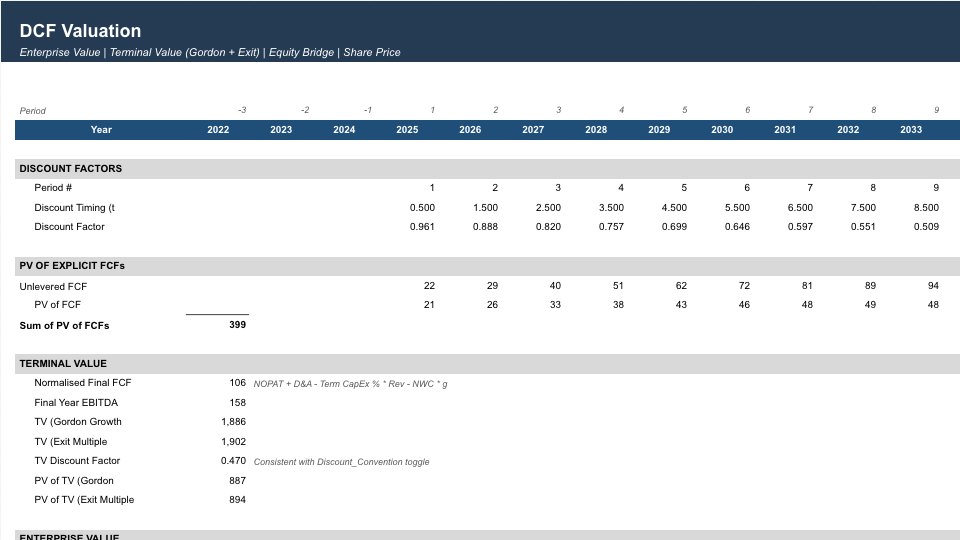
DCF Model
Discounted cash flow valuation model with explicit forecast, terminal value, and WACC.
Adjusted Present Value (APV) Model
Compare two financing offers with adjusted present value: tax shields, fees, risk costs, liquidity and coverage tests.







