Property Hold Versus Sell Analysis
Real Estate Financial Model (Excel Download)
Decide whether to sell a property now or hold it for a few more years. Compare after-tax wealth, IRR and equity multiple for each sale year, and check you can fund the hold.



professionals from Deloitte






About this model
A hold or sell analysis for a current property owner. The shipped case is a fictional owner of a rented property with an existing mortgage. It compares selling today with selling in any year from one to ten.
Each case starts from the same after-tax equity the owner would get by selling today. Property cash flows cover rent, vacancy, operating costs, renovation, tax, mortgage interest and principal. A sale deducts transaction costs, the mortgage payoff and illustrative capital gain and recapture taxes. Owner cash and sale proceeds are reinvested at an alternative return to year ten, so every case compares on common-horizon wealth.
On the shipped case selling now releases about USD 927,000 of equity. Holding for ten years gives the highest year-ten wealth, about USD 488,000 more than selling now. A two-way table shows how the uplift changes with current value and sale year. Under a downside with weak growth and an operating shock, the best funded sale year moves to year three, so the hold benefit depends on funding. Mortgage and tax basis checks return zero.
What every model includes
Live formulas, no hardcoded values
Outputs are driven by live formulas, so the workbook updates from its assumptions instead of relying on hardcoded results.
All assumptions in one tab
Inputs are clearly marked in the Assumptions tab and separated from calculations, making it clear what to change and what to leave intact.
Statements always balancing
For integrated-statement models, the balance sheet, cash flow, and supporting schedules tie through properly.
Distinct schedules for clarity
Debt, working capital, taxes, and cash flow can get messy quickly. We group calculations in clear schedules, not across disconnected tabs.
No hidden macros or external links
There are no unexplained external workbook links or macros to undermine auditability or portability.
Changes flow through the model
Update a key driver and see the impact carry through the forecast, financing, and return outputs. We never use hardcoded numbers in formulas.
What's inside the Property Hold Versus Sell Analysis
- Owner inputs for value, rent, vacancy, costs, mortgage and tax cost
- Annual property cash flow with rent, vacancy, operating cost and renovation
- Mortgage amortization with interest, payment and principal
- Tax basis rollforward with depreciation
- Sale proceeds after transaction costs, mortgage payoff and taxes
- Sale cases for every year from now to year ten
- IRR, equity multiple and year-ten wealth for each case
- Reinvestment of owner cash and proceeds at an alternative return



Formatted to IB standards
Named theme colors repaint the whole workbook in one click, on top of an investment-banking structure with clear input, output, and cross-sheet reference styling - brand-ready, institutional-grade, and fully auditable.

Created by ex-finance professionals
Hey, I’m Alex and I created Finamodel.
Over my years in the finance industry I kept building the same models over and over again. Same structure, same assumptions, different logo. So I started building frameworks to turn them into clean, reusable templates.
Every model here is one I’d actually use for a client, and I personally vet each one before it goes up.
I’m not an expert in every industry, but I’ve built enough models to know what belongs in one. And when something is completely foreign to me, I reach out to my network for experts to work on our models with us.
Having a template library on hand cuts a first build from hours to minutes.
Frequently asked
What is a hold versus sell analysis?+
It compares the money you would get by selling a property today with what you would have by keeping it and selling later. The answer depends on rent, costs, value growth, debt, taxes and what you could earn elsewhere.
Why use year-ten wealth to compare?+
Cases with different sale years produce cash at different times. The model reinvests all owner cash and sale proceeds to year ten at an alternative return, so each case ends at the same date.
What does the funding test show?+
If the property needs cash in a bad year, you may not be able to fund it. The downside case caps outside contributions and shows the best sale year you can actually fund.
What is not included?+
Tax rates are illustrative and are not advice for any jurisdiction. Sale exemptions, tax loss benefits and suspended losses are left out.
How do I use it for my property?+
Enter your current value, rent, costs, mortgage terms, tax cost and expected growth on Owner inputs. Set your alternative return and review all sale years and the sensitivity before choosing.
Have more financial modelling questions? Contact us
Related templates
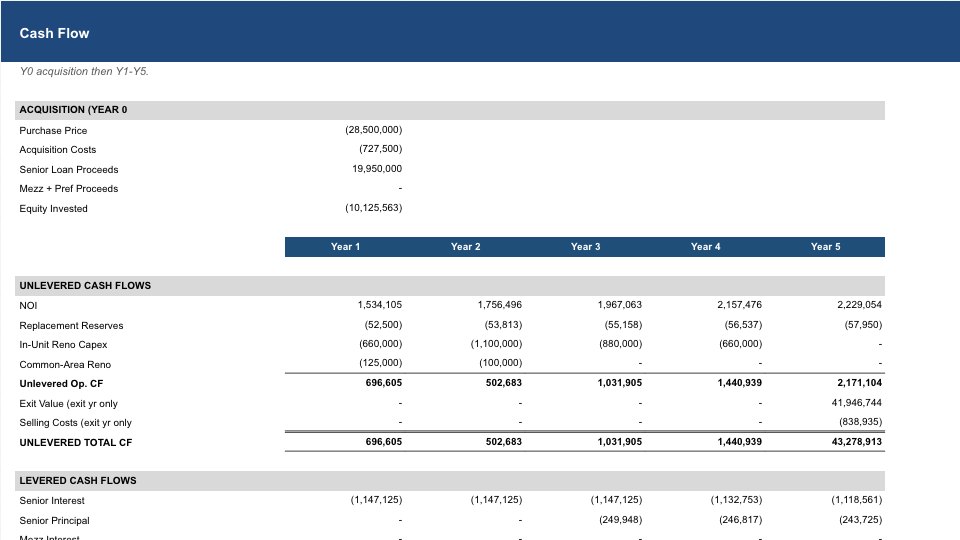
Multifamily Residential Model
Investment model for multifamily apartment communities with unit economics, rents, occupancy, and NOI.
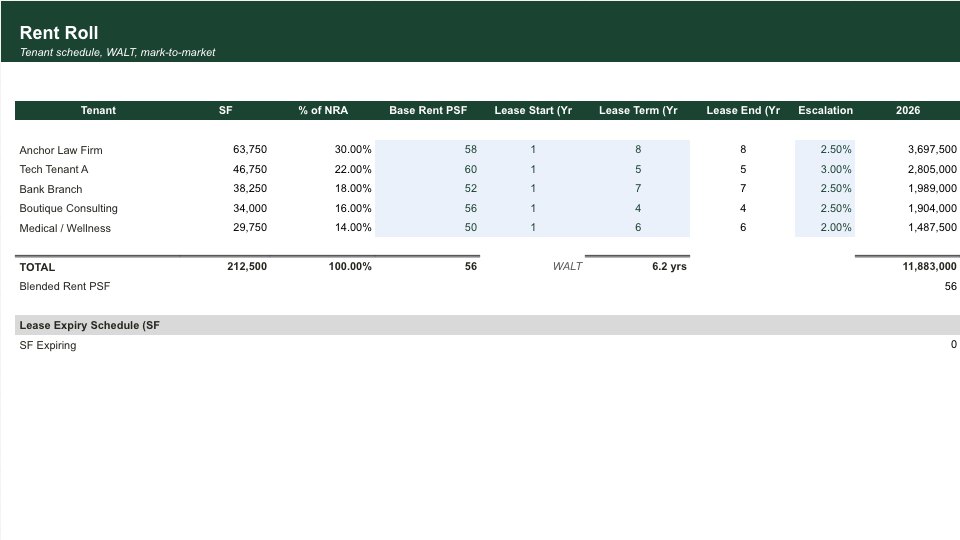
Office Building Investment Model
Income-producing office building model with lease-up, rent growth, occupancy, and terminal value analysis.
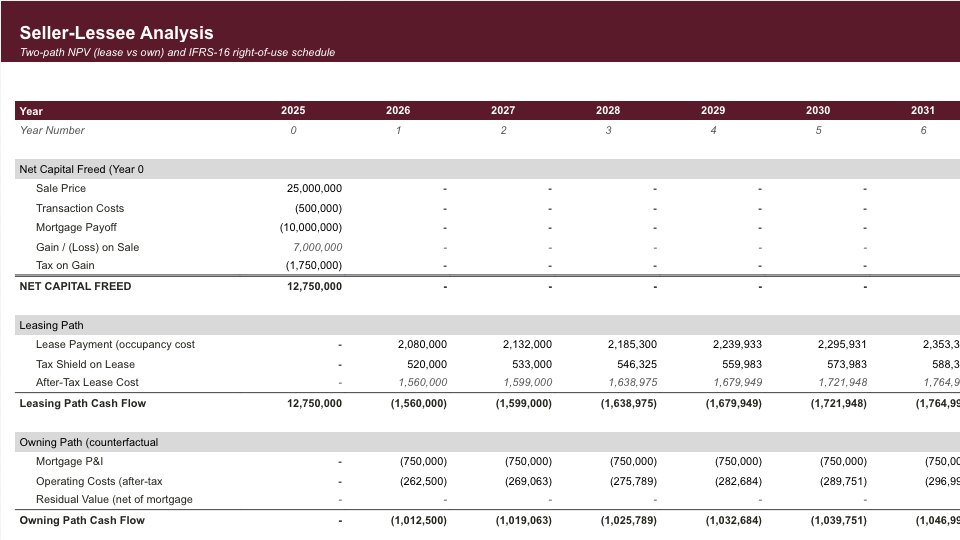
Sale-Leaseback Real Estate Model
Financing model for property owners selling real estate to investors and leasing it back, with lease terms, IRR, and tax deferral analysis.
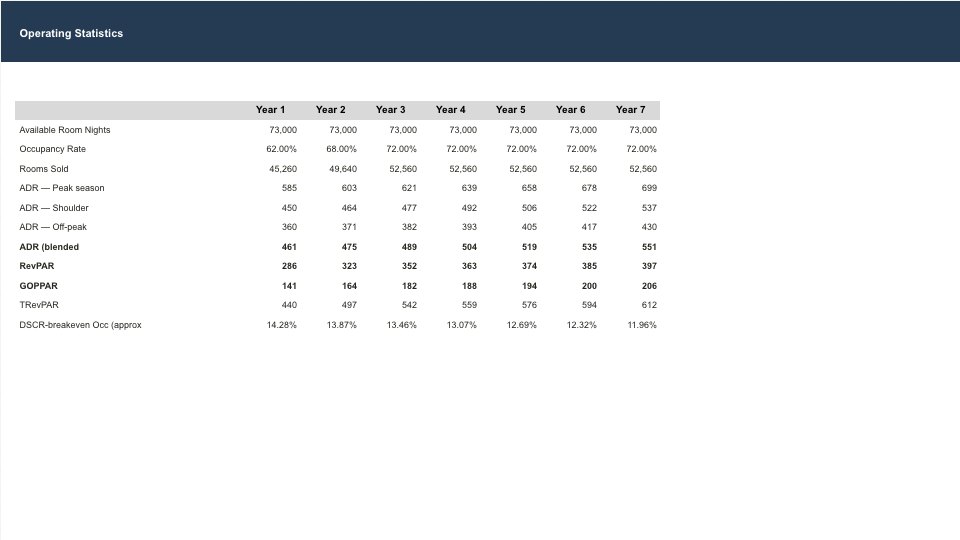
Hotel Operating Model
Operating model for hotel properties including occupancy rates, average daily rate (ADR), RevPAR optimization, and facility-level profitability.







