Residual Income Valuation Excel Model
Valuation Financial Model (Excel Download)
Value a company from its book equity and the returns it earns above its cost of equity. The model tests whether the share price needs those excess returns to last and how fast they can fade.



professionals from Deloitte






About this model
A residual income model for equity valuation. The starting case is a fictional company with $500m of book equity, a five-year forecast of return on equity falling from 15% to 11.5%, a 45% payout ratio and constant shares. All amounts are in USD millions except per-share prices.
Residual income each year is ROE less the cost of equity, times opening book value. Book value rolls forward by earnings less dividends under clean surplus. Equity value is opening book plus the present value of residual income and a terminal value, and a dividend schedule reconciles to the same answer. The model also solves the terminal ROE that the market price implies. A runoff sheet lets excess ROE fade over zero to fifteen years.
With a 10% cost of equity and 11% terminal ROE, value is $12.61 a share against a $11.50 price, an upside of about 9.7%. If excess returns vanish at once, value is about $11.50, and a five-year fade gives $11.72. A nine-case table tests cost of equity and terminal ROE.
What every model includes
Live formulas, no hardcoded values
Outputs are driven by live formulas, so the workbook updates from its assumptions instead of relying on hardcoded results.
All assumptions in one tab
Inputs are clearly marked in the Assumptions tab and separated from calculations, making it clear what to change and what to leave intact.
Statements always balancing
For integrated-statement models, the balance sheet, cash flow, and supporting schedules tie through properly.
Distinct schedules for clarity
Debt, working capital, taxes, and cash flow can get messy quickly. We group calculations in clear schedules, not across disconnected tabs.
No hidden macros or external links
There are no unexplained external workbook links or macros to undermine auditability or portability.
Changes flow through the model
Update a key driver and see the impact carry through the forecast, financing, and return outputs. We never use hardcoded numbers in formulas.
What's inside the Residual Income Valuation Excel Model
- Five-year forecast of book equity, ROE, earnings and dividends
- Residual income and capital charge by year
- Equity value from book, explicit residual income and terminal value
- Dividend model that reconciles to the same equity value
- Implied terminal ROE solved from market capitalization
- Value per share and upside against the market price
- Excess ROE runoff over zero to fifteen years
- Comparison of permanent, immediate fade and selected fade values



Formatted to IB standards
Named theme colors repaint the whole workbook in one click, on top of an investment-banking structure with clear input, output, and cross-sheet reference styling - brand-ready, institutional-grade, and fully auditable.

Created by ex-finance professionals
Hey, I’m Alex and I created Finamodel.
Over my years in the finance industry I kept building the same models over and over again. Same structure, same assumptions, different logo. So I started building frameworks to turn them into clean, reusable templates.
Every model here is one I’d actually use for a client, and I personally vet each one before it goes up.
I’m not an expert in every industry, but I’ve built enough models to know what belongs in one. And when something is completely foreign to me, I reach out to my network for experts to work on our models with us.
Having a template library on hand cuts a first build from hours to minutes.
Frequently asked
What is residual income valuation?+
Residual income valuation says equity is worth its book value plus the present value of future profits above the cost of equity. Residual income is net income less a charge for the equity used. It is common for banks and other asset-heavy firms.
How does it relate to a dividend discount model?+
Under clean surplus accounting, both methods give the same value. The model includes a dividend schedule that reconciles to the residual income result as a check.
What does the implied terminal ROE show?+
It is the long-run return on equity that makes the model value equal to the market price, using the same forecast. In the case it equals the cost of equity, so the price does not need returns above it.
What are the limits?+
Shares are constant and items outside net income (OCI) are not modeled. Terminal ROE must exceed growth and cost of equity must exceed growth. Negative forecast ROE is outside the supported range, and the company is fictional.
Can I value my own company?+
Yes. Enter book equity, the ROE path, payout, cost of equity, growth and price in the blue cells. Set the runoff years on the ROE runoff sheet.
Have more financial modelling questions? Contact us
Related templates
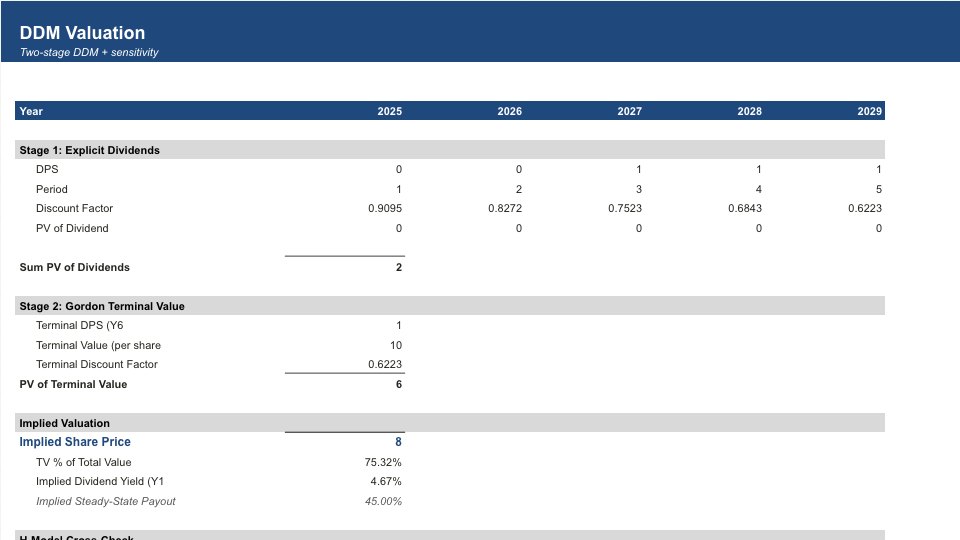
Dividend Discount Model
Valuation of dividend-paying stocks using multi-stage dividend growth and terminal yield.
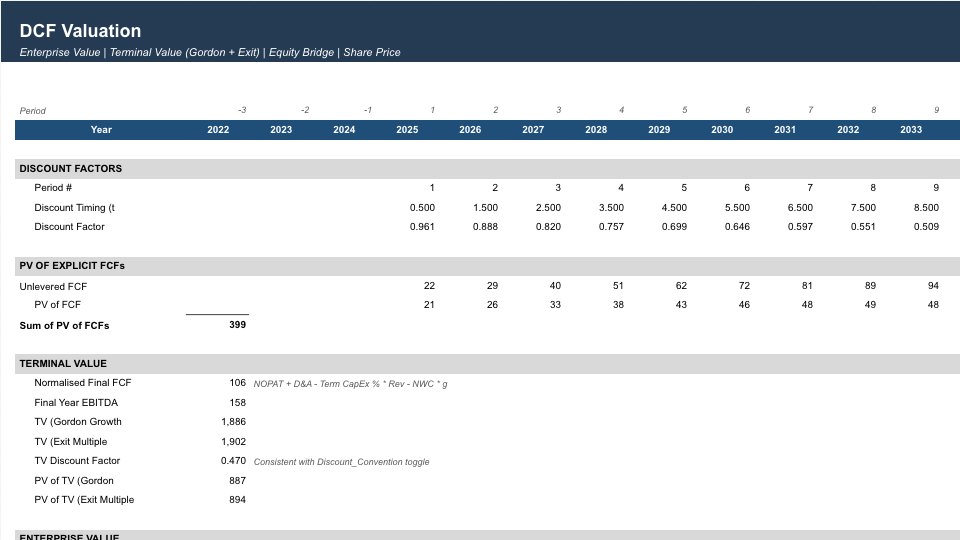
DCF Model
Discounted cash flow valuation model with explicit forecast, terminal value, and WACC.
R&D Capitalization and Earnings Restatement Model
Capitalize past R&D spend as a research asset and restate EBIT, NOPAT, invested capital, ROIC and economic profit.
Adjusted Present Value (APV) Model
Compare two financing offers with adjusted present value: tax shields, fees, risk costs, liquidity and coverage tests.







