Revenue and Expense Cut-Off Testing Tracker
Accounting & Audit Financial Model (Excel Download)
Check that sales and costs near period end land in the right month. The workpaper tests each sample against its evidence date, proposes close journals and tracks their reversals next month.



professionals from Deloitte






About this model
A cut-off testing workpaper for the month-end or year-end close. It tests revenue and expense items around the cutoff date against dispatch notes, service completion records and goods receipts. The shipped case is a fictional components maker closing December 2026, with ten sales and ten cost samples from a window of 26 December to 5 January.
Each sample compares the evidence date with the invoice and posting dates. Items are classed as missing, late or premature, and the required December amount is compared with what was recorded. Proposed close journals carry a reversal date, and each sample gets a review decision, approval and posting reference. The selection sheet ties the sample to the full event population.
On the shipped case required December revenue is 78,550 USD against 76,550 USD recorded, and required expense is 28,850 USD against 20,700 USD. The net sample correction to profit is minus 6,150 USD. The result covers the sample only, with no extrapolation. A January worklist traces each correction to its reversing entry and flags missing, duplicate or invalid evidence.
What every model includes
Live formulas, no hardcoded values
Outputs are driven by live formulas, so the workbook updates from its assumptions instead of relying on hardcoded results.
All assumptions in one tab
Inputs are clearly marked in the Assumptions tab and separated from calculations, making it clear what to change and what to leave intact.
Statements always balancing
For integrated-statement models, the balance sheet, cash flow, and supporting schedules tie through properly.
Distinct schedules for clarity
Debt, working capital, taxes, and cash flow can get messy quickly. We group calculations in clear schedules, not across disconnected tabs.
No hidden macros or external links
There are no unexplained external workbook links or macros to undermine auditability or portability.
Changes flow through the model
Update a key driver and see the impact carry through the forecast, financing, and return outputs. We never use hardcoded numbers in formulas.
What's inside the Revenue and Expense Cut-Off Testing Tracker
- Complete event population for the selection window
- Population coverage check by count and amount
- Risk-based sample of revenue and expense items
- Evidence, invoice and posting date tests for each sample
- Missing, late and premature amounts for revenue and expense
- Required versus recorded amounts and net profit impact
- Proposed close journals with reversal dates and owners
- Review decision, approval and posting reference by sample



Formatted to IB standards
Named theme colors repaint the whole workbook in one click, on top of an investment-banking structure with clear input, output, and cross-sheet reference styling - brand-ready, institutional-grade, and fully auditable.

Created by ex-finance professionals
Hey, I’m Alex and I created Finamodel.
Over my years in the finance industry I kept building the same models over and over again. Same structure, same assumptions, different logo. So I started building frameworks to turn them into clean, reusable templates.
Every model here is one I’d actually use for a client, and I personally vet each one before it goes up.
I’m not an expert in every industry, but I’ve built enough models to know what belongs in one. And when something is completely foreign to me, I reach out to my network for experts to work on our models with us.
Having a template library on hand cuts a first build from hours to minutes.
Frequently asked
What is cut-off testing?+
Cut-off testing checks that sales and costs near the period end are recorded in the correct period. It compares the date the goods or services were delivered with the date the item was invoiced and posted. Items in the wrong period are corrected.
What do missing, late and premature mean?+
Missing means the item belongs in the period but was not recorded. Late means it was recorded after the period it belongs to. Premature means it was recorded before the goods or services were delivered.
Does the result apply to the whole ledger?+
No. The sample is chosen by risk, not by statistics, so the result covers the tested items only. There is no extrapolation to untested events.
How are reversals tracked?+
Each correction has an expected reversing amount. You enter one actual posting per original journal in the Reversal evidence sheet. The worklist shows confirmed and open amounts and flags missing, duplicate, future or invalid evidence.
How do I use it for my own close?+
Enter your event population for the cutoff window, select your samples and add their evidence dates. Update the close and review dates on the Cutoff sheet. Extend the bounded ranges and their formulas together if you need more rows.
Have more financial modelling questions? Contact us
Related templates
Search for Unrecorded Liabilities Workpaper
Test payments and invoices after year end for missing accruals, measure the omission and track journals to posting.
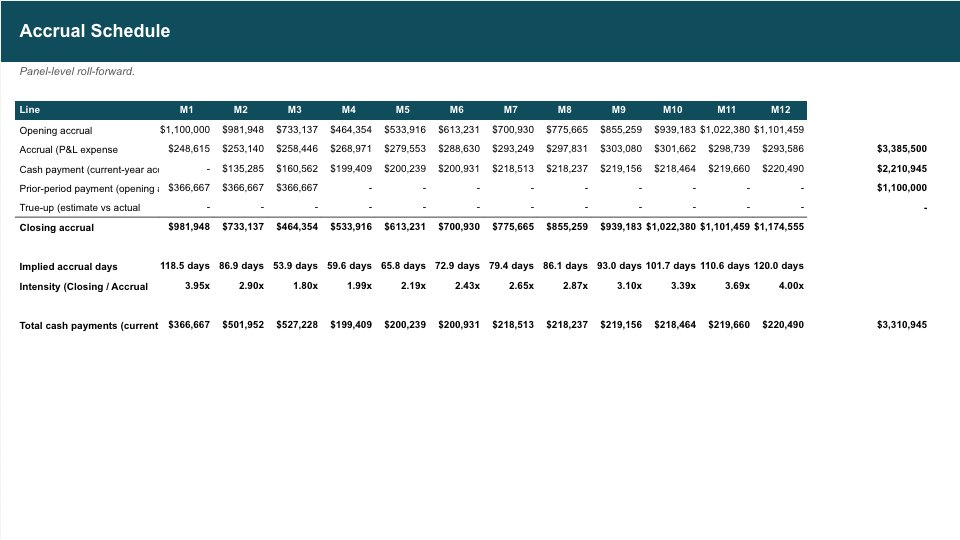
Accrued Expenses
12-month accrued-liability roll-forward with reversal timing across an accrual panel.
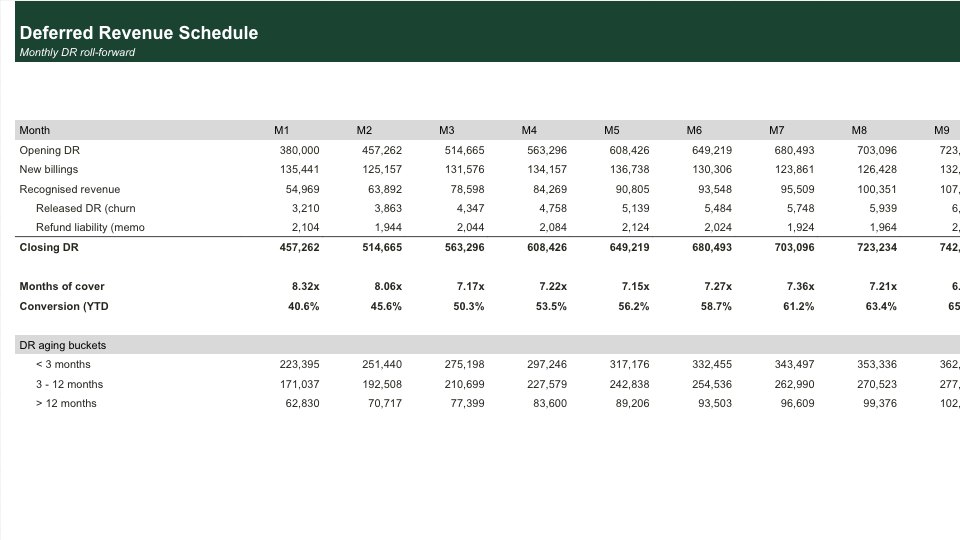
Deferred Revenue
12-month deferred-revenue (contract liability) roll-forward with billings-to-revenue conversion across a contract panel.
Beneish M-Score Earnings Manipulation Diagnostic
Calculate the Beneish M-Score from three years of financials, see which ratios drive it and track follow-up questions.







