Revenue Waterfall
Corporate Finance Financial Model (Free Excel Download)
Reconcile bookings, billings, revenue recognition, and deferred revenue across subscription, licence, service, and hardware streams with clear monthly and YTD outputs.



professionals from Deloitte
Used by professionals from






About this model
A revenue waterfall model converts gross bookings into recognized revenue using stream-specific recognition rules, then tracks the deferred-revenue balance that sits on the balance sheet between billing and recognition. The workbook handles four streams in parallel - subscription (12-month ratable), license (point-in-time), professional services (3-month ratable), and hardware (point-in-time) - so the gap between cash committed and GAAP revenue is auditable per stream and per month.
The Bookings sheet drives every downstream calculation: each stream has an editable month-1 base in the Assumptions sheet and compounds at a monthly bookings growth rate across 12 months. The Recognition sheet applies the per-stream recognition period using a windowed OFFSET that takes a trailing average of bookings: subscription bookings are spread over the next 12 months, license and hardware are recognized fully in the booking month, and services are spread over 3 months. The window is bounded by month 1 so the formulas never reach back into a prior-year column. The Deferred Revenue sheet rolls forward each stream from an opening balance using closing = prior + bookings - revenue, with a check row that reconciles closing balance to (opening + cumulative bookings - cumulative revenue) to the cent.
CFOs, revenue accountants, controllers, and FP&A teams use this template for ASC 606 / IFRS 15 close packs, investor reporting on growth quality, and pricing or packaging decisions. The Summary sheet condenses Y1 outcomes per stream into YTD bookings, YTD revenue, closing deferred, recognition lag (closing DR over monthly run-rate), and a conversion ratio (revenue over bookings). Recognition periods are exposed as named-range parameters, so toggling subscription from 12 to 24 months or services from 3 to 6 months flexes the whole waterfall in one assumption change.
What every model includes
Live formulas, no hardcoded values
Outputs are driven by live formulas, so the workbook updates from its assumptions instead of relying on hardcoded results.
All assumptions in one tab
Inputs are clearly marked in the Assumptions tab and separated from calculations, making it clear what to change and what to leave intact.
Statements always balancing
For integrated-statement models, the balance sheet, cash flow, and supporting schedules tie through properly.
Distinct schedules for clarity
Debt, working capital, taxes, and cash flow can get messy quickly. We group calculations in clear schedules, not across disconnected tabs.
No hidden macros or external links
There are no unexplained external workbook links or macros to undermine auditability or portability.
Changes flow through the model
Update a key driver and see the impact carry through the forecast, financing, and return outputs. We never use hardcoded numbers in formulas.
What's inside the Revenue Waterfall
- 12-month Bookings sheet across four streams driven by editable assumptions
- Recognition sheet with stream-specific revenue logic (12-month ratable, 3-month ratable, point-in-time)
- Deferred Revenue roll-forward: opening + bookings - revenue = closing, per stream
- Closing-balance check row that ties to cumulative bookings minus revenue exactly
- Per-stream YTD bookings, YTD revenue, closing deferred, recognition lag, and conversion ratio
- Editable recognition period per stream so multi-year contracts flip ratable on a parameter change
Revenue Waterfall: How Bookings Convert to Recognized Revenue and Deferred Balances
A revenue waterfall template for SaaS CFOs, controllers, and revenue accountants that connects subscription, license, services, and hardware bookings to GAAP revenue and deferred revenue. It handles four recognition patterns side-by-side, showing how cash collected differs from revenue recognized and how much remains as a future obligation.
Operating drivers and recognition patterns
Bookings for each stream start from a month-one base and grow at a per-stream monthly rate, creating distinct growth trajectories. Subscription bookings recognize ratably over a recognition period, commonly twelve months for annual prepaid contracts.
- License and hardware bookings recognize at a point in time—when control transfers. Services bookings recognize over a shorter delivery period.
- These four patterns run in parallel, so the model captures how each stream's economics differ and how they combine into total revenue.
Calculation flow from bookings to deferred revenue
From bookings, the model derives recognized revenue per stream using stream-specific windows. Ratable streams sum bookings over the recognition period and divide evenly, while point-in-time streams recognize the full booking amount in the month it occurs.
- Deferred revenue then rolls forward each month: the opening balance plus new bookings minus recognized revenue equals the closing balance. This equation is applied per stream, and total deferred revenue sums the four streams.
- An independent reconciliation compares this rollforward to cumulative bookings minus cumulative revenue, helping catch inconsistencies between recognition and deferral logic.
Outputs and summary metrics
The Summary sheet presents horizon-total bookings and revenue per stream, bookings mix, conversion ratio, and closing deferred revenue split between current and long-term portions.
- It also shows recognition lag in months—both including and excluding opening deferred revenue—to indicate how long it takes for bookings to flow through the income statement.
- The net contract position is displayed as negative total deferred revenue, since unbilled receivables are out of scope; users extending the model can adjust this.
- These outputs help evaluate the balance-sheet impact of recognition timing.
Practical use for planning and analysis
This template suits scenario planning and variance analysis by revealing how changes in bookings growth or recognition periods affect revenue and deferred balances.
- It supports checking that cash collected (treated as billings) differs from recognized revenue, and it highlights the deferred-revenue tail that arises when bookings outpace recognition.
- The built-in reconciliation and checks help maintain consistency.
- The public download is a values-only preview, so live formulas are not included; it illustrates the model's structure and relationships without enabling automatic recalculation.
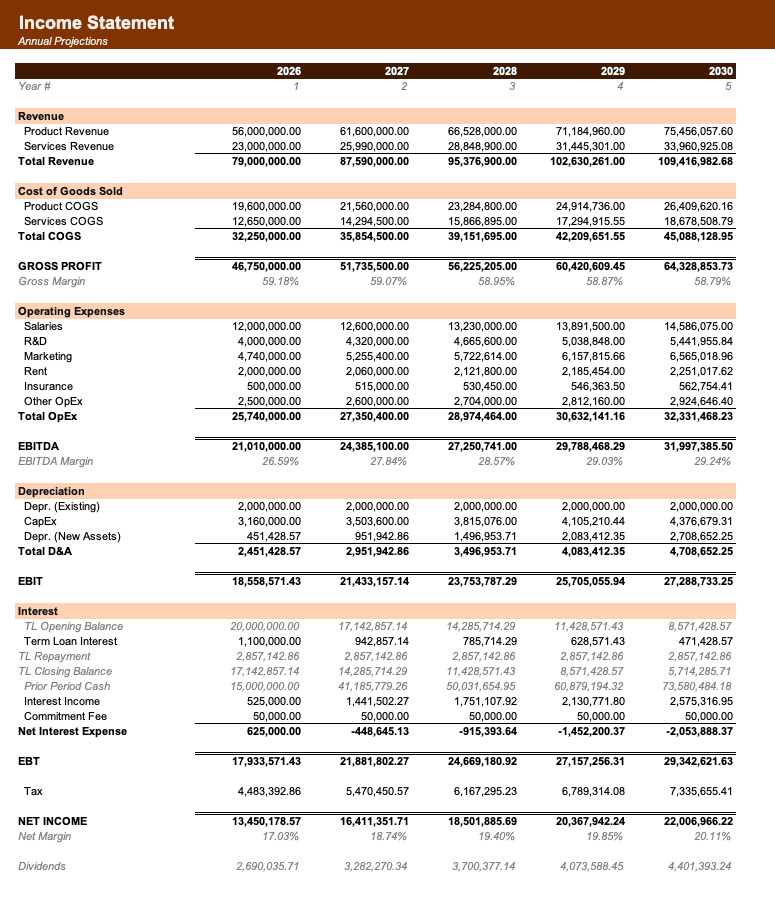
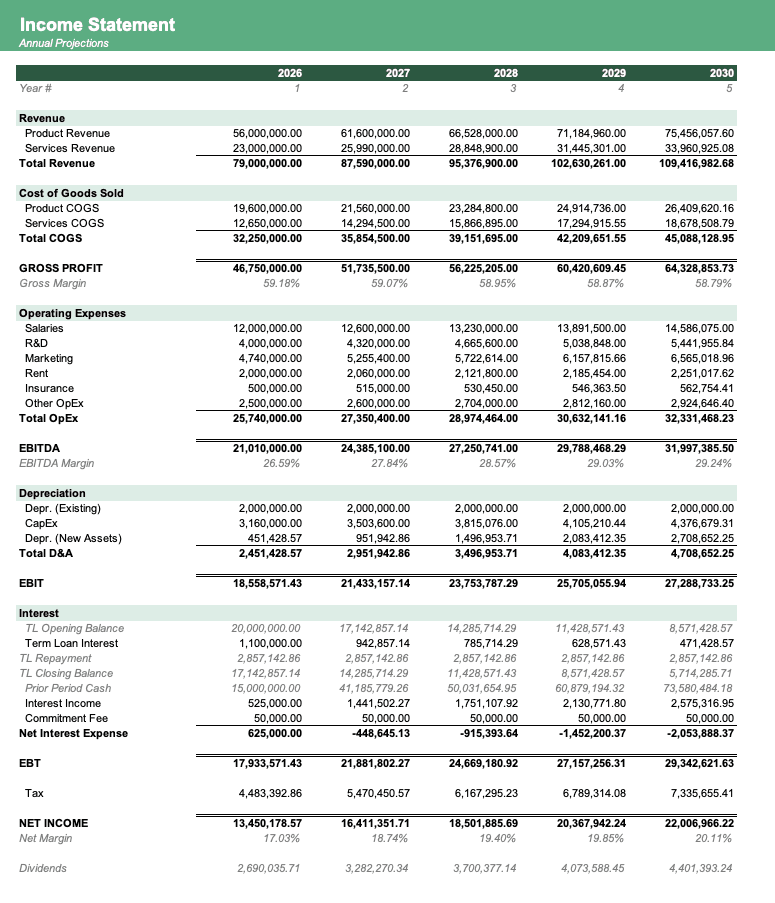
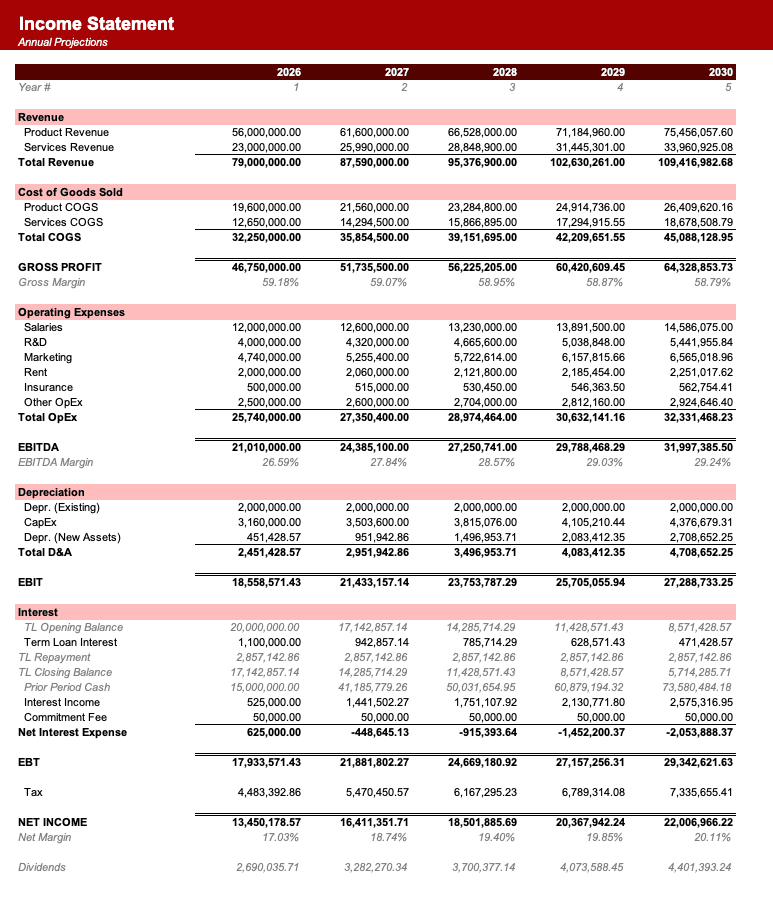
Formatted to IB standards
Named theme colors repaint the whole workbook in one click, on top of an investment-banking structure with clear input, output, and cross-sheet reference styling - brand-ready, institutional-grade, and fully auditable.

Created by ex-finance professionals
Hey, I’m Alex and I created Finamodel.
Over my years in the finance industry I kept building the same models over and over again. Same structure, same assumptions, different logo. So I started building frameworks to turn them into clean, reusable templates.
Every model here is one I’d actually use for a client, and I personally vet each one before it goes up.
I’m not an expert in every industry, but I’ve built enough models to know what belongs in one. And when something is completely foreign to me, I reach out to my network for experts to work on our models with us.
Having a template library on hand cuts a first build from hours to minutes.
Need help finding your model? You’ll find me in the Finamodel app!
Frequently asked
What is a revenue waterfall?+
A revenue waterfall converts gross bookings into recognized revenue using stream-specific recognition rules, then tracks the deferred-revenue balance that sits on the balance sheet between billing and recognition. It is how SaaS and software businesses reconcile bookings to GAAP revenue under ASC 606 / IFRS 15.
How does the subscription recognition logic work?+
Each month's bookings are spread evenly across the recognition period (default 12 months) using a windowed OFFSET on the Bookings row. The window is bounded by month 1 so early periods never reach back into prior-year columns. Change Rec_Sub_Period in Assumptions to flex to 24 or 36 months for multi-year prepaid.
Why is the closing deferred balance so much larger than Y1 revenue?+
Because bookings made late in the year only have one or two months of recognition before year-end, leaving the rest of the contract on the balance sheet. The Summary recognition-lag line quantifies this - a 12-month ratable book in steady state sits around 6 months of lag, more when the business is growing.
Can I drop in real bookings?+
Yes. Replace the formula-driven cells on the Bookings sheet with monthly invoiced amounts per stream. Recognition, Deferred Revenue, and Summary recompute automatically. The check row on the Deferred Revenue sheet catches any roll-forward inconsistency.
Does this replace a full ASC 606 system?+
No. This is a forecast and management-reporting tool, not a sub-ledger. For audit-ready ASC 606 compliance with contract-level recognition, use a revenue-recognition platform and import the outputs into this template for reporting.
Have more financial modelling questions? Contact us
Related templates
SaaS MRR/ARR Forecast Model
Subscription forecast with logo motion, MRR build, ARR, NRR/GRR, and CAC payback for SaaS businesses.
3 Statement Model
Integrated income statement, balance sheet, and cash flow forecasts.
Budget vs Actuals Tracker
12-month operating P&L variance tracker with YTD summary.
M&A Modeling & Valuation
Comprehensive M&A valuation with DCF, comparable companies, and precedent transactions analysis.


