Spin-Off Model
Corporate Finance Financial Model (Free Excel Download)
Evaluate a business separation with RemainCo and SpinCo capital structures, transition services, standalone forecasts, debt allocation, and pro forma credit metrics.



professionals from Deloitte
Used by professionals from






About this model
Model spin-off standalone financials so you see the true cost structure and viability without buried allocations. The model separates revenues by line of business being spun; allocates COGS directly; splits operating expenses (paying only the portion attributable to the spun entity); and includes estimated corporate overhead and shared service costs. It then projects standalone P&L, calculates standalone EBITDA and FCF, and estimates the standalone valuation using comparable trading multiples or DCF.
The model surface key allocation decisions: are shared IT systems charged at cost or at a markup? Are corporate G&A allocated on headcount or revenue? Are tax functions estimated at a % of EBT or fixed? These allocations often swing standalone profitability by 200-300 bps in margin. The model flags items requiring separation: pension liabilities, insurance pools, and pension plan obligations may be retained vs transferred. Working capital requirements (DSO, DIO, DPO) must be re-estimated for the standalone business without the parent's scale and centralised functions.
Use cases: sell-side advisors valuing divestiture targets, buy-side investors evaluating acquisition targets where separation costs are material, and CFOs planning divisional spin-offs. Works with tax planning (allocation of debt, centralized treasury functions) and financing strategy.
What every model includes
Live formulas, no hardcoded values
Outputs are driven by live formulas, so the workbook updates from its assumptions instead of relying on hardcoded results.
All assumptions in one tab
Inputs are clearly marked in the Assumptions tab and separated from calculations, making it clear what to change and what to leave intact.
Statements always balancing
For integrated-statement models, the balance sheet, cash flow, and supporting schedules tie through properly.
Distinct schedules for clarity
Debt, working capital, taxes, and cash flow can get messy quickly. We group calculations in clear schedules, not across disconnected tabs.
No hidden macros or external links
There are no unexplained external workbook links or macros to undermine auditability or portability.
Changes flow through the model
Update a key driver and see the impact carry through the forecast, financing, and return outputs. We never use hardcoded numbers in formulas.
What's inside the Spin-Off Model
- Parent-subsidiary capital resegmentation logic
- Standalone cost adjustments and transition service agreement (TSA) framework
- Pro-forma financial statements for the separated entity
- Tax-efficient distribution and compliance modelling
- Equity linkage and exchange ratio calculations
- Revenue projection for standalone entity
- Cost of goods sold and gross margin assumptions
- Operating expense allocation from parent company
Spin-Off Model: How the Template Projections Work
This spin-off model template shows how a corporate separation can be projected and valued. It splits a parent into SpinCo and RemainCo, builds standalone financials with separation costs, and compares the sum of the parts to the pre-spin conglomerate.
The following sections explain the key mechanics for evaluating the template.
Operating Drivers Behind SpinCo and RemainCo
A core driver is how revenue is divided. SpinCo revenue starts as a share of the parent base and then grows on its own path.
- Its costs—COGS, SG&A, R&D—are modeled as percentages of revenue with improvement ramps, plus an allocated corporate overhead charge. A dis-synergy penalty phases out as standalone capability builds, reflecting the initial cost disadvantage of separation.
- RemainCo is projected from its own revenue growth and EBITDA margin, then charged stranded costs it cannot shed when SpinCo stops paying allocated overhead. Parent revenue and EBITDA are simply the sum of the two parts, so the model avoids forcing one entity to eat into the other.
Calculation Flow from Revenue to Cash and Debt
Once SpinCo’s revenue and cost structure yield EBITDA, the model runs a full P&L that includes separation costs, transition service agreement costs, D&A, interest and tax. A Day-0 carve-out balance sheet is built to balance by construction, supported by an indirect cash flow statement.
- The debt schedule covers a term loan and revolver with a covenant test. For RemainCo, the flow is simpler: revenue growth and EBITDA margin drive the projection, and stranded costs are subtracted.
- The model builds both entities independently while keeping the parent consolidated at the revenue and EBITDA level.
Outputs and Valuation Views
The dashboard provides a KPI strip, a RemainCo-versus-SpinCo projection table, trend charts, and a sum-of-the-parts value bridge. The valuation sheet combines a DCF, trading comps, and a DCF-versus-comps reconciliation, along with the distribution to parent shareholders.
- The sum-of-the-parts block compares the pre-spin conglomerate multiple with the separate peer-group multiples for SpinCo and RemainCo, isolating the value unlock. A checks sheet with 11 validation rows and a disclaimer round out the outputs.
- All monetary figures are in millions except per-share values, which show two decimals.
Practical Use and Documented Limitations
This template is built for evaluating a separation case, not for predicting a real market outcome. Its annual, five-year horizon and single blended dis-synergy rate keep the analysis simple, and the DCF can sit above the peer mid—a gap disclosed on the valuation sheet for the user to calibrate by adjusting WACC, terminal growth, or the peer set.
- Terminal value is a high portion of enterprise value, given the short explicit window. RemainCo carries no debt schedule, so the sum-of-the-parts mixes unlevered RemainCo EV with levered SpinCo equity value.
- No separation timeline or tax-free qualification test is modeled. These are deliberate simplifications, not hidden errors.
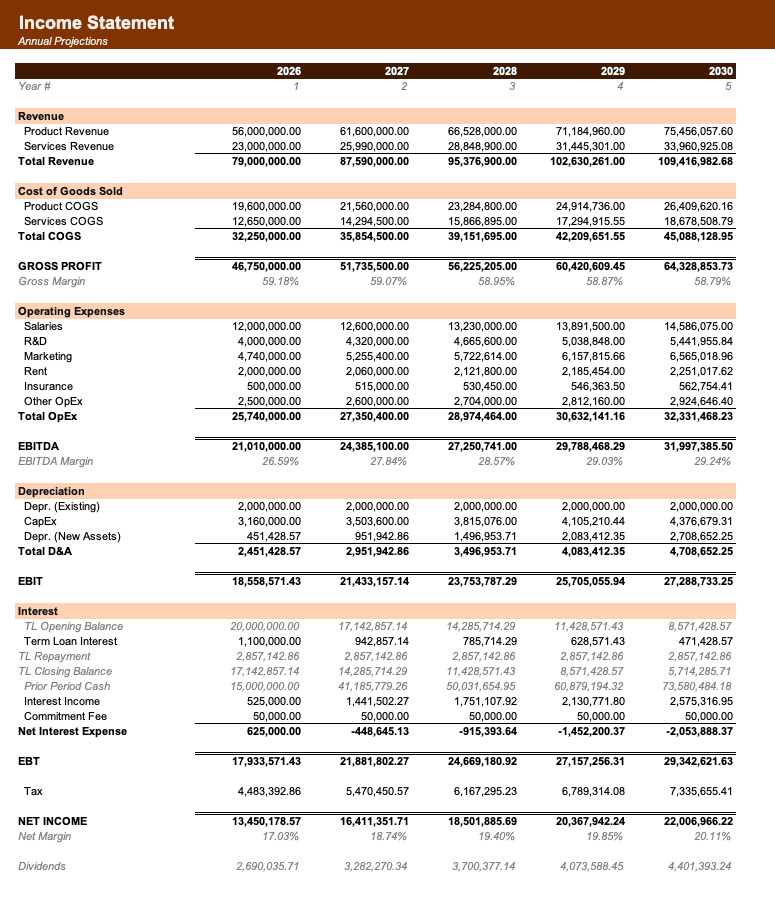
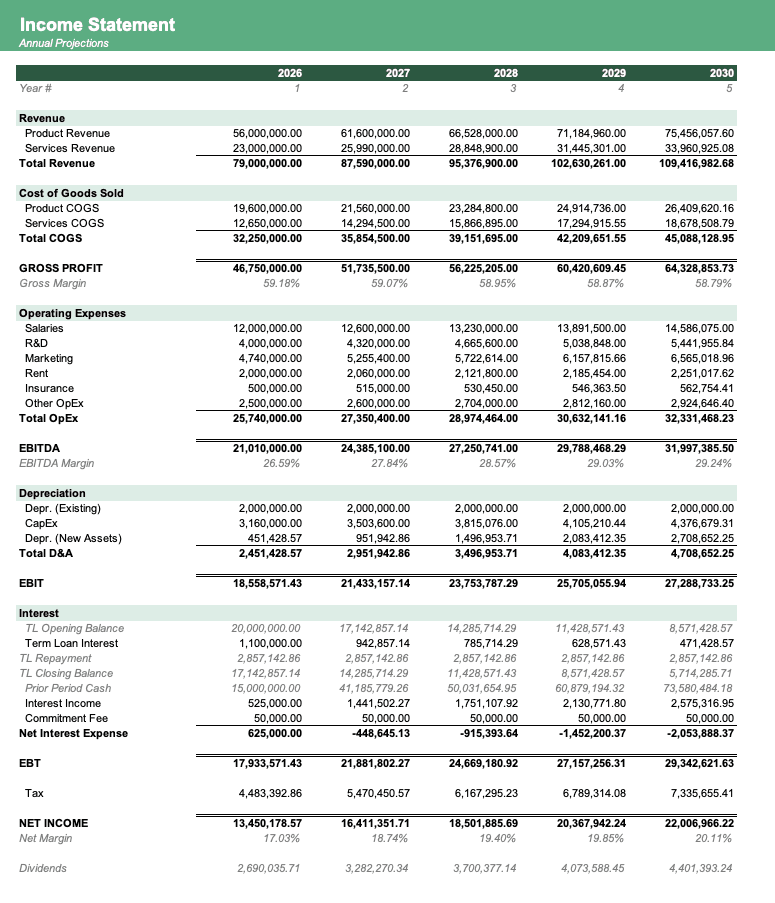
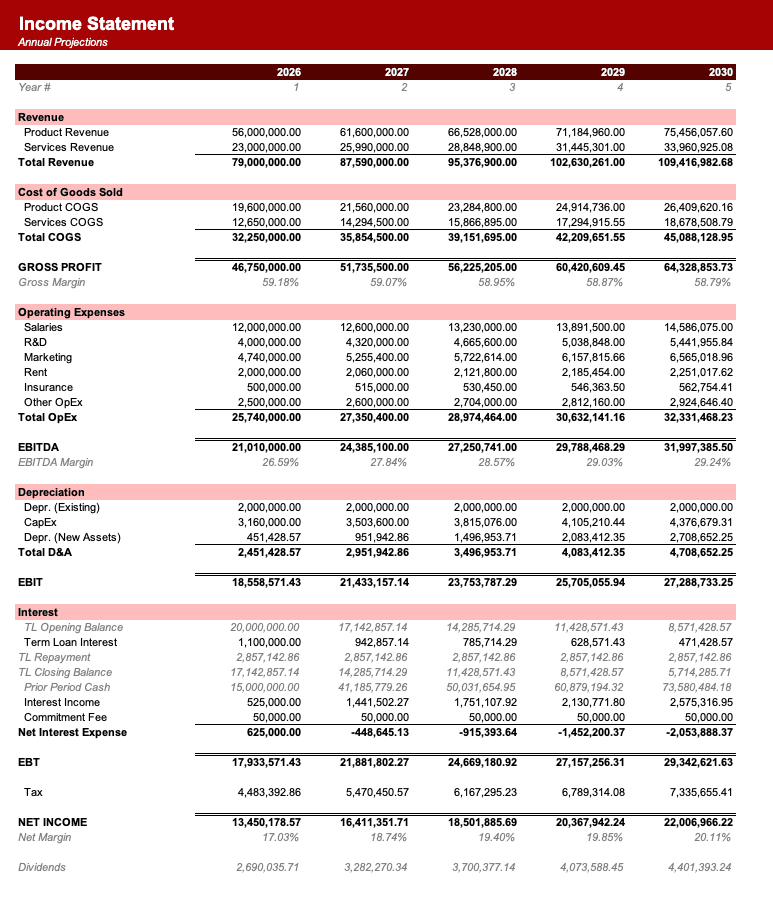
Formatted to IB standards
Named theme colors repaint the whole workbook in one click, on top of an investment-banking structure with clear input, output, and cross-sheet reference styling - brand-ready, institutional-grade, and fully auditable.

Created by ex-finance professionals
Hey, I’m Alex and I created Finamodel.
Over my years in the finance industry I kept building the same models over and over again. Same structure, same assumptions, different logo. So I started building frameworks to turn them into clean, reusable templates.
Every model here is one I’d actually use for a client, and I personally vet each one before it goes up.
I’m not an expert in every industry, but I’ve built enough models to know what belongs in one. And when something is completely foreign to me, I reach out to my network for experts to work on our models with us.
Having a template library on hand cuts a first build from hours to minutes.
Need help finding your model? You’ll find me in the Finamodel app!
Frequently asked
What is a spin-off financial model?+
A spin-off model evaluates the separation of a business unit from its parent company, covering capital allocation, standalone operating costs, and pro-forma financial statements for both entities.
Who uses spin-off models?+
Investment bankers, corporate development teams, and financial advisers use them when evaluating or executing corporate separations and divestitures.
What should a spin-off model include?+
It should include capital resegmentation, transition service agreements, pro-forma financials, tax compliance logic, and exchange ratio calculations.
How does a spin-off model handle shared costs?+
The model quantifies transition service agreements and incremental overhead the separated entity needs to operate independently, covering functions like HR, IT, and legal.
Can this be used for sum-of-the-parts valuation?+
Yes. Spin-off models are often used alongside SOTP analysis to evaluate whether the market is undervaluing a business unit within a larger group.
Have more financial modelling questions? Contact us
Related templates
3 Statement Model
Integrated income statement, balance sheet, and cash flow forecasts.
M&A Modeling & Valuation
Comprehensive M&A valuation with DCF, comparable companies, and precedent transactions analysis.
Debt Restructuring and Out-of-Court Model
Restructured debt terms, covenant relief, and debtor recovery for out-of-court and bankruptcy scenarios.
Cashflow Model
Detailed monthly and annual cash flow projections with sweep and liquidity mechanics.