

The effective total cost for IDR = all payments made + the tax bombStudent Loan Model
Credit Financial Model (Free Excel Download)
Model student-loan repayment, grace periods, defaults, recoveries, warehouse funding, and portfolio cash flows for lending-platform underwriting and financing decisions.
DownloadSign up to downloadFree, no credit card required
Edit in Excelprofessionals from Deloitte
Loading...
Used by professionals from






About this model
Compare student loan repayment plans - standard amortization or income-driven repayment (IDR) - to calculate the lowest total cost over a 25-year horizon. This borrower-focused model projects payments under both plan types, accounts for Discretionary Income thresholds tied to the Federal Poverty Level, and estimates the tax liability if forgiveness is triggered. Interest accrual, negative amortization, and the interaction between rising income and payment caps are all modeled explicitly.
The workbook contains a 25-year repayment schedule for each plan, a Borrower_Income sheet tracking discretionary income and affordability ratios, and detailed P&L-equivalent outputs showing cumulative cost, forgiven balance, and tax-bomb implications. Grace-period interest capitalization is handled upfront; payment formulas reference a single master payment calculation to ensure consistency across all years.
Standard repayment is best for borrowers with predictable incomes and no forgiveness eligibility; IDR plans suit graduates with low starting salaries or substantial forgiveness expectations. Origination balance averages $45,000 (federal data); IDR rates default to 10% of discretionary income with 25-year forgiveness.
What every model includes
Live formulas, no hardcoded values
Outputs are driven by live formulas, so the workbook updates from its assumptions instead of relying on hardcoded results.
All assumptions in one tab
Inputs are clearly marked in the Assumptions tab and separated from calculations, making it clear what to change and what to leave intact.
Statements always balancing
For integrated-statement models, the balance sheet, cash flow, and supporting schedules tie through properly.
Distinct schedules for clarity
Debt, working capital, taxes, and cash flow can get messy quickly. We group calculations in clear schedules, not across disconnected tabs.
No hidden macros or external links
There are no unexplained external workbook links or macros to undermine auditability or portability.
Changes flow through the model
Update a key driver and see the impact carry through the forecast, financing, and return outputs. We never use hardcoded numbers in formulas.
What's inside the Student Loan Model
- Multi-tranche cohort modelling by vintage and programme type
- Repayment and grace period logic with graduation-based transitions
- Default rate curves and recovery lag assumptions
- Warehouse financing and capital stack modelling
- Net interest margin and unit economics outputs
- Loan origination and cohort segmentation by school type and degree level
- Repayment schedule mechanics with multiple repayment plans
- Forbearance and deferment period tracking
How the Student Loan Model Compares Standard and Income-Driven Repayment
This student loan model helps borrowers compare two federal repayment paths: standard amortisation and income-driven repayment. It projects annual payments, interest accrual, and the potential tax liability from forgiven balances over a 25-year horizon.
The template provides a transparent framework for evaluating total cost and monthly affordability, using configurable assumptions for loan terms, income growth, and poverty-level thresholds.
Operating Drivers: Loan Terms, Income, and IDR Parameters
The model's behaviour is shaped by inputs on the Assumptions sheet. Loan terms include the original balance, annual interest rate, grace period, and standard repayment term.
- A capitalisation flag determines whether accrued interest during grace is added to principal. The IDR side relies on the discretionary income formula, which subtracts a multiple of the Federal Poverty Level (FPL) from gross income.
- The payment rate, forgiveness year, family size, and FPL inflation rate are all configurable, allowing the model to represent any IDR plan by adjusting these parameters. Income assumptions include the starting salary, annual growth rate, and the marginal tax rate applied to forgiven amounts.
Calculation Flow: Annual Schedules and Payment Logic
The model builds two parallel annual schedules: one for standard repayment and one for IDR. In the standard schedule, the annual payment is computed once at grace-end using the PMT function and remains fixed for the entire term.
- Each year, interest is calculated on the opening balance, and principal is reduced by the payment amount. The IDR schedule uses a separate income projection to determine discretionary income and the uncapped IDR payment, which is then capped at the standard payment.
- Interest accrues on the opening balance; payments cover interest first, and any remainder reduces principal. When payments are less than interest, negative amortisation occurs and the balance grows.
No circular references exist because IDR payments depend only on income, not on the loan balance.
Outputs: Total Cost, Forgiveness, and the Tax Bomb
The Summary sheet presents a side-by-side comparison of total payments, interest paid, and final balances. For standard repayment, the loan fully amortises, and the final balance is zero.
- For IDR, the model calculates the forgiven balance at the end of the forgiveness year, which is then multiplied by the assumed marginal tax rate to produce the tax bomb. The effective total cost for IDR equals all payments made plus the tax bomb.
- The model also computes a differential and recommends the plan with the lower total cost. Additionally, it derives annual and monthly savings under the recommended plan, providing a clear measure of financial impact.
Practical Use: Evaluating Repayment Plans and Affordability
This template is designed for individual borrowers or advisors assessing federal student loan repayment options. By adjusting assumptions such as income growth or family size, users can explore how IDR payments evolve and whether they remain affordable relative to income.
- The model also highlights the importance of planning for the tax bomb, a one-time tax liability that can be substantial. The built-in checks ensure that both schedules balance and that payments never exceed the standard amount.
- While the public download is a values-only preview, the underlying structure captures the key relationships needed to compare plans and supports informed decision-making.
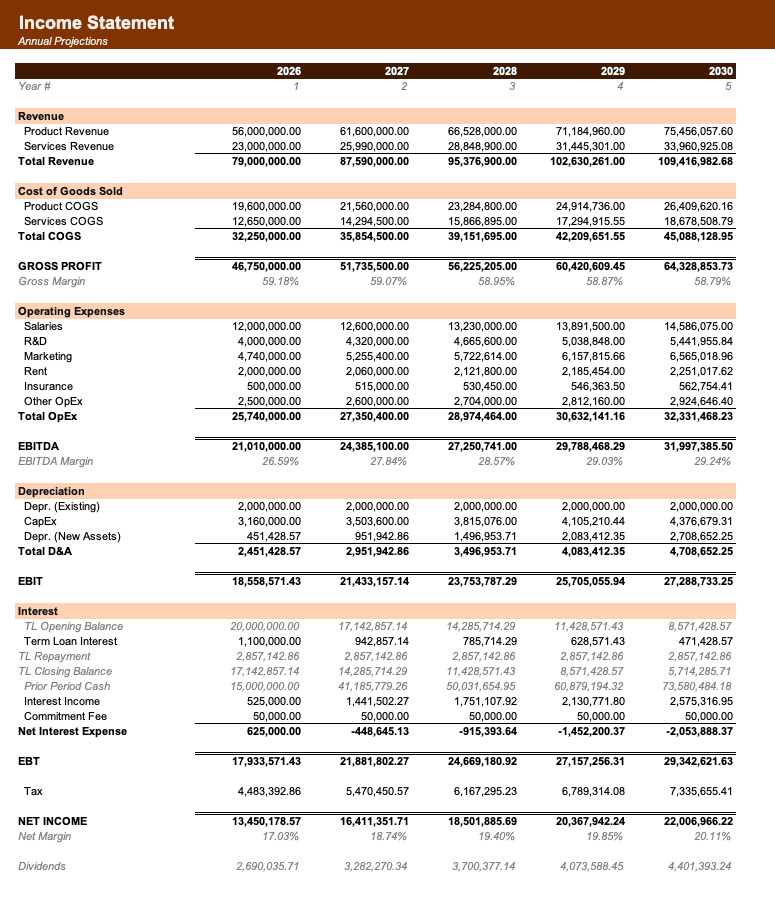
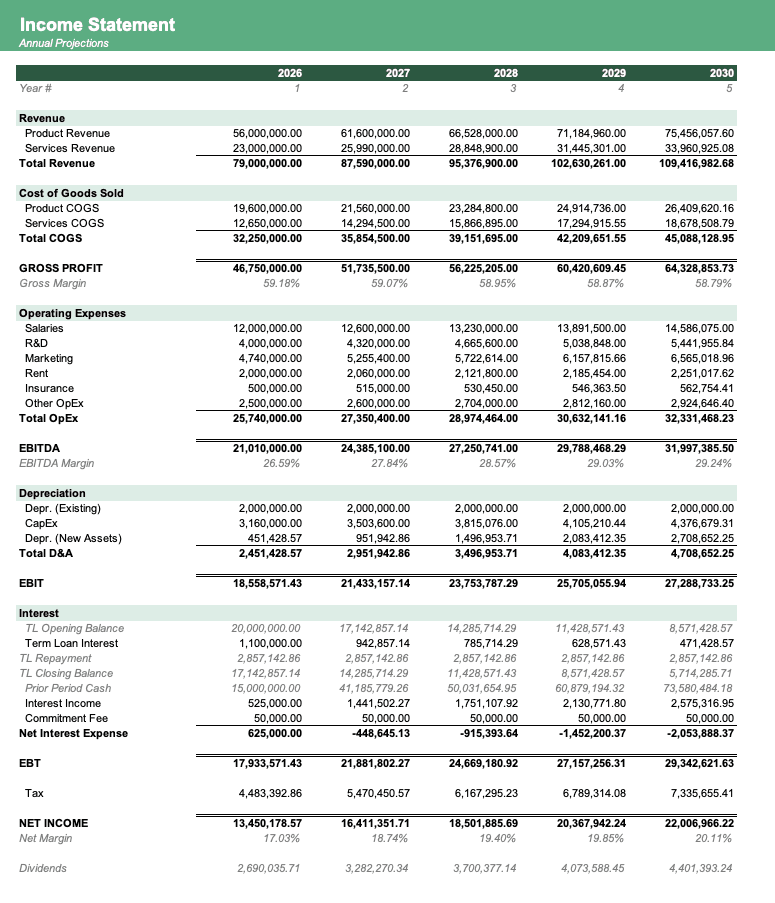
income_statement.xlsx
income_statement.xlsx
income_statement.xlsx
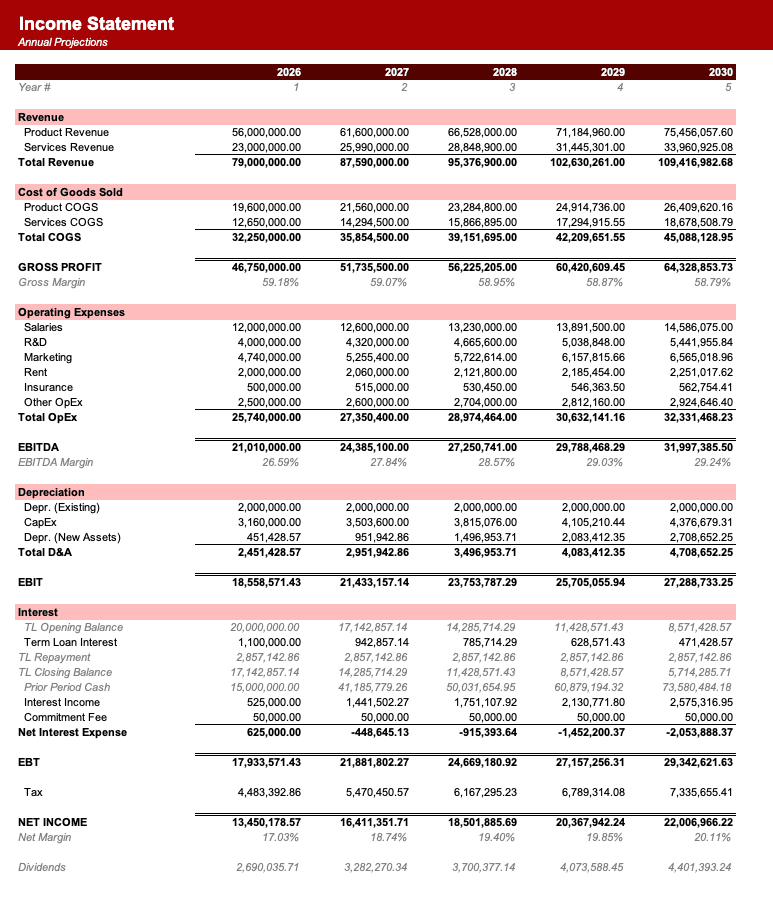
Formatted to IB standards
Named theme colors repaint the whole workbook in one click, on top of an investment-banking structure with clear input, output, and cross-sheet reference styling - brand-ready, institutional-grade, and fully auditable.

Created by ex-finance professionals
Hey, I’m Alex and I created Finamodel.
Over my years in the finance industry I kept building the same models over and over again. Same structure, same assumptions, different logo. So I started building frameworks to turn them into clean, reusable templates.
Every model here is one I’d actually use for a client, and I personally vet each one before it goes up.
I’m not an expert in every industry, but I’ve built enough models to know what belongs in one. And when something is completely foreign to me, I reach out to my network for experts to work on our models with us.
Having a template library on hand cuts a first build from hours to minutes.
Need help finding your model? You’ll find me in the Finamodel app!
Frequently asked
What is a student loan financial model?+
It is a model that forecasts loan origination, repayment behaviour, default rates, and portfolio economics for student lending businesses or fintech platforms.
Who uses student loan models?+
Fintech lenders, private loan originators, warehouse lenders, and investors use them for portfolio forecasting and capital planning.
What should a student loan model include?+
It should include cohort-based origination, repayment schedules, default and recovery assumptions, warehouse financing, and net interest margin analysis.
How does it handle loan defaults?+
The model applies monthly constant default rate curves to outstanding balances, with configurable recovery lags and net recovery percentages from collection efforts.
Can I model both fixed and variable rate loans?+
Yes. The model supports SOFR-based variable rates with configurable spreads as well as fixed-rate tranches for interest rate sensitivity analysis.
Have more financial modelling questions? Contact us
Related templates
Auto_Loan_Portfolio_Model.xlsx
Metric
2026
Revenue
--
EBITDA
--
Auto Loan Portfolio Model
Automotive loan securitization and portfolio analysis.
Mortgage_Portfolio_Model.xlsx
Metric
2026
Revenue
--
EBITDA
--
Mortgage Portfolio Model
Mortgage loan portfolio analysis with prepayment speeds, default rates, and cash flow projections.
Credit_Portfolio_CDO_Model.xlsx
Metric
2026
Revenue
--
EBITDA
--
Credit Portfolio CDO Model
Model credit default swap portfolio, tranching, and waterfall for CDO securitization.
BNPL_Financial_Model.xlsx
Metric
2026
Revenue
--
EBITDA
--
Buy Now Pay Later Model
BNPL fintech platform financial projections.