Supplier Credit Recovery Tracker
Treasury & Cash Financial Model (Excel Download)
Make sure money owed back by suppliers is actually recovered. The register follows each claim from supplier acceptance to credit note and to real cash or AP offset, with an owner for every open step.



professionals from Deloitte






About this model
A supplier recovery register for procurement owners, AP recovery accountants and reviewers. It tracks claims against suppliers for returned goods, price errors and poor service. The shipped case has six fictional claims at a September cutoff, in USD.
Each claim moves through stages: awaiting supplier acceptance, accepted, credited and recovered by cash or AP offset. Supplier acceptances are dated increments, and a credit note cannot exceed what was accepted on its issue date. Recoveries must match an actual bank receipt or AP offset, and one receipt can split across credits without counting twice. Approved write-offs close exposure but are never treated as recovery.
On the shipped case claims total $4,926: $1,500 awaits acceptance, $960 is credited but not settled, $2,416 is recovered and $50 is an approved loss. Recovery is supported by $1,016 of cash and $1,400 of AP offsets. A $75 credit note with no matching claim stays open as a follow-up.
What every model includes
Live formulas, no hardcoded values
Outputs are driven by live formulas, so the workbook updates from its assumptions instead of relying on hardcoded results.
All assumptions in one tab
Inputs are clearly marked in the Assumptions tab and separated from calculations, making it clear what to change and what to leave intact.
Statements always balancing
For integrated-statement models, the balance sheet, cash flow, and supporting schedules tie through properly.
Distinct schedules for clarity
Debt, working capital, taxes, and cash flow can get messy quickly. We group calculations in clear schedules, not across disconnected tabs.
No hidden macros or external links
There are no unexplained external workbook links or macros to undermine auditability or portability.
Changes flow through the model
Update a key driver and see the impact carry through the forecast, financing, and return outputs. We never use hardcoded numbers in formulas.
What's inside the Supplier Credit Recovery Tracker
- Claim register for return, price and service claims with owner and follow-up
- Supplier acceptance history as dated increments
- Credit notes limited to accepted value at the issue date
- Actual settlement ledger for bank receipts and AP offsets
- Recovery allocations matched to credit, claim, supplier and source
- Approved write-offs within authority and remaining balance
- Claim bridge across awaiting, credited, recovered and loss
- Unmapped credit notes kept as a separate follow-up



Formatted to IB standards
Named theme colors repaint the whole workbook in one click, on top of an investment-banking structure with clear input, output, and cross-sheet reference styling - brand-ready, institutional-grade, and fully auditable.

Created by ex-finance professionals
Hey, I’m Alex and I created Finamodel.
Over my years in the finance industry I kept building the same models over and over again. Same structure, same assumptions, different logo. So I started building frameworks to turn them into clean, reusable templates.
Every model here is one I’d actually use for a client, and I personally vet each one before it goes up.
I’m not an expert in every industry, but I’ve built enough models to know what belongs in one. And when something is completely foreign to me, I reach out to my network for experts to work on our models with us.
Having a template library on hand cuts a first build from hours to minutes.
Frequently asked
What is a supplier credit recovery register?+
It tracks money a business is owed back by suppliers, for example for returned goods, overcharges or poor service. It follows each claim until the supplier pays it back or offsets it against invoices you owe.
Why is a credit note not counted as recovery?+
A credit note only confirms the supplier agrees. The money is recovered when cash arrives or the credit is used against a payable. The register shows credited but unsettled amounts separately.
How are write-offs treated?+
An approved write-off closes part of a claim but is never shown as money recovered. It must be within the approver's limit and the remaining claim balance, or it does not reduce exposure.
What does the register not do?+
It excludes recoverable tax and does not convert currencies. Other currencies stay visible in their own subtotals. It does not post entries or chase suppliers for you.
How do I add claims and settlements?+
Add rows on Claims, Supplier decisions, Credits, Actual settlements and Recoveries with stable IDs. Update the independent counts and values on Source control from your real source data.
Have more financial modelling questions? Contact us
Related templates
Supplier Statement Reconciliation
Reconcile a supplier statement to your AP ledger document by document, explain every difference and track each fix to closure.
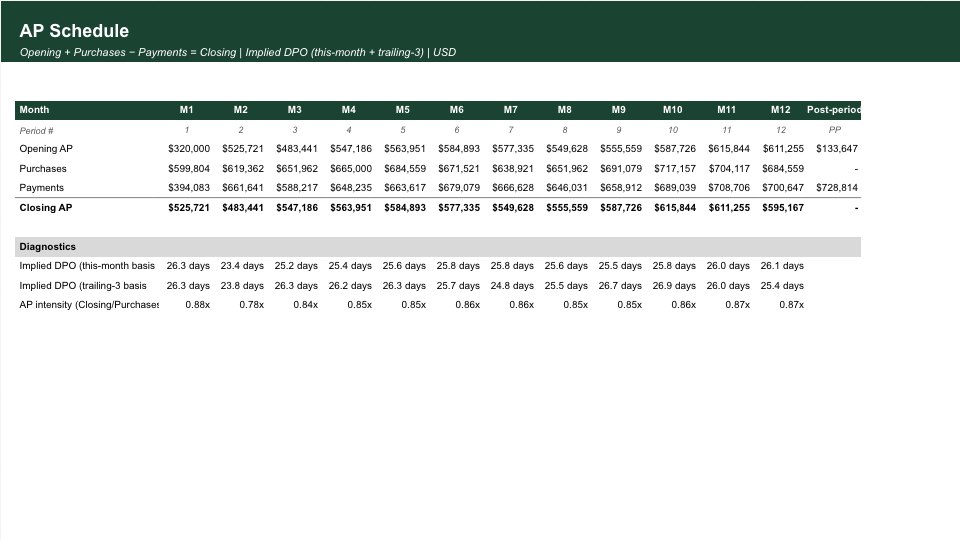
AP Forecast
12-month accounts-payable timing forecast with vendor terms and DPO.
Customer Deduction and Short-Payment Claim
Review customer short payments line by line, accept valid deductions as credits and recover the rest with a due-date queue.
Three-Way Invoice Matching Workpaper
Match supplier invoices to purchase orders and goods receipts, hold exceptions and control payment release.







