 By Alex Tapio
 Pivotal180 alternatives
People look for Pivotal180 alternatives for three main reasons. A full course costs $900, and access lasts 12 months before a $100 yearly fee to extend it. Live, in-house and model audit prices are not public, so a team has to ask for a quote. And some people want something else: a recognised certificate, free material to learn from, or a working model for a deal this month rather than a course. Pivotal180 lists no AI features.
What is Pivotal180?
Pivotal180 teaches financial modeling for project finance, renewable energy and infrastructure. It offers self-paced courses, live-streamed public classes and in-house workshops, and it also builds bankable models for clients and audits models before financial close. Its self-paced courses cover project finance, renewables, tax equity, battery storage and mining, each with downloadable Excel models and line-by-line walk-throughs. Pivotal180 says it is built for developers, lenders and investors, and it describes its main course model as comparable to one used for project development or investment decisions.
Pivotal180 at a glance
Pivotal180 publishes its self-paced prices. Project Finance and Infrastructure Modeling, Renewable Energy Project Finance, and Tax Equity and Hybrid cost $900 each. Advanced Project Finance Debt is $600, Battery Storage $500 and Mining and Critical Minerals $400. Micro-courses cost $80 to $100, and bundles $1,160 to $1,950. Each course gives 12 months of access, then $100 a year to extend. In-house training and model audits are priced on request, and free webinars and articles are available.
Quick picks
Pivotal180 is the first row, for reference. Most options here are project finance specialists that teach you to build the model, and several also build or audit models for a fee. Compare the price column carefully, since some charge per course, some per year and some per classroom day. The AI columns show that only Finamodel edits the model for you.
| Tool | Best for | Type of tool | Price (entry plan) | Works in | Free option | Builds the model for you | Excel file you keep | AI edits your file | Templates library |
|---|---|---|---|---|---|---|---|---|---|
| Project finance and renewables courses | Training + model services | $400 to $900 per course | Online, live, in-house | Yes: Free webinars, articles | No: You build it, or hire | Yes: Downloadable course models | No: No AI noted | No: Course files, not a library |
 | Masterclass, audits and advisory | Advisory + training | Masterclass €2,750 | Courses, advisory services | Yes: Free essentials course | No: You build it, or hire | Yes: Course and client models | No: AI guide, Openbox software | Not stated: Not stated |
 | CPFM certificate and PF membership | Training + certificates | $60/mo or $540/yr | Online, live support | Yes: 7-day trial | No: You build it | Yes: Downloadable models | No: Teaches AI, no tool | No: Course files, not a library |
 | Classroom courses and model audit | Training + audit | £2,100 for 2 days | Classroom, online | Yes: Free tutorials, webinars | No: You build it, or hire | Yes: Course models | No: AI-assisted model review | Not stated: Not stated |
 | A ready project model today | Ready models + AI | $20/mo or $120/yr | Web app, Excel file | Yes: 30 models + free samples | Yes: Fina chat builds it | Yes: .xlsx, formulas visible | Yes: Fina chat edits it | Yes: 500+ models |
 | Renewables and storage certification | Online certification | $597/yr or $997 once | Online courses, Excel | No: No free offer stated | No: You build it | Yes: Template package | No: No AI noted | Yes: Template package included |
 | Free project finance models | Free library + courses | No public tuition | Excel, videos, webinars | Yes: Free models and videos | No: You work through it | Yes: Free Excel models | No: No AI noted | Yes: Free model library |
yes · no · not stated in the vendor's sources. Hover a mark for details. From each vendor's own site; prices change, so check before you buy.
1.Gridlines

Gridlines is a project finance advisory and modelling firm. It builds models, audits them, values infrastructure assets and runs financial modelling courses for sponsors, investors, lenders and deal teams.
The courses run from foundations to advanced project finance modelling, a 3-day Project Finance Modelling Masterclass and model review. The masterclass is co-taught with Edward Bodmer. On the services side, Gridlines builds models, including models built to the FAST standard, and audits them with a live shared issues list. Its homepage promises independent, lender-trusted audits with no cap on iterations, and its courses page says its trainers have taught over 27,000 modellers.
Gridlines fits people who want Pivotal180-style depth plus a firm that can later audit or build the deal model. Sectors include energy, renewables, transport, social infrastructure, real estate and corporate models. Beginners can start with the free Essential Financial Modelling Course and free guides, including one on AI for financial modelling.
Gridlines publishes more prices than Pivotal180 does for services. The masterclass costs €2,750, with 10% off for teams of 2 to 5 and 20% off for 5 or more, and the Certificate in Project Modelling assessment is £650 on its own. Typical audit fees are $16,000 to $20,000 for a comfort review and $32,000 to $40,000 for a full audit of a model with about 3,000 unique formulae. The Advanced course fee and advisory fees are not shown. Gridlines has also built modelling software called Openbox, but we found only a blog post about it. It has no self-paced course library on Pivotal180's scale in our files.
- Price
- Masterclass €2,750. Certificate assessment £650. Audits typically $16,000 to $40,000.
- Free option
- A free Essential Financial Modelling Course, free guides and an AI for financial modelling guide.
Pros
- Published audit fee ranges
- Masterclass co-taught with Edward Bodmer
- Free starter course
Cons
- Advanced course fee not shown
- Masterclass costs €2,750
Pick it if you want training from a firm that can also audit your deal model.
2.Project Finance Institute
The Project Finance Institute runs project finance and PPP modelling training. Its main programme is the Certificate in Project Finance Modelling (CPFM), and it also offers a Certified Project Finance Analyst programme and a course on AI for project finance modelling.
The CPFM is a self-paced, CPD-accredited advanced course of 35 hours, with downloadable models and weekly live support. An optional skills assessment leads to the certificate. The Certified Project Finance Analyst programme is a bid simulation. Project Finance Modelling with AI runs over six live weekly modules on using Cellori and Claude for Excel, and its assignment puts you in the reviewer's seat, checking models a junior analyst changed with AI.
Its audience is project finance and infrastructure professionals, plus banks, sponsors, development institutions and advisors that buy in-house training with model review and feedback. For a Pivotal180 student, the AI course is the clearest difference: Pivotal180 lists no AI teaching. The bid simulation also gives practice that feels closer to a real transaction than a recorded lesson.
On price, the Institute is cheaper to start. Membership costs $60 a month or $540 a year, with a 7-day trial, and includes courses, instructor support and webinars. The CPFM assessment is $650 alone or $1,099 with 12 months of community, the CPFA programme is $5,900 and the AI course is $1,450. Pivotal180 has more sector courses, such as tax equity, battery storage and mining, and also offers model building and audits. The Institute's in-house price is not public, so teams must ask for a quote.
- Price
- Membership $60 a month or $540 a year. CPFM assessment $650. AI course $1,450. CPFA $5,900.
- Free option
- A 7-day trial of the membership.
Pros
- CPD-accredited certificate
- Teaches AI-assisted project finance modelling
- Monthly membership option
Cons
- Fewer sector courses than Pivotal180
- In-house price not public
Pick it if you want a certificate and to learn how AI fits into project finance modelling.
Project Finance Institute alternatives · Visit projectfinanceinstitute.com
3.Forvis Mazars Financial Modelling
Forvis Mazars Financial Modelling, formerly Corality, runs practitioner-led courses in project finance, renewables, corporate finance and real estate modelling. It also provides independent model audits, model development and modelling support.
Its core course is Best Practice Project Finance Modelling, over two days, followed by Advanced and Further Advanced levels. One-day sector modules cover renewables and battery storage, mining and digital infrastructure, and there is a course on AI in project finance modelling. Courses run in person in major cities and online. Free tutorials, webinars and articles sit alongside them. The mining and digital infrastructure modules reach beyond energy, which helps advisers with mixed deal flow.
The team says it has issued audit opinions on more than 2,000 project models, and its homepage mentions a systematic AI-assisted approach to model review. That makes it a natural choice for sponsors and lenders who want training and an audit from one practice, much like Pivotal180's mix of courses and services. Its sector modules are short, so an experienced modeller can add one topic without taking a full course.
Forvis Mazars is classroom-first, where Pivotal180 is strongest online. The two-day course costs £2,100 plus taxes in London, €2,100 in Paris, A$4,350 in Melbourne, A$3,700 in Perth or Sydney and US$2,600 in Singapore. One-day renewables and battery storage modules cost £1,500 or €1,500 plus taxes. That is more than a Pivotal180 self-paced course, but you get a trainer in the room. Audit and in-house fees are not public, and its course price page was blocked by bot checks when we read it.
- Price
- Best Practice Project Finance Modelling, 2 days: £2,100 plus taxes in London. One-day modules £1,500.
- Free option
- Free tutorials, webinars and articles.
Pros
- In-person courses in several cities
- Large audit practice
- Course on AI in project finance modelling
Cons
- Audit and in-house fees not public
- Costs more than self-paced courses
Pick it if you learn best in a classroom and may need an audit later.
Forvis Mazars Financial Modelling alternatives · Visit financialmodelling.forvismazars.com
4.Finamodel
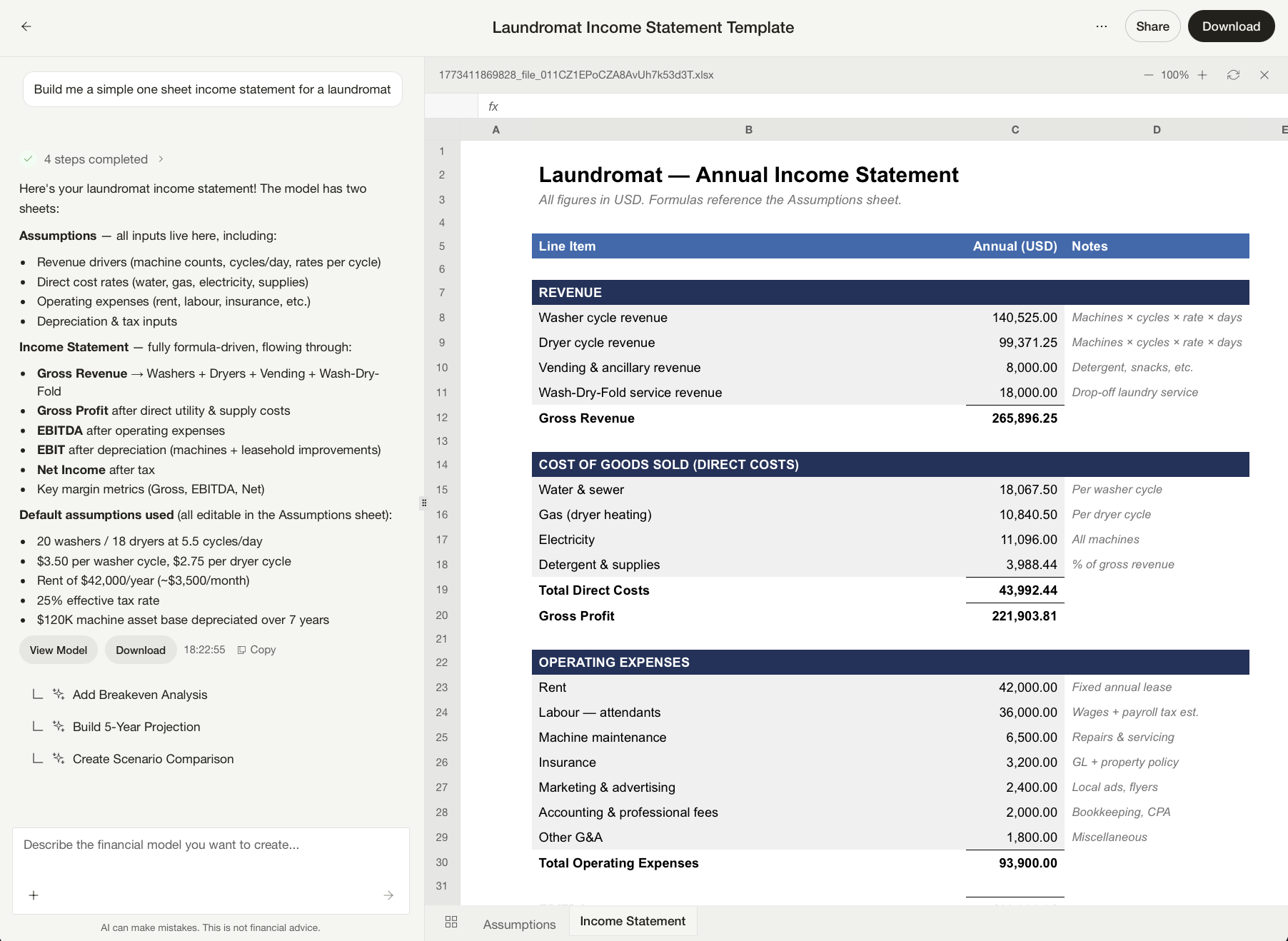
Finamodel is a library of ready Excel financial models with an AI assistant called Fina. It has no courses. Pivotal180 teaches you to build a project finance model; Finamodel gives you a finished one and changes it for your project.
You pick a model, such as a project finance debt sculpting, renewable energy or toll road model, and describe your project to Fina chat: capacity, costs, tariff, debt terms. Fina builds, edits, explains and fixes the model for that case. When a formula is unclear, ask Fina and it explains the logic. Version history lets you restore any earlier file. You then download a real .xlsx file with every formula visible, which works without Finamodel and opens in Excel, Google Sheets and Numbers.
Developers, investors and analysts who already know project finance and need a model for a bid, a lender meeting or a screening are the main users. A voice walkthrough of a model helps a colleague understand a file they did not build, and read-only links to QuickBooks, Google Sheets, Google Drive and 42 other apps can bring in figures. You can try one of 30 free models or a free sample of any other model. The Models plan is $20 a month or $120 a year, with a 14-day money-back guarantee on the first paid plan.
Next to Pivotal180, Finamodel skips the teaching, and that cuts both ways. There are no courses, videos, live classes or certificates. There is no model audit and no model-building team, and support is by email. A lender will still want an independent audit before financial close. If you are new to sculpting or tax equity, take a course first, because Fina changes a model for your case but does not teach you the method. If you know the method and need a model this week, Finamodel saves the build.
How it works
- Pick a ready model, such as a DCF or a 3-statement model, from a library of more than 500.
- Ask Fina chat to change, explain or fix it for your case and your numbers.
- Download a real .xlsx file. Every formula is visible, and it works without Finamodel. It opens in Excel, Google Sheets and Numbers.
- Price
- Models plan: $20 a month or $120 a year. All Templates: $30 a month or $144 a year. You can cancel at any time.
- Free option
- 30 free models with live formulas, and a free sample of every other model, with values but no formulas. Both are sent by email link, one model email per email address per day. The library is free to browse.
Better than Pivotal180 at
- A working project model for your case today
- Fina chat edits and explains the model
- Monthly price, cancel any time
Worse than Pivotal180 at
- No courses, videos or live classes
- No model audit or model-building service
- Does not teach the method behind the model
Models that fit: Project Finance Debt Sculpting Model, Renewable Energy Model, Toll Road Model.
Pick it if you know project finance and need a model for a real deal now.
5.Renewables Valuation Institute
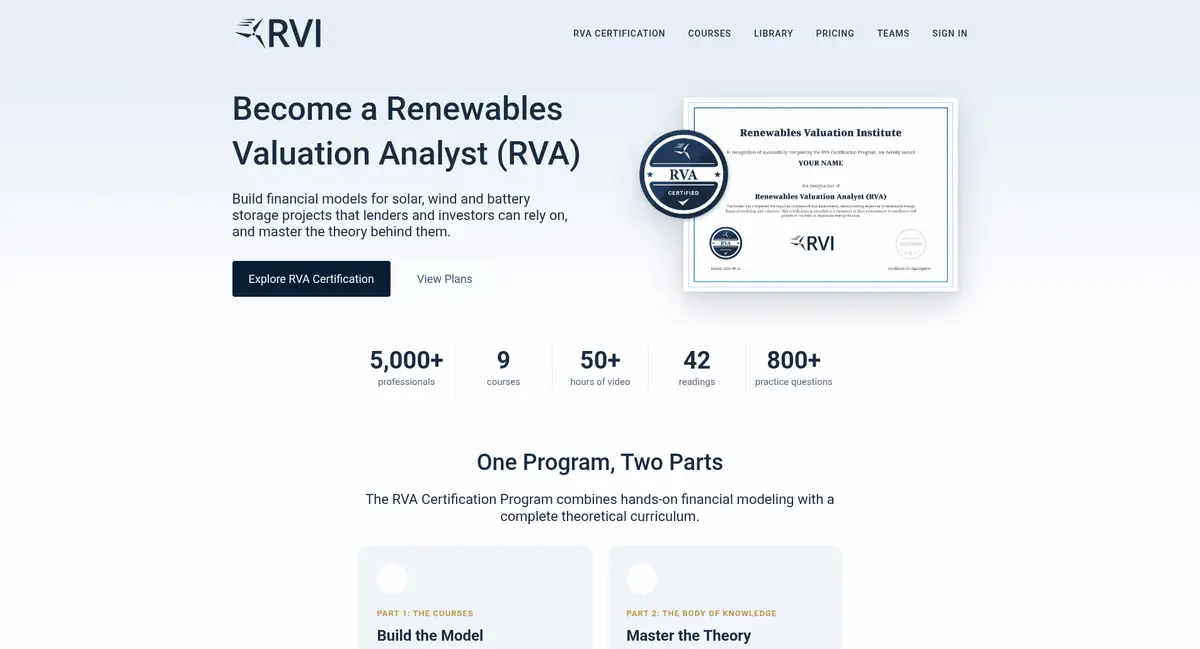
Renewables Valuation Institute (RVI) offers the self-paced Renewables Valuation Analyst (RVA) certification in project finance modelling for solar, wind, hydro and battery storage. It is built for banks, infrastructure funds, developers and advisory firms, and for students.
The RVA programme goes from core concepts to advanced, bank-ready financial models. Courses include Excel DNA for Project Finance Modeling and advanced and expert project finance modelling. Deal Labs and interview tests give practice, and a Financial Model Template Package comes with the programme. Banks, funds and developers can buy team seat licences. The template package gives you finished renewables models to study and reuse after the course.
RVI suits analysts who work only on renewables and storage and want one certification for that niche. A Pivotal180 student interested in its renewables and battery storage courses will find RVI more focused on those sectors, with interview tests that help a job search. The lifetime option means you can come back to the material later without paying again.
The pricing model differs. RVI costs $597 a year for individual access or $997 once for lifetime access, with a 30-day money-back term on individual plans. Team plans cost $495 per seat a year, minimum 2, or $797 per seat once. Pivotal180 charges $900 per course for 12 months. RVI's prices were last confirmed on 10 Nov 2026; later reads were blocked. It has no model building or audit service, no live classes in our files and no free offer stated. Pivotal180 covers more deal types, such as tax equity and mining.
- Price
- Individual $597 a year or $997 one-time. Teams $495 per seat a year or $797 per seat one-time.
- Free option
- No free offer stated. A 30-day money-back term on individual plans.
Pros
- Renewables and storage focus
- One-time lifetime option
- Model template package included
Cons
- Narrower than Pivotal180
- No free offer stated
Pick it if you work only on renewables and want a certification for that.
Renewables Valuation Institute alternatives · Visit courses.renewablesvaluationinstitute.com
6.Edward Bodmer
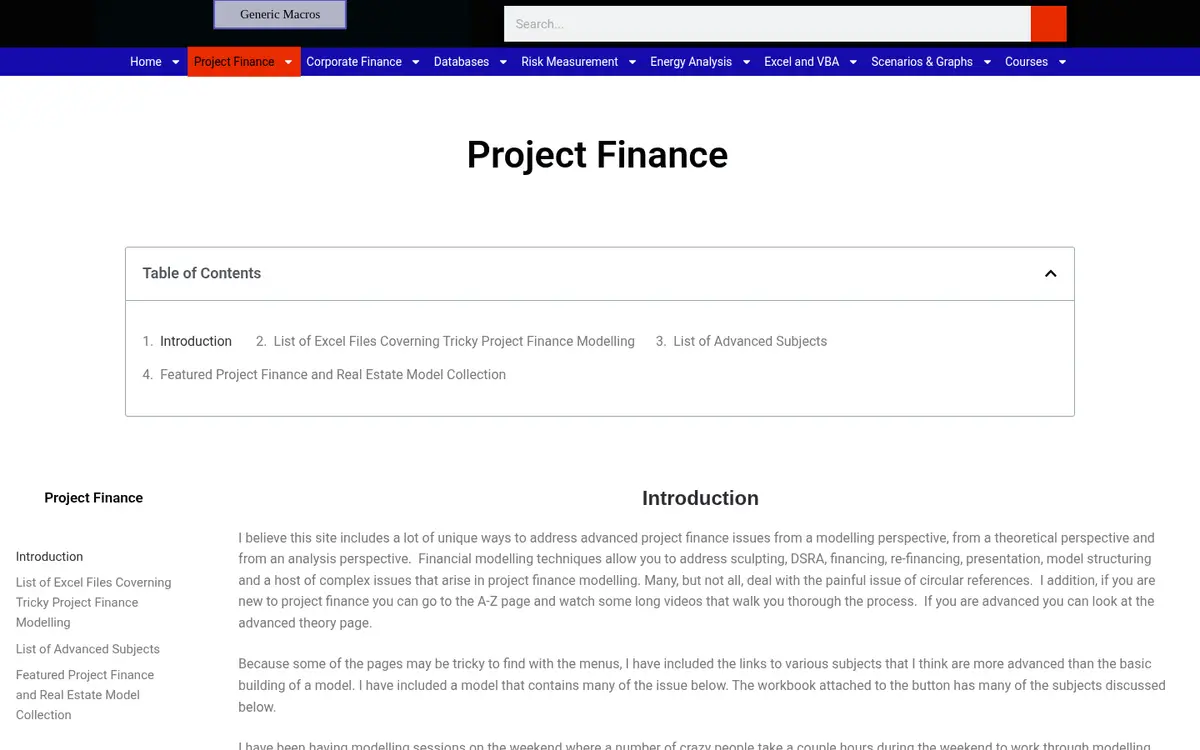
Edward Bodmer's site, edbodmer.com, is a project finance and corporate finance modelling resource with a free library of Excel models, exercises and video lessons. He also runs webinars and in-person or custom courses.
The A-Z project finance course teaches through videos, Excel files and screenshots. Advanced pages cover circular references, debt sculpting and debt service reserve accounts, topics that trip up many modellers. Sector models include solar, wind, toll roads, PPP, mining, real estate and tax equity, and a corporate finance section adds A-Z corporate, M&A and LBO material.
The library suits students, interview candidates and practitioners who want to work through completed models at no cost. Bodmer also co-teaches the Gridlines Project Finance Modelling Masterclass, so you can move from the free material to a paid class. Because each model is a complete file, you can take apart a working structure instead of starting from a blank sheet.
Against Pivotal180, the obvious difference is price: the models and videos are free, while Pivotal180 charges up to $900 per course. You give up structure. It is a personal site with no visible post dates, the pages are long, and there is no certificate or set path. Pivotal180 also gives you a planned course order, line-by-line walk-throughs and live classes, and it offers audits and model builds. Tuition for Bodmer's in-person and custom courses is not public, and we found no course dates in our files. A practical plan is to use the free library to check whether you need a paid course at all.
- Price
- Free library. In-person and custom course prices are not public.
- Free option
- A free library of models, exercises and lesson videos.
Pros
- Large free library of project finance models
- Deep coverage of sculpting and circularity
- Many sector models
Cons
- No set learning path or certificate
- No visible post dates
Pick it if you want free project finance models to learn from.
Who should pick what
Pivotal180 sells two things: training and model services. The right alternative depends on which one you need, and how you like to learn. Compare per-course, membership and classroom prices on the total you will pay, and check whether access ends after a year.
- A masterclass plus audits from one firm: Gridlines. Classroom courses and a large audit practice: Forvis Mazars.
- A certificate and AI teaching: Project Finance Institute. A renewables-only certification: Renewables Valuation Institute.
- Free project finance models to work through: Edward Bodmer.
- A ready project model, changed by AI for your deal: Finamodel.
If you like Pivotal180's courses but not the 12-month limit, compare the yearly extension fee with a membership or lifetime plan elsewhere. Before paying anyone, work through a free model from Edward Bodmer or a free Gridlines course; it shows how much teaching you still need.
Frequently asked
How much does Pivotal180 cost?+
Self-paced courses cost $400 to $900, micro-courses $80 to $100 and bundles $1,160 to $1,950. Each course includes 12 months of access, then $100 a year to extend. In-house training and model audits are priced on request. We read the prices on 10 Nov 2026.
Is there a free version of Pivotal180?+
No free course is listed, but Pivotal180 publishes free webinars and articles. Edward Bodmer's site and Gridlines's Essential Financial Modelling Course are free alternatives.
What are the main Pivotal180 alternatives?+
For project finance courses and services: Gridlines and Forvis Mazars. For certificates: Project Finance Institute and Renewables Valuation Institute. For free models: Edward Bodmer. For a ready model that AI changes for your deal: Finamodel.
Pivotal180 vs Finamodel: which should I pick?+
Pick Pivotal180 to learn project finance modelling or to hire a model build or audit. Pick Finamodel for a ready project model that Fina chat changes for your case; it has no courses. Finamodel's Models plan is $20 a month or $120 a year.
Does Pivotal180 audit financial models?+
Yes. Pivotal180 offers independent model audit and review before financial close, and it builds custom bankable models for project finance, renewables and infrastructure deals. Prices for both are not public.
How long do Pivotal180 courses last?+
Self-paced courses include 12 months of access to the online material. After that, extending access costs $100 a year.
Sources for Pivotal180 (5), last checked 15 Nov 2026+
- pivotal180.com · Course prices · 10 Nov 2026
- pivotal180.com · Homepage positioning · 10 Nov 2026
- pivotal180.com · About page · 10 Nov 2026
- pivotal180.com · Instructor-led training · 10 Nov 2026
- pivotal180.com · Consulting and audit quotes · 15 Nov 2026
Each alternative's own page lists its sources.


