Real Estate Model Example
Real Estate Financial Model (Free Excel Download)
Underwrite property acquisitions and developments with rent, occupancy, expenses, debt terms, exit cap rates, and levered investor returns linked in one real estate model.



professionals from Deloitte
Used by professionals from






About this model
Model commercial or residential real estate development from land acquisition through lease-up and stabilised operations, calculating project IRR and equity returns. This template forecasts construction cost by phase with cost per square foot, soft costs (professional fees, permits), and contingency, then models phased leasing with lease rates and tenant rollover assumptions. Operating period cash flows project NOI with escalating rents, operating expense budgets, and debt paydown from operating cash.
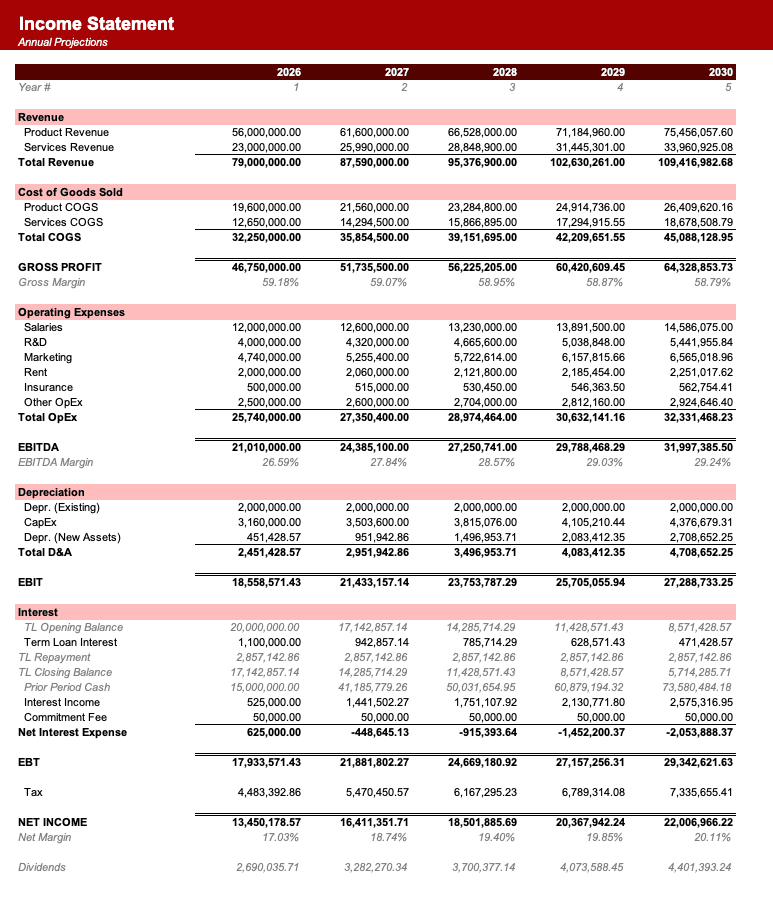
The workbook contains land and development cost schedules, construction phase capex with timing, a phased lease-up schedule showing absorption curves (typically 12–24 months to stabilisation), an income statement for operating years, and debt amortisation post-construction. The model calculates levered returns (equity IRR and multiple) from the initial equity injection through exit assuming a terminal NOI/cap rate valuation. Key inputs include entry cost, construction duration, lease-up assumptions, operating margin targets, and exit cap rate (conservative underwriting assumes 25–50 bps expansion).
Target users are real estate developers, real estate PE funds, and equity investors evaluating commercial and multifamily development projects valued at $50M to $1B+.
What every model includes
Live formulas, no hardcoded values
Outputs are driven by live formulas, so the workbook updates from its assumptions instead of relying on hardcoded results.
All assumptions in one tab
Inputs are clearly marked in the Assumptions tab and separated from calculations, making it clear what to change and what to leave intact.
Statements always balancing
For integrated-statement models, the balance sheet, cash flow, and supporting schedules tie through properly.
Distinct schedules for clarity
Debt, working capital, taxes, and cash flow can get messy quickly. We group calculations in clear schedules, not across disconnected tabs.
No hidden macros or external links
There are no unexplained external workbook links or macros to undermine auditability or portability.
Changes flow through the model
Update a key driver and see the impact carry through the forecast, financing, and return outputs. We never use hardcoded numbers in formulas.
What's inside the Real Estate Model Example
- Rent roll and occupancy assumptions
- Operating expense schedule
- Debt service and financing logic
- Cash flow and returns analysis
- Disposition assumptions
- Land acquisition cost and site preparation
- Hard construction costs by phase and cost per square foot
- Soft costs including professional fees and permits
Real Estate Model: How the Template Evaluates Property Investments
This real estate model evaluates the acquisition, operation, and disposition of a commercial or multifamily property. It projects levered and unlevered returns—IRR, equity multiple, and cash-on-cash—over a specific hold period.
The template connects rent roll, operating expenses, financing, and exit assumptions into a single investment-ready workbook.
Operating and Financing Drivers
The model's assumptions sheet drives the entire analysis. It captures property metrics (units or square feet), acquisition costs, financing terms such as LTV, interest rate, interest-only period, and amortisation, plus rent and operating expense growth rates, exit cap rate, selling costs, and hold period.
- These inputs feed the rent roll, operating expenses, debt schedule, and exit timing. The rent roll builds gross potential rent, then applies vacancy and credit loss and adds other income to produce effective gross income.
- Operating expenses cover fixed and variable items including taxes, insurance, management, utilities, and repairs and maintenance. Together these determine net operating income, the core driver of property value and debt service capacity.
Calculation Flow from Revenue to Cash Flow
The model follows a logical flow: gross potential rent is reduced by vacancy and credit loss, and other income is added to yield effective gross income. Subtracting total operating expenses gives net operating income.
- Debt service is calculated from the debt schedule, which tracks loan funding, the interest-only period, principal amortisation, and the debt service coverage ratio. Unlevered cash flow combines the acquisition cost in Year 0 with NOI, capital expenditures, and gross exit sale value.
- Levered cash flow starts with equity invested in Year 0, adds annual net cash flow after debt service, and includes exit sale proceeds net of loan payoff. Exit valuation uses forward NOI (Year N+1) divided by the exit cap rate, and cash-on-cash return is annual levered cash flow divided by total equity invested.
Outputs and Return Metrics
The cash flow and returns sheet aggregates the analysis to produce key metrics: levered and unlevered IRR, equity multiple, and cash-on-cash return. It also shows property valuation at exit and proceeds distribution.
- The debt schedule outputs DSCR, which is typically checked against a minimum threshold such as 1.20x. Cross-sheet dependencies ensure assumptions feed all modules, while the rent roll and operating expenses flow into NOI, and the debt schedule feeds levered cash flow and loan payoff.
- The cover sheet summarises property details and executive returns. Sign conventions are consistent: revenues and expenses are positive, outflows such as acquisition and equity invested are negative, and debt proceeds are positive in Year 0 with debt service and payoff negative.
Practical Use and Common Pitfalls
This model is used for evaluating property acquisitions and hold-period performance. It helps users test how changes in financing, rent growth, or exit assumptions affect returns.
- The template includes validation checks: changing the hold period must shift exit proceeds correctly, DSCR should be calculated and compared to a typical minimum, remaining loan balance at exit must match the debt schedule, and levered IRR should exceed unlevered IRR when positive leverage exists. Total equity is acquisition price plus costs minus loan proceeds.
- Common pitfalls to avoid include using Year N NOI instead of Year N+1 for exit valuation, failing to dynamically cut off cash flows at the hold period, incorrectly switching from interest-only to amortising, omitting closing costs from Year 0 equity, and calculating LTV on purchase price rather than current estimated value.
Formatted to IB standards
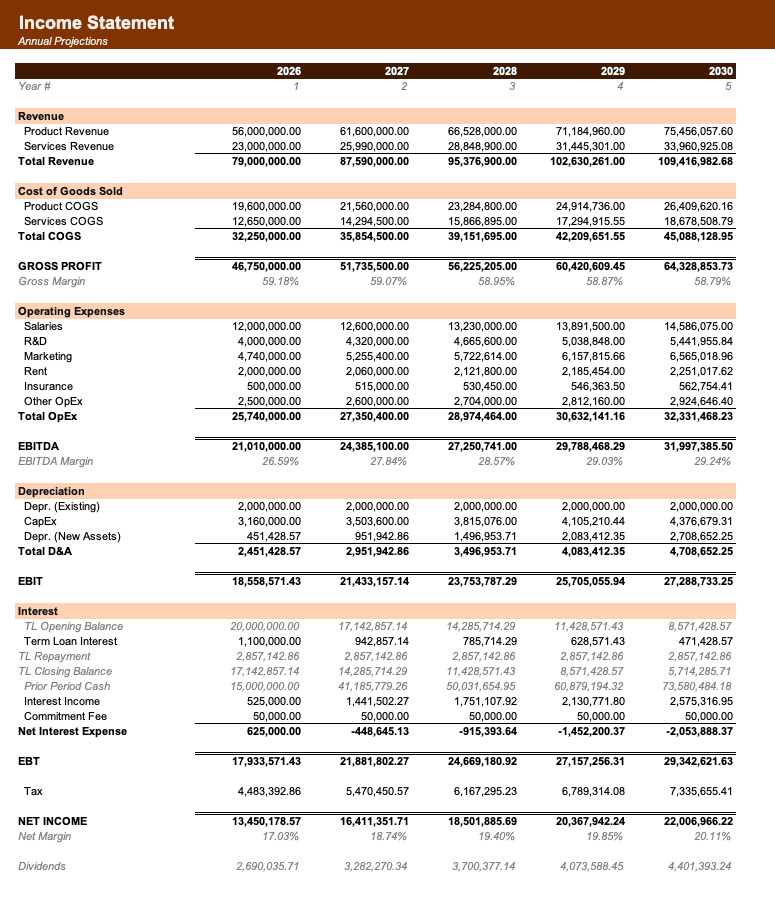
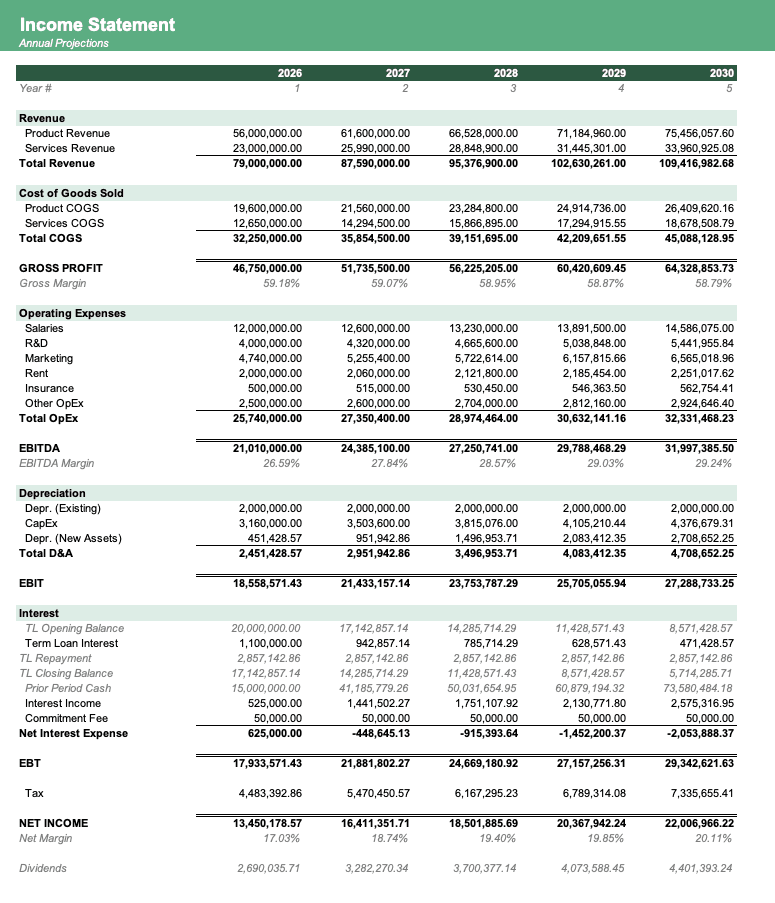
Named theme colors repaint the whole workbook in one click, on top of an investment-banking structure with clear input, output, and cross-sheet reference styling - brand-ready, institutional-grade, and fully auditable.

Created by ex-finance professionals
Hey, I’m Alex and I created Finamodel.
Over my years in the finance industry I kept building the same models over and over again. Same structure, same assumptions, different logo. So I started building frameworks to turn them into clean, reusable templates.
Every model here is one I’d actually use for a client, and I personally vet each one before it goes up.
I’m not an expert in every industry, but I’ve built enough models to know what belongs in one. And when something is completely foreign to me, I reach out to my network for experts to work on our models with us.
Having a template library on hand cuts a first build from hours to minutes.
Need help finding your model? You’ll find me in the Finamodel app!
Frequently asked
What is a real estate financial model?+
It is a model used to forecast property income, costs, financing, and exit returns for an investment or development.
Who uses real estate models?+
Investors, developers, acquisition teams, and advisers use them to underwrite opportunities.
What should a real estate model include?+
It should include rent assumptions, operating expenses, debt service, cash flow, and exit or sale assumptions.
Can it be used for acquisitions?+
Yes. Real estate models are widely used for acquisition underwriting and investment review.
Does it cover financing?+
Yes. A proper real estate model should include the impact of leverage on cash flow and returns.
Have more financial modelling questions? Contact us
Related templates
Multifamily Residential Model
Investment model for multifamily apartment communities with unit economics, rents, occupancy, and NOI.
Office Building Investment Model
Income-producing office building model with lease-up, rent growth, occupancy, and terminal value analysis.
Retail Centre Operating and Development Model
Tenant mix, rent roll, operating expenses, and profitability for shopping centers and retail property.
Hotel Operating Model
Operating model for hotel properties including occupancy rates, average daily rate (ADR), RevPAR optimization, and facility-level profitability.