Startup Financial Model Example
Tech & Software Financial Model (Free Excel Download)
Plan an early-stage company with monthly revenue, headcount, operating expenses, funding rounds, cash flow, and runway outputs for hiring and fundraising decisions.



professionals from Deloitte
Used by professionals from






About this model
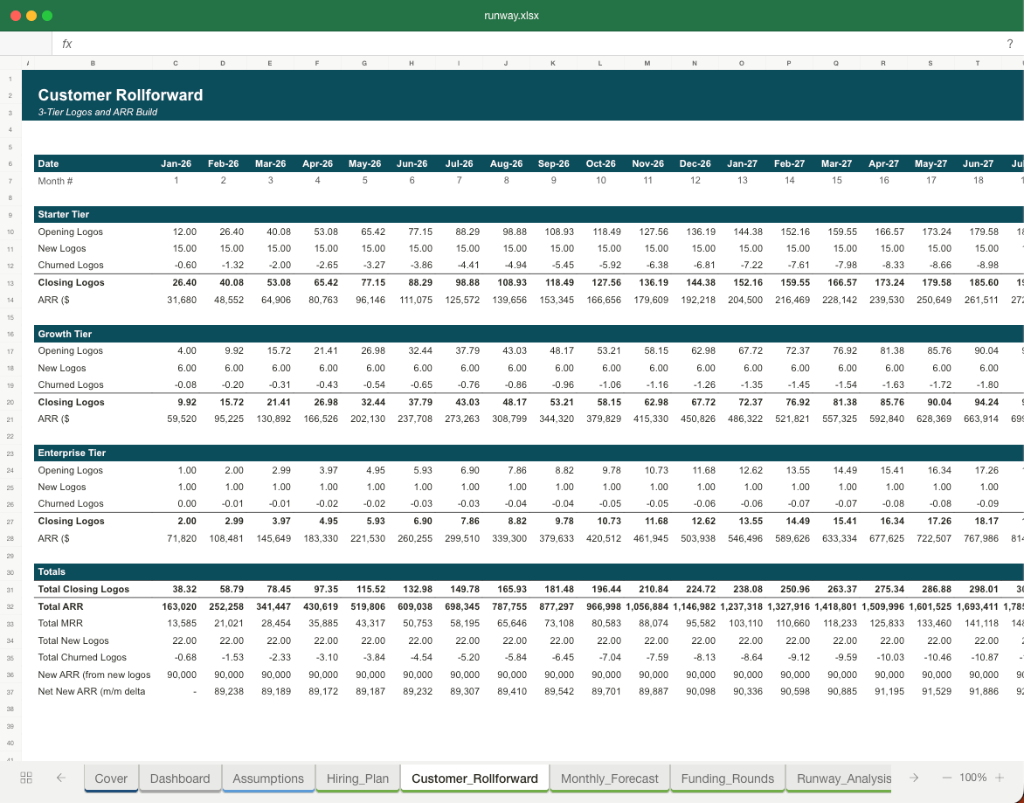
An all-in-one financial plan for early-stage startups, projected monthly across five years (60 months). The model combines three revenue streams (subscription with growth and churn, services growing off a base, and other / partnership revenue), a five-department headcount build (Engineering, Sales, Marketing, Customer Success, G&A) with quarterly hiring cadence, fully-loaded payroll cost, a monthly P&L through net income, and a cash and runway view with two explicit funding rounds.
The Assumptions sheet exposes every driver as a named range: opening customers and ARPU, customer growth and churn, services and other revenue base and growth rates, gross margin per stream, opening FTE and hires-per-quarter for each department, average salary per department, benefits load, marketing as a percent of revenue, fixed monthly G&A, tax rate, starting cash, and the month and amount of each funding round. A change to any cell flows through every downstream sheet - there are no hardcoded numbers in calculation cells.
The Headcount sheet rolls FTEs forward one month at a time, adding the quarterly hire bump at the start of months 1, 4, 7, and so on. Payroll = ending FTE × (annual salary / 12) × (1 + benefits load). The P&L pulls subscription, services, and other revenue, applies stream-specific gross margins to compute COGS and gross profit, then deducts payroll, marketing (% of revenue), and other G&A to arrive at EBITDA. Net income applies tax only on positive EBITDA. The Cash_and_Runway sheet rolls cash forward (opening + net income + funding inflows = ending), tracks a trailing 3-month burn, and computes runway in months from the current cash balance - the headline number for every founder and board.
The template is intentionally focused on the operating model and cash position. It does not include a full balance sheet or working-capital schedule - link to the 3-statement template downstream when you need those views.
What every model includes
Live formulas, no hardcoded values
Outputs are driven by live formulas, so the workbook updates from its assumptions instead of relying on hardcoded results.
All assumptions in one tab
Inputs are clearly marked in the Assumptions tab and separated from calculations, making it clear what to change and what to leave intact.
Statements always balancing
For integrated-statement models, the balance sheet, cash flow, and supporting schedules tie through properly.
Distinct schedules for clarity
Debt, working capital, taxes, and cash flow can get messy quickly. We group calculations in clear schedules, not across disconnected tabs.
No hidden macros or external links
There are no unexplained external workbook links or macros to undermine auditability or portability.
Changes flow through the model
Update a key driver and see the impact carry through the forecast, financing, and return outputs. We never use hardcoded numbers in formulas.
What's inside the Startup Financial Model Example
- Subscription, services, and other revenue streams
- Five-department headcount with quarterly hiring cadence
- Fully-loaded payroll cost build (salary plus benefits)
- Monthly P&L through EBITDA and net income
- Cash and runway view with two named funding rounds
- Trailing 3-month burn and runway-in-months output
Startup Financial Model: How the Template Works
This startup financial model template provides a 5-year monthly plan for early-stage SaaS ventures, combining three revenue streams, a departmental headcount build, monthly P&L, and cash runway with two funding rounds. It's the standard template for evaluating an early-stage operating plan, showing how drivers like customer adds, churn, and hiring translate into financial outcomes.
Operating Drivers: What You Control
The model's assumptions are organized around a small set of operating drivers that you can adjust. Subscription revenue is built from opening customers, new logo additions, churn, and average revenue per user (ARPU) that expands monthly.
- Services and other revenue grow at a compounded rate. Headcount is driven by a hire schedule per department, with payroll calculated from average salaries plus a benefits load.
- Scenario inputs for bull, base, and bear cases let you toggle all these drivers at once. Marketing spend is set as a percentage of revenue, and tax, funding, and cash policies are also input.
How the Numbers Flow Through the Model
From assumptions, the model calculates revenue by stream, then feeds into the monthly P&L. Cost of goods sold is derived from each stream's gross margin, while payroll, marketing, and other G&A are subtracted to arrive at EBITDA.
- A tax block applies an NOL carryforward, so taxes are only paid on positive EBITDA after using accumulated losses. Net income then flows to the cash and runway sheet, where funding inflows are added to give ending cash.
- Runway is calculated as ending cash divided by trailing three-month average burn, and is floored at zero. Cross-sheet checks validate that totals tie out month by month.
Outputs: What the Model Tells You
The model produces a range of outputs to assess the business. The P&L shows revenue, gross profit, EBITDA, and net income each month.
- The cash and runway sheet reports ending cash, net burn, average burn, and an explicit 'month cash runs out' indicator. A dashboard summarizes annual revenue growth, gross margin, EBITDA margin, headcount, revenue per FTE, CAC, LTV/CAC, net burn, ending cash, and runway.
- SaaS unit economics are also calculated, including CAC, LTV, LTV/CAC ratio, CAC payback, and burn multiple, helping you evaluate the efficiency of growth spending.
Practical Use and Interpretation
This template is designed for founders and finance teams building an investable operating plan. By adjusting drivers like logo growth, churn, ARPU expansion, and hiring pace, you can stress-test the plan under different scenarios.
- The checks suite helps catch common errors, such as mismatched totals or missing cost lines. The base case is calibrated to a credible venture plan, but you should replace defaults with your own assumptions.
- The model's value lies in showing how changes in customer dynamics and headcount decisions affect cash, profitability, and runway, supporting informed decisions about fundraising and spending.
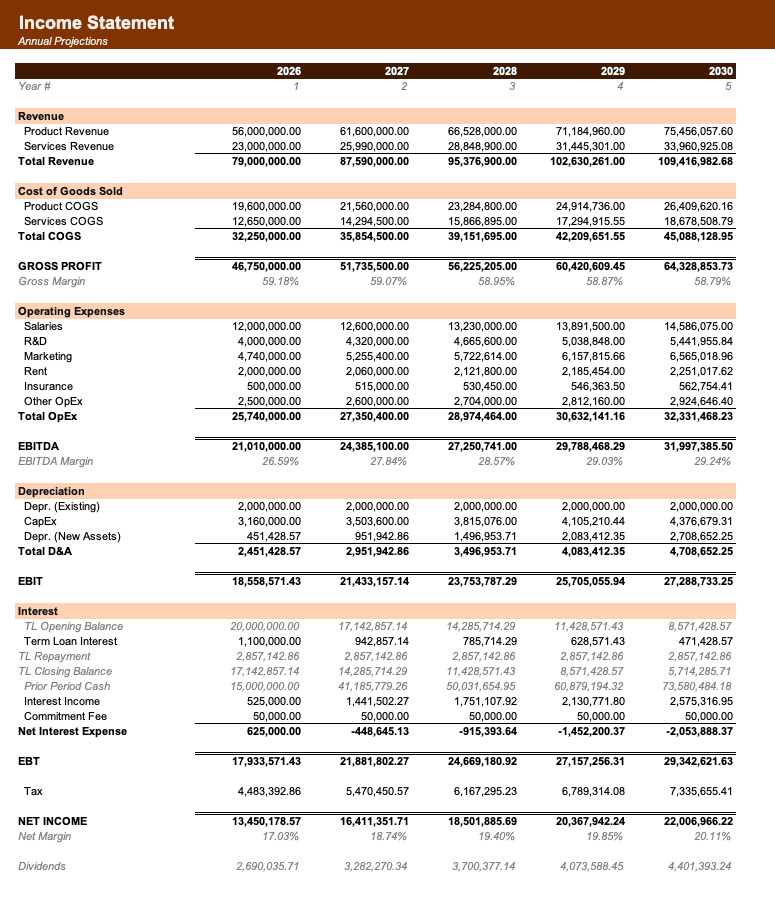
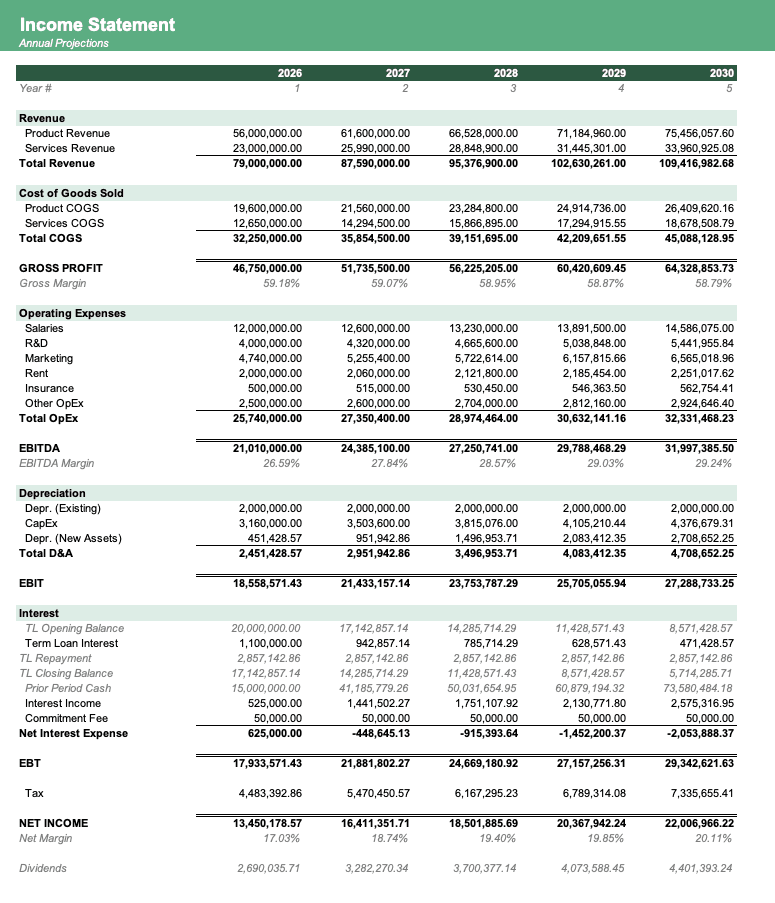
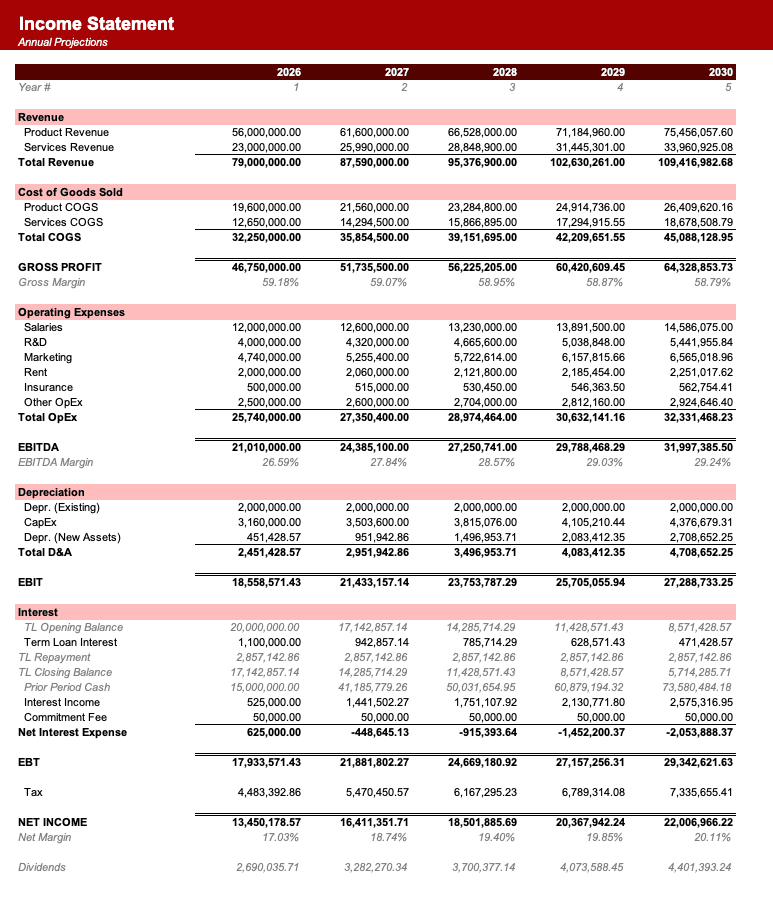
Formatted to IB standards
Named theme colors repaint the whole workbook in one click, on top of an investment-banking structure with clear input, output, and cross-sheet reference styling - brand-ready, institutional-grade, and fully auditable.

Created by ex-finance professionals
Hey, I’m Alex and I created Finamodel.
Over my years in the finance industry I kept building the same models over and over again. Same structure, same assumptions, different logo. So I started building frameworks to turn them into clean, reusable templates.
Every model here is one I’d actually use for a client, and I personally vet each one before it goes up.
I’m not an expert in every industry, but I’ve built enough models to know what belongs in one. And when something is completely foreign to me, I reach out to my network for experts to work on our models with us.
Having a template library on hand cuts a first build from hours to minutes.
Need help finding your model? You’ll find me in the Finamodel app!
Frequently asked
What is a startup financial model?+
A startup financial model is a monthly forecast that ties revenue, headcount, operating expenses, profit, and cash together so a founder can see whether the plan reaches break-even and how much runway each funding round buys.
How is this different from a runway model?+
A runway model is narrower - it focuses on burn and cash. This template adds a headcount build, a multi-stream revenue forecast, and a full P&L, so the operating plan ties to the cash balance.
Why monthly for 60 months?+
Early-stage planning happens in months: hiring decisions, marketing campaigns, and funding-round timing all matter at month-level granularity. Sixty months covers the typical seed-through-Series-C horizon.
Where do funding rounds appear?+
On the Cash_and_Runway sheet. Each round has a month and amount input on Assumptions; the inflow cell is `IF(Month = Round_Month, Round_Amount, 0)`, so the round only adds cash in its named month.
Does it include a balance sheet?+
No. This template treats net income as a cash proxy for simplicity. For full balance sheet, working capital, and debt mechanics, link the 3-statement template downstream.
Have more financial modelling questions? Contact us
Related templates
Startup Cash Runway Model
Monthly cash flow projection for seed and early-stage companies showing burn rate, months of runway, and funding milestones.
SaaS MRR/ARR Forecast Model
Subscription forecast with logo motion, MRR build, ARR, NRR/GRR, and CAC payback for SaaS businesses.
3 Statement Model
Integrated income statement, balance sheet, and cash flow forecasts.
Pre-Seed Startup Financial Projection Model
Bootstrapped growth, burn rate, path to profitability, and funding milestone planning for early-stage startups.