AKArk Kapital Financial Model
InsurTech Startup Financials (Free Excel Download)
AI-powered precision lending platform for European tech startups, providing non-dilutive growth loans using real-time raw data analytics.



professionals from Deloitte
Used by professionals from






About this model
Ark Kapital is a precision-lending platform for European technology companies, using real-time data to offer non-dilutive growth loans and advances against marketplace receivables. It targets businesses with stable income and an underlying path to profitability.
The company earns interest and fees on loans rather than SaaS subscriptions. Its Marketplace Forward product advances cash against receivables from platforms such as app stores, while growth loans create a longer-duration credit relationship.
The model is specialty finance: originations, loan size, repayment, yield, cost of funds, defaults, and recoveries build the P&L and loan book. Underwriting quality, funding capacity, credit losses, and borrower growth determine returns.
A turnkey financial model
Live formulas, no hardcoded values
Outputs are driven by live formulas, so the workbook updates from its assumptions instead of relying on hardcoded results.
All assumptions in one tab
Inputs are clearly marked in the Assumptions tab and separated from calculations, making it clear what to change and what to leave intact.
Statements always balancing
For integrated-statement models, the balance sheet, cash flow, and supporting schedules tie through properly.
Distinct schedules for clarity
Debt, working capital, taxes, and cash flow can get messy quickly. We group calculations in clear schedules, not across disconnected tabs.
No hidden macros or external links
There are no unexplained external workbook links or macros to undermine auditability or portability.
Changes flow through the model
Update a key driver and see the impact carry through the forecast, financing, and return outputs. We never use hardcoded numbers in formulas.
About Ark Kapital

How to build a detailed financial model for Ark Kapital
A complete walkthrough of the business, drivers, and assumptions behind the downloadable Ark Kapital model - distilled from its pitch deck and publicly available information.
Product & value proposition
Two live lending products:
Growth Loan - Long-term non-dilutive loan sized and structured dynamically based on real-time company data. Target borrowers: SaaS companies and others with stable income and underlying profitability. Pie-chart indicators on slide 18 suggest moderate credit risk, partial automation, limited direct competition, and a large companies-in-scope pool.
Marketplace Forward - Short-term automated advance against marketplace receivables (App Store, Steam, etc. - payment cycle ~70 days). Target borrowers: game developers and marketplace sellers. Indicators suggest very low credit risk (near-full pie), near-full automation, moderate competition, and moderate company scope.
AiM platform - Connects via API to borrowers' raw data sources (payment transactions, marketing spend, engagement events, contracts, orders/inventory, accounting events, cloud data warehouses such as Redshift, BigQuery, PostgreSQL, S3, etc.). Uses ML to produce LTV predictions (stated 98%+ accuracy on 12-month LTV) and continuous risk monitoring (dashboards, alerts, APIs back to borrowers).
Revenue model
Not explicitly stated in deck. Inferred from business model:
- Interest / fees on Growth Loans (term loans to SaaS/tech companies).
- Discount fee or factor rate on Marketplace Forwards (cash advance against receivables).
- Channels: proactive data-driven lead sourcing via AiM platform; "large customer pipeline built in 2 months in stealth mode".
- No specific interest rates, fee percentages, or loan sizes disclosed.
Traction & metrics
- Pipeline: "Significant pipeline in less than 2 months"; "large customer pipeline built in 2 months in stealth mode".
- Product: "Sizeable loan product live".
- Funding: "First large funding being secured at favorable terms".
- Team: "12 star recruitments across all relevant disciplines".
- Platform: "Predictive tech platform supporting major data platforms"; "Loan decisions significantly improved by tech platform".
- ML accuracy: 98%+ accuracy on 12-month LTV predictions.
- No revenue figures, loan volumes, number of funded companies, or specific pipeline counts disclosed.
Competition / moat
Positioned against:
- Traditional bank lending - unable to assess tech risk, inflexible structures.
- VC equity - dilutive, expensive, available to only a minority of companies.
- Other fintech lenders - implied by "mispriced risk in the market" framing.
Stated moats:
- Proprietary AiM data platform with low-level API integrations to raw event-level data (not aggregated financials).
- ML at user/micro-cohort level - claimed differentiation vs. competitors using Excel models, ARR multiples, or contract financing.
- Scalable credit facilities secured at launch ("profitable lending from day 1").
- Team pedigree: Spotify analytics, EQT Motherbrain, Tink, Nordea, SEB, UC credit bureau.
Team & funding ask / use of funds
Founders:
- Oliver Hildebrandt (CEO, 29) - built and scaled 6 companies (4 fintechs), combined €100M revenue / 500 employees.
- Henrik Landgren (CPТО & Founder) - built Spotify analytics team; built AI investment platform Motherbrain at EQT; founded EQT Ventures & Growth data-driven VC.
- Axel Bruzelius (COO & Founder) - built first debt-driven startup unit at Nordea; lent to hundreds of tech companies with no credit losses.
Key hires:
- Elin Bäcklund (CTO) - Head of Motherbrain dev team (25 people), Forbes 30 Under 30.
- Jens Larsson (Head of Analytics) - Tink analytics head; prior Spotify + Google data.
- Julia Erhardt (CFO) - SEB Head of Debt IR (>€10B annual fundraising), Chief Retail Bank at Hoist Finance.
- Tim Bisander (Head of Credit) - 20+ yrs, Head of Analytics at Swedish credit bureau UC, Marginalen Bank, Skandia mortgage.
- Anders Hising (Head of Structuring) - 14 yrs leverage finance & corporate debt at Nordea.
Existing angel investors: Jacob de Geer, Hjalmar Winbladh, Patrick Söderlund, Johan Bergqvist, Gabriella Sahlman.
Funding ask: ~€15M Seed.
- Lead investor(s): €8–10M.
- Existing angels pro-rata: €3M.
- Selected new hand-picked angels: €2–4M.
Use of funds (stated):
- Hire 40 FTEs across tech, lending, and growth teams.
- Expand to multiple European markets.
- Build out scalable AI platform.
- Finance loans against debt facility (i.e., equity funds equity cushion / credit enhancement, not loan principal directly).
- Drive explosive customer growth.
Recommended financial model
Archetype + why: Specialty lender / balance-sheet lending P&L + loan-book model. ArK is a credit business: revenue is interest and fees on loans originated; costs are cost of funds (debt facility), OpEx (tech + team), and credit losses. The correct model archetype is a lending / specialty finance model: loan book build (originations, repayments, outstanding balance), net interest margin, provision for credit losses, and an operating P&L sitting above. The AiM platform has SaaS-like cost structure (data infra, ML team) but is not a revenue line - it's the underwriting engine. Do not model as SaaS ARR.
Forecast horizon & granularity: Monthly for Year 1–2 (loan book ramps fast post-seed); quarterly summary for Years 3–5. 5-year forecast total. Two product lines modelled separately (Growth Loan, Marketplace Forward) given different duration, credit risk, and automation profiles.
Key drivers & assumptions:
*Loan book - Growth Loan (long-term):*
- Number of new borrowers per month.
- Average loan size per borrower.
- Average loan tenor.
- Interest rate / fee yield.
- Net interest margin after cost of funds.
- Monthly repayment / amortization profile.
*Loan book - Marketplace Forward (short-term):*
- Number of advances per month.
- Average advance size.
- Discount rate / factor fee.
- Turnover / recycling rate.
*Funding / balance sheet:*
- Equity raised: €15M seed.
- Debt facility: size not disclosed.
- Cost of debt facility.
- Loan-to-facility utilisation ramp.
*Credit / risk:*
- Default / loss rate.
- Provision coverage ratio.
*OpEx:*
- Headcount ramp to 40 FTEs;.
- Tech infrastructure (data platform, cloud, APIs).
- Overhead (office, legal, compliance, audit).
Scenarios (Base / Bull / Bear - which variables flex):
- Bear: Slow pipeline conversion (50% of base borrower ramp), higher credit losses (3% Growth Loan / 1.5% Forward), debt facility at 3x equity, higher cost of funds (8%).
- Base: Mid-case borrower ramp, 1.5% Growth Loan losses / 0.5% Forward, 5x leverage, 7% cost of funds.
- Bull: Fast pipeline (150% of base), 0.5% loss rate, 8x leverage, 6% cost of funds, faster European market expansion.
- Flex variables: origination volume, average loan size, loss rate, leverage ratio, cost of funds.
Required sheets / outputs:
- Assumptions - all drivers, clearly flagged vs..
- Loan Book - Growth Loan - monthly originations, repayments, outstanding balance, interest income, fees.
- Loan Book - Marketplace Forward - monthly volume, advance balance (short-dated), discount income.
- Funding / Liabilities - equity, debt facility drawdown, utilisation, interest expense.
- P&L - gross interest income, cost of funds, NIM, credit provisions, gross profit, OpEx, EBITDA, net income.
- Balance Sheet - loan receivables, cash, debt facility, equity.
- Cash Flow - operating CF, net new originations (investing), debt drawdowns (financing), ending cash / runway.
- KPI Dashboard - loan book size, NIM%, loss rate, cost/income ratio, runway months, cumulative borrowers.
- Scenario Toggle - bear/base/bull selector feeding Assumptions sheet.
Frequently asked
Is the Ark Kapital financial model free?+
Yes. The Ark Kapital model is a free Excel (.xlsx) download with live formulas. Sign up with your email and the workbook is yours to keep, review, and edit.
What's included in the model?+
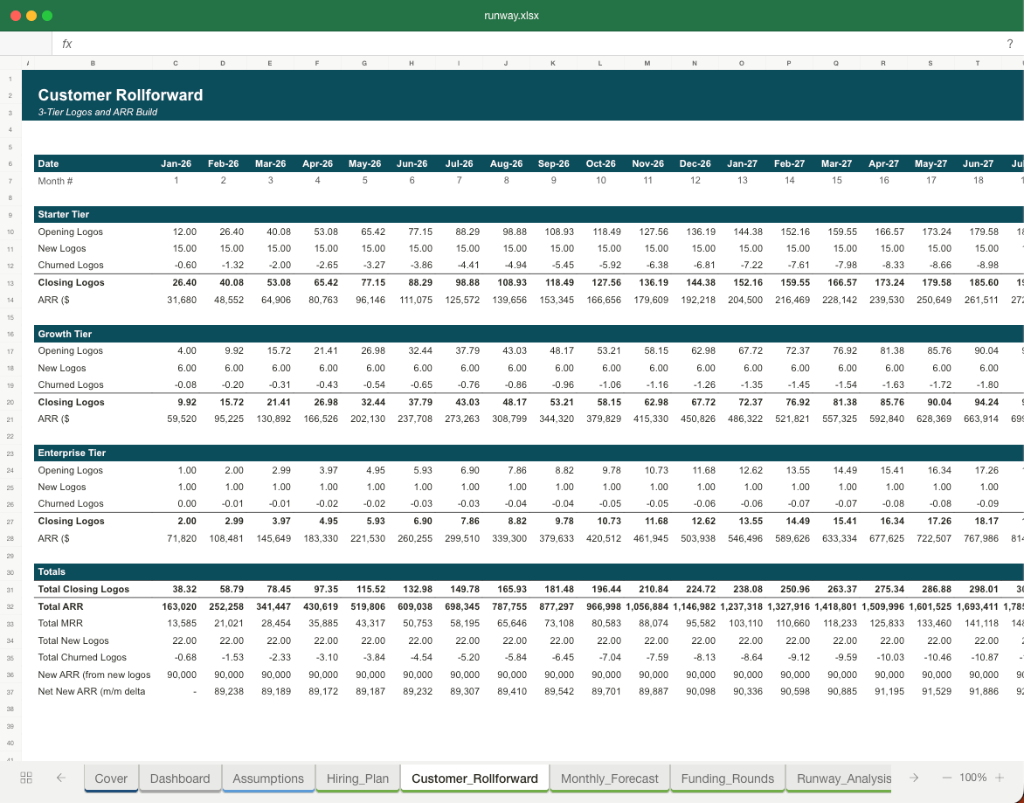
A 5-year monthly forecast with P&L, cash flow and runway, valuation (exit multiple plus a DCF cross-check), MOIC/IRR returns, and unit economics, with live formulas throughout.
How was this model built?+
It was built from Ark Kapital's pitch deck and publicly available information, then structured to investment-banking standards as a fully editable Excel model.
Can I change the assumptions?+
Yes. You can change assumptions and the live formulas will recalculate in the downloadable Excel model.
Have more financial modelling questions? Contact us

Created by ex-finance professionals
Hey, I’m Alex and I created Finamodel.
Over my years in the finance industry I kept building the same models over and over again. Same structure, same assumptions, different logo. So I started building frameworks to turn them into clean, reusable templates.
Every model here is one I’d actually use for a client, and I personally vet each one before it goes up.
I’m not an expert in every industry, but I’ve built enough models to know what belongs in one. And when something is completely foreign to me, I reach out to my network for experts to work on our models with us.
Having a template library on hand cuts a first build from hours to minutes.
Need help finding your model? You’ll find me in the Finamodel app!
Other InsurTech Startup Financial Models
Browse another startup in the same category.

Battleface
Tech-enabled travel insurance platform covering high-risk and non-standard destinations globally, sold direct and via B2B2C partners.
Beam
Digital-first dental insurance company selling group dental (and ancillary) benefits to employers via brokers

Branch
Tech-enabled home & auto insurance company operating as a reciprocal exchange, selling bundled policies via embedded, direct, and agency channels.
Cachet
B2B2C insurtech marketplace offering flexible, usage-based insurance products to gig/platform economy workers via partnerships with ride-hailing, delivery, and gig platforms.

Caura
Mobile app that aggregates all car-related payments (parking, congestion/ULEZ, tolls, tax, insurance) into a single platform, with insurance comparison as a key monetisation layer.

Clark
Digital insurance broker (Makler) providing a robo-advisor + human expert hybrid platform to manage and purchase all insurance lines via mobile app

Counterpart
Digital MGA (managing general agent) selling D&O and management liability insurance to US SMEs via a tech-enabled underwriting platform.

Cover Genius
API-first B2B2C insurtech platform enabling digital companies to embed and distribute insurance and warranty products globally at the point of sale.