Accounting Estimates Register Tracker
Accounting & Audit Financial Model (Excel Download)
Keep every material estimate in one register with its method, range, owner and review date. Compare calculated and booked amounts and hold adjustments until the review is complete.



professionals from Deloitte






About this model
A register for material accounting estimates such as credit loss allowances, warranty reserves, inventory write-downs, rebates, returns, bonuses and legal claims. Each estimate records its exposure, rates, method, evidence, owner and next review date. The shipped case is a fictional industrial components group at its September 2026 close, in USD thousands.
Each estimate is calculated from exposure and a base rate, with low and high cases from alternative rates. The expected credit loss rate is calibrated from 24 months of losses by aging bucket, and the warranty rate from matured claim cohorts. A retrospective compares prior estimates with outcomes on the same pool. Posting decisions need a reviewer, date and evidence, and a reserve roll-forward keeps approvals apart from actual postings.
On the shipped case the eight estimates total 1,680 calculated against 1,510 booked, an adjustment of 170. The range runs from 1,297.5 to 2,355. Of the approved adjustments, 160 are available to post and 10 are held, because the warranty reserve is past its review date. It stays held until a formal reassessment is recorded.
What every model includes
Live formulas, no hardcoded values
Outputs are driven by live formulas, so the workbook updates from its assumptions instead of relying on hardcoded results.
All assumptions in one tab
Inputs are clearly marked in the Assumptions tab and separated from calculations, making it clear what to change and what to leave intact.
Statements always balancing
For integrated-statement models, the balance sheet, cash flow, and supporting schedules tie through properly.
Distinct schedules for clarity
Debt, working capital, taxes, and cash flow can get messy quickly. We group calculations in clear schedules, not across disconnected tabs.
No hidden macros or external links
There are no unexplained external workbook links or macros to undermine auditability or portability.
Changes flow through the model
Update a key driver and see the impact carry through the forecast, financing, and return outputs. We never use hardcoded numbers in formulas.
What's inside the Accounting Estimates Register Tracker
- Register of estimates with calculated, booked and adjustment amounts
- Low and high case for each estimate
- Method, exposure, base rate and evidence by estimate
- Review evidence with conclusion, reviewer and next review date
- Expected credit loss rates calibrated from aging and realized losses
- Warranty claim rate calibrated from matured cohorts
- Retrospective review of prior estimates against outcomes
- Posting decisions with approver, date and evidence



Formatted to IB standards
Named theme colors repaint the whole workbook in one click, on top of an investment-banking structure with clear input, output, and cross-sheet reference styling - brand-ready, institutional-grade, and fully auditable.

Created by ex-finance professionals
Hey, I’m Alex and I created Finamodel.
Over my years in the finance industry I kept building the same models over and over again. Same structure, same assumptions, different logo. So I started building frameworks to turn them into clean, reusable templates.
Every model here is one I’d actually use for a client, and I personally vet each one before it goes up.
I’m not an expert in every industry, but I’ve built enough models to know what belongs in one. And when something is completely foreign to me, I reach out to my network for experts to work on our models with us.
Having a template library on hand cuts a first build from hours to minutes.
Frequently asked
What is an accounting estimates register?+
It is a list of the amounts in the accounts that depend on judgment, such as bad debt allowances or warranty reserves. For each estimate it records the method, inputs, evidence, owner and review date. It helps controllers and auditors see how each figure was reached.
How are the low and high cases set?+
Each estimate has a base rate and a low and high rate applied to the same exposure. This gives a range around the calculated amount. On the shipped case the total range is 1,297.5 to 2,355 thousand.
Why is an adjustment held?+
An adjustment is held when the estimate is past its scheduled review date. It is released only when a formal reassessment is recorded with a reviewer, review record and current evidence version. The approval must also fall on or before the close date.
Does the register post to the ledger?+
No. It records approved adjustments and the evidence of actual postings. Approvals and actual postings are kept apart in the reserve roll-forward.
How do I add my own estimates?+
Enter each estimate on the Methods sheet with its exposure, rates and evidence, and its review schedule on Review evidence. Update the close date and posting threshold on the Register. Extend bounded ranges and their formulas together.
Have more financial modelling questions? Contact us
Related templates
Trade Receivable Impairment Estimate
Estimate the bad debt allowance on trade receivables with a calibrated provision matrix, outlook overlays and specific debtors.
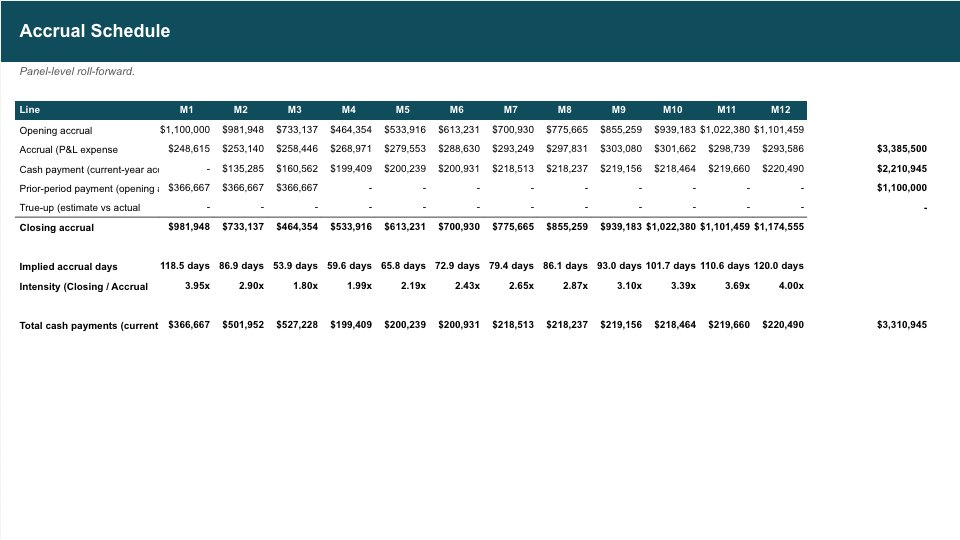
Accrued Expenses
12-month accrued-liability roll-forward with reversal timing across an accrual panel.
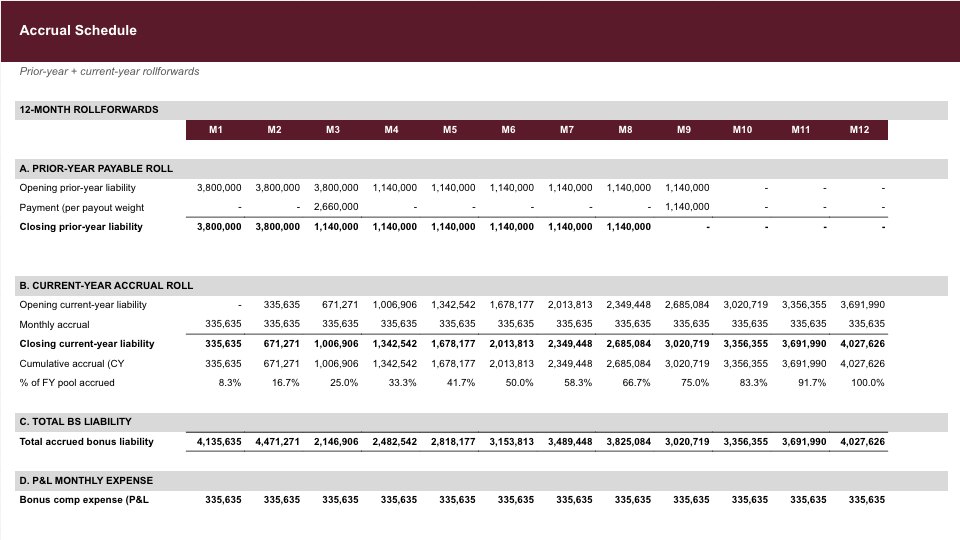
Bonus Accrual
Plan your annual bonus pool by department and track the monthly expense and payout.
Beneish M-Score Earnings Manipulation Diagnostic
Calculate the Beneish M-Score from three years of financials, see which ratios drive it and track follow-up questions.







