Bonus Accrual
Corporate Finance Financial Model (Free Excel Download)
Forecast bonus pools, monthly accruals, payout timing, and department-level expense to protect EBITDA visibility and plan the cash impact of incentive compensation.



professionals from Deloitte
Used by professionals from






About this model
Use this workbook to set an annual bonus pool by department and see its monthly cost. Change headcount, salary, target bonus, and performance assumptions to update the plan.
The summary shows the total bonus cost, monthly expense, outstanding liability, and payout timing, so finance and people teams can plan the budget and cash impact together.
What every model includes
Live formulas, no hardcoded values
Outputs are driven by live formulas, so the workbook updates from its assumptions instead of relying on hardcoded results.
All assumptions in one tab
Inputs are clearly marked in the Assumptions tab and separated from calculations, making it clear what to change and what to leave intact.
Statements always balancing
For integrated-statement models, the balance sheet, cash flow, and supporting schedules tie through properly.
Distinct schedules for clarity
Debt, working capital, taxes, and cash flow can get messy quickly. We group calculations in clear schedules, not across disconnected tabs.
No hidden macros or external links
There are no unexplained external workbook links or macros to undermine auditability or portability.
Changes flow through the model
Update a key driver and see the impact carry through the forecast, financing, and return outputs. We never use hardcoded numbers in formulas.
What's inside the Bonus Accrual
- Bonus pool by department, based on headcount, salary, target bonus, and performance
- Employer costs and the total cost of the annual bonus pool
- Monthly expense, liability, and payout schedule
- Summary of bonus cost, cash timing, and impact on EBITDA
- Five departments with headcount, average salary, target bonus %, and individual performance multiplier
- Single corporate performance multiplier and uniform employer burden %
- Pool sheet with per-department gross bonus, burden, and fully-loaded cost plus a panel-total annual pool
- 12-month BS roll with opening liability, monthly accrual, payment in the payout month, closing liability, cumulative accrual, and percent accrued
How the Bonus Accrual Model Turns Headcount Plans into Monthly Liability
This bonus accrual model helps finance teams size an annual bonus pool, spread the cost across twelve months, and track the resulting liability and cash payout. It builds everything from a named employee list, so the numbers tie back to individuals rather than top-down estimates, and it shows how a single scenario switch changes the pool, the monthly accrual, and the year-end balance.
What Drives the Pool: Employees, Ratings, and the Corporate Multiplier
The pool starts at the individual level. Each named employee has a base salary, a target bonus percentage, a performance rating, tenure, and a vested flag.
- A lookup table converts the rating into an individual multiplier, which is then capped by a scenario-driven limit. Gross bonus per employee equals base pay times target percentage times that individual multiplier, times a corporate multiplier, times full-time-equivalent and vested factors.
- This means the model reflects actual headcount and pay structure rather than an assumed average bonus. A forfeiture adjustment is applied row by row, reducing each gross bonus by the expected forfeiture rate before any department totals are calculated.
The employee-level detail then rolls up into five departments using conditional sums, producing department headcount, gross bonus, and forfeiture-adjusted bonus.
From Department Totals to a Fully Loaded Liability
Once department totals are in place, the model adds employer burden. A separate detail sheet stacks statutory and benefit components, including Social Security and Medicare taxes, federal and state unemployment contributions, retirement match, and a benefits load.
- Several of these components are effectively zero on bonus pay because annual wage bases are already exceeded on base salary, so the model uses an effective-rate approximation rather than recomputing caps month by month. The derived burden percentage is applied to the forfeiture-adjusted pool to produce total burden dollars, and adding that to the adjusted pool gives the fully loaded pool.
- That fully loaded figure is what gets accrued, because employer taxes and benefits are real cash costs that belong alongside the bonus itself.
How the Accrual, Liability, and Journal Entries Flow Each Month
The accrual schedule runs three stacked rollforwards. The prior-year payable opens at a known liability and drains according to a payout-weight vector, so a multi-month payment pattern is visible rather than assumed to be a single lump sum.
- The current-year accrual builds from zero to the fully loaded pool over twelve months, either straight-line or, if a true-up trigger fires mid-year, as a revised remaining amount spread across the months left. Total balance sheet liability is the sum of the prior-year and current-year closing balances.
- Each month, the accrual is allocated across departments in proportion to their share of gross bonus, creating debit entries that tie exactly to the credit to accrued compensation liability. A pass-or-fail check confirms that debits equal credits every month.
Scenarios, Capacity Checks, and Practical Use
A three-way scenario switch selects between floor, target, and stretch assumptions for the corporate multiplier, forfeiture rate, individual cap, and EBITDA realisation. The scenarios sheet compares all three side by side regardless of which one is active, and reports a probability-weighted expected pool so a compensation committee can see the range rather than a single point.
- A quarterly EBITDA capacity sheet tests whether the pool fits within a chosen percentage of earnings, showing headroom or shortfall at mid-year and full-year cutoffs. Sensitivity grids display how the pool-to-EBITDA ratio changes with the corporate multiplier, forfeiture, and EBITDA movement, with colour-coded status flags.
- The model is designed for a single operating entity and does not cover multi-entity consolidation, stock-based compensation, or currency translation.
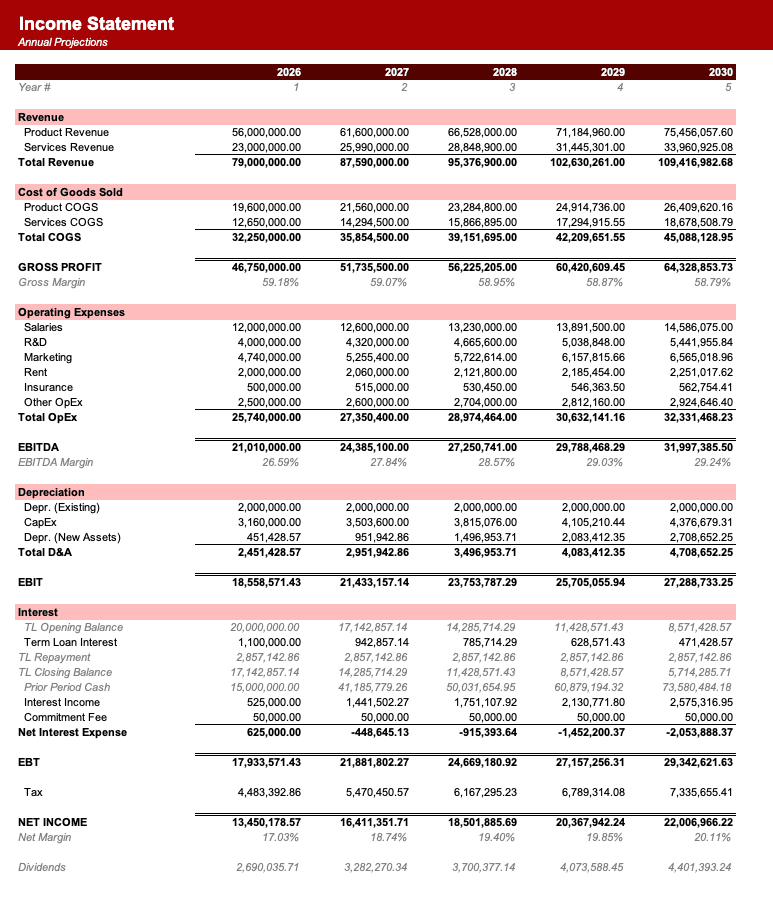
Formatted to IB standards
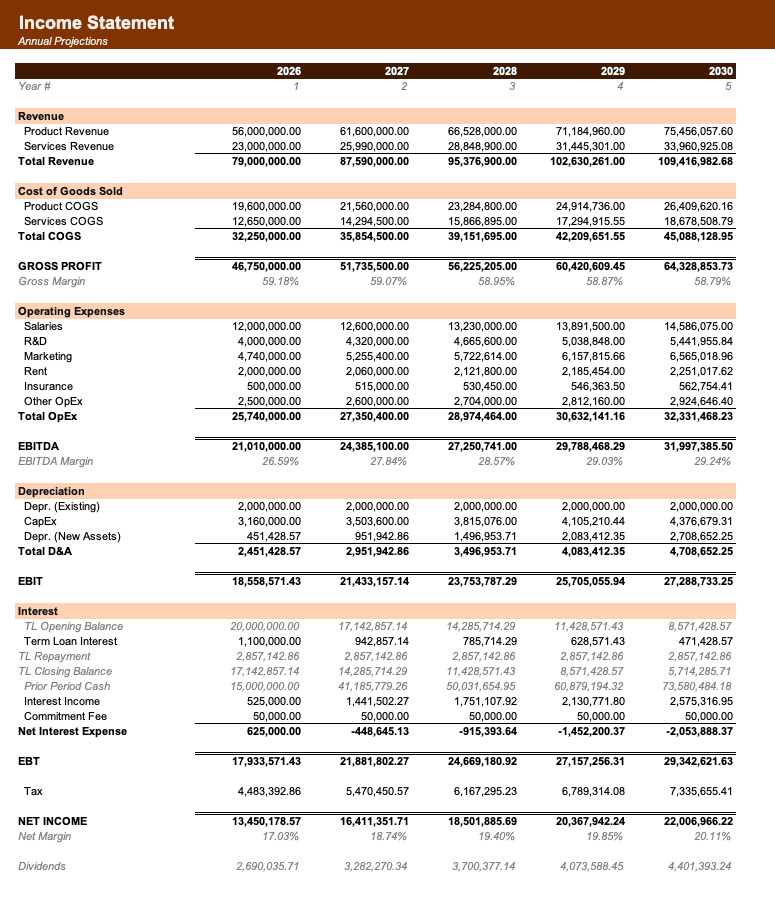
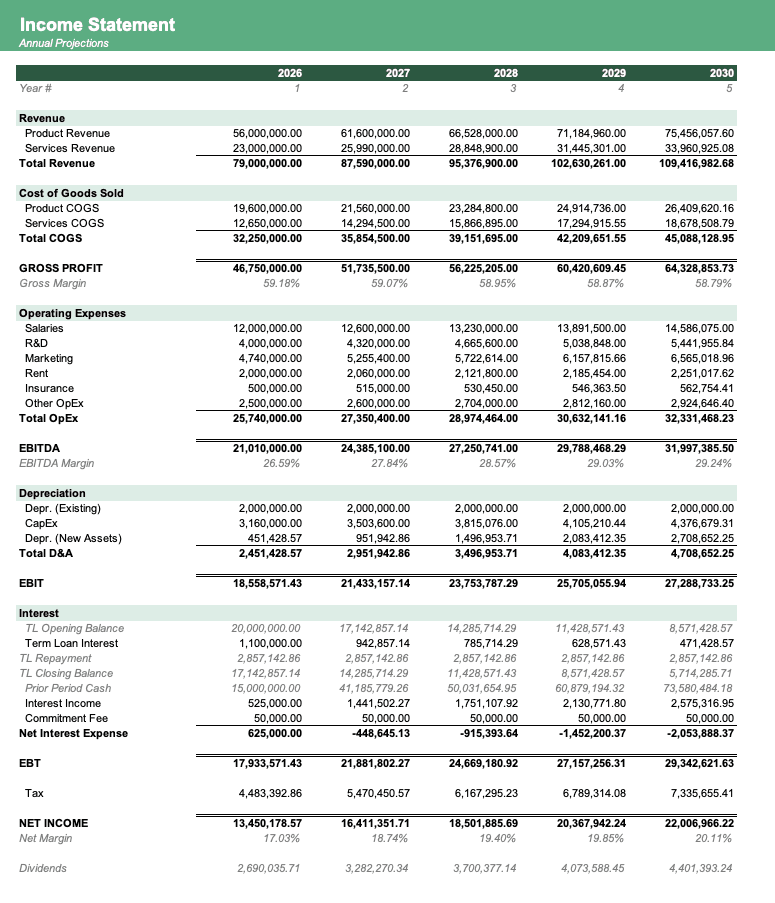
Named theme colors repaint the whole workbook in one click, on top of an investment-banking structure with clear input, output, and cross-sheet reference styling - brand-ready, institutional-grade, and fully auditable.

Created by ex-finance professionals
Hey, I’m Alex and I created Finamodel.
Over my years in the finance industry I kept building the same models over and over again. Same structure, same assumptions, different logo. So I started building frameworks to turn them into clean, reusable templates.
Every model here is one I’d actually use for a client, and I personally vet each one before it goes up.
I’m not an expert in every industry, but I’ve built enough models to know what belongs in one. And when something is completely foreign to me, I reach out to my network for experts to work on our models with us.
Having a template library on hand cuts a first build from hours to minutes.
Need help finding your model? You’ll find me in the Finamodel app!
Frequently asked
What is a bonus accrual model?+
It helps you estimate the year's bonuses, record the cost evenly each month, and plan when the cash will be paid.
What can I change?+
Update headcount, salary, target bonus, performance, employer costs, and the payout month. The workbook updates the pool, monthly expense, and liability for you.
Can I use it for more than five departments?+
Yes. Add rows for your departments and extend the formulas in the pool and summary sheets.
How is bonus cost recorded each month?+
The annual bonus pool is spread evenly across the year, so the monthly expense reflects the cost as it is earned.
When is the bonus paid?+
Choose the expected payout month. The model separates that cash payment from the monthly expense for the new bonus year.
Have more financial modelling questions? Contact us
Related templates
Payroll Forecast
12-month fully-loaded payroll forecast across five departments.
Accrued Expenses
12-month accrued-liability roll-forward with reversal timing across an accrual panel.
Stock-Based Compensation
Plan stock-based compensation expense, vesting, and remaining unrecognised cost in one place.
3 Statement Model
Integrated income statement, balance sheet, and cash flow forecasts.