Bank Resolution Loss Allocation Excel Model
Banking Financial Model (Excel Download)
See how losses in a bank resolution flow through each class of creditor. The workbook marks assets, applies the creditor hierarchy, sizes the conversion to new equity and shows headroom by tier.



professionals from Deloitte






About this model
A bank resolution valuation and loss allocation workbook for resolution, finance and risk teams. It shows how asset losses are absorbed by shareholders and creditors in a BRRD-style hierarchy. The shipped case is a fictional bank with nine asset portfolios and 13 claim records, in EUR millions.
Each portfolio takes a haircut to reach its resolution value, and execution costs are deducted. Secured claims up to marked collateral and covered deposits are excluded. Losses first wipe out equity, then write down each creditor class in order, pro rata within a class. Further claims convert to new equity until the target CET1 ratio is met on post-resolution risk-weighted assets.
On the shipped case net resolution assets are €782.4m, a loss of €217.6m. Equity absorbs €70m and creditors €147.6m, from Additional Tier 1 down to senior non-preferred. €48m converts to restore an 8% CET1 ratio. Headroom before ordinary unsecured creditors take losses is €12.4m, and stress waterfalls test asset and cost shocks.
What every model includes
Live formulas, no hardcoded values
Outputs are driven by live formulas, so the workbook updates from its assumptions instead of relying on hardcoded results.
All assumptions in one tab
Inputs are clearly marked in the Assumptions tab and separated from calculations, making it clear what to change and what to leave intact.
Statements always balancing
For integrated-statement models, the balance sheet, cash flow, and supporting schedules tie through properly.
Distinct schedules for clarity
Debt, working capital, taxes, and cash flow can get messy quickly. We group calculations in clear schedules, not across disconnected tabs.
No hidden macros or external links
There are no unexplained external workbook links or macros to undermine auditability or portability.
Changes flow through the model
Update a key driver and see the impact carry through the forecast, financing, and return outputs. We never use hardcoded numbers in formulas.
What's inside the Bank Resolution Loss Allocation Excel Model
- Asset portfolios with book value, haircut and resolution mark
- Pledged assets and marked collateral without double counting
- Execution cost deduction to net resolution assets
- Claim records with creditor type, rank and gross claim
- Exclusions for covered deposits and secured claims up to collateral
- Loss allocation through the creditor hierarchy, pro rata within each class
- Conversion to new CET1 to meet the target ratio
- Post-resolution CET1 ratio and closing balance check



Formatted to IB standards
Named theme colors repaint the whole workbook in one click, on top of an investment-banking structure with clear input, output, and cross-sheet reference styling - brand-ready, institutional-grade, and fully auditable.

Created by ex-finance professionals
Hey, I’m Alex and I created Finamodel.
Over my years in the finance industry I kept building the same models over and over again. Same structure, same assumptions, different logo. So I started building frameworks to turn them into clean, reusable templates.
Every model here is one I’d actually use for a client, and I personally vet each one before it goes up.
I’m not an expert in every industry, but I’ve built enough models to know what belongs in one. And when something is completely foreign to me, I reach out to my network for experts to work on our models with us.
Having a template library on hand cuts a first build from hours to minutes.
Frequently asked
What is bank resolution loss allocation?+
When a bank fails, its losses are allocated to shareholders and creditors in a set order, often called bail-in. This workbook values the bank's assets and shows which classes absorb the loss and how much debt converts to new equity.
Which claims are excluded?+
Covered deposits are excluded, and secured claims are excluded up to the value of their marked collateral. Any unsecured part of a secured claim stays in its class and can absorb losses.
How is the recapitalization sized?+
After losses are absorbed, further claims convert to new CET1 until the target ratio is met on post-resolution risk-weighted assets. Loss, write-down and conversion are shown separately.
What does the workbook not claim?+
It uses an illustrative BRRD-style hierarchy with selected national assumptions. It is not a legal certification or a market recovery valuation. Class order and asset marks need legal and valuation review.
How do I adapt it?+
Enter your asset portfolios and haircuts, the claim records with ranks and flags, and the execution cost, target ratio and post-resolution RWA. Review the breakpoints and stress waterfalls.
Have more financial modelling questions? Contact us
Related templates
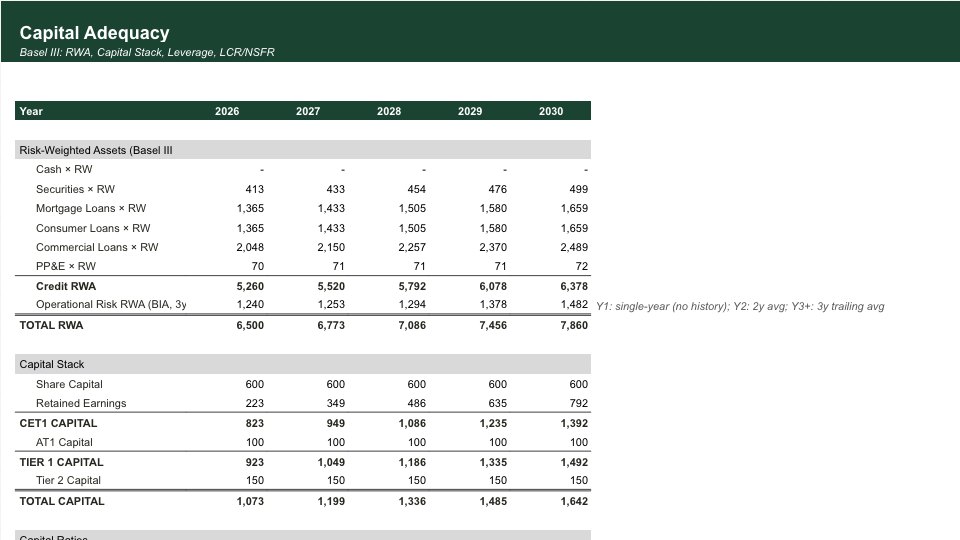
Bank Capital Adequacy Model
Regulatory capital calculations and stress testing for banks.
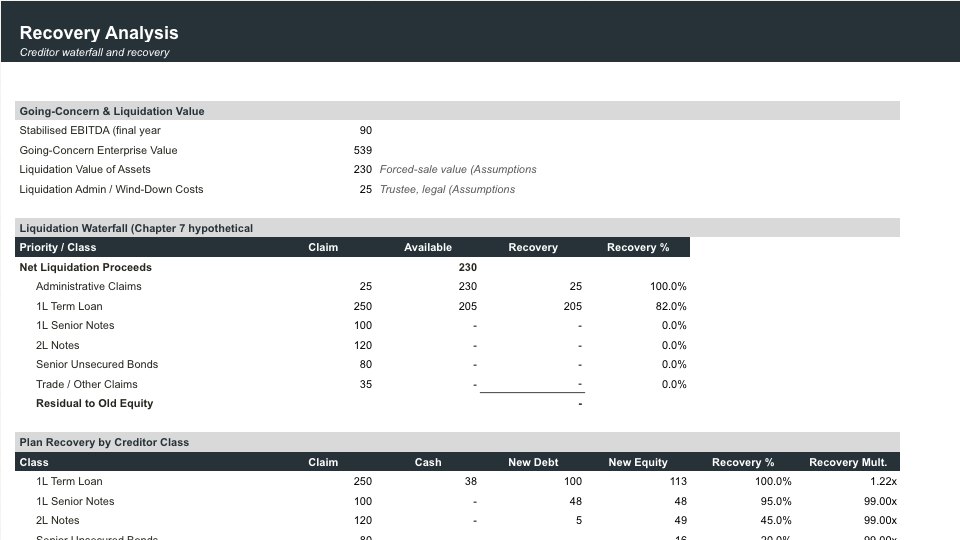
Debt Restructuring and Out-of-Court Model
Restructured debt terms, covenant relief, and debtor recovery for out-of-court and bankruptcy scenarios.
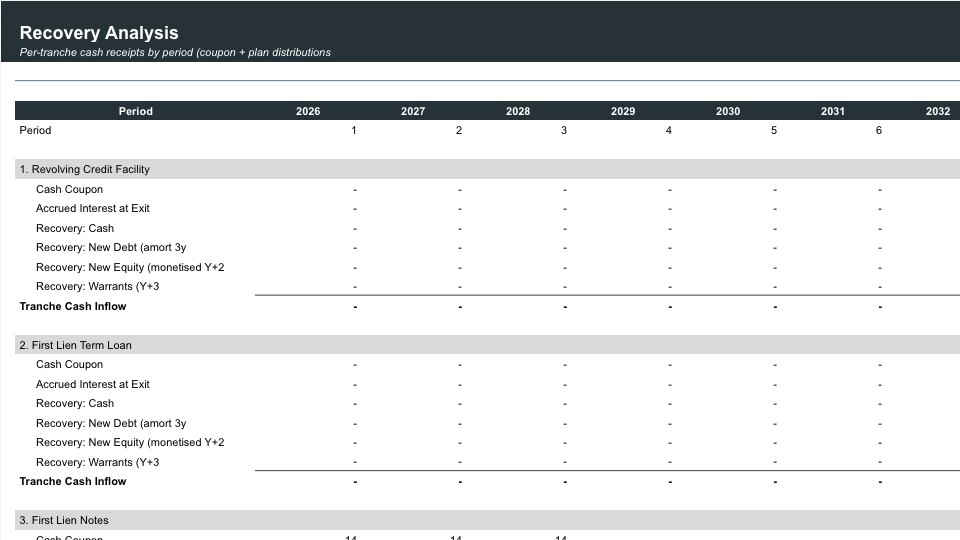
Distressed Debt Analysis
Valuation and recovery analysis for distressed bonds and loans with recovery timeline and outcomes.
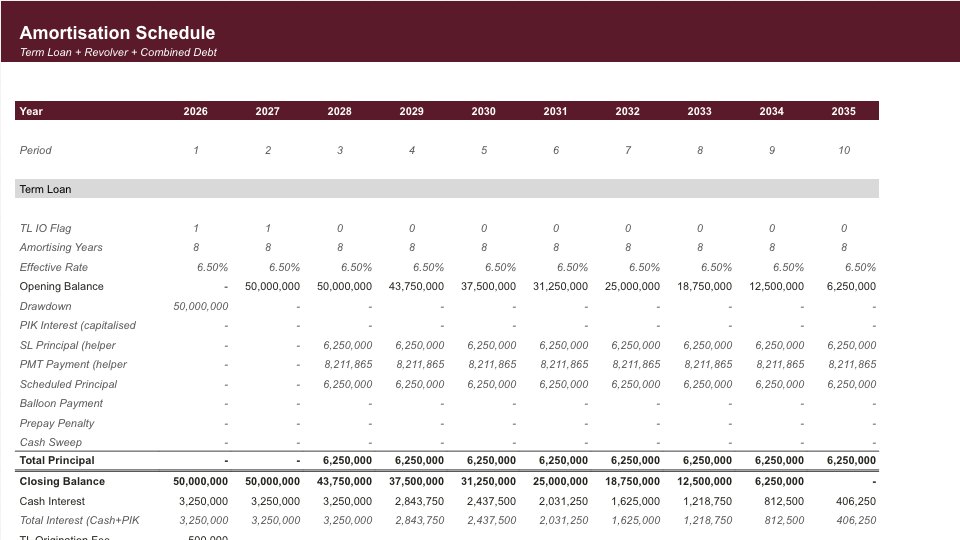
Bank Loan Analysis Model
Commercial bank loan origination and portfolio underwriting.







