Stock-Based Compensation
Corporate Finance Financial Model (Free Excel Download)
Forecast employee equity expense and dilution through grant sizes, vesting schedules, award balances, and compensation outputs for budgeting and workforce planning.



professionals from Deloitte
Used by professionals from






About this model
This stock-based compensation model gives finance teams a practical view of options, RSUs, performance awards, and employee share plans. It brings grant details, vesting, expense, and remaining cost together in a monthly schedule.
Use it when preparing budgets, forecasting payroll costs, or explaining equity compensation to management and auditors. Different grant types remain easy to compare without turning the workbook into an accounting manual.
What every model includes
Live formulas, no hardcoded values
Outputs are driven by live formulas, so the workbook updates from its assumptions instead of relying on hardcoded results.
All assumptions in one tab
Inputs are clearly marked in the Assumptions tab and separated from calculations, making it clear what to change and what to leave intact.
Statements always balancing
For integrated-statement models, the balance sheet, cash flow, and supporting schedules tie through properly.
Distinct schedules for clarity
Debt, working capital, taxes, and cash flow can get messy quickly. We group calculations in clear schedules, not across disconnected tabs.
No hidden macros or external links
There are no unexplained external workbook links or macros to undermine auditability or portability.
Changes flow through the model
Update a key driver and see the impact carry through the forecast, financing, and return outputs. We never use hardcoded numbers in formulas.
What's inside the Stock-Based Compensation
- Eight tranches: founder options, CEO options, executive options, engineering RSUs, sales RSUs, performance SUs, ESPP, new-hire RSUs
- Per-tranche awards granted, grant-date fair value, vesting months, cliff months, elapsed service, forfeiture rate
- Grant Master with net awards, grant value, monthly straight-line expense, opening unrecognised, weighting
- Per-tranche Vesting Schedule with cliff-and-graded cumulative vested across 12 months and a final-month column
- Per-tranche Expense Schedule with ASC 718 expense, panel total row, and annual total column
- SBC Register: panel monthly opening / expense / closing unrecognised plus cumulative expense, cumulative vested, vested in month, SBC vs payroll
- Dashboard with annual SBC, opening and closing unrecognised, cumulative vested at M12, SBC vs payroll, weighted remaining vesting, peak month
- Per-tranche composition block with grant value, opening unrecognised, and annual expense
Stock-Based Compensation Model: How the Template Works
This stock-based compensation model template gives finance teams a structured way to project equity award costs. It translates grant details and vesting assumptions into monthly expense, unrecognised balances, and dilution metrics.
The design supports budgeting, forecasting, and audit discussions by showing the relationships between awards, service, and financial statement impact.
Grant-Level Inputs and Operating Drivers
The model covers eight award tranches, each with its own grant package and vesting terms. Inputs include awards granted, grant-date fair value per award, vesting period, cliff months, elapsed service months, expected forfeiture rate, grant month within the 12-month window, achievement probability, and actual forfeitures.
- A modifications block handles incremental fair value and cancellation acceleration, while operating drivers capture payroll, revenue, diluted shares outstanding, average share price, and statutory withholding. A forfeiture method switch toggles between expected and actual forfeiture treatment.
- These assumptions feed every downstream schedule, so flexing any input cell updates the expense and vesting calculations.
Calculation Flow and Vesting Convention
The calculation starts by converting gross awards into net expected awards using forfeiture and achievement probability. Grant value is net awards multiplied by fair value, and monthly expense is that value spread straight-line over the vesting period.
- Expense is recognised only when the month is at or after the grant month and the service-month-end is within the vesting term. Vesting follows a cliff-then-linear-from-grant convention: zero before the cliff, a catch-up to the cliff fraction at the cliff anniversary, then straight-line accrual thereafter.
- Modification expense adds incremental fair value over remaining vesting, and a monthly forfeiture true-up adjusts at month 12 under the actual method. Cumulative vested awards are computed on both expected and gross bases, with a hidden baseline column ensuring the vested-in-month figure correctly references the pre-window position.
Outputs and Integrity Checks
The SBC Register rolls forward opening unrecognised expense, base, modification, true-up and total expense, closing unrecognised, cumulative expense, cumulative vested, vested in month, net shares delivered after withholding, and intensity ratios against payroll and revenue.
- The Dashboard summarises annual SBC, unrecognised balances, burn rate, overhang, weighted-average remaining vesting period, peak monthly expense, and treasury-stock-method incremental dilutive shares.
- Ten PASS/FAIL checks validate roll-forward identity, vested-versus-awards caps, non-negative expense, monthly sums equalling annual totals, function allocation summing to 100% per tranche, probability bounds, vesting greater than or equal to cliff, positive revenue and diluted shares, and a valid forfeiture method.
Practical Use and Documented Scope
This model helps operators estimate equity compensation expense for budgets, forecasts, and management reporting. It lets different award types — options, RSUs, performance shares, ESPP, and new-hire pools — sit side by side for comparison.
- The function-allocation block traces SBC into COGS, R&D, S&M, and G&A buckets, while net shares delivered and TSM incremental shares support dilution analysis. Several items are deliberately out of scope: modification accounting nuance, ESPP look-back fair value, periodic PSU true-ups, market-condition PSU re-estimation, Black-Scholes decomposition, tax effects, full cap-table mechanics, and integration with downstream financial statements.
- The public download is a values-only preview; the underlying model captures these relationships without providing live formulas.
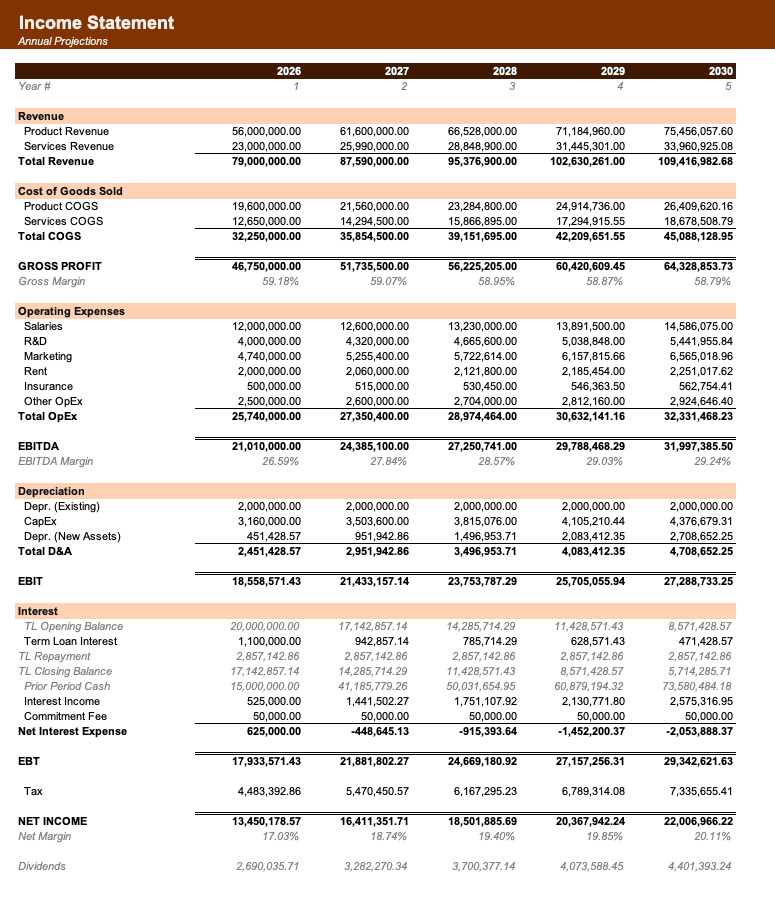
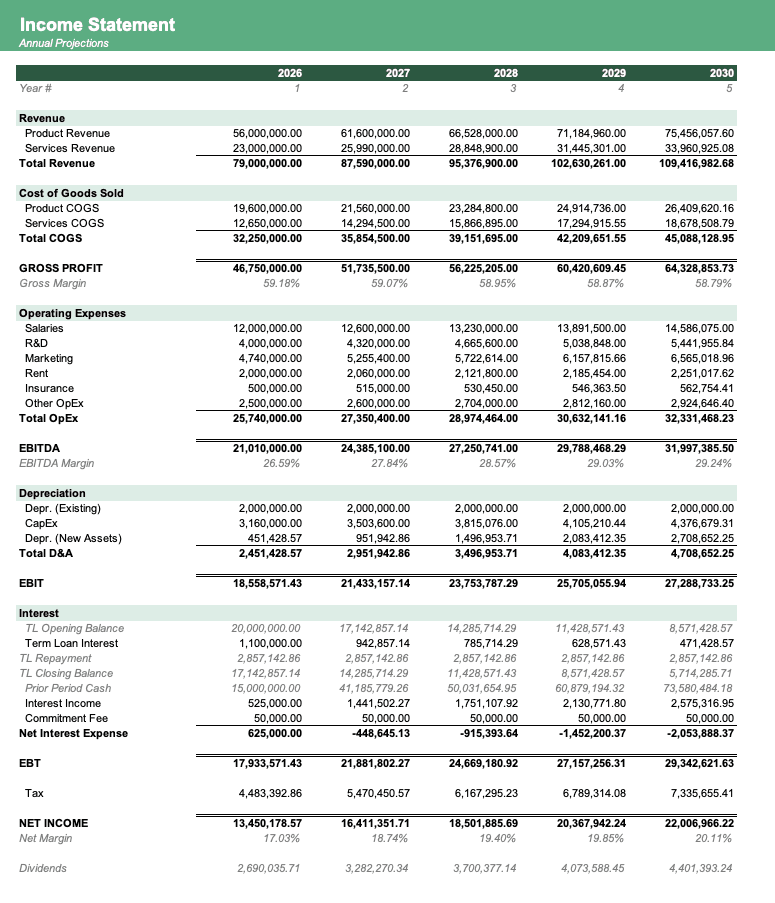
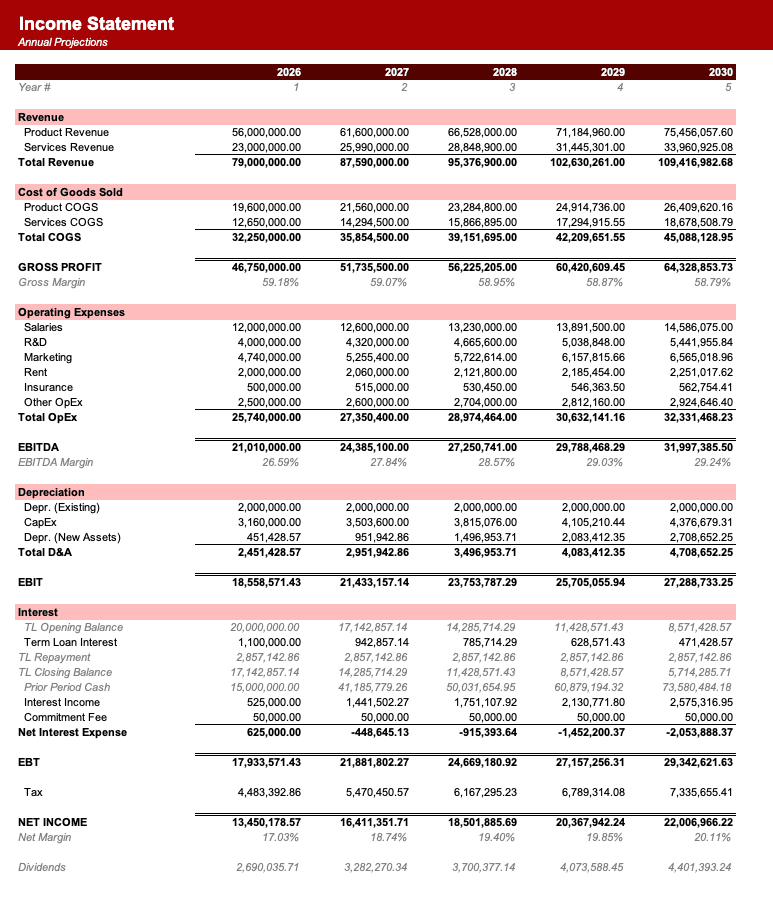
Formatted to IB standards
Named theme colors repaint the whole workbook in one click, on top of an investment-banking structure with clear input, output, and cross-sheet reference styling - brand-ready, institutional-grade, and fully auditable.

Created by ex-finance professionals
Hey, I’m Alex and I created Finamodel.
Over my years in the finance industry I kept building the same models over and over again. Same structure, same assumptions, different logo. So I started building frameworks to turn them into clean, reusable templates.
Every model here is one I’d actually use for a client, and I personally vet each one before it goes up.
I’m not an expert in every industry, but I’ve built enough models to know what belongs in one. And when something is completely foreign to me, I reach out to my network for experts to work on our models with us.
Having a template library on hand cuts a first build from hours to minutes.
Need help finding your model? You’ll find me in the Finamodel app!
Frequently asked
What is a stock-based compensation model?+
A stock-based compensation (SBC) model is an equity-award register that translates per-tranche grant packages into an ASC 718 income-statement expense schedule and an unrecognised-SBC balance path. It is how CFOs, controllers, and FP&A teams accrue SBC each period and explain the next-12-month expense trajectory to the board.
How is the monthly expense computed?+
Monthly expense per tranche = awards * (1 - forfeiture rate) * fair value / vesting months. The expected-forfeiture method applies the forfeiture haircut up-front, so the recognised expense is flat across the vesting period.
How does cliff vesting fit into ASC 718?+
ASC 718 requires expense to be attributed straight-line from grant date over the requisite service period, even though cliff awards legally vest in a lump at the cliff date. This template tracks both paths: the expense is straight-line on the Expense Schedule, while the Vesting Schedule shows the legal vesting curve (zero before cliff, full at vesting, linear in between).
Does it true up for actual forfeitures?+
No. The template uses the expected-forfeiture method, where the forfeiture rate is applied up-front. ASC 718 also permits an actual-forfeiture method that trues up each period as awards are forfeited. Switching is a per-period adjustment to the forfeiture input.
Can I extend it beyond 12 months?+
Yes. The builder is parameterised by N_MONTHS - bump it and rerun. The Expense Schedule, Vesting Schedule, and SBC Register all use a column-position trick so the formulas adapt to a wider horizon.
Have more financial modelling questions? Contact us
Related templates
Cap Table Management Model
Equity ownership tracking and scenario modeling.
ESOP Pool Model
Employee Stock Ownership Plan model with vesting, allocation, and dilution impact.
3 Statement Model
Integrated income statement, balance sheet, and cash flow forecasts.
M&A Modeling & Valuation
Comprehensive M&A valuation with DCF, comparable companies, and precedent transactions analysis.