Capital Rationing Project Selection Model
Budgeting Financial Model (Excel Download)
Choose the best mix of capital projects when money and people are limited. The model tests every combination against budget, staff and risk limits and picks the set with the highest NPV.



professionals from Deloitte






About this model
A capital rationing model that selects a portfolio of discrete projects. The starting case is a fictional manufacturer with eight candidate projects, such as an automation cell, plant expansion and warehouse robotics. Each has capex and cash inflows for three years plus engineering staff and risk points. Limits cover capex in each year, engineering staff and total risk.
The model lists all 256 combinations of the eight projects. Each one is tested against every limit, one mutually exclusive pair and one dependency, where a project needs its prerequisite. The feasible set with the highest NPV wins, with a clear tie rule. A review sheet compares the top three feasible sets and their headroom, and a grid reruns the search for different capital and risk caps.
In the case the best portfolio has an NPV of $26.45m, using four projects: automation cell, contract outsourcing, digital twin and fleet replacement. The runner-up is only $0.34m lower. At a risk cap of 14, raising first-year capital from $8m to $23m lifts optimal NPV from $10.84m to $26.45m.
What every model includes
Live formulas, no hardcoded values
Outputs are driven by live formulas, so the workbook updates from its assumptions instead of relying on hardcoded results.
All assumptions in one tab
Inputs are clearly marked in the Assumptions tab and separated from calculations, making it clear what to change and what to leave intact.
Statements always balancing
For integrated-statement models, the balance sheet, cash flow, and supporting schedules tie through properly.
Distinct schedules for clarity
Debt, working capital, taxes, and cash flow can get messy quickly. We group calculations in clear schedules, not across disconnected tabs.
No hidden macros or external links
There are no unexplained external workbook links or macros to undermine auditability or portability.
Changes flow through the model
Update a key driver and see the impact carry through the forecast, financing, and return outputs. We never use hardcoded numbers in formulas.
What's inside the Capital Rationing Project Selection Model
- Eight editable project slots with three years of capex and inflows
- NPV for each project at an editable discount rate
- Capital caps for each of three years
- Engineering staff cap and risk points cap
- One mutually exclusive pair and one dependency rule
- Full search of all 256 project combinations
- Highest-NPV feasible portfolio with a tie rule
- Top three feasible portfolios with headroom on each limit



Formatted to IB standards
Named theme colors repaint the whole workbook in one click, on top of an investment-banking structure with clear input, output, and cross-sheet reference styling - brand-ready, institutional-grade, and fully auditable.

Created by ex-finance professionals
Hey, I’m Alex and I created Finamodel.
Over my years in the finance industry I kept building the same models over and over again. Same structure, same assumptions, different logo. So I started building frameworks to turn them into clean, reusable templates.
Every model here is one I’d actually use for a client, and I personally vet each one before it goes up.
I’m not an expert in every industry, but I’ve built enough models to know what belongs in one. And when something is completely foreign to me, I reach out to my network for experts to work on our models with us.
Having a template library on hand cuts a first build from hours to minutes.
Frequently asked
What is capital rationing?+
Capital rationing is choosing which projects to fund when there is not enough money or resource for all of them. The goal is to pick the set that adds the most value within the limits. It is a common task in annual capex planning.
How does the model find the best set?+
With eight projects there are 256 possible combinations. The model tests every one against all limits and rules, then picks the feasible set with the highest NPV. This is exact, not an estimate.
Why is a positive-NPV project sometimes left out?+
A project can be good on its own but use too much capital, staff or risk budget. Leaving it out may allow a better combination of other projects. Rejection does not mean the project is bad.
What are the limits?+
The model holds eight project slots and one exclusive pair and one dependency. A ninth project needs the search extended. All projects and figures are fictional.
Can I enter my own projects?+
Yes. Replace the projects in the eight slots on Projects and set the discount rate, caps and rules on Assumptions. A zero cap is valid.
Have more financial modelling questions? Contact us
Related templates
Capex Planning
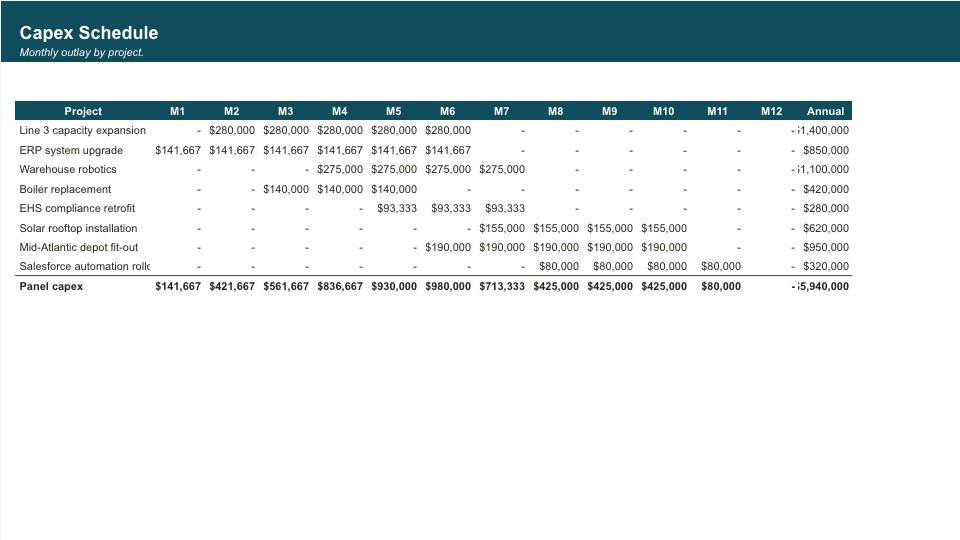
12-month capex portfolio plan with NPV economics, budget envelope tracking, and traffic-light approval status.
Real Options Investment Appraisal Model
Value the option to wait, expand or abandon a project with a binomial decision tree and compare it with fixed NPV.
Capital Project Cost to Complete and Change Control
Forecast final cost by work package from actuals, contracts and changes, and compare it with the authorized budget.
Production Cost Variance Analysis
Split the gap between standard and actual factory cost into material, labor and overhead variances by order.







