Real Options Investment Appraisal Excel Model
Valuation Financial Model (Excel Download)
Put a value on management flexibility. The model rolls back a binomial decision tree to price the choice to invest now, wait, expand or abandon, and checks each step against approval limits.



professionals from Deloitte






About this model
A real options model that values flexibility in a staged investment. The starting case is a fictional storage project with an asset value of $100m and an initial investment of $95m. Four cases sit on one selector: Base, Fee, Tight cap and High fee, which change the licence cost and approval limits.
Project value moves up or down on a two-step recombining tree with risk-neutral probabilities. At year two an active project can operate, expand or abandon for salvage, and a project not yet started can invest at escalated capex. Backward induction then picks invest, wait or walk away at year one and today. A stage register sets a separate approval limit for each decision.
In the Base case the fixed commitment NPV is $5m, investing now with flexibility is worth $24.59m and waiting is worth $40.40m, so the model recommends waiting. The maximum viable licence is about $15.81m. A check sheet tests the martingale identity, asset present value, the policy value bridge and that a blocked action stays blocked.
What every model includes
Live formulas, no hardcoded values
Outputs are driven by live formulas, so the workbook updates from its assumptions instead of relying on hardcoded results.
All assumptions in one tab
Inputs are clearly marked in the Assumptions tab and separated from calculations, making it clear what to change and what to leave intact.
Statements always balancing
For integrated-statement models, the balance sheet, cash flow, and supporting schedules tie through properly.
Distinct schedules for clarity
Debt, working capital, taxes, and cash flow can get messy quickly. We group calculations in clear schedules, not across disconnected tabs.
No hidden macros or external links
There are no unexplained external workbook links or macros to undermine auditability or portability.
Changes flow through the model
Update a key driver and see the impact carry through the forecast, financing, and return outputs. We never use hardcoded numbers in formulas.
What's inside the Real Options Investment Appraisal Excel Model
- Two-step recombining binomial tree under risk-neutral probabilities
- Choices to invest now, wait, expand, abandon or walk away
- Fixed commitment NPV against option value with flexibility
- Four cases on one selector: Base, Fee, Tight cap and High fee
- Switches to turn deferral, expansion and abandonment on or off
- Stage register with decision dates, approval body, limit and headroom
- Next action by realised up or down state
- Expansion trigger, abandonment threshold and maximum viable licence



Formatted to IB standards
Named theme colors repaint the whole workbook in one click, on top of an investment-banking structure with clear input, output, and cross-sheet reference styling - brand-ready, institutional-grade, and fully auditable.

Created by ex-finance professionals
Hey, I’m Alex and I created Finamodel.
Over my years in the finance industry I kept building the same models over and over again. Same structure, same assumptions, different logo. So I started building frameworks to turn them into clean, reusable templates.
Every model here is one I’d actually use for a client, and I personally vet each one before it goes up.
I’m not an expert in every industry, but I’ve built enough models to know what belongs in one. And when something is completely foreign to me, I reach out to my network for experts to work on our models with us.
Having a template library on hand cuts a first build from hours to minutes.
Frequently asked
What is a real option?+
A real option is a right, but not a duty, to take a business action later, such as to delay, expand or abandon a project. These rights have value because you can act after you learn more. A standard NPV does not capture that value.
How does the decision tree work?+
Project value moves up or down each year. At the end, each path picks its best action. The model then works back to today, discounting at the risk-free rate with risk-neutral probabilities, and picks the best action at each step.
Why does the model recommend waiting?+
In the Base case waiting is worth more than investing now because the down state can be avoided. The fixed NPV is positive, but the option to delay adds more value than it costs.
What are the limits?+
The tree has two steps and uses a simplified risk-neutral framework. The up and down moves describe scenarios, not forecast probabilities. All values are fictional.
Can I change the project or limits?+
Yes. Edit the project value, investment, multipliers, expansion and salvage inputs on the Assumptions sheet. Change the case to test tighter limits or higher fees.
Have more financial modelling questions? Contact us
Related templates
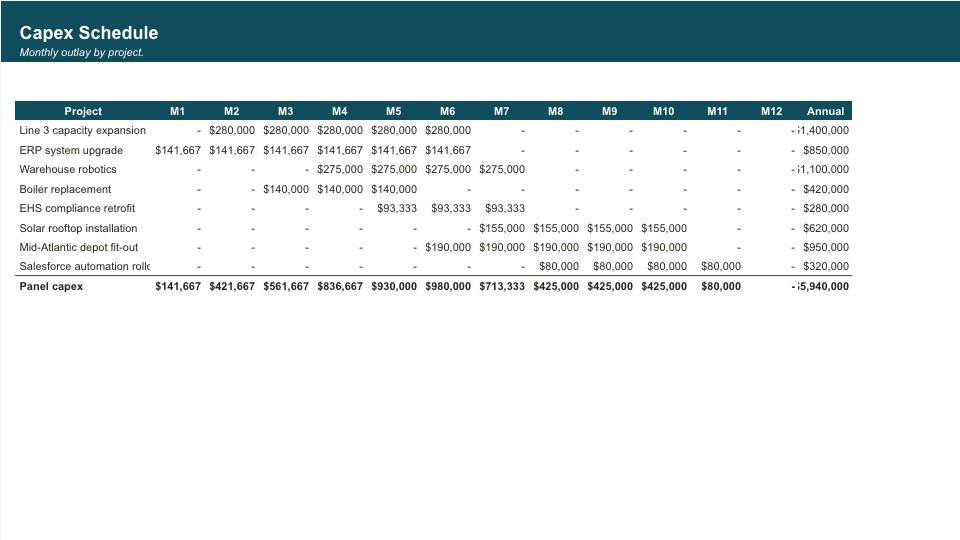
Capex Planning
12-month capex portfolio plan with NPV economics, budget envelope tracking, and traffic-light approval status.
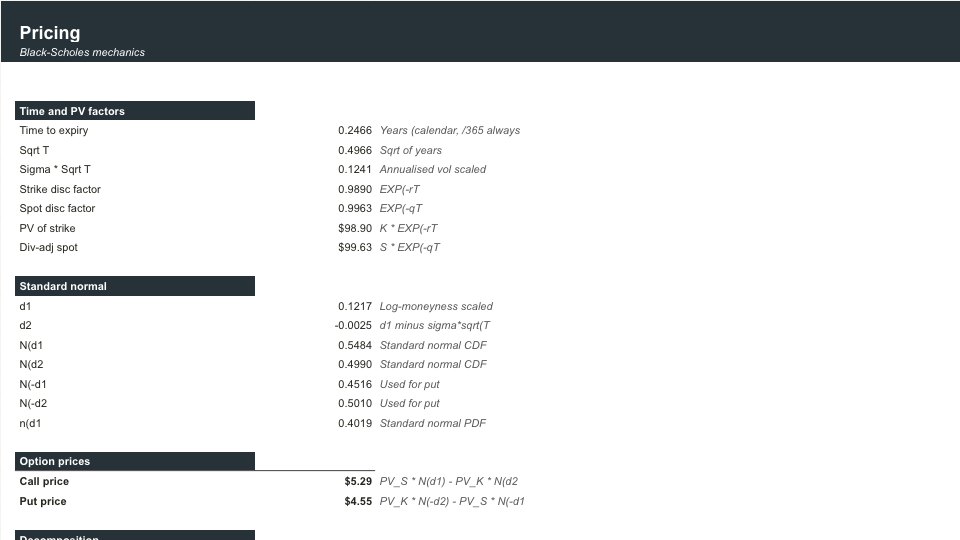
Option Pricing
Black-Scholes call and put prices with Greeks, payoff grid, and two-way sensitivity.
Capital Project Portfolio Optimizer
Pick the set of capital projects with the highest NPV within yearly capex, staff and risk limits, with exclusive and dependent projects.
Adjusted Present Value (APV) Model
Compare two financing offers with adjusted present value: tax shields, fees, risk costs, liquidity and coverage tests.







