Corporate Card Reconciliation Tracker
Operating Businesses Financial Model (Excel Download)
Reconcile each corporate card statement and code every charge correctly. The workbook classifies spending, holds charges with missing evidence and tracks recovery of any personal spend.



professionals from Deloitte






About this model
A corporate card reconciliation for one cardholder's monthly statement. It ties the issuer statement, classifies each charge and controls the journals. The shipped case is one fictional cardholder's October cycle with ten transactions in USD, including a refund linked to its original charge.
Each charge needs a receipt, an approval and a cost code that match the exact amount. Approved charges go to expense, personal charges go to an employee receivable, and charges with missing or wrong evidence go to suspense. Evidence cases record the reason, owner and fix. The initial journal posts once, and later fixes move amounts out of suspense by reclassification, never by a second issuer entry.
On the shipped case card activity is $1,293: $820 business expense, $65 personal and $408 in suspense across four open cases. The issuer liability rolls forward from $300 opening, charges, a $40 refund and a $300 payment. The cycle closes only when journals are posted, cases are resolved and the employee repays the $65.
What every model includes
Live formulas, no hardcoded values
Outputs are driven by live formulas, so the workbook updates from its assumptions instead of relying on hardcoded results.
All assumptions in one tab
Inputs are clearly marked in the Assumptions tab and separated from calculations, making it clear what to change and what to leave intact.
Statements always balancing
For integrated-statement models, the balance sheet, cash flow, and supporting schedules tie through properly.
Distinct schedules for clarity
Debt, working capital, taxes, and cash flow can get messy quickly. We group calculations in clear schedules, not across disconnected tabs.
No hidden macros or external links
There are no unexplained external workbook links or macros to undermine auditability or portability.
Changes flow through the model
Update a key driver and see the impact carry through the forecast, financing, and return outputs. We never use hardcoded numbers in formulas.
What's inside the Corporate Card Reconciliation Tracker
- Issuer statement with charges, refunds and fees
- Issuer liability roll-forward from opening balance to closing
- Refunds linked to the original charge by card, employee and merchant
- Receipt, approval and cost code evidence for each charge
- Classification into business expense, personal and suspense
- Evidence cases with full exposure, owner, due date and fix
- Initial allocation journal posted once
- Reclassification out of suspense with no second issuer entry



Formatted to IB standards
Named theme colors repaint the whole workbook in one click, on top of an investment-banking structure with clear input, output, and cross-sheet reference styling - brand-ready, institutional-grade, and fully auditable.

Created by ex-finance professionals
Hey, I’m Alex and I created Finamodel.
Over my years in the finance industry I kept building the same models over and over again. Same structure, same assumptions, different logo. So I started building frameworks to turn them into clean, reusable templates.
Every model here is one I’d actually use for a client, and I personally vet each one before it goes up.
I’m not an expert in every industry, but I’ve built enough models to know what belongs in one. And when something is completely foreign to me, I reach out to my network for experts to work on our models with us.
Having a template library on hand cuts a first build from hours to minutes.
Frequently asked
What is a corporate card reconciliation?+
It checks each charge on a company card statement against receipts and approvals, codes it to the right account and ties the statement balance to the ledger. Personal charges are recovered from the cardholder.
What goes to suspense?+
Charges with a missing receipt, a receipt for the wrong amount, a pending approval or no cost code go to suspense. The full charge amount is held, not only the difference, until the evidence case is resolved.
Why is the issuer not credited again when cases are fixed?+
The issuer liability is booked once in the initial journal. When a case is fixed, a reclassification moves the amount from suspense to expense. The issuer side does not change.
What does the workbook not do?+
It does not create payment files or calculate tax or VAT. Foreign currency rows stay visible but are not converted. Closing the workpaper does not pay the remaining issuer balance.
How do I use it for my own cards?+
Replace the statement, receipts and approvals with your own data, keeping stable IDs, and refresh the independent issuer and cash controls on Source control. Do not overwrite formula cells.
Have more financial modelling questions? Contact us
Related templates
Employee Expense Reimbursement Claim
Check an employee expense claim line by line against receipts and policy, net any advance and show the amount payable now.
Bank Reconciliation
Match the bank statement to the cashbook, bridge both to adjusted cash and follow open timing items into next month.
Accrued Expenses
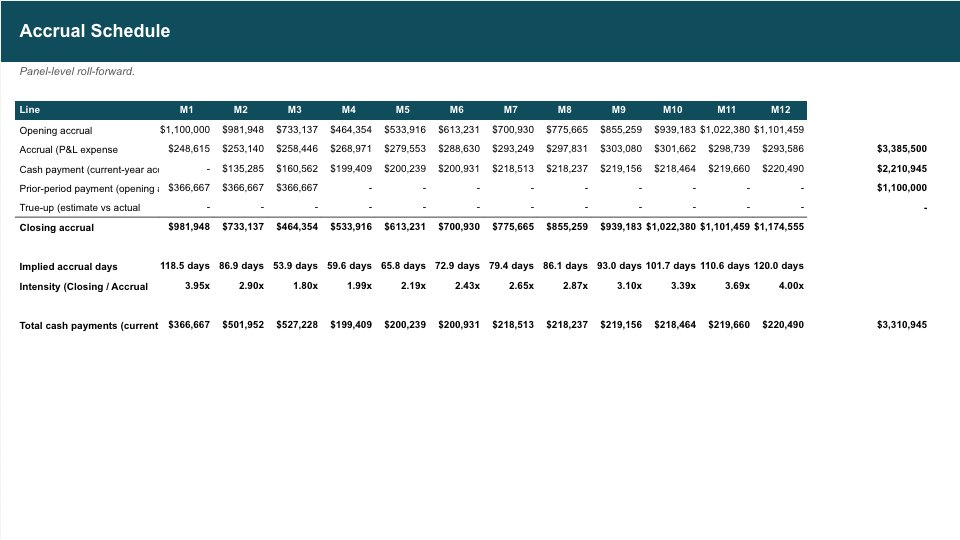
12-month accrued-liability roll-forward with reversal timing across an accrual panel.
Food Manufacturing Model
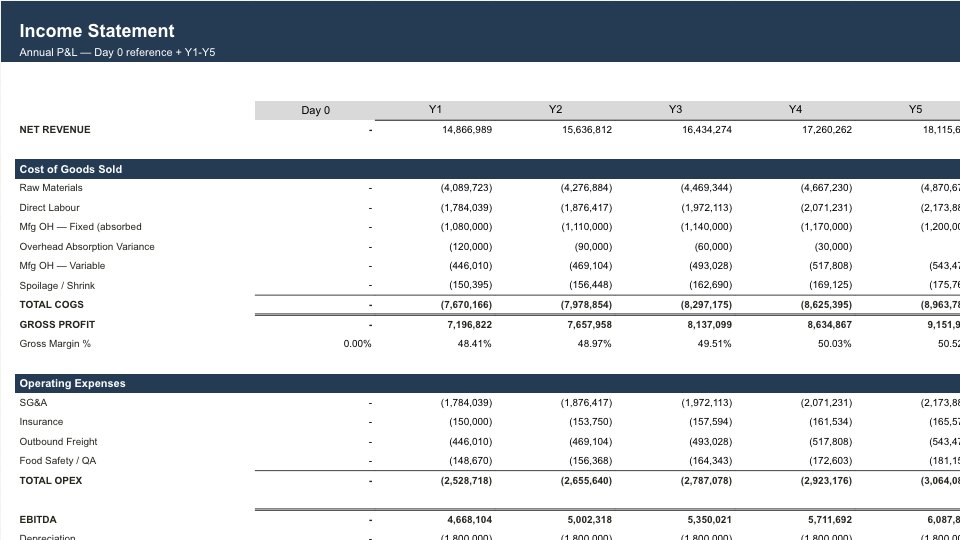
Operating model for food production and processing businesses with ingredient sourcing, production scheduling, and margin analysis.







