Deductions and Withholding Remittance Tracker
Operating Businesses Financial Model (Excel Download)
Check that what you withheld from staff and suppliers agrees with your returns, certificates and payments. The workbook shows what is safe to remit now and what must wait for a fix.



professionals from Deloitte






About this model
A remittance reconciliation for payroll deductions, employer contributions and supplier withholding. It covers one month for a fictional services company with four categories: employee pension, employer pension, a voluntary employee deduction and supplier withholding.
Expected amounts come from eligible bases and entered category rates. They are compared with booked amounts, filed returns, certificates and bank payments. A liability roll-forward runs from opening balance plus booked less cash. A staging sheet proposes the next payments with value dates and unique references, and tracks due dates.
On the shipped case the open liability is $1,065. $640 across three categories is eligible to stage before the due date. Supplier withholding of $425 is held because its return and certificate are each $25 short. These are reporting gaps, not extra tax.
What every model includes
Live formulas, no hardcoded values
Outputs are driven by live formulas, so the workbook updates from its assumptions instead of relying on hardcoded results.
All assumptions in one tab
Inputs are clearly marked in the Assumptions tab and separated from calculations, making it clear what to change and what to leave intact.
Statements always balancing
For integrated-statement models, the balance sheet, cash flow, and supporting schedules tie through properly.
Distinct schedules for clarity
Debt, working capital, taxes, and cash flow can get messy quickly. We group calculations in clear schedules, not across disconnected tabs.
No hidden macros or external links
There are no unexplained external workbook links or macros to undermine auditability or portability.
Changes flow through the model
Update a key driver and see the impact carry through the forecast, financing, and return outputs. We never use hardcoded numbers in formulas.
What's inside the Deductions and Withholding Remittance Tracker
- Entered category rates with authority or recipient
- Payroll and supplier detail with eligible base and expected amount
- Accrual, return and certificate deltas by category
- Remittance cash evidence with reference, date and bank statement
- Liability roll-forward from opening, booked and cash
- Duplicate cash reference check
- Payment candidate limited to undisputed categories
- Remittance staging with value date, reference and due date



Formatted to IB standards
Named theme colors repaint the whole workbook in one click, on top of an investment-banking structure with clear input, output, and cross-sheet reference styling - brand-ready, institutional-grade, and fully auditable.

Created by ex-finance professionals
Hey, I’m Alex and I created Finamodel.
Over my years in the finance industry I kept building the same models over and over again. Same structure, same assumptions, different logo. So I started building frameworks to turn them into clean, reusable templates.
Every model here is one I’d actually use for a client, and I personally vet each one before it goes up.
I’m not an expert in every industry, but I’ve built enough models to know what belongs in one. And when something is completely foreign to me, I reach out to my network for experts to work on our models with us.
Having a template library on hand cuts a first build from hours to minutes.
Frequently asked
What is a withholding remittance reconciliation?+
It checks that amounts withheld from employees and suppliers, plus employer contributions, agree with what was filed and paid to the authority or fund. Any unpaid balance is the open liability.
Why is a return gap not extra tax?+
If a return or certificate shows less than was booked, the documents need fixing. The liability is still the booked amount. The workbook shows these gaps apart from cash due.
How are payments staged?+
You enter a proposed amount, value date and unique reference for each eligible category. A blank is incomplete, zero means no payment, and a negative or over-eligible amount is held.
Does the workbook include statutory rates?+
No. Rates are entered company or contract rules. Enter the rates that apply to you and check them against your local rules.
How do I use it for a new month?+
Replace the transactions, returns, certificates and payments with the new period records. Carry the closing liability forward as the opening balance.
Have more financial modelling questions? Contact us
Related templates
Payroll Forecast
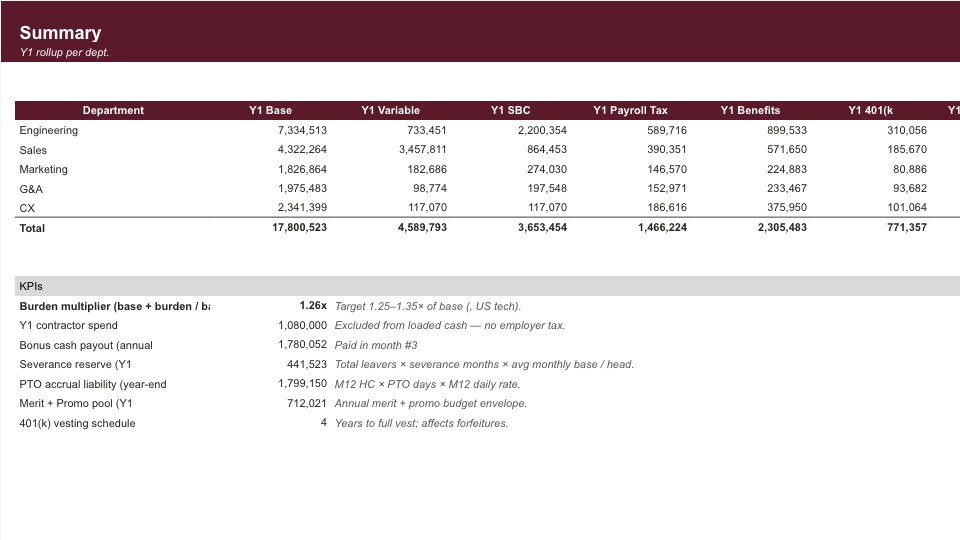
12-month fully-loaded payroll forecast across five departments.
Payroll Reconciliation and Variance Check
Tie HR headcount, approved pay, payroll output, bank payments and GL postings by employee and explain changes.
Gross-to-Net Payroll and Payslip Pack
Run gross-to-net payroll with linked payslips, a balanced payroll journal and a two-step bank release control.
Food Manufacturing Model
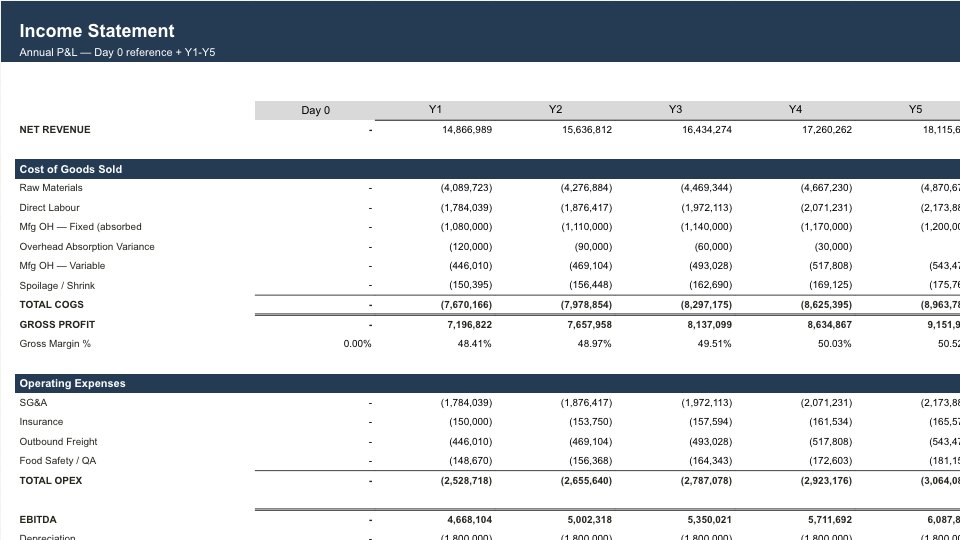
Operating model for food production and processing businesses with ingredient sourcing, production scheduling, and margin analysis.







