Deposit Beta and Pricing Analysis
Banking Financial Model (Excel Download)
Measure how much of a market rate move your bank passes to depositors. The study estimates deposit betas, sizes the funding cost of a rate shock and phases repricing through the year.



professionals from Deloitte






About this model
A deposit beta study for bank treasury and ALCO teams. It estimates how deposit rates and balances respond to market rate changes. The shipped case is a fictional bank with transaction and savings deposits over 37 months of observations.
Pooled OLS regresses the monthly change in paid rate on the change in market rate to give a pricing beta. A second fit links monthly balance growth to the prior gap between market and paid rates. Rising, falling and one-month-lag betas test stability, with a minimum sample and short-sample warnings. Selected planning betas and ranges are policy inputs kept apart from the fitted estimates.
On the shipped case the observed pricing betas are 0.24 for transaction and 0.62 for savings deposits. With planning betas of 0.25 and 0.60 and a 100bp shock, annual interest cost rises by $1.41m and $2.39m on the latest balances. The shock exceeds observed monthly steps, so the view flags extrapolation, and the assumption stays pending until cycle review.
What every model includes
Live formulas, no hardcoded values
Outputs are driven by live formulas, so the workbook updates from its assumptions instead of relying on hardcoded results.
All assumptions in one tab
Inputs are clearly marked in the Assumptions tab and separated from calculations, making it clear what to change and what to leave intact.
Statements always balancing
For integrated-statement models, the balance sheet, cash flow, and supporting schedules tie through properly.
Distinct schedules for clarity
Debt, working capital, taxes, and cash flow can get messy quickly. We group calculations in clear schedules, not across disconnected tabs.
No hidden macros or external links
There are no unexplained external workbook links or macros to undermine auditability or portability.
Changes flow through the model
Update a key driver and see the impact carry through the forecast, financing, and return outputs. We never use hardcoded numbers in formulas.
What's inside the Deposit Beta and Pricing Analysis
- Monthly market rates, paid rates and balances for two deposit products
- Pooled OLS pricing beta with R squared and standard error
- Normal-approximation confidence range for each beta
- Balance growth sensitivity to the prior rate gap
- Rising, falling and one-month-lag betas with sample checks
- Selected planning betas and lower and upper cases
- Annual interest cost change on latest balances for a rate shock
- Extrapolation flag when the shock exceeds observed moves



Formatted to IB standards
Named theme colors repaint the whole workbook in one click, on top of an investment-banking structure with clear input, output, and cross-sheet reference styling - brand-ready, institutional-grade, and fully auditable.

Created by ex-finance professionals
Hey, I’m Alex and I created Finamodel.
Over my years in the finance industry I kept building the same models over and over again. Same structure, same assumptions, different logo. So I started building frameworks to turn them into clean, reusable templates.
Every model here is one I’d actually use for a client, and I personally vet each one before it goes up.
I’m not an expert in every industry, but I’ve built enough models to know what belongs in one. And when something is completely foreign to me, I reach out to my network for experts to work on our models with us.
Having a template library on hand cuts a first build from hours to minutes.
Frequently asked
What is a deposit beta?+
A deposit beta is the share of a market rate change that a bank passes on to depositors. A beta of 0.25 means paid rates rise by a quarter of the market move. Betas drive funding cost and net interest margin forecasts.
How are the betas estimated?+
The study regresses the monthly change in each product's paid rate on the monthly change in the market rate, with an intercept. It reports the beta, R squared, standard error and an approximate 95% range.
Why are rising and falling betas shown as unavailable?+
In the shipped case market rates move in constant steps within each cycle, so there is no variation to estimate a slope. The study returns unavailable rather than a misleading number.
What are the limits?+
Funding cost holds the latest balances fixed for one year. The balance sensitivity is descriptive, not causal. A shock larger than observed monthly moves is extrapolation and is flagged.
How do I use it for my bank?+
Replace the observed monthly series with your own rates and balances. Set the planning betas, ranges and shock, then complete the review record before using the assumption.
Have more financial modelling questions? Contact us
Related templates
Bank Funds Transfer Pricing Curve Workbook
Build a bank's internal funding curve, charge and credit each loan and deposit, and test asset quotes under stress.
Bank Asset Liability Repricing Gap Workbook
Allocate a bank's assets and liabilities to repricing buckets, show the gap and estimate the one-year NII impact of rate moves.
Neobank Operating Model
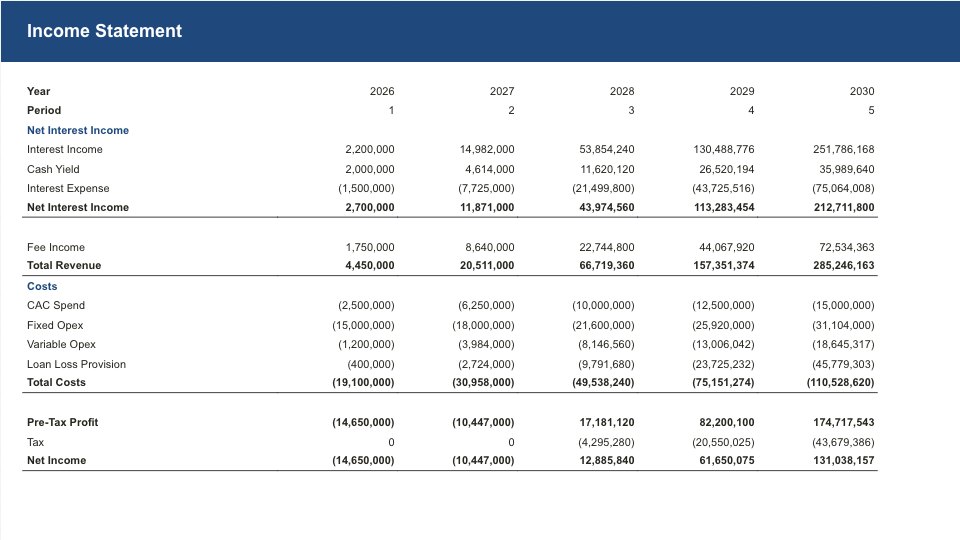
5-year digital-bank forecast: customer cohort, NIM, CET1 capital ratio, LTV/CAC, P&L and balance sheet.
Bank Loan Analysis Model
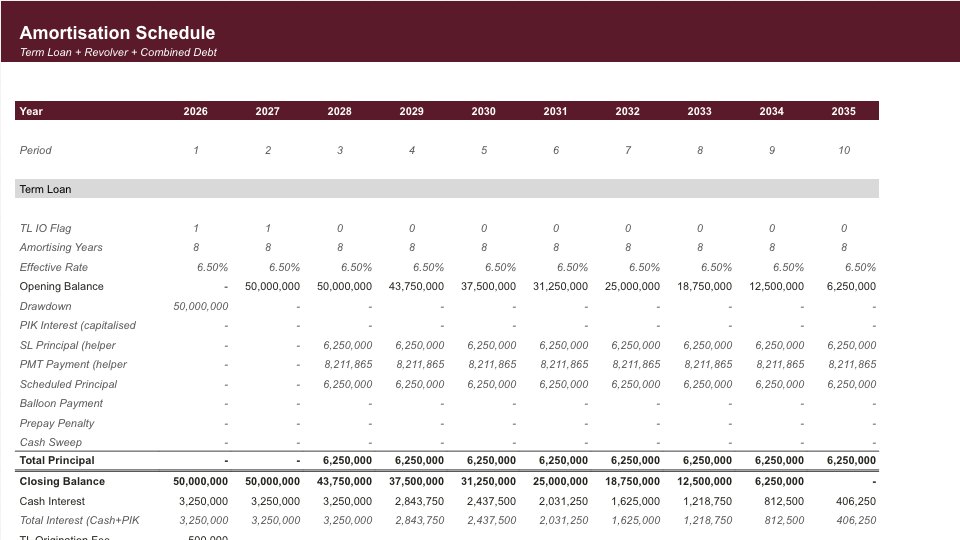
Commercial bank loan origination and portfolio underwriting.







