Free Cash Flow to Equity (FCFE) Valuation Excel Model
Valuation Financial Model (Excel Download)
Value a company's shares from the cash left for equity holders after debt flows. The model discounts that cash at the cost of equity and gives a value per share with clear checks.



professionals from Deloitte






About this model
A free cash flow to equity (FCFE) valuation. It values the shares directly, without first valuing the whole firm. The shipped case is a fictional equipment and service business with two revenue segments and a five-year forecast.
Segment EBIT, less interest on opening debt and cash tax, gives net income. FCFE then adds D&A, deducts capex and the increase in working capital, and adds net borrowing. The cash is discounted at the cost of equity. The terminal value keeps a stable debt-to-EBIT policy, so debt is not deducted a second time.
On the shipped case equity is worth $200.1m, or $11.12 per share, and the terminal value is 65% of the total. With no annual borrowing the value falls to $9.96 per share. Checks cover the FCFE bridge, the debt roll and a valid gap between cost of equity and growth.
What every model includes
Live formulas, no hardcoded values
Outputs are driven by live formulas, so the workbook updates from its assumptions instead of relying on hardcoded results.
All assumptions in one tab
Inputs are clearly marked in the Assumptions tab and separated from calculations, making it clear what to change and what to leave intact.
Statements always balancing
For integrated-statement models, the balance sheet, cash flow, and supporting schedules tie through properly.
Distinct schedules for clarity
Debt, working capital, taxes, and cash flow can get messy quickly. We group calculations in clear schedules, not across disconnected tabs.
No hidden macros or external links
There are no unexplained external workbook links or macros to undermine auditability or portability.
Changes flow through the model
Update a key driver and see the impact carry through the forecast, financing, and return outputs. We never use hardcoded numbers in formulas.
What's inside the Free Cash Flow to Equity (FCFE) Valuation Excel Model
- Five-year forecast with two revenue segments and segment EBIT margins
- Debt schedule with borrowing, repayment and interest on opening debt
- Net income to FCFE bridge with D&A, capex, working capital and net borrowing
- Working capital from receivable, inventory and payable days
- Discounting at the cost of equity
- Terminal value with a stable debt-to-EBIT policy
- Equity value, value per share and terminal value share
- Sensitivity of value to discount rate and growth



Formatted to IB standards
Named theme colors repaint the whole workbook in one click, on top of an investment-banking structure with clear input, output, and cross-sheet reference styling - brand-ready, institutional-grade, and fully auditable.

Created by ex-finance professionals
Hey, I’m Alex and I created Finamodel.
Over my years in the finance industry I kept building the same models over and over again. Same structure, same assumptions, different logo. So I started building frameworks to turn them into clean, reusable templates.
Every model here is one I’d actually use for a client, and I personally vet each one before it goes up.
I’m not an expert in every industry, but I’ve built enough models to know what belongs in one. And when something is completely foreign to me, I reach out to my network for experts to work on our models with us.
Having a template library on hand cuts a first build from hours to minutes.
Frequently asked
What is free cash flow to equity?+
Free cash flow to equity (FCFE) is the cash a company can pay to its shareholders after operating costs, tax, reinvestment and debt flows. It equals net income plus D&A, less capex and the increase in working capital, plus net borrowing.
How is FCFE valuation different from a DCF on free cash flow to the firm?+
A firm DCF discounts unlevered cash flow at WACC and then deducts net debt. FCFE valuation discounts cash after debt flows at the cost of equity, so it gives equity value directly. You must not deduct debt again.
Why does borrowing change the value?+
Net borrowing adds to FCFE in the years it is drawn, while the interest on it reduces net income. On the shipped case, annual borrowing of $7m gives a higher value per share than no borrowing.
When is the valuation not shown?+
The valuation status flags missing inputs, shares that are not positive and a cost of equity that is not above terminal growth. Terminal value, equity value and the sensitivities stay blank until these are fixed.
Can I change the forecast?+
Yes. Revenue, growth, margins, tax, D&A, capex, working capital days, debt flows and the cost of equity are blue input cells on the Assumptions sheet. The forecast, bridge and value update at once.
Have more financial modelling questions? Contact us
Related templates
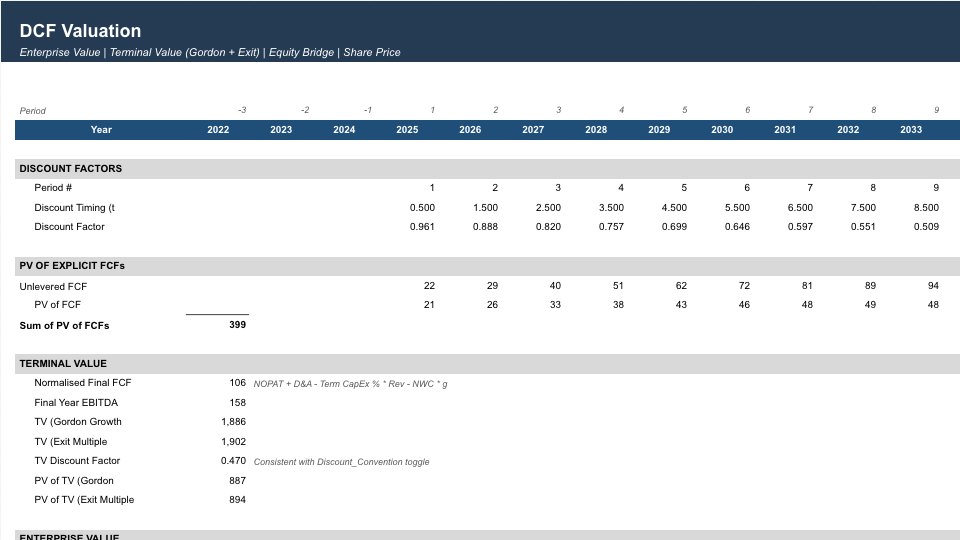
DCF Model
Discounted cash flow valuation model with explicit forecast, terminal value, and WACC.
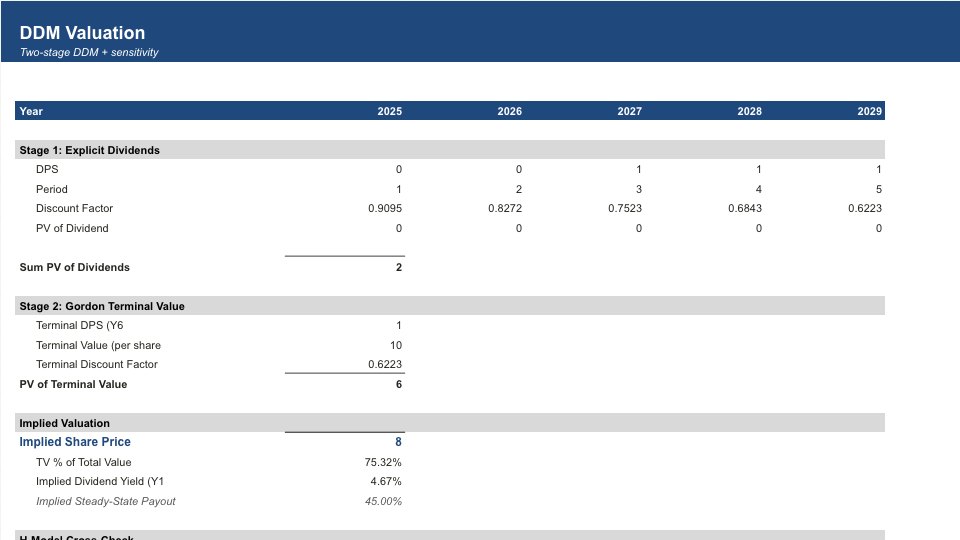
Dividend Discount Model
Valuation of dividend-paying stocks using multi-stage dividend growth and terminal yield.
Residual Income Valuation Model
Value equity from book value plus residual income, solve the implied terminal ROE and test how fast excess returns fade.
Adjusted Present Value (APV) Model
Compare two financing offers with adjusted present value: tax shields, fees, risk costs, liquidity and coverage tests.







