Fund Equalization and Series Accounting Excel Model
Capital Markets Financial Model (Excel Download)
Give every fund subscription its own series, high-water mark and performance fee. The workbook rolls each series month by month, crystallizes fees at period end and settles cash to investors and the manager.



professionals from Deloitte






About this model
A series accounting workbook for a hedge fund that charges a performance fee. Each subscription lot is issued as its own series with its own high-water mark, so investors who enter at different times pay a fair fee. The fictional case is an absolute return fund with six subscription lots from four investors in USD, across two half-years.
Each series issues at 100 and earns only returns after its entry date. A 20% fee with no hurdle accrues monthly and crystallizes only on June 30 and December 31. Accruals reverse in losses and underwater series stay separate. An equalization bridge shows how each series fee compares with a lead series, and the adjustment is never extra cash.
On the shipped case 6,400,000 is admitted and H1 gross profit is about 307,749. Incentive fees are about 70,693, and investor NAV closes at about 6,151,293 after redemptions. Investor redemptions of 485,763.15 and a manager payment of 50,000 are separate instructions, and sub-cent residuals stay visible.
What every model includes
Live formulas, no hardcoded values
Outputs are driven by live formulas, so the workbook updates from its assumptions instead of relying on hardcoded results.
All assumptions in one tab
Inputs are clearly marked in the Assumptions tab and separated from calculations, making it clear what to change and what to leave intact.
Statements always balancing
For integrated-statement models, the balance sheet, cash flow, and supporting schedules tie through properly.
Distinct schedules for clarity
Debt, working capital, taxes, and cash flow can get messy quickly. We group calculations in clear schedules, not across disconnected tabs.
No hidden macros or external links
There are no unexplained external workbook links or macros to undermine auditability or portability.
Changes flow through the model
Update a key driver and see the impact carry through the forecast, financing, and return outputs. We never use hardcoded numbers in formulas.
What's inside the Fund Equalization and Series Accounting Excel Model
- One series per subscription lot, each issued at 100
- Own high-water mark per series with no pooled HWM
- Monthly return index and lead series comparator
- Monthly performance fee accrual with reversal in losses
- Crystallization on June 30 and December 31 only
- Equalization bridge from lead series fee to actual series fee
- Investor capital by series, kept separate for each lot
- Subscription and AML register checks before admission



Formatted to IB standards
Named theme colors repaint the whole workbook in one click, on top of an investment-banking structure with clear input, output, and cross-sheet reference styling - brand-ready, institutional-grade, and fully auditable.

Created by ex-finance professionals
Hey, I’m Alex and I created Finamodel.
Over my years in the finance industry I kept building the same models over and over again. Same structure, same assumptions, different logo. So I started building frameworks to turn them into clean, reusable templates.
Every model here is one I’d actually use for a client, and I personally vet each one before it goes up.
I’m not an expert in every industry, but I’ve built enough models to know what belongs in one. And when something is completely foreign to me, I reach out to my network for experts to work on our models with us.
Having a template library on hand cuts a first build from hours to minutes.
Frequently asked
What is fund equalization?+
Equalization makes sure each investor pays a performance fee only on gains they earned. Investors who join at different times would otherwise share one fee. This workbook uses the multiple series method, where each subscription gets its own series and high-water mark.
How is the performance fee calculated?+
Each series accrues 20% of gains above its own high-water mark each month, with no hurdle. Accruals reverse if the series loses money. The fee crystallizes only on June 30 and December 31, and the high-water mark moves up only where a fee was earned.
What does the equalization adjustment mean?+
It shows the difference between the lead series fee and each series actual fee. It explains the fee only. It is never extra investor cash, shares or a second fee.
Are series consolidated after crystallization?+
No. Underwater series stay separate with their own NAV and high-water mark. There is no pooled high-water mark in this workbook.
Can I use other fee terms?+
You can change the fee rate, issue NAV and dates in Assumptions. The workbook assumes monthly dealing, USD only and crystallization at half-year ends. Other structures, such as a hurdle or FX classes, need changes to the formulas.
Have more financial modelling questions? Contact us
Related templates
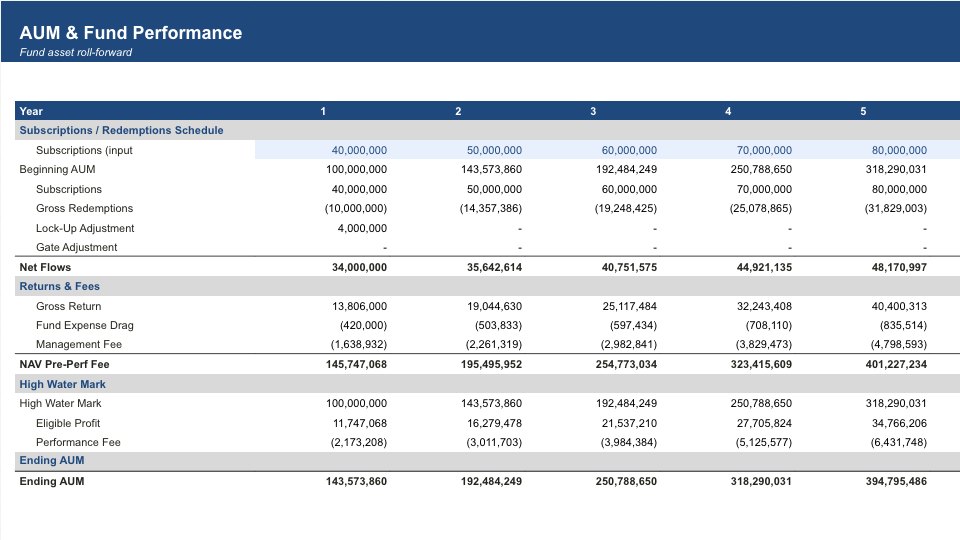
Hedge Fund Operating Model
Operating model for hedge funds including investor cash flows, fee structure, leverage, and performance-based compensation.
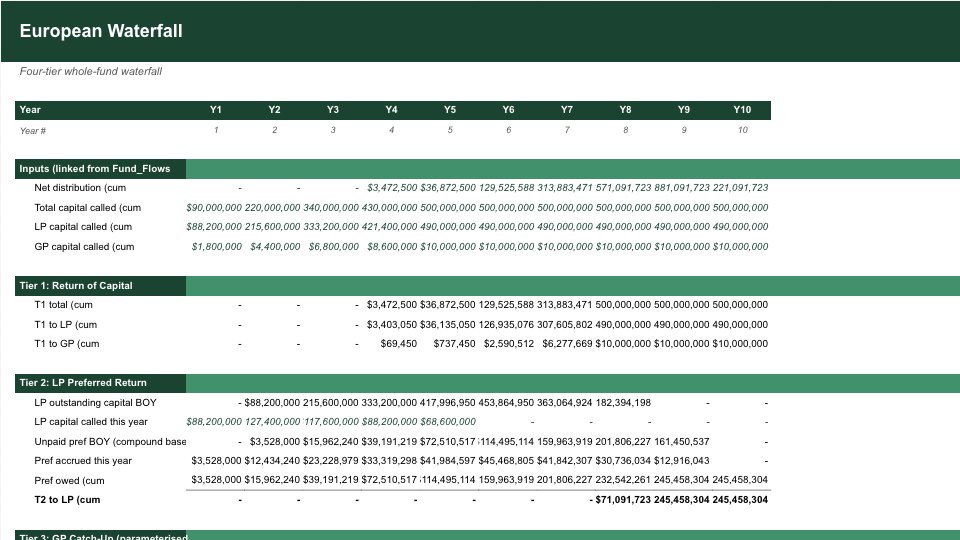
Carried Interest
European-waterfall PE / VC carried-interest model with LP MoIC and GP carry $.
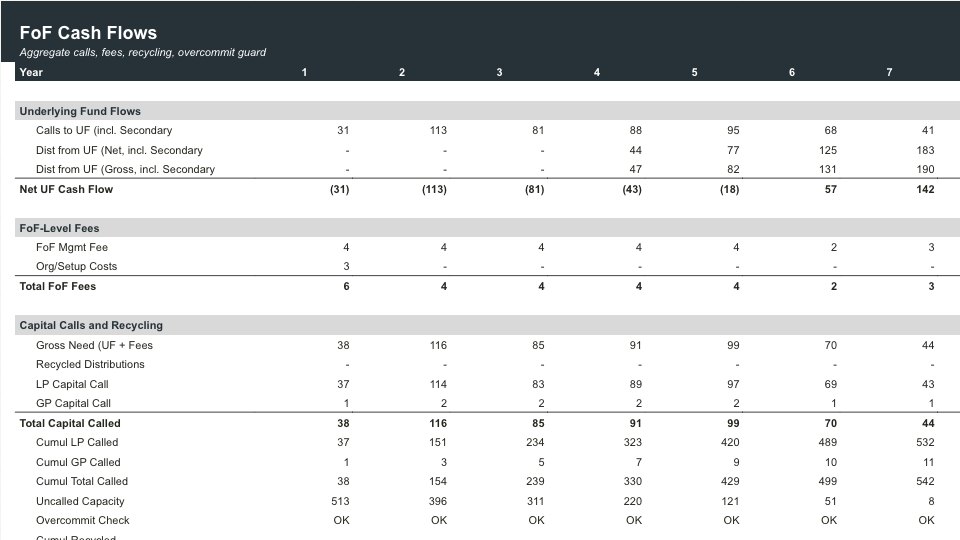
Fund of Funds Portfolio Model
Portfolio construction and performance tracking model for fund-of-funds vehicles investing across multiple manager-run funds.
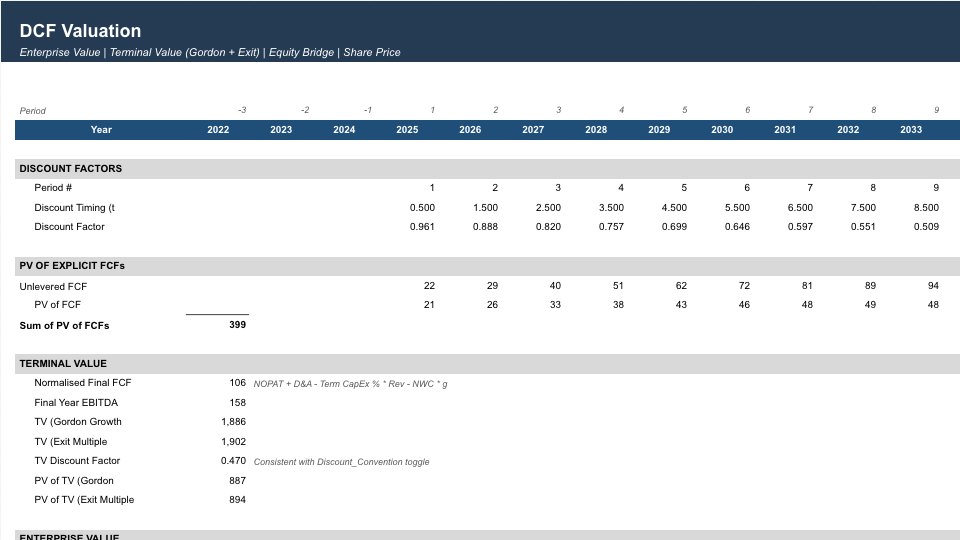
DCF Model
Discounted cash flow valuation model with explicit forecast, terminal value, and WACC.







