Inventory Movement and Ownership Reconciliation Tracker
Operating Businesses Financial Model (Excel Download)
Reconcile your stock ledger to physical and third-party counts at each location. The workbook keeps owned stock apart from stock you only hold and holds the close until every gap is explained.



professionals from Deloitte






About this model
An inventory reconciliation for stock held in your own sites, at third-party warehouses and at customer depots. It compares ledger units with counts for each SKU, custodian and legal owner, for one month of a fictional manufacturer with four SKU lines held at several locations.
Each line keeps its own SKU, custodian and owner, so unrelated gaps are never netted. Only approved adjustments change the adjusted ledger. Supplier-owned stock is shown but excluded from owned value. Transfers must pair an out ticket and an in ticket with the same value date, opposite signs and distinct custodians.
On the shipped case owned value is $25,060 and one Harbor 3PL line is 5 units short with dispatch proof missing. That gap shows as a potential $60 reduction, not a posting, so close readiness is on hold. The transfer pair is matched.
What every model includes
Live formulas, no hardcoded values
Outputs are driven by live formulas, so the workbook updates from its assumptions instead of relying on hardcoded results.
All assumptions in one tab
Inputs are clearly marked in the Assumptions tab and separated from calculations, making it clear what to change and what to leave intact.
Statements always balancing
For integrated-statement models, the balance sheet, cash flow, and supporting schedules tie through properly.
Distinct schedules for clarity
Debt, working capital, taxes, and cash flow can get messy quickly. We group calculations in clear schedules, not across disconnected tabs.
No hidden macros or external links
There are no unexplained external workbook links or macros to undermine auditability or portability.
Changes flow through the model
Update a key driver and see the impact carry through the forecast, financing, and return outputs. We never use hardcoded numbers in formulas.
What's inside the Inventory Movement and Ownership Reconciliation Tracker
- Reconciliation by SKU, custodian and legal owner
- Ledger, count, raw difference, approved adjustment and unresolved units
- Owned value that excludes supplier-owned stock
- Custodial transaction ledger with signed units and unit cost
- Custodian confirmations with owned flag and approval
- Ownership evidence with owner, approver, due date and status
- Paired transfer check on value date, signs and custodians
- Potential owned impact kept apart from posted entries



Formatted to IB standards
Named theme colors repaint the whole workbook in one click, on top of an investment-banking structure with clear input, output, and cross-sheet reference styling - brand-ready, institutional-grade, and fully auditable.

Created by ex-finance professionals
Hey, I’m Alex and I created Finamodel.
Over my years in the finance industry I kept building the same models over and over again. Same structure, same assumptions, different logo. So I started building frameworks to turn them into clean, reusable templates.
Every model here is one I’d actually use for a client, and I personally vet each one before it goes up.
I’m not an expert in every industry, but I’ve built enough models to know what belongs in one. And when something is completely foreign to me, I reach out to my network for experts to work on our models with us.
Having a template library on hand cuts a first build from hours to minutes.
Frequently asked
What is an inventory ownership reconciliation?+
It checks that the stock in your ledger agrees with what is counted at each location, and that you only report stock you legally own. Stock at a third-party warehouse can still be yours, while supplier-owned stock on your site is not.
Why reconcile by custodian and legal owner?+
A total count can look right while one site is short and another is over. Matching each SKU, custodian and owner line on its own shows each real gap and who must fix it.
How are transfers between sites checked?+
Each transfer needs an out ticket and an in ticket. The pair must have the same value date, opposite signed units, transfer activity on both tickets and two distinct custodians. A failed pair enters the exception count.
Does the workbook post adjustments?+
No. It shows approved adjustments and the potential impact of open gaps. You post journals in your own ledger after the evidence is approved.
How do I use it for my own stock?+
Replace the ledger tickets, custodian confirmations and ownership evidence with your own records. Keep one line for each SKU, custodian and owner, and set the reporting period dates.
Have more financial modelling questions? Contact us
Related templates
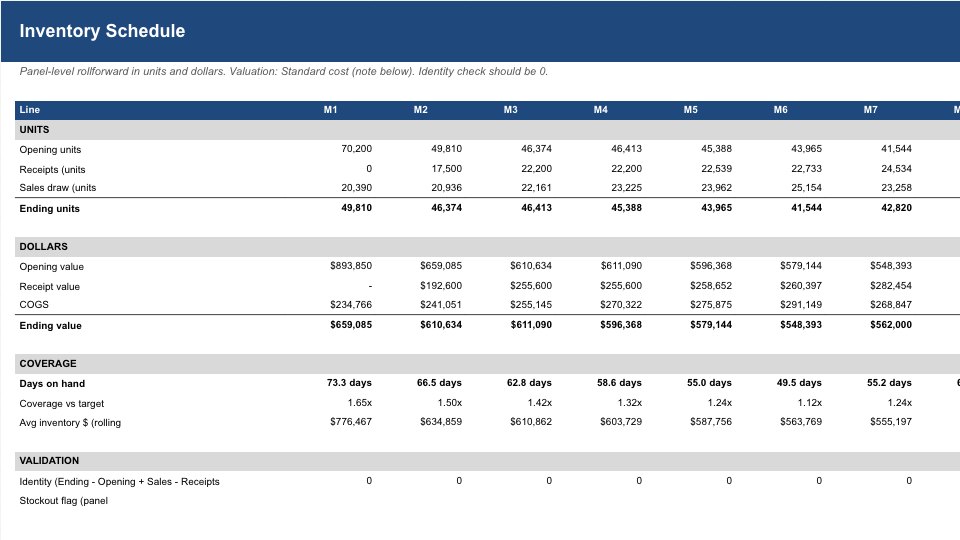
Inventory Forecast
12-month inventory build, COGS draw, and DOH coverage forecast across a SKU panel.
Inventory Count Sheets and Variance Reconciliation
Run blind stock counts and recounts, reconcile them to the stock ledger and post only approved adjustments.
Inventory Aging and Recoverability Write-Down
Age stock by lot, compare cost with net realizable value and obsolescence, and post the approved inventory reserve.
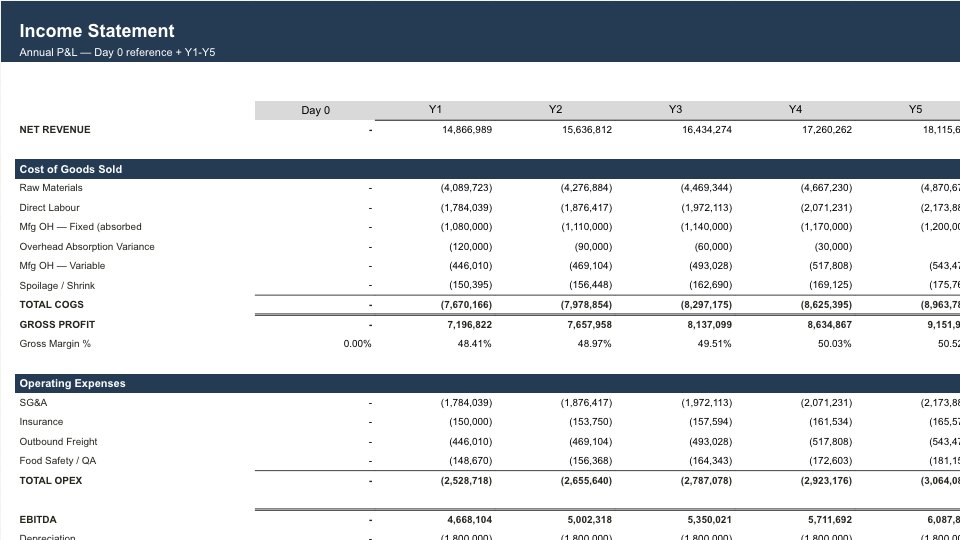
Food Manufacturing Model
Operating model for food production and processing businesses with ingredient sourcing, production scheduling, and margin analysis.







