Job Costing and Contract Profitability Excel Model
Operating Businesses Financial Model (Excel Download)
Know the profit on every job before it finishes. The model adds up actual cost by job, forecasts the cost to complete from remaining work and flags jobs that fall below your margin floor.



professionals from Deloitte






About this model
A job costing ledger and profit forecast for contract work. It records actual labor, material and subcontract transactions by job, and compares them with approved estimates and change orders. The shipped case is a fictional manufacturer with four jobs at its October 2026 close, in USD.
Each transaction is quantity times unit rate and needs a date, job, category and evidence. Unsupported records are held and counted. Cost to complete is a fresh forecast of remaining work, backed by remaining-only evidence, not a plug to the estimate. Final cost is actual plus cost to complete, and profit is approved revenue less final cost. Billing is tracked for contract admin only.
On the shipped case three jobs forecast margins between 27% and 47%. One job, a lab project, forecasts a 7.9% margin, with 27,290 USD of profit erosion against its revised estimate, and is escalated. A scenario sheet applies a 10% overrun to remaining labor and materials only and tests each job against an editable 10% margin floor. Actual costs and subcontract commitments are not stressed.
What every model includes
Live formulas, no hardcoded values
Outputs are driven by live formulas, so the workbook updates from its assumptions instead of relying on hardcoded results.
All assumptions in one tab
Inputs are clearly marked in the Assumptions tab and separated from calculations, making it clear what to change and what to leave intact.
Statements always balancing
For integrated-statement models, the balance sheet, cash flow, and supporting schedules tie through properly.
Distinct schedules for clarity
Debt, working capital, taxes, and cash flow can get messy quickly. We group calculations in clear schedules, not across disconnected tabs.
No hidden macros or external links
There are no unexplained external workbook links or macros to undermine auditability or portability.
Changes flow through the model
Update a key driver and see the impact carry through the forecast, financing, and return outputs. We never use hardcoded numbers in formulas.
What's inside the Job Costing and Contract Profitability Excel Model
- Cost ledger by job and category with quantity, rate and evidence
- Held record count for unsupported transactions
- Approved reversal rules for negative entries
- Contract inputs with original contract and change orders
- Original and changed estimate by labor, material and subcontract
- Cost to complete backed by remaining-work evidence
- Forecast final cost, profit and margin by job
- Billed to date and remaining contract billings



Formatted to IB standards
Named theme colors repaint the whole workbook in one click, on top of an investment-banking structure with clear input, output, and cross-sheet reference styling - brand-ready, institutional-grade, and fully auditable.

Created by ex-finance professionals
Hey, I’m Alex and I created Finamodel.
Over my years in the finance industry I kept building the same models over and over again. Same structure, same assumptions, different logo. So I started building frameworks to turn them into clean, reusable templates.
Every model here is one I’d actually use for a client, and I personally vet each one before it goes up.
I’m not an expert in every industry, but I’ve built enough models to know what belongs in one. And when something is completely foreign to me, I reach out to my network for experts to work on our models with us.
Having a template library on hand cuts a first build from hours to minutes.
Frequently asked
What is job costing?+
Job costing collects the actual cost of each project or contract separately. Labor, materials and subcontract costs are tagged to the job they belong to. Comparing them with the price and estimate shows the profit on each job.
How is the cost to complete set?+
It is a fresh forecast of the work still to do, in quantity times rate, with evidence that it excludes cost already posted. It is not a balancing figure to reach the estimate. Final cost is actual cost plus cost to complete.
What does the stress scenario change?+
It applies a percentage overrun to remaining labor and a price uplift to remaining materials. Actual costs and subcontract commitments stay the same. Each job's stressed margin is compared with the margin floor.
Does it recognize revenue?+
No. Profit uses approved contract revenue. Billing is tracked for contract admin only and is not used for revenue recognition.
How do I use it for my own jobs?+
Enter your contracts and estimates on Contract inputs and your transactions on the Cost ledger. Add remaining-work evidence for each job and category. Extend formulas, validations and controls together when adding rows.
Have more financial modelling questions? Contact us
Related templates
Capital Project Cost to Complete and Change Control
Forecast final cost by work package from actuals, contracts and changes, and compare it with the authorized budget.
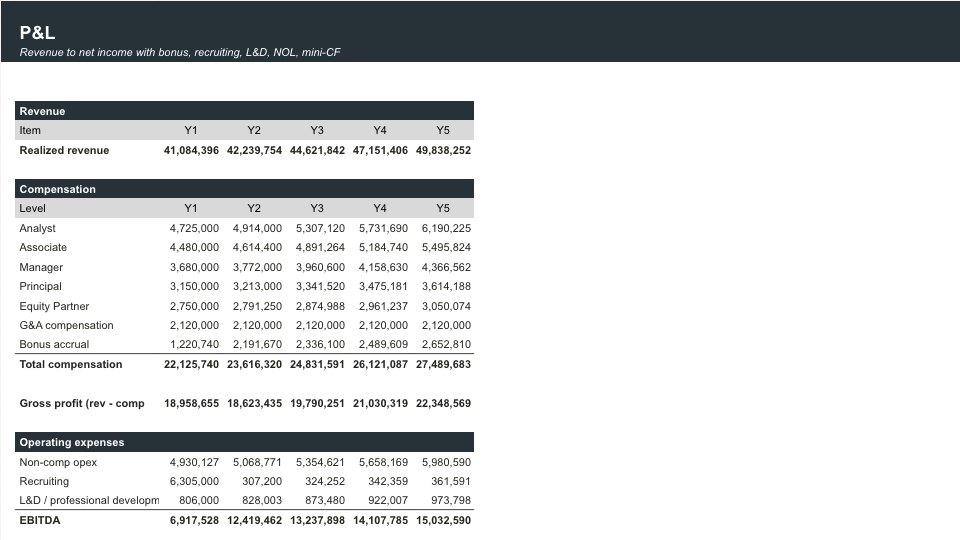
Consulting Firm
Five-year pyramid model: headcount, utilization, billable rate, comp, and margins.
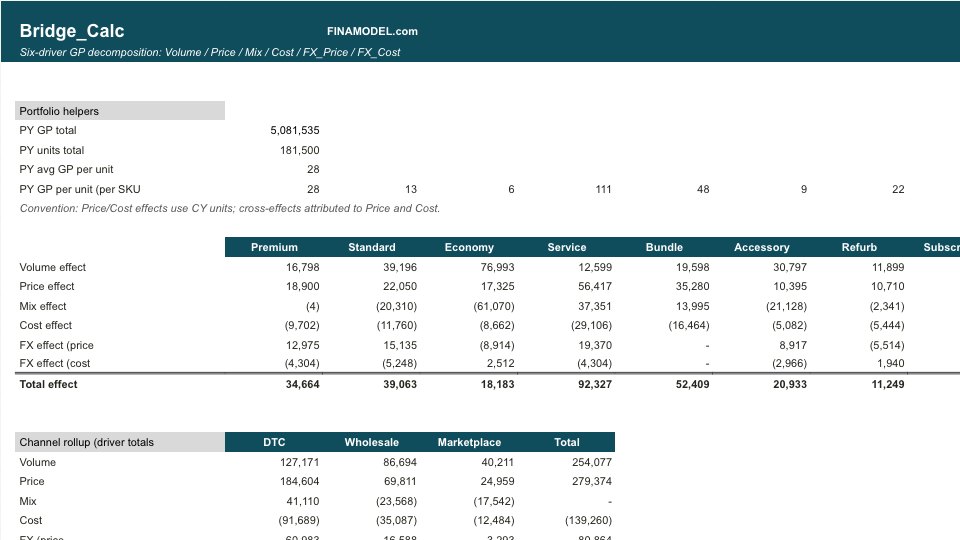
Gross Margin Bridge
PY to CY gross profit walk across Volume, Price, Mix, Cost, FX for a 5-SKU portfolio.
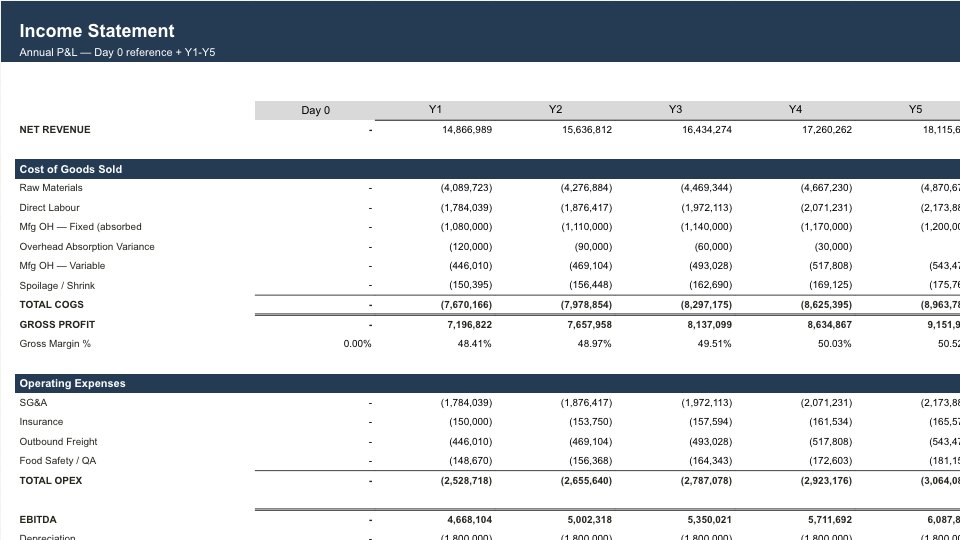
Food Manufacturing Model
Operating model for food production and processing businesses with ingredient sourcing, production scheduling, and margin analysis.







