Property Tax Roll Reconciliation Tracker
Public Finance Financial Model (Excel Download)
Prove that every parcel on the tax roll was billed the right amount. The tracker rolls forward assessed values, applies only valid exemptions and ties bills and receivables to independent controls.



professionals from Deloitte






About this model
A close reconciliation for a municipal property tax roll. It checks that assessed values, exemptions, bills, receipts and receivables agree at parcel level and with independent controls. The shipped case is a fictional town with ten parcels at a month-end close.
Each parcel's assessed value rolls forward from opening value through additions, revaluations and disposals. Only approved, unexpired exemptions reduce taxable value. Taxable value times the tax rate gives the expected levy, which is compared with actual bills. Receipts and credits roll the receivable forward, tied to the general ledger. Exceptions get an owner and a proposed correction.
On the shipped case assessed value of 13.8 million USD, gross bills of 145,600 USD and receivables of 31,500 USD all tie to their controls. The expected levy is 146,400 USD, so one parcel is underbilled by 800 USD after its relief was not approved. The close stays on hold until the correction is posted and reviewed.
What every model includes
Live formulas, no hardcoded values
Outputs are driven by live formulas, so the workbook updates from its assumptions instead of relying on hardcoded results.
All assumptions in one tab
Inputs are clearly marked in the Assumptions tab and separated from calculations, making it clear what to change and what to leave intact.
Statements always balancing
For integrated-statement models, the balance sheet, cash flow, and supporting schedules tie through properly.
Distinct schedules for clarity
Debt, working capital, taxes, and cash flow can get messy quickly. We group calculations in clear schedules, not across disconnected tabs.
No hidden macros or external links
There are no unexplained external workbook links or macros to undermine auditability or portability.
Changes flow through the model
Update a key driver and see the impact carry through the forecast, financing, and return outputs. We never use hardcoded numbers in formulas.
What's inside the Property Tax Roll Reconciliation Tracker
- Assessed value rollforward by parcel
- Exemption register with approval, expiry and evidence
- Taxable base from active parcels less valid exemptions
- Expected levy compared with actual bills by parcel
- Bills, receipts and credits ledger
- Receivable tie-out to the general ledger control
- Signed roster check against the land registry
- Exception disposition with owner and proposed correction



Formatted to IB standards
Named theme colors repaint the whole workbook in one click, on top of an investment-banking structure with clear input, output, and cross-sheet reference styling - brand-ready, institutional-grade, and fully auditable.

Created by ex-finance professionals
Hey, I’m Alex and I created Finamodel.
Over my years in the finance industry I kept building the same models over and over again. Same structure, same assumptions, different logo. So I started building frameworks to turn them into clean, reusable templates.
Every model here is one I’d actually use for a client, and I personally vet each one before it goes up.
I’m not an expert in every industry, but I’ve built enough models to know what belongs in one. And when something is completely foreign to me, I reach out to my network for experts to work on our models with us.
Having a template library on hand cuts a first build from hours to minutes.
Frequently asked
What is a property tax roll reconciliation?+
It checks that the assessed values on the tax roll, the exemptions granted, the bills issued and the receivables recorded all agree with each other and with independent records.
How is the expected levy calculated?+
Each active parcel's closing assessed value is reduced by any valid exemption, with a floor of zero. The taxable value is multiplied by the tax rate.
Which exemptions count?+
Only exemptions that are approved and not expired at the roll date reduce taxable value. Rejected or lapsed claims stay on the register with a valid value of zero.
When is a correction included?+
A proposed correction stays excluded until it is posted with a GL reference and independently reviewed. The close holds until the difference is resolved.
How do I use it for my municipality?+
Enter your parcels, exemptions, transactions and control totals, and set the tax rate and roll date. The tax rules in the shipped case are fictional.
Have more financial modelling questions? Contact us
Related templates
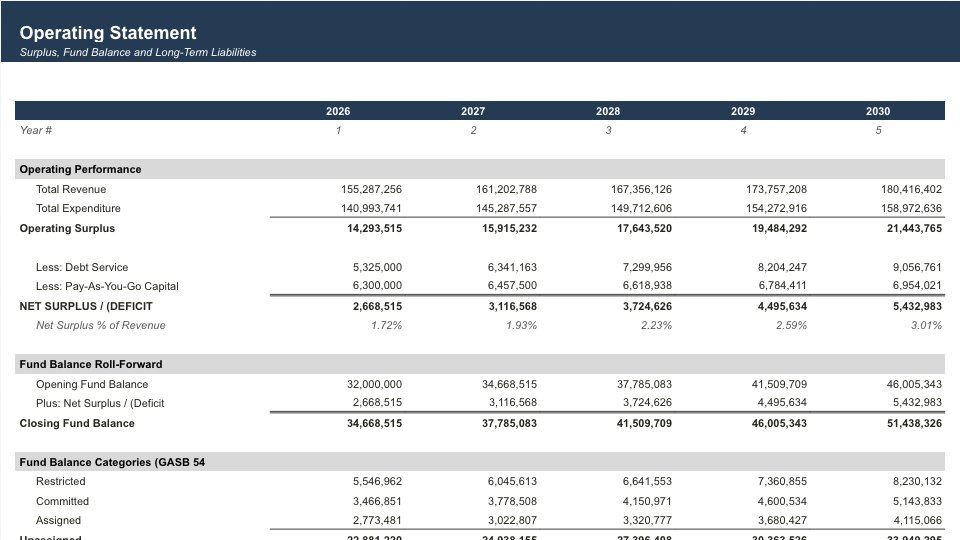
Municipal Budget Model
Financial model for municipal governments including revenue forecasts, expenditure planning, and debt capacity.
Balance Sheet Reconciliation and Substantiation Workbook
Reconcile each balance sheet account to independent support, log reconciling items and track clearing actions.
Sales Order and Invoice Completeness Reconciliation
Match sales orders to deliveries and invoices line by line to find unbilled deliveries, overbilling and invoice errors.
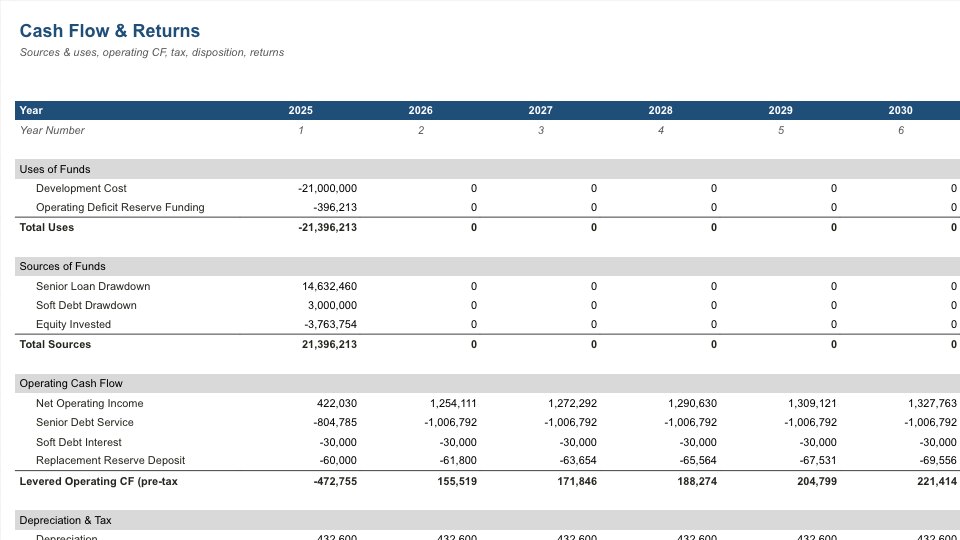
Public Housing Authority Operating Model
Unit mix, rent roll, operating expenses, and asset replacement reserve for public housing portfolios.







