Sales Order to Invoice Reconciliation Tracker
Operating Businesses Financial Model (Excel Download)
Make sure every delivery is billed once and at the right price. The workbook matches order, delivery and invoice lines and lists each gap with an owner until it is fixed.



professionals from Deloitte






About this model
A billing completeness reconciliation for a billing controller. It matches accepted sales order lines to confirmed delivery lines and posted invoice lines. The shipped case is a fictional components supplier with partial billing, missing billing, a duplicate invoice line, a price error, an invoice with a bad delivery link and a void invoice.
Only accepted orders, confirmed deliveries and posted invoices up to the cutoff count. Each delivery shows missing and excess quantity at the contract price, and each invoice line is tested for duplicate IDs, bad links, amount errors, price differences and future dates. Missing billing is never offset against unrelated overbilling.
On the shipped case $2,225 of delivered value is unbilled and $10,000 is overbilled, with two duplicate invoice rows and $120 of price exceptions. With a 10-day SLA, $425 of unbilled value is overdue. A billing actions sheet keeps each exception open until the source is corrected.
What every model includes
Live formulas, no hardcoded values
Outputs are driven by live formulas, so the workbook updates from its assumptions instead of relying on hardcoded results.
All assumptions in one tab
Inputs are clearly marked in the Assumptions tab and separated from calculations, making it clear what to change and what to leave intact.
Statements always balancing
For integrated-statement models, the balance sheet, cash flow, and supporting schedules tie through properly.
Distinct schedules for clarity
Debt, working capital, taxes, and cash flow can get messy quickly. We group calculations in clear schedules, not across disconnected tabs.
No hidden macros or external links
There are no unexplained external workbook links or macros to undermine auditability or portability.
Changes flow through the model
Update a key driver and see the impact carry through the forecast, financing, and return outputs. We never use hardcoded numbers in formulas.
What's inside the Sales Order to Invoice Reconciliation Tracker
- Order, delivery and invoice line input sheets
- Support for several deliveries per order and split invoice lines
- Eligibility rules for accepted orders, confirmed deliveries and the cutoff date
- Missing and excess quantity by delivery at contract price
- Invoice tests for duplicate IDs, bad links, amounts, prices and future dates
- Void invoices excluded from matching
- Order review of unfulfilled, delivered and billed quantities
- Billing actions log that cannot close a live exception



Formatted to IB standards
Named theme colors repaint the whole workbook in one click, on top of an investment-banking structure with clear input, output, and cross-sheet reference styling - brand-ready, institutional-grade, and fully auditable.

Created by ex-finance professionals
Hey, I’m Alex and I created Finamodel.
Over my years in the finance industry I kept building the same models over and over again. Same structure, same assumptions, different logo. So I started building frameworks to turn them into clean, reusable templates.
Every model here is one I’d actually use for a client, and I personally vet each one before it goes up.
I’m not an expert in every industry, but I’ve built enough models to know what belongs in one. And when something is completely foreign to me, I reach out to my network for experts to work on our models with us.
Having a template library on hand cuts a first build from hours to minutes.
Frequently asked
What is an order to invoice reconciliation?+
It checks that every delivered order line has been billed once, in full and at the agreed price. It finds revenue that was delivered but not billed, and invoices that bill too much or repeat a line.
Which records count in the match?+
Only accepted order lines, confirmed deliveries and posted invoices dated on or before the cutoff count. Void invoices are excluded. Future invoices stay visible for review but do not count.
Why is missing billing not netted against overbilling?+
A shortfall on one delivery and an excess on another are separate errors. Netting them would hide both. The workbook shows each one with its own exposure and owner.
What is outside the scope?+
Tax, revenue recognition timing and cash collection are not covered. It is a worked example with six order lines, eight delivery lines and nine invoice lines, not a live ERP connection.
How do I use it with my own data?+
Paste your order, delivery and invoice lines into the blue input cells with stable line IDs, and set the cutoff on Summary. For more rows, extend the input ranges and the formulas together.
Have more financial modelling questions? Contact us
Related templates
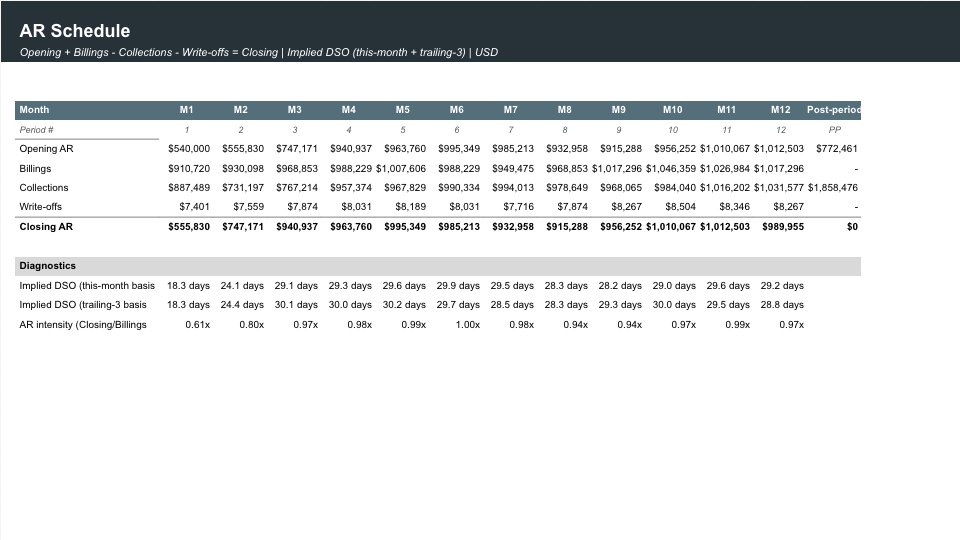
AR Forecast
12-month accounts-receivable timing forecast with customer terms and DSO.
Invoice Price and Contract Compliance Check
Test customer invoice lines against signed contract rates and quantities, then queue and approve the credits and debits due.
Three-Way Invoice Matching Workpaper
Match supplier invoices to purchase orders and goods receipts, hold exceptions and control payment release.
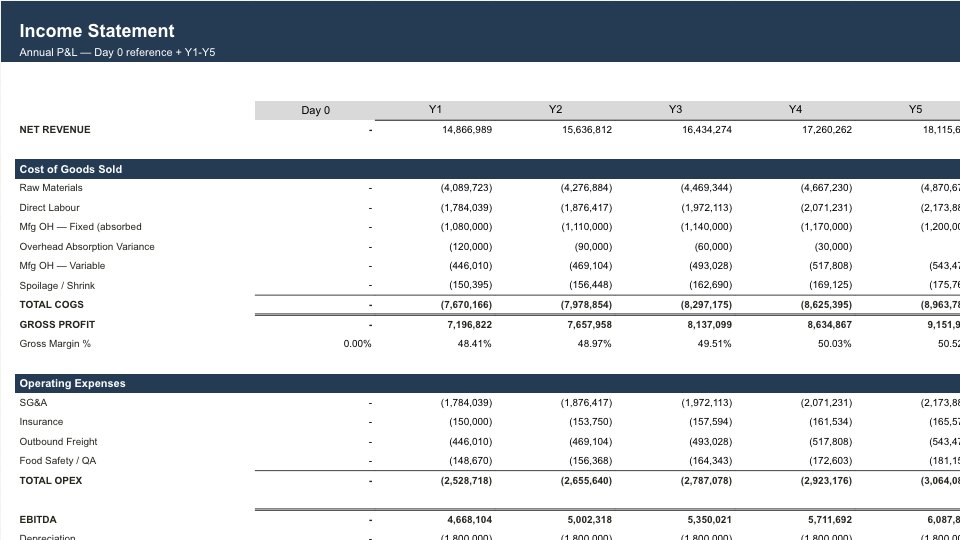
Food Manufacturing Model
Operating model for food production and processing businesses with ingredient sourcing, production scheduling, and margin analysis.







