Policyholder Dividend and Experience Refund Excel Model
Insurance Financial Model (Excel Download)
Share a participating pool's surplus fairly among eligible policyholders. The model measures the surplus, applies eligibility, weights and caps, and shows what is payable and what is held.



professionals from Deloitte






About this model
An experience refund model for a participating insurer. It applies approved participating terms to share surplus as policyholder dividends or experience refunds. The shipped case is a fictional mutual with a motor pool and a property pool, eight policies and one policy year.
Pool surplus is earned premium less incurred claims, allocated expenses, risk retention and any prior deficit. A participation share sets the formula pool, limited by a board cap. Eligible policies, based on months covered, arrears and loss ratio, get weights from earned premium and an experience factor, with a cap per policy.
On the shipped case awards total 85,499.99 USD. The motor pool's 42,000 USD is approved and payable, while 43,499.99 USD in the property pool is held pending clearance. A claims stress shows capacity, awards and residual under extra claims. Checks tie each pool to awards plus retained residual.
What every model includes
Live formulas, no hardcoded values
Outputs are driven by live formulas, so the workbook updates from its assumptions instead of relying on hardcoded results.
All assumptions in one tab
Inputs are clearly marked in the Assumptions tab and separated from calculations, making it clear what to change and what to leave intact.
Statements always balancing
For integrated-statement models, the balance sheet, cash flow, and supporting schedules tie through properly.
Distinct schedules for clarity
Debt, working capital, taxes, and cash flow can get messy quickly. We group calculations in clear schedules, not across disconnected tabs.
No hidden macros or external links
There are no unexplained external workbook links or macros to undermine auditability or portability.
Changes flow through the model
Update a key driver and see the impact carry through the forecast, financing, and return outputs. We never use hardcoded numbers in formulas.
What's inside the Policyholder Dividend and Experience Refund Excel Model
- Pool surplus from premium, claims, expenses, retention and prior deficit
- Approved pool terms with participation share and board limit
- Policy eligibility from covered months, arrears and loss ratio
- Experience factor and weight for each policy
- Per-policy caps with retained residual
- Payable and held awards by policy
- Signed pool control extract
- Pool appropriation from surplus to payable awards



Formatted to IB standards
Named theme colors repaint the whole workbook in one click, on top of an investment-banking structure with clear input, output, and cross-sheet reference styling - brand-ready, institutional-grade, and fully auditable.

Created by ex-finance professionals
Hey, I’m Alex and I created Finamodel.
Over my years in the finance industry I kept building the same models over and over again. Same structure, same assumptions, different logo. So I started building frameworks to turn them into clean, reusable templates.
Every model here is one I’d actually use for a client, and I personally vet each one before it goes up.
I’m not an expert in every industry, but I’ve built enough models to know what belongs in one. And when something is completely foreign to me, I reach out to my network for experts to work on our models with us.
Having a template library on hand cuts a first build from hours to minutes.
Frequently asked
What is a policyholder dividend or experience refund?+
It is a return of part of the premium to policyholders when a participating pool has better results than expected. The amount depends on the pool's surplus and on each policy's own experience.
How is the distributable amount set?+
The pool surplus is multiplied by the participation share to give the formula pool. The board limit caps it, and the lower amount is the distributable capacity.
Which policies are eligible?+
Eligibility follows the pool terms. A policy needs to be participating, have enough covered months and no premium arrears. The loss ratio drives the experience factor used in the weight.
What does the claims stress show?+
It adds extra incurred claims to a selected pool and shows the new capacity, the indicative awards and the residual. It is separate from the live approval and payable amounts.
How do I adapt it to my own pools?+
Enter your own pool terms, policies and claims data in the blue cells. Keep pool and policy keys consistent across sheets, and extend the checks when you add rows.
Have more financial modelling questions? Contact us
Related templates
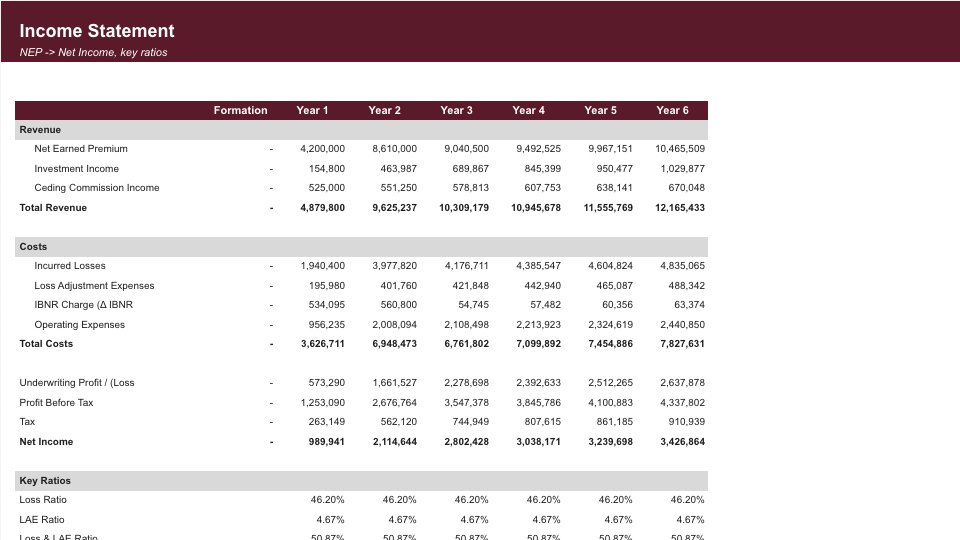
Captive Insurance Company Model
Captive insurer financial projections and reinsurance analysis.
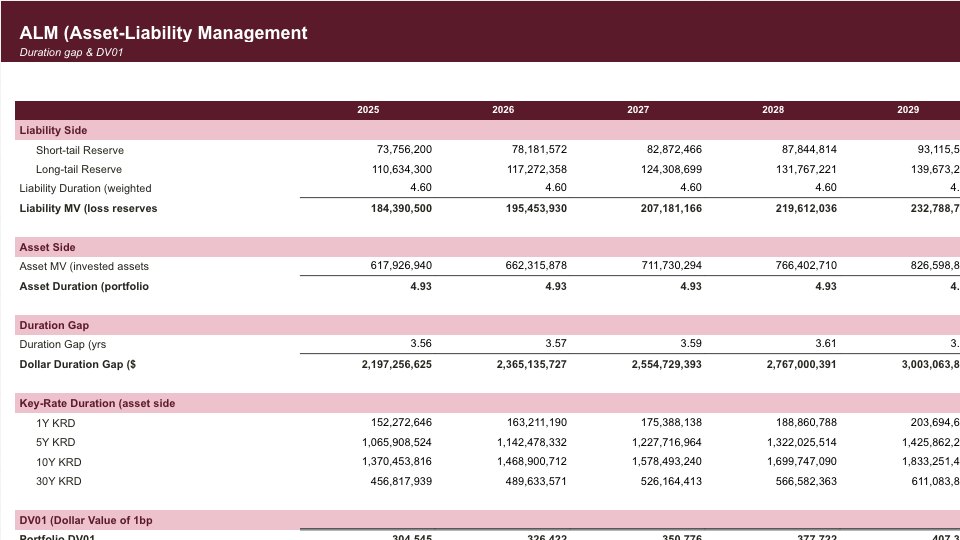
Insurance Portfolio Risk and Return Model
Portfolio model for insurance investment holdings including asset allocation, duration matching, credit risk, and spread analysis.
Insurance Rate Adequacy Study
Develop and trend claims experience to find the indicated insurance rate, then test rate actions and retention.
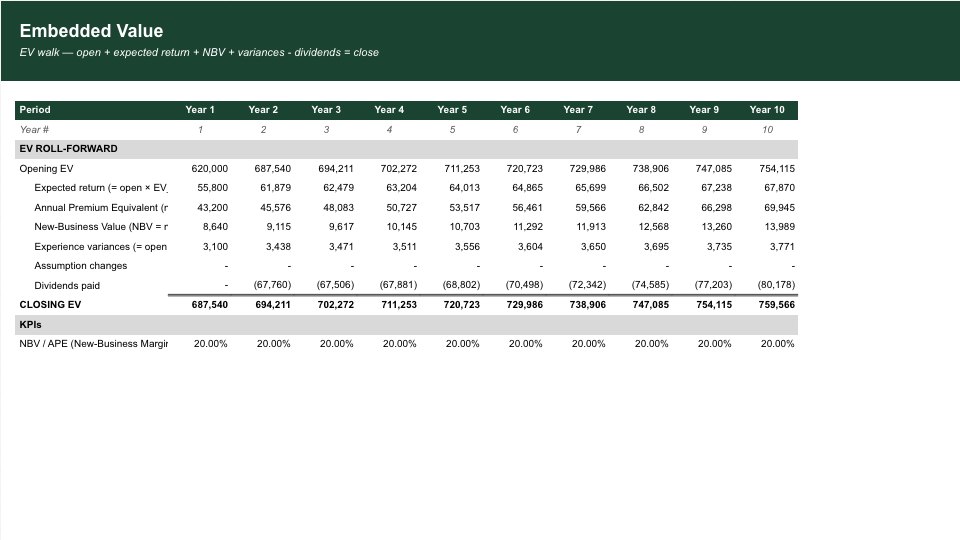
Life Insurance Valuation Model
Valuation model for life insurance products and in-force book value using mortality assumptions and surrender rates.







