Premium Audit Adjustment Calculator
Insurance Financial Model (Excel Download)
Turn audited payroll or sales into a final premium bill. The workbook compares actual exposure with the estimate by class and splits the adjustment into agreed and held amounts.



professionals from Deloitte






About this model
A premium audit workbook for an insurer. It reconciles the actual insured exposure, such as payroll or sales, with the estimate used at inception. The shipped case covers three fictional commercial policies for one policy year.
Quarterly exposure records roll up by policy and class, less contract exclusions. Each class is priced with its rate per exposure unit, then the policy modifier, minimum premium and fixed fee apply. Accepted exposure must tie to an independent signed control. The adjustment is released only once the insured has signed an agreement.
On the shipped case audited premium is 69,818 USD against 67,960 USD at inception. Agreed adjustments total 2,158 USD and 300 USD is held for one policy that awaits endorsement approval. Checks cover unmapped records, class coverage, initial invoices and the tie to signed controls.
What every model includes
Live formulas, no hardcoded values
Outputs are driven by live formulas, so the workbook updates from its assumptions instead of relying on hardcoded results.
All assumptions in one tab
Inputs are clearly marked in the Assumptions tab and separated from calculations, making it clear what to change and what to leave intact.
Statements always balancing
For integrated-statement models, the balance sheet, cash flow, and supporting schedules tie through properly.
Distinct schedules for clarity
Debt, working capital, taxes, and cash flow can get messy quickly. We group calculations in clear schedules, not across disconnected tabs.
No hidden macros or external links
There are no unexplained external workbook links or macros to undermine auditability or portability.
Changes flow through the model
Update a key driver and see the impact carry through the forecast, financing, and return outputs. We never use hardcoded numbers in formulas.
What's inside the Premium Audit Adjustment Calculator
- Declared versus accepted exposure by policy and class
- Quarterly exposure ledger with contract exclusions and evidence IDs
- Class rates per exposure unit
- Policy modifier, minimum premium and fixed fee
- Agreed and held adjustments kept apart
- Independent signed exposure controls
- Insured agreement with reviewer and date
- Audit findings with rationale and required evidence



Formatted to IB standards
Named theme colors repaint the whole workbook in one click, on top of an investment-banking structure with clear input, output, and cross-sheet reference styling - brand-ready, institutional-grade, and fully auditable.

Created by ex-finance professionals
Hey, I’m Alex and I created Finamodel.
Over my years in the finance industry I kept building the same models over and over again. Same structure, same assumptions, different logo. So I started building frameworks to turn them into clean, reusable templates.
Every model here is one I’d actually use for a client, and I personally vet each one before it goes up.
I’m not an expert in every industry, but I’ve built enough models to know what belongs in one. And when something is completely foreign to me, I reach out to my network for experts to work on our models with us.
Having a template library on hand cuts a first build from hours to minutes.
Frequently asked
What is a premium audit?+
A premium audit checks the actual exposure, such as payroll or sales, after the policy year ends. The premium was first set on an estimate, so the audit produces an additional or return premium to correct it.
How is the audited premium calculated?+
Accepted exposure for each class is divided by the exposure unit and multiplied by the class rate. The policy modifier applies to the total, the minimum premium is tested, and the fixed fee is added.
Why are some adjustments held?+
An adjustment is agreed only when the insured has signed the audit agreement. Without it, the amount is held and the final bill stays at the initial premium.
Does the what-if change the bill?+
No. The exposure what-if shows the effect of a hypothetical correction for one class. The live agreed bill does not change.
How do I add policies or classes?+
Add rows to Terms, Rates and Exposure with the same policy and class keys, then add a signed control total. Extend the formulas and checks with the new rows.
Have more financial modelling questions? Contact us
Related templates
Insurance Exposure and Policy Bordereau
Build a reconciled policy, premium and exposure bordereau for each reinsurer or capacity provider before dispatch.
Insurance Rate Adequacy Study
Develop and trend claims experience to find the indicated insurance rate, then test rate actions and retention.
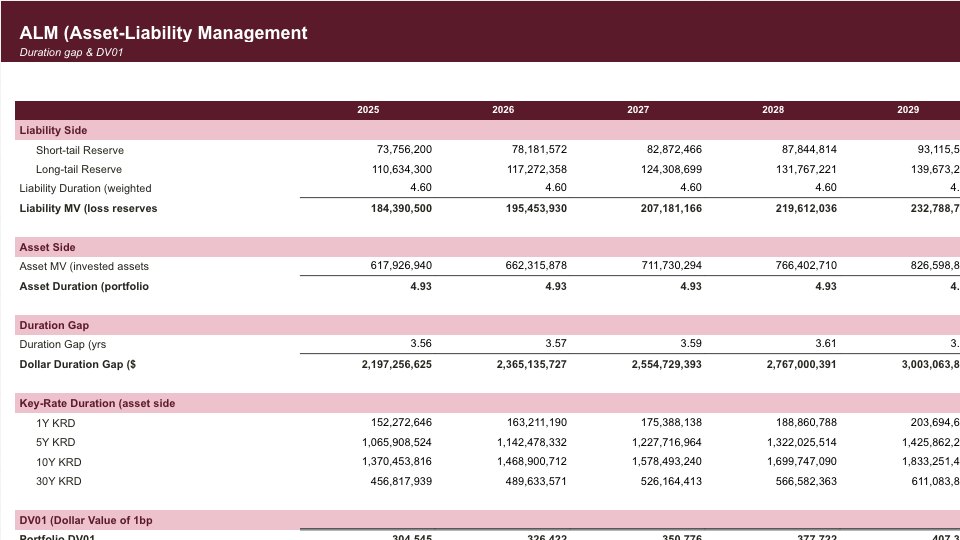
Insurance Portfolio Risk and Return Model
Portfolio model for insurance investment holdings including asset allocation, duration matching, credit risk, and spread analysis.
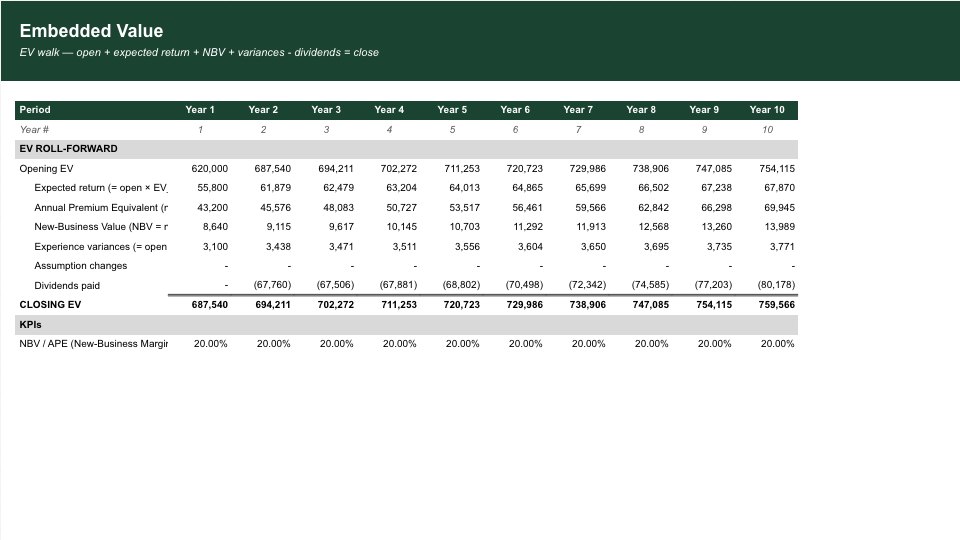
Life Insurance Valuation Model
Valuation model for life insurance products and in-force book value using mortality assumptions and surrender rates.







