Discount for Lack of Marketability Excel Model
Valuation Financial Model (Excel Download)
Value a private minority stake that cannot be sold freely. The model blends an option method and matched sale evidence into one discount and tests the result against a cash offer.



professionals from Deloitte






About this model
A model that estimates a discount for lack of marketability (DLOM) on a private equity stake. The starting case is a fictional holding company with marketable equity of $120m, a 20% stake and a cash offer of $19.5m for that stake. Two restriction cases are available: Base and Extended.
The first method prices an at-the-money European protective put from the restriction term, equity volatility and the risk-free rate. The second method takes three fictional matched observations and scales each discount by volatility and the square root of the holding period. A weight blends the two methods, and the discount is deducted once from the marketable stake value.
In the Base case the put gives 15.19% and the evidence gives 23.04%. At a 65% option weight the selected discount is 17.94% and the stake is worth $19.695m, above the $19.5m offer. The offer and model meet at an option weight of about 54.65%. A check sheet ties the value bridge, weights, bounds and offer gap.
What every model includes
Live formulas, no hardcoded values
Outputs are driven by live formulas, so the workbook updates from its assumptions instead of relying on hardcoded results.
All assumptions in one tab
Inputs are clearly marked in the Assumptions tab and separated from calculations, making it clear what to change and what to leave intact.
Statements always balancing
For integrated-statement models, the balance sheet, cash flow, and supporting schedules tie through properly.
Distinct schedules for clarity
Debt, working capital, taxes, and cash flow can get messy quickly. We group calculations in clear schedules, not across disconnected tabs.
No hidden macros or external links
There are no unexplained external workbook links or macros to undermine auditability or portability.
Changes flow through the model
Update a key driver and see the impact carry through the forecast, financing, and return outputs. We never use hardcoded numbers in formulas.
What's inside the Discount for Lack of Marketability Excel Model
- Protective put method with d1, d2 and the put value as a share of market value
- Three matched liquidity observations with a comparability note and pair weight
- Evidence discounts adjusted for volatility and holding period
- Option method weight to blend the two discounts
- Two restriction cases: Base and Extended
- Bridge from marketable equity to illiquid stake value
- Cash offer comparison with the discount the offer implies
- Crossover option weight where the model meets the offer



Formatted to IB standards
Named theme colors repaint the whole workbook in one click, on top of an investment-banking structure with clear input, output, and cross-sheet reference styling - brand-ready, institutional-grade, and fully auditable.

Created by ex-finance professionals
Hey, I’m Alex and I created Finamodel.
Over my years in the finance industry I kept building the same models over and over again. Same structure, same assumptions, different logo. So I started building frameworks to turn them into clean, reusable templates.
Every model here is one I’d actually use for a client, and I personally vet each one before it goes up.
I’m not an expert in every industry, but I’ve built enough models to know what belongs in one. And when something is completely foreign to me, I reach out to my network for experts to work on our models with us.
Having a template library on hand cuts a first build from hours to minutes.
Frequently asked
What is a discount for lack of marketability?+
It is a reduction in value because a stake cannot be sold quickly for cash. Private shares with transfer limits are worth less than the same shares if they traded freely. The DLOM measures that gap.
How does the protective put method work?+
It asks what it would cost to buy a put that protects the holder for the restriction period. The model prices an at-the-money European put from term, volatility and the risk-free rate. The put cost as a share of value is the discount.
How is the matched evidence adjusted?+
Each observed discount is scaled by the target volatility against the evidence volatility, times the square root of the horizon ratio. This puts all observations on the target's basis before they are averaged with pair weights.
What are the limits?+
All observations are fictional and are not market data. The put measures a hypothetical insurance cost and is not a universal answer. The method weight is a judgment you must support.
Can I change the offer or restriction?+
Yes. Change the method weight, the offer and the restriction case in the blue cells on the Assumptions sheet. Edit the pair weights on the Matched observations sheet to change the evidence mix.
Have more financial modelling questions? Contact us
Related templates
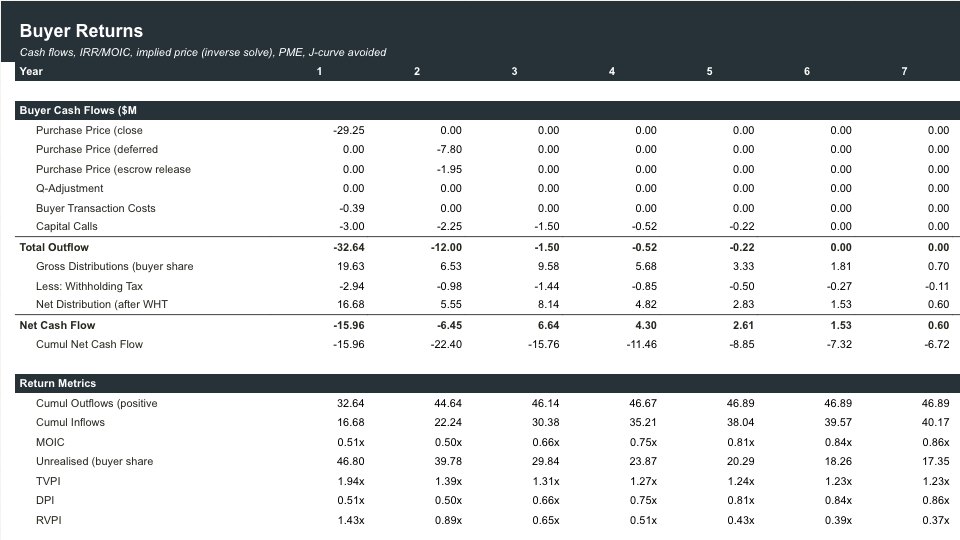
Secondary Private Company Sale Model
Modeling secondary sales of stakes in private companies, including buyer valuations, hold periods, and investor return scenarios.
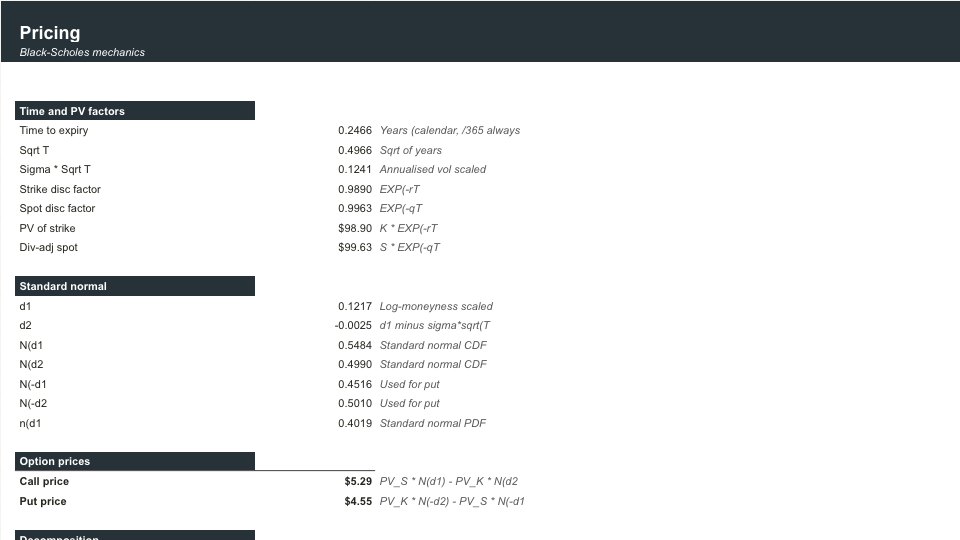
Option Pricing
Black-Scholes call and put prices with Greeks, payoff grid, and two-way sensitivity.
Control Premium and Minority Discount Model
Value a business as-is and under new control, weight the benefit by its odds, and derive the control premium and minority discount.
Adjusted Present Value (APV) Model
Compare two financing offers with adjusted present value: tax shields, fees, risk costs, liquidity and coverage tests.







