Retained Earnings
Corporate Finance Financial Model (Free Excel Download)
Build a retained earnings roll-forward linking opening equity, net income, dividends, and closing balances so the balance sheet and distributions reconcile cleanly.



professionals from Deloitte
Used by professionals from






About this model
Use this retained earnings model to explain the change in shareholders' equity from one month to the next. Start with opening retained earnings, add profit, account for dividends, and keep other adjustments visible in one clean schedule.
It is useful for month-end reporting, board packs, and dividend planning. The workbook also separates dividends declared from dividends paid, so outstanding obligations do not disappear from view.
What every model includes
Live formulas, no hardcoded values
Outputs are driven by live formulas, so the workbook updates from its assumptions instead of relying on hardcoded results.
All assumptions in one tab
Inputs are clearly marked in the Assumptions tab and separated from calculations, making it clear what to change and what to leave intact.
Statements always balancing
For integrated-statement models, the balance sheet, cash flow, and supporting schedules tie through properly.
Distinct schedules for clarity
Debt, working capital, taxes, and cash flow can get messy quickly. We group calculations in clear schedules, not across disconnected tabs.
No hidden macros or external links
There are no unexplained external workbook links or macros to undermine auditability or portability.
Changes flow through the model
Update a key driver and see the impact carry through the forecast, financing, and return outputs. We never use hardcoded numbers in formulas.
What's inside the Retained Earnings
- Opening balances for retained earnings, common stock, APIC, treasury, AOCI, and dividend payable
- Monthly net-income plan and monthly dividend declaration plan with declared-to-paid lag (months)
- Six adjustment lines: SBC, prior-period, OCI reclassifications, cumulative accounting change, treasury retirement, other
- Equity Master with opening, activity, closing, and mix per component (treasury treated as contra)
- Dividend Schedule with opening / declared / paid / closing payable and cumulative declared and paid
- 12-month retained-earnings roll-forward with monthly payout and retention ratios
- Closing RE = opening + net income - dividends declared + total adjustments identity at every month
- Dashboard with closing RE, RE growth, annual NI, annual dividends, payout, retention, return on RE, dividend payable, closing equity
Inside the Retained Earnings Model: How Monthly Equity Rolls Forward
This page explains the inner workings of the retained earnings model: a monthly roll-forward that ties net income, dividends, and equity-component activity to closing shareholders' equity. It covers operating drivers, calculation flow, outputs, and practical use, helping you evaluate whether the template fits month-end reporting, board packs, and dividend planning before you open the values-only preview.
What Drives the Monthly Equity Roll-Forward
The schedule starts from per-component opening balances covering common stock, additional paid-in capital, retained earnings, treasury stock, and accumulated other comprehensive income split into CTA, AFS, pension, and hedging sub-components. Monthly net income, often the single hand-off from the income statement, feeds the roll-forward directly.
- Dividend policy can be set three ways through a toggle: a constant quarterly payout, a percentage of monthly net income, or custom monthly amounts. A monthly activity panel routes stock-based compensation, treasury retirements, and OCI reclasses to their own equity accounts rather than distorting retained earnings.
- Retained earnings also accepts prior-period, cumulative accounting change, and other adjustments that legitimately land there.
How the Roll-Forward and Supporting Schedules Calculate
Each month's opening retained earnings equals the prior month's closing balance. Closing retained earnings is opening plus net income, minus dividends declared, plus any retained earnings adjustments.
- Dividends declared follow the chosen policy, while dividends paid lag by a documented pay-lag, and the opening dividend payable is released at the corresponding month. Other equity components update independently: APIC grows by stock-based compensation, treasury reflects retirement activity, and AOCI aggregates its four sub-component movements.
- Total equity sums common stock, APIC, retained earnings, minus treasury, plus AOCI, with treasury subtracted because it is contra-equity. Annual figures pull from monthly totals, and year-two through year-five roll forward from annual flex inputs.
Outputs and Reporting Views
The model produces a monthly retained earnings roll-forward with payout and retention ratios, plus a dividend schedule separating declared from paid amounts and tracking the payable balance. A single-year Equity Master shows opening, activity, and closing balances per component, while a multi-year Annual_Rollforward extends the view across five years.
- Per-share metrics include EPS, DPS, BVPS, and dividend yield. A 10-K-style statement of stockholders' equity matrix presents events by equity component, and a dashboard surfaces headline metrics with traffic lights for payout, earnings yield on retained earnings, and return on equity, along with equity composition.
- Eight integrity checks on the Checks sheet test roll-forward identities with conditionally formatted pass or fail results.
Using the Schedule in Practice
This equity-side template fits month-end reporting, board packs, and dividend planning. Because stock-based compensation, treasury retirements, and OCI movements are routed to their proper equity accounts, the retained earnings balance reflects only legitimate items such as prior-period adjustments and cumulative accounting changes.
- Dividends declared remain visible as a payable until paid, so outstanding obligations do not disappear. A net loss period can push retained earnings negative and flip status indicators to the worst tier, while a pay-lag beyond twelve months accumulates declarations as a closing payable.
- The scope is the equity section of the balance sheet only; net income is the single income statement input, so pair it with a full three-statement model for an integrated view.
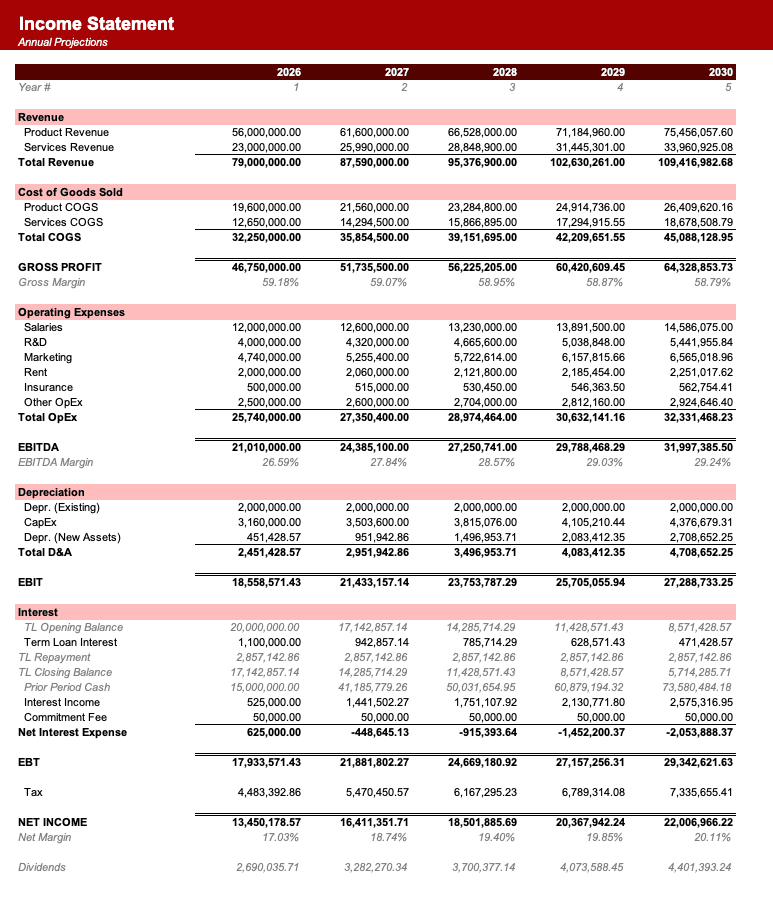
Formatted to IB standards
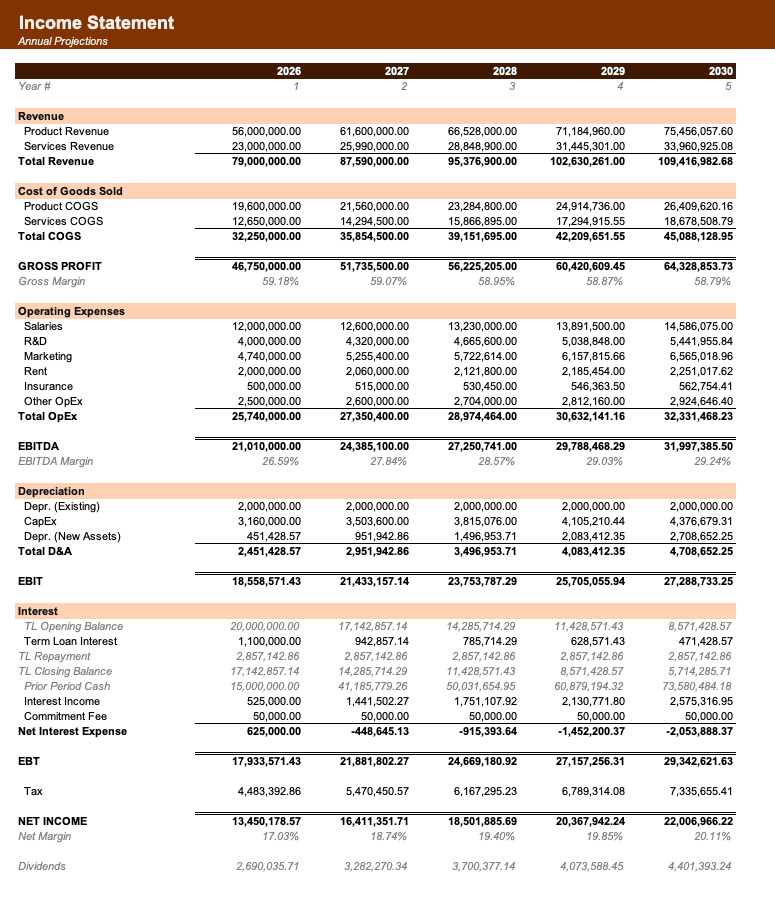
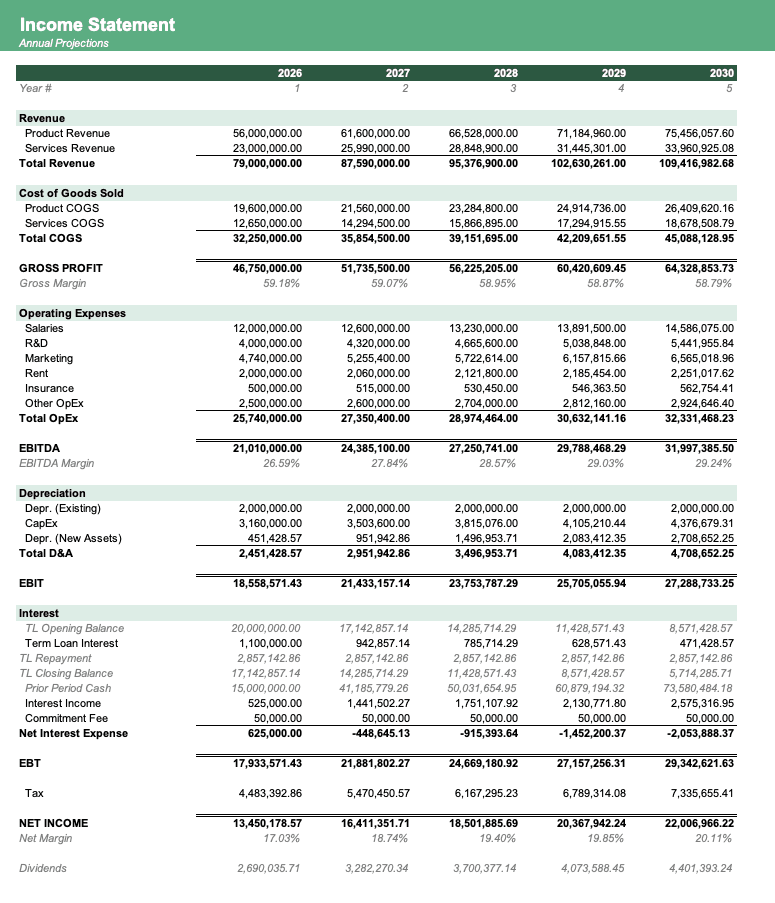
Named theme colors repaint the whole workbook in one click, on top of an investment-banking structure with clear input, output, and cross-sheet reference styling - brand-ready, institutional-grade, and fully auditable.

Created by ex-finance professionals
Hey, I’m Alex and I created Finamodel.
Over my years in the finance industry I kept building the same models over and over again. Same structure, same assumptions, different logo. So I started building frameworks to turn them into clean, reusable templates.
Every model here is one I’d actually use for a client, and I personally vet each one before it goes up.
I’m not an expert in every industry, but I’ve built enough models to know what belongs in one. And when something is completely foreign to me, I reach out to my network for experts to work on our models with us.
Having a template library on hand cuts a first build from hours to minutes.
Need help finding your model? You’ll find me in the Finamodel app!
Frequently asked
What is a retained-earnings model?+
A retained-earnings model rolls the retained-earnings balance forward month by month from opening + net income - dividends declared + adjustments = closing. It also tracks the dividend-payable balance separately, so the declared-vs-paid timing flows are audit-clean.
How does the dividend pay-lag work?+
Each month's dividends declared are paid Pay_Lag months later. The first month's payment in the model pays out the opening dividend payable (a single named-range input). Subsequent months pay the declaration from (current month - Pay_Lag). The lag is a single named-cell input so flexing it reshapes the entire payable roll.
Why are there six adjustment lines instead of one "other"?+
The six lines are the recurring equity adjustments most operators end up tracking separately - stock-based compensation, prior-period adjustments, OCI reclassifications, cumulative effect of accounting changes, treasury stock retirements, and other. Keeping them broken out makes the equity walk legible to auditors and removes the need to expand the model when one of these items comes up.
What if net income is negative?+
The model permits it. Closing RE = opening + (negative NI) - dividends + adjustments, which may print negative if losses compound. The dashboard return-on-RE check flips to "Heavy draw" below the amber threshold so the warning is visible.
Can I add more equity components?+
Yes. Extend the opening-balance block on Assumptions, add the corresponding row on Equity Master with the right opening / activity / closing formulas, and update the total-equity row to include or contra the new component. The dashboard mix block points at Equity Master row positions explicitly.
Have more financial modelling questions? Contact us
Related templates
3 Statement Model
Integrated income statement, balance sheet, and cash flow forecasts.
Cap Table Management Model
Equity ownership tracking and scenario modeling.
Share Buyback Program Model
Analysis of share buyback programs showing impact on EPS, share count, capital allocation, and shareholder return comparison.
M&A Modeling & Valuation
Comprehensive M&A valuation with DCF, comparable companies, and precedent transactions analysis.