Securities Lending Fee Reconciliation Tracker
Capital Markets Financial Model (Excel Download)
Rebuild daily stock loan and borrow fees from settled units, marks and rate changes, then compare them with counterparty statements. Open recalls are tracked notice by notice.



professionals from Deloitte






About this model
A fee reconciliation workbook for securities lending and stock borrow. It rebuilds the fee on each contract day by day and compares it with the counterparty statement. The fictional case covers four contracts for October, two lends and two borrows, with recalls, returns and mid-month rate resets.
Each day uses settled units, the mark price, the rate in force and the contract day basis. Lending income is positive and borrow cost is negative. Only movements with valid evidence change units. Returns are allocated to dated recall notices, and applied units are capped at each notice amount.
On the shipped case one borrow differs from its statement by about 25 and another by 10 after a statement adjustment. The net fee is about negative 272. Two recalls still have open units and are escalated. A sensitivity sheet shows how a different rate on chosen days moves the fee.
What every model includes
Live formulas, no hardcoded values
Outputs are driven by live formulas, so the workbook updates from its assumptions instead of relying on hardcoded results.
All assumptions in one tab
Inputs are clearly marked in the Assumptions tab and separated from calculations, making it clear what to change and what to leave intact.
Statements always balancing
For integrated-statement models, the balance sheet, cash flow, and supporting schedules tie through properly.
Distinct schedules for clarity
Debt, working capital, taxes, and cash flow can get messy quickly. We group calculations in clear schedules, not across disconnected tabs.
No hidden macros or external links
There are no unexplained external workbook links or macros to undermine auditability or portability.
Changes flow through the model
Update a key driver and see the impact carry through the forecast, financing, and return outputs. We never use hardcoded numbers in formulas.
What's inside the Securities Lending Fee Reconciliation Tracker
- Signed lending and borrow contracts with day basis and dates
- Daily accrual from settled units, mark price and the rate in force
- Dated rate changes by contract
- Fee by rate interval with balance and mark effect
- Comparison of accrued fee with the counterparty statement
- Statement adjustments with rationale, owner and approval
- Return allocation to dated recall notices, capped at each notice
- Recall ledger with open units and escalation actions



Formatted to IB standards
Named theme colors repaint the whole workbook in one click, on top of an investment-banking structure with clear input, output, and cross-sheet reference styling - brand-ready, institutional-grade, and fully auditable.

Created by ex-finance professionals
Hey, I’m Alex and I created Finamodel.
Over my years in the finance industry I kept building the same models over and over again. Same structure, same assumptions, different logo. So I started building frameworks to turn them into clean, reusable templates.
Every model here is one I’d actually use for a client, and I personally vet each one before it goes up.
I’m not an expert in every industry, but I’ve built enough models to know what belongs in one. And when something is completely foreign to me, I reach out to my network for experts to work on our models with us.
Having a template library on hand cuts a first build from hours to minutes.
Frequently asked
What is a securities lending fee reconciliation?+
Lenders earn a fee, and borrowers pay one, on the value of securities on loan. The fee changes each day with units, prices and rates. A reconciliation rebuilds that fee and compares it with the counterparty statement to find differences.
How is the daily fee calculated?+
Each day, settled units times the mark price gives the loan value. The rate in force for that date is applied using the contract day basis. Lending fees are positive and borrow fees are negative.
How are recalls handled?+
Each recall notice has a due date and a unit amount. Settled returns are allocated to notices, and applied units cannot exceed the notice. Units still open are shown with an escalation action.
Can a statement adjustment close a difference?+
An adjustment is recorded with a rationale, owner and decision. The workbook keeps the accrued fee, the statement and the adjustment visible side by side, so any remaining difference is clear.
Can I add more contracts?+
Yes. Add contracts, rates and events to the source sheets and extend the daily accrual rows to cover them. Keep event evidence filled in, because movements without evidence do not change units.
Have more financial modelling questions? Contact us
Related templates
Securities Lending Collateral Return Calculation
Work out how much collateral to return on each securities loan after returns, haircuts and margin, and flag any shortfall.
Bank Fee and Interest Statement Audit
Recheck bank fees and interest against agreed tariffs, find value-date errors and track refund claims to credit.
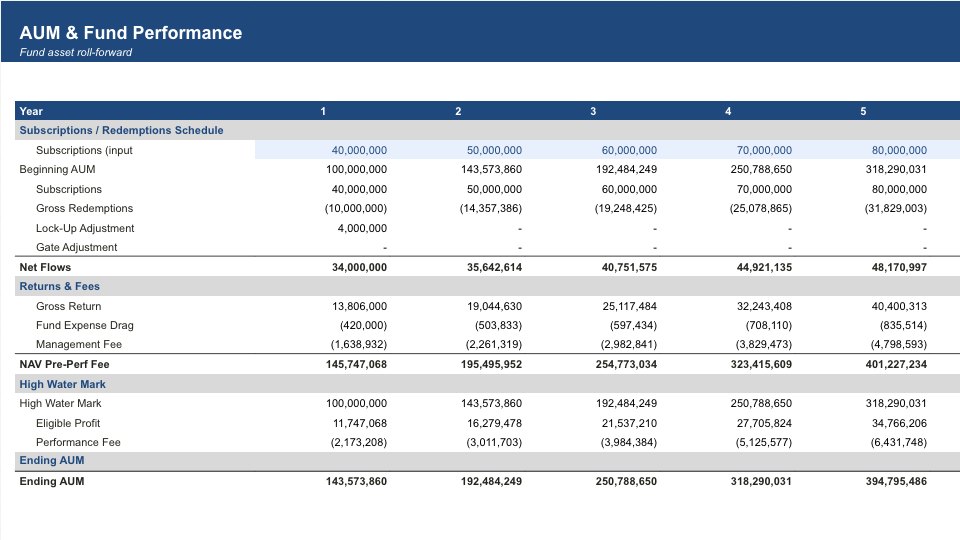
Hedge Fund Operating Model
Operating model for hedge funds including investor cash flows, fee structure, leverage, and performance-based compensation.
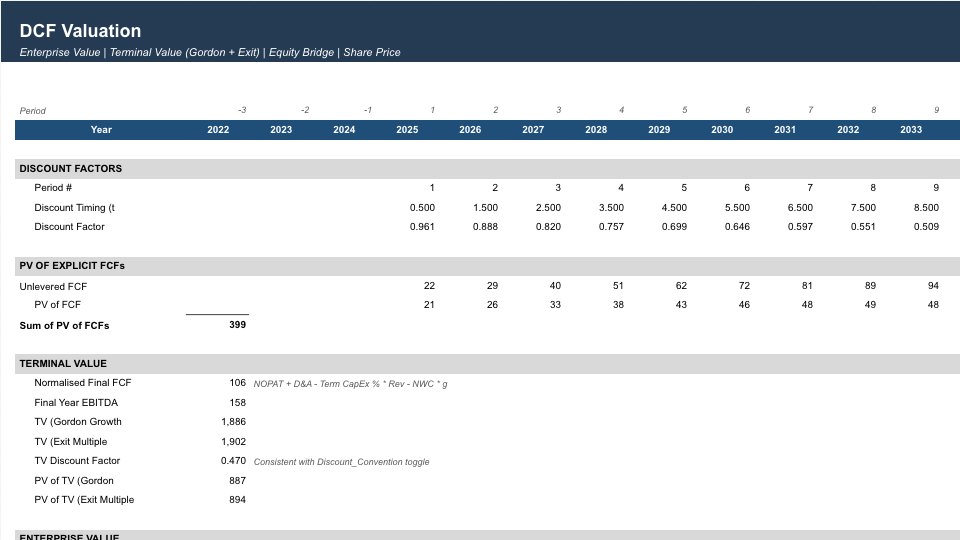
DCF Model
Discounted cash flow valuation model with explicit forecast, terminal value, and WACC.







