Syndicated Loan Model
Credit Financial Model (Free Excel Download)
Analyse a syndicated facility across lenders, tranches, fees, amortisation, and covenants to forecast debt service, lender economics, and refinancing capacity.



professionals from Deloitte
Used by professionals from






About this model
Model a syndicated credit facility with covenant grids, club structure, and bank-level economics. The deal structure captures term loans, revolving credit, accordion features, pricing grids tied to leverage multiples, and arranger/lead manager/participant ticket economics. Pricing grid mechanics link all-in cost (base rate + spread) to quarterly leverage tests; spreads widen as the borrower deleverages, creating embedded incentives to pay down debt.
The model includes a 25-bank syndication schedule with commitment fees by tranche, covenant compliance testing (quarterly leverage and interest coverage), and the intercompany waterfall showing how cash available for distribution flows to lenders by seniority. Covenant breaches are tracked explicitly; the Checks sheet confirms minimum 1.20x DSCR in all scenarios.
Key metrics tracked: syndication success (all commitments underwritten), arranger economics (upfront and commitment fees), pricing grid impact (cost-of-debt sensitivity), and lender concentration risk. Typical syndicated loans range from $500M to $3B+ and carry 5–7 year revolving facilities plus 7–10 year term loans.
What every model includes
Live formulas, no hardcoded values
Outputs are driven by live formulas, so the workbook updates from its assumptions instead of relying on hardcoded results.
All assumptions in one tab
Inputs are clearly marked in the Assumptions tab and separated from calculations, making it clear what to change and what to leave intact.
Statements always balancing
For integrated-statement models, the balance sheet, cash flow, and supporting schedules tie through properly.
Distinct schedules for clarity
Debt, working capital, taxes, and cash flow can get messy quickly. We group calculations in clear schedules, not across disconnected tabs.
No hidden macros or external links
There are no unexplained external workbook links or macros to undermine auditability or portability.
Changes flow through the model
Update a key driver and see the impact carry through the forecast, financing, and return outputs. We never use hardcoded numbers in formulas.
What's inside the Syndicated Loan Model
- Multi-tranche debt waterfall with independent amortisation schedules
- Dynamic pricing engine for commitment, arrangement, and agency fees
- Covenant compliance testing with headroom analysis
- Cash sweep and voluntary prepayment logic
- Leverage and coverage ratio tracking
- Deal structure with term loan, revolving credit, and accordion features
- Pricing grid tied to leverage multiples and other financial covenants
- Lender syndication with arranger, lead manager, and participant tickets
Syndicated Loan Model: How the Template Structures Multi-Tranche Facilities
This syndicated loan model template schedules a three-tranche facility, prices it through a SOFR margin grid, sweeps excess cash flow, and tests maintenance covenants. It reports borrower cost of capital and each lender's IRR, giving a complete view of leveraged loan mechanics for structuring and monitoring.
Rates and financial results described here reflect illustrative model settings, not industry benchmarks.
Tranche structure and repayment mechanics
The model splits a total facility into three tranches: Term Loan A at 30%, Term Loan B at 50%, and a revolving credit facility at 20%. Term Loan A amortises straight-line after a two-year interest-only period, fully retiring at maturity with no residual; an annuity option is available.
- Term Loan B is an institutional bullet with mandatory 1% annual amortisation of original face, an excess-cash-flow sweep, and a balloon at maturity, issued at a discount. The revolver is drawn to a target utilisation each year, pays interest on drawn balances and a commitment fee on undrawn amounts, and is fully repaid at facility maturity.
- These structures drive the facility schedule and lender cash flows.
Pricing, the margin ratchet, and the ECF sweep
All-in interest is the greater of SOFR or a floor, plus a spread. Term Loan A and the revolver have fixed spreads, while the Term Loan B spread ratchets down as prior-period leverage falls.
- A pricing grid defines step-downs: above 4.5x adds 100 basis points, 3.5–4.5x adds 50, 2.5–3.5x adds nothing, and below 2.5x uses the base spread only. The excess-cash-flow sweep prepays Term Loan B when prior-period leverage exceeds a trigger, using a set percentage of surplus cash flow.
- Both mechanisms interact: the sweep de-levers the credit, which steps the pricing grid down, creating a self-reinforcing improvement loop.
Cash flow, covenants, and circularity resolution
Borrower cash flow builds from revenue to EBITDA to cash flow available for debt service, with covenant ratios calculated along the way. The DSCR denominator includes interest, scheduled Term Loan A amortisation, mandatory Term Loan B amortisation, and the revolver commitment fee.
- It deliberately excludes the Term Loan B balloon, revolver maturity repayment, and the discretionary sweep. The bullet sits in a separate line, and the refinancing sheet assesses whether the year-7 residual can be refinanced within the leverage covenant.
- Two circularities are broken without iterative calculation: the pricing grid and sweep trigger read prior-period closing leverage, and the sweep is sized off debt service excluding itself. This ensures period-t figures never depend on period-t outputs.
Outputs and practical use
The model reports borrower cost and lender returns through several integrated sheets. Facility_Schedule shows per-tranche balances, amortisation, sweeps, and endogenous pricing.
- Fee_Schedule covers upfront fees, OID, and ongoing commitment and agent fees. Lender_Returns calculates per-lender cash flows, IRR, and yield-on-commitment.
- Summary presents headline cost of borrowing, covenant compliance, and lender returns, while Checks provides integrity and covenant tests with conditional formatting. The Refinancing sheet addresses the year-7 bullet.
Key inputs can be flexed, including total facility, tranche shares, loan term, SOFR rate, floor, spreads, OID, pricing grid tiers, sweep percentage and leverage trigger, Term Loan B amortisation percentage, borrower financials, and covenant floors or ceilings. This supports evaluating structuring and monitoring decisions for a sponsor-owned borrower.
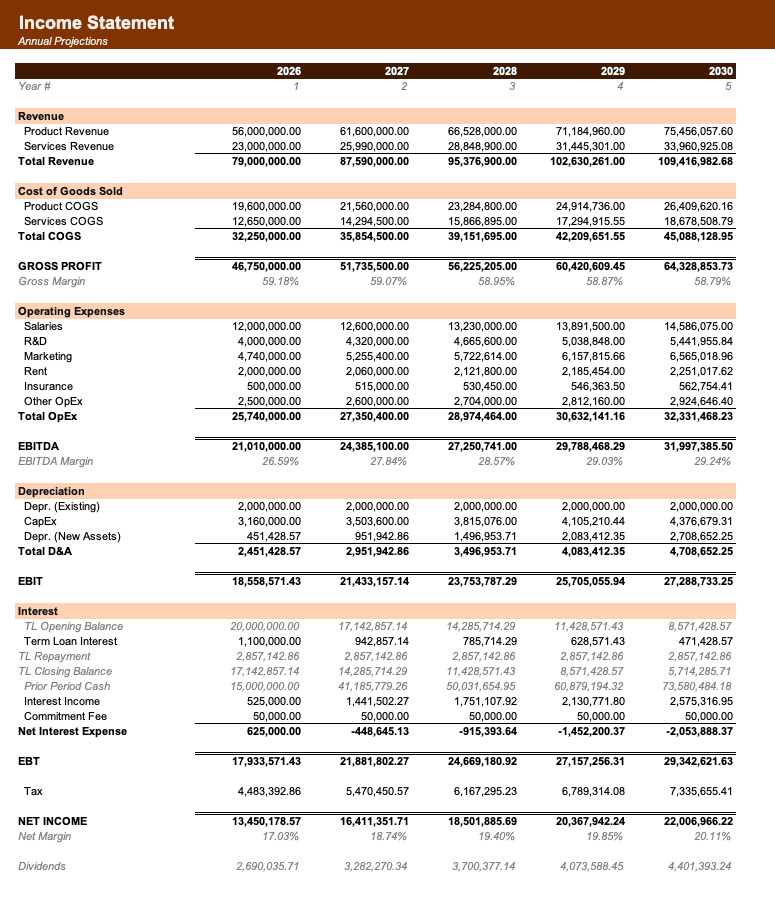
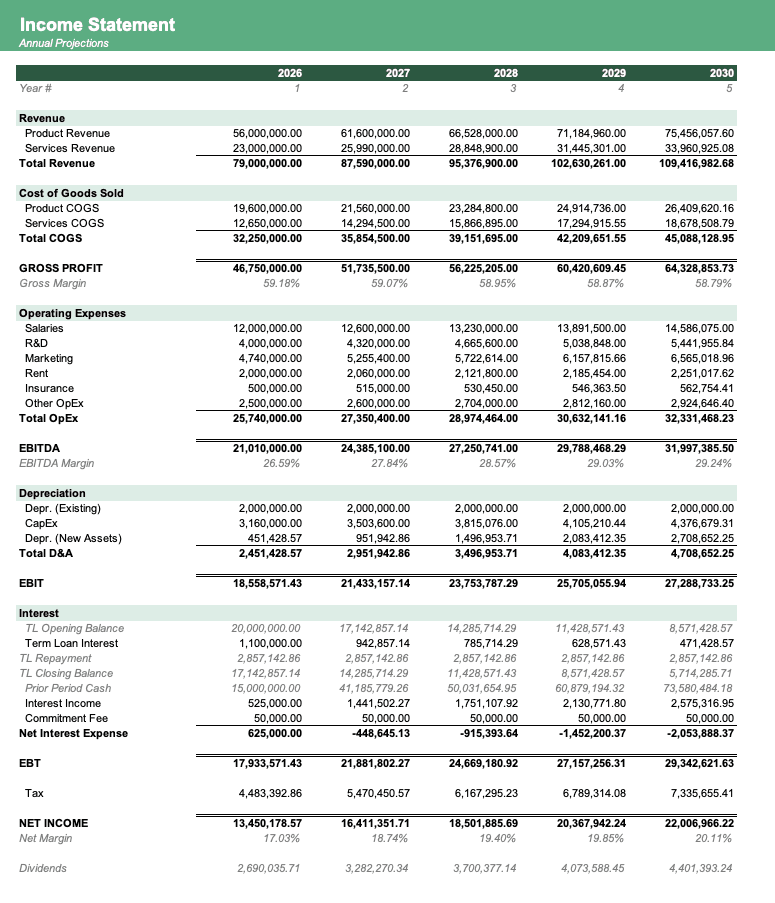
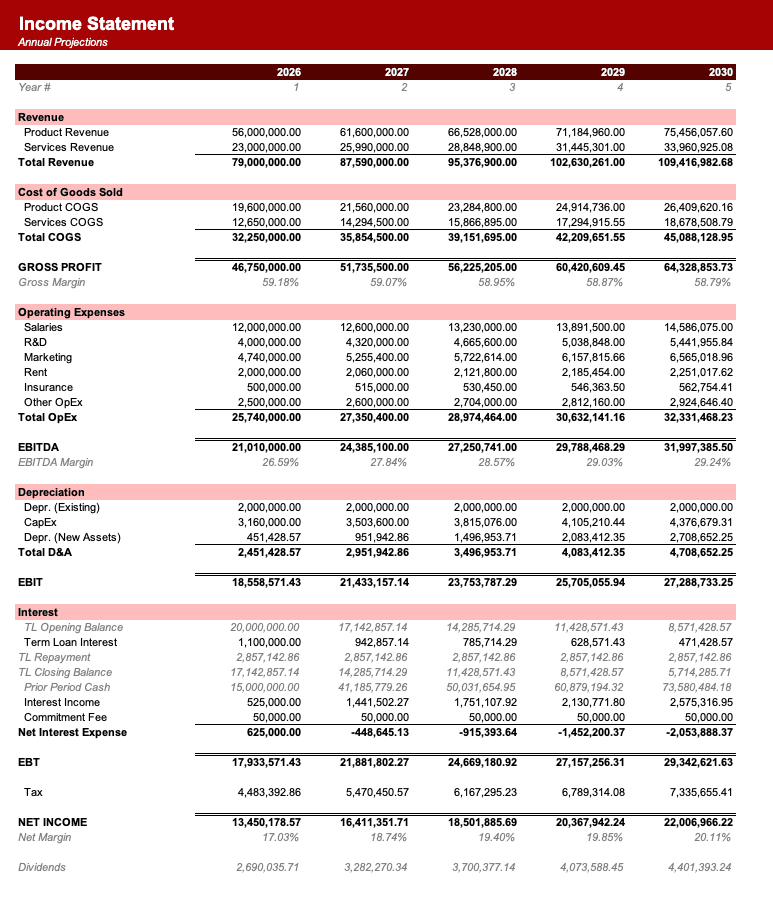
Formatted to IB standards
Named theme colors repaint the whole workbook in one click, on top of an investment-banking structure with clear input, output, and cross-sheet reference styling - brand-ready, institutional-grade, and fully auditable.

Created by ex-finance professionals
Hey, I’m Alex and I created Finamodel.
Over my years in the finance industry I kept building the same models over and over again. Same structure, same assumptions, different logo. So I started building frameworks to turn them into clean, reusable templates.
Every model here is one I’d actually use for a client, and I personally vet each one before it goes up.
I’m not an expert in every industry, but I’ve built enough models to know what belongs in one. And when something is completely foreign to me, I reach out to my network for experts to work on our models with us.
Having a template library on hand cuts a first build from hours to minutes.
Need help finding your model? You’ll find me in the Finamodel app!
Frequently asked
What is a syndicated loan financial model?+
It is a model used to structure, price, and manage multi-tranche loan facilities involving multiple lenders, covering repayment waterfalls, fees, and covenant compliance.
Who uses syndicated loan models?+
Investment bankers, leveraged finance teams, corporate treasurers, and credit analysts use them for deal structuring and ongoing facility management.
What should a syndicated loan model include?+
It should include tranche-level amortisation, interest and fee schedules, cash sweep logic, and covenant compliance outputs with headroom visibility.
Does it support PIK interest?+
Yes. Each tranche can be configured with payment-in-kind interest options, allowing interest to accrue and capitalise onto the principal balance.
Can I model bridge-to-bond financing?+
Yes. The model supports short-term bridge facilities with takeout assumptions through permanent capital market instruments.
Have more financial modelling questions? Contact us
Related templates
Bank Loan Analysis Model
Commercial bank loan origination and portfolio underwriting.
Leveraged Buyout Model
Complete LBO analysis with debt financing structures, sponsor returns, and sensitivity to exit scenarios.
Direct Lending Fund Model
Financial model for direct lending fund with loan origination, yield, losses, and fund returns.
Auto Loan Portfolio Model
Automotive loan securitization and portfolio analysis.