 By Alex Tapio
 Forecastr alternatives
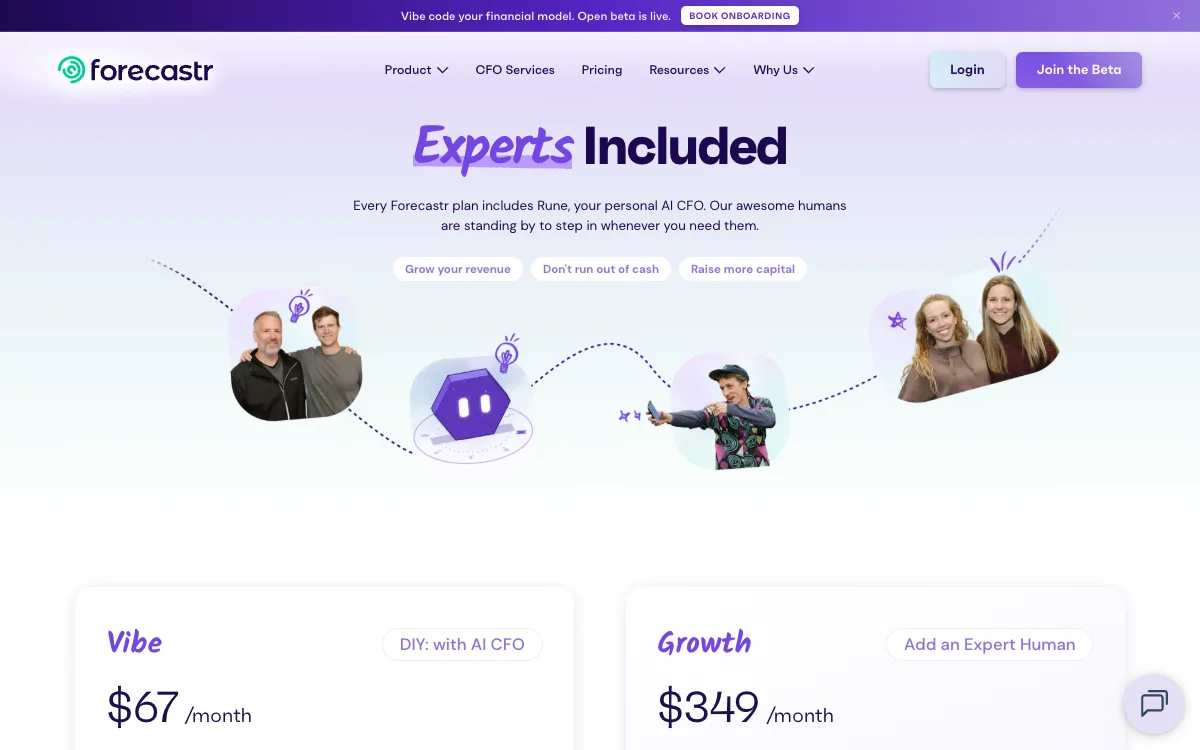
People look for Forecastr alternatives for three main reasons. The first is cost: paid plans start at $5,000 a year, which is a lot for a pre-seed team. The second is access. On 10 Nov 2026 every plan button read Join the Waitlist, and Vibe entry ran through booked onboarding calls. The third is control. Some founders would rather own and change the model themselves, with a template or an AI tool, than wait for an analyst.
What is Forecastr?
Forecastr is a financial modelling platform for startups that comes with a person. Every paid plan includes a dedicated finance expert, who builds the model with you: revenue, hiring, expenses, runway, scenarios and budget vs actuals. You share the model with investors through live links. Forecastr also sells a fractional CFO tier, and Vibe, an AI tool that builds a model from words instead of formulas, is in open beta. Its customers are venture-track founders who are raising money.
Forecastr at a glance
Forecastr has three service plans. Essentials costs $5,000 a year and Growth $10,000 a year, and CFO Services is priced on request. The Vibe beta adds a do-it-yourself tier at $67 a month, and Forecastr says an expert analyst reviews a Vibe model at no extra cost. Beta prices may change. A free set of Excel and Google Sheets startup templates covers 12 business models, up to 60 months, after an email sign-up.
Quick picks
Forecastr is the first row. The rest fall into three groups: AI software that builds the model for you, people who build it for you, and templates you fill in yourself. Read the "Builds it" and "Price" columns together. In this group, the more of the work someone else does, the more you pay each month.
| Tool | Best for | Type of tool | Price (entry plan) | Works in | Free option | Builds the model for you | Excel file you keep | AI edits your file | Templates library |
|---|---|---|---|---|---|---|---|---|---|
| Funded founders wanting an analyst | Software + analyst | From $5,000 a year | Web, Excel, Google Sheets | Yes: Free templates | Yes: Analyst builds it | Yes: Excel, Google Sheets | Yes: Vibe, in open beta | Yes: 12 free templates |
 | An AI CFO on live actuals | AI FP&A software | From $375 a month | Web, Slack, Excel export | Yes: 14-day trial | Yes: Ari builds it | Yes: Excel export | No: Edits its own model | No: Built from your data |
 | Founders who build it themselves | Startup model library | $199 suggested, $0 allowed | Excel, Google Sheets, browser | Yes: Pay what you want | No: You fill it in | Yes: Excel and Sheets | No: Built for your AI | Yes: Startup and VC models |
 | A cheap plan and forecast | Plan software | $15 to $40 a month | Web, PDF, PowerPoint | No: 35-day money-back only | Yes: From your answers | No: Web app, PDF export | No: AI in its app | Yes: 550+ sample plans |
 | A startup model you own | Ready models + AI | $20/mo or $120/yr | Web app, Excel file | Yes: 30 models + free samples | Yes: Fina chat builds it | Yes: .xlsx, formulas visible | Yes: Fina chat edits it | Yes: 500+ models |
 | A human CFO plus bookkeeping | Finance service | CFO from $2,450 a month | Service, QuickBooks Online | No: None noted | Yes: CFO builds it | Not stated: File format not stated | No: AI for bookkeeping | No: Built for you |
 | A model built from your books | AI FP&A software | From $719 a month | Web, QuickBooks, Xero | Yes: 14-day trial | Yes: AI builds it | No: Excel is input only | No: Edits its own model | No: Built from your data |
yes · no · not stated in the vendor's sources. Hover a mark for details. From each vendor's own site; prices change, so check before you buy.
1.cfo.ai
cfo.ai, the company formerly called Runway, sells Ari, an AI CFO that builds and maintains a company's financial model from chat. It is aimed at founders, chiefs of staff, finance teams and fractional CFOs.
You connect your accounting, payroll, billing and CRM systems, such as QuickBooks, Xero, Stripe, Salesforce and Rippling, and Ari builds the model from your actuals. Then you ask questions in plain words, for example whether you can afford two hires, and Ari builds upside, base and downside scenarios. It also keeps the forecast current, prepares monthly packs and drafts board decks. If you already have a spreadsheet model, cfo.ai can import it and build a tie-out page that bridges the old workbook to the new model.
This suits a founder who has outgrown a spreadsheet and wants the model to update itself from live data. cfo.ai says every figure traces back to its formula inputs and source rows, and every change Ari makes is logged and can be undone, which helps when a board member asks where a number came from.
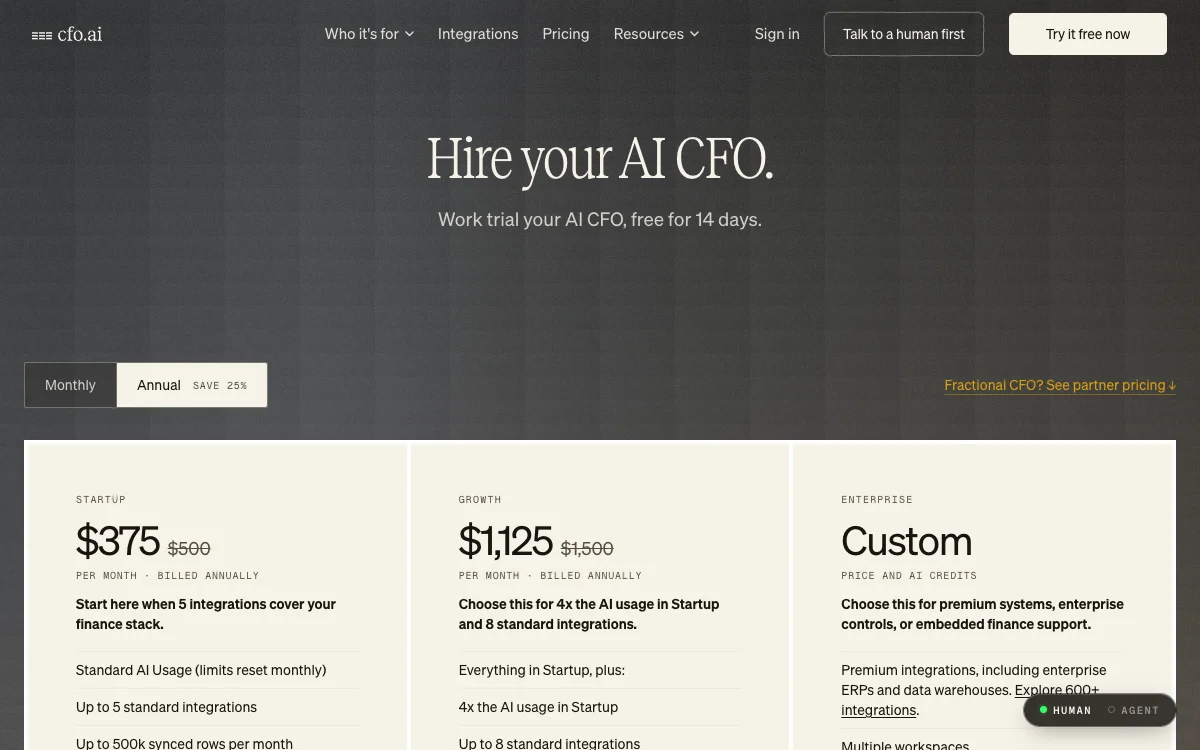
Next to Forecastr, the AI does much of what the analyst does, and you can start a 14-day trial with no waitlist. The price is close to Forecastr's: Startup is $375 a month billed yearly, or $500 month to month, which is $4,500 a year at the lower rate, and Growth is $1,125 a month. What you lose is the person. There is no dedicated analyst on the Startup plan, and the model lives in cfo.ai, with an Excel export, rather than in a file you work on yourself.
- Price
- Startup $375 a month billed yearly ($500 monthly). Growth $1,125 a month billed yearly. Enterprise custom.
- Free option
- A 14-day free trial.
Pros
- Model built from live actuals
- Plain-language scenarios
- Every change logged and reversible
Cons
- Entry plan near $4,500 a year
- No dedicated analyst on the entry plan
Pick it if you want an AI to build and update the model from your live data.
2.Hemrock
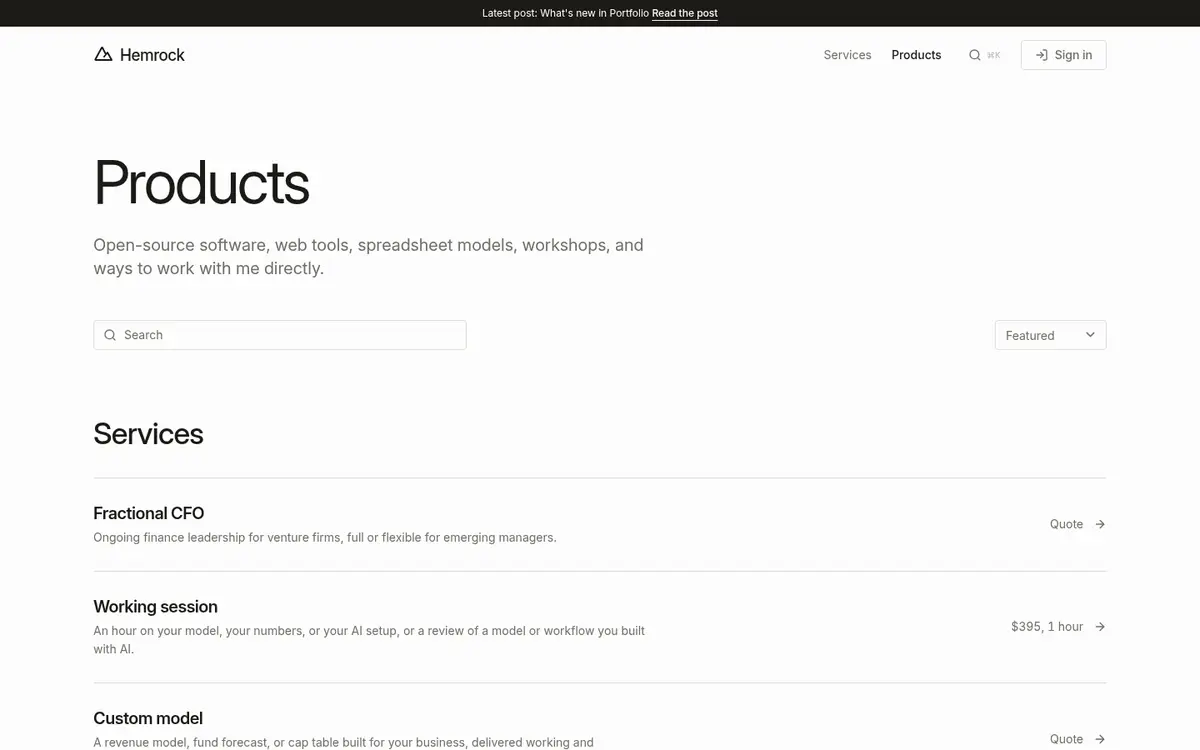
Hemrock, which used to be called Foresight, makes open-source financial models for startups and venture funds, in Excel and Google Sheets. It also offers browser tools, workshops, custom models and fractional CFO services.
Its main product, the Standard Financial Model, is a five-year monthly model with an income statement, balance sheet, cash flow statement, charts and metrics. Separate models and tools cover runway, SaaS, ecommerce, unit economics, cap tables and exit waterfalls, venture valuation and fund economics. Each model is documented so that an AI tool such as Claude or ChatGPT can read and extend it without breaking it, and Hemrock sells prompt guides and a Claude skill for that.
The audience is founders from idea stage to Series B board meetings, which is much the same audience as Forecastr's. The difference is who does the work. With Hemrock you build your own forecast on a tested structure. When you get stuck, you can book a working session, pay for a custom model or hire its fractional CFO service.
The price gap is large. Hemrock's product pages suggest $199 and accept $0, against $5,000 a year for Forecastr Essentials. One catch: a Hemrock pricing document lists the Standard model at $149 and the venture capital model at $349, one-time, so check the price on the day. What you give up is Forecastr's analyst, its accounting and CRM integrations, budget vs actuals from live data and the live investor links. You also have to know enough modelling to adapt the template, and nobody checks your assumptions unless you pay for a session.
- Price
- Pay what you want, $199 suggested. A pricing document lists $149 and $349 one-time.
- Free option
- The models can be taken for $0.
Pros
- Startup models for any price, including $0
- Excel and Google Sheets versions
- Workshops and custom help if needed
Cons
- Prices differ across its own pages
- You do the modelling yourself
Pick it if you want to build your own startup model on a free template.
3.LivePlan
LivePlan, from Palo Alto Software, is browser-based business plan and forecasting software. It builds a linked profit and loss, cash flow and balance sheet from your answers, and helps you write the plan.
You answer questions about how the business will make money, and a Help Me Forecast AI assistant helps you start. LivePlan then builds the three statements and lets you write the plan with guidance and more than 550 sample plans. It turns the plan into a pitch presentation you can export to PDF or PowerPoint. Premium adds QuickBooks Online and Xero links, auto-updating cash forecasts, budget vs actual dashboards and up to 10 what-if scenarios.
Its core users are small business owners, and lenders, SBA partners, educators and accelerators roll it out to clients and students. For a startup founder it works best early on, when you need a plan and a basic forecast at low cost, before an investor asks for a detailed model. A founder testing an idea can get a full set of statements for $15 a month.
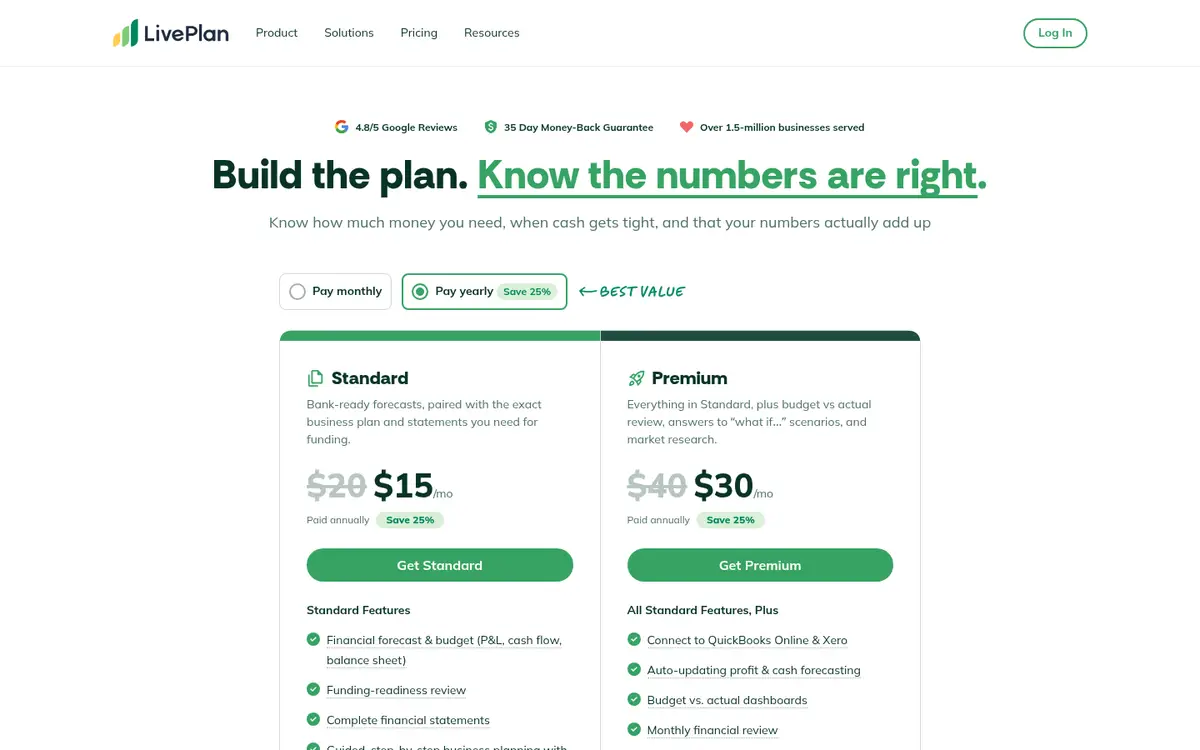
On price, LivePlan is the opposite of Forecastr. Standard is $20 a month, or $15 paid yearly, and Premium is $40 a month, or $30 paid yearly, with a 35-day money-back guarantee. You can start the same day. The trade-off is depth and help. LivePlan is built for traditional business plans, not venture models with detailed hiring and runway plans, and its pricing page does not name runway or burn. Help from a person is a paid Expert add-on, not a dedicated analyst, and the forecast stays in LivePlan's web app.
- Price
- Standard $20 a month ($15 paid yearly). Premium $40 a month ($30 paid yearly).
- Free option
- No free plan; a 35-day money-back guarantee.
Pros
- Low monthly price
- Plan writing and pitch export in one app
- Budget vs actual on Premium
Cons
- Not built for venture-style models
- Forecast stays in the web app
Pick it if you need a plan and a simple forecast for a small budget.
4.Finamodel
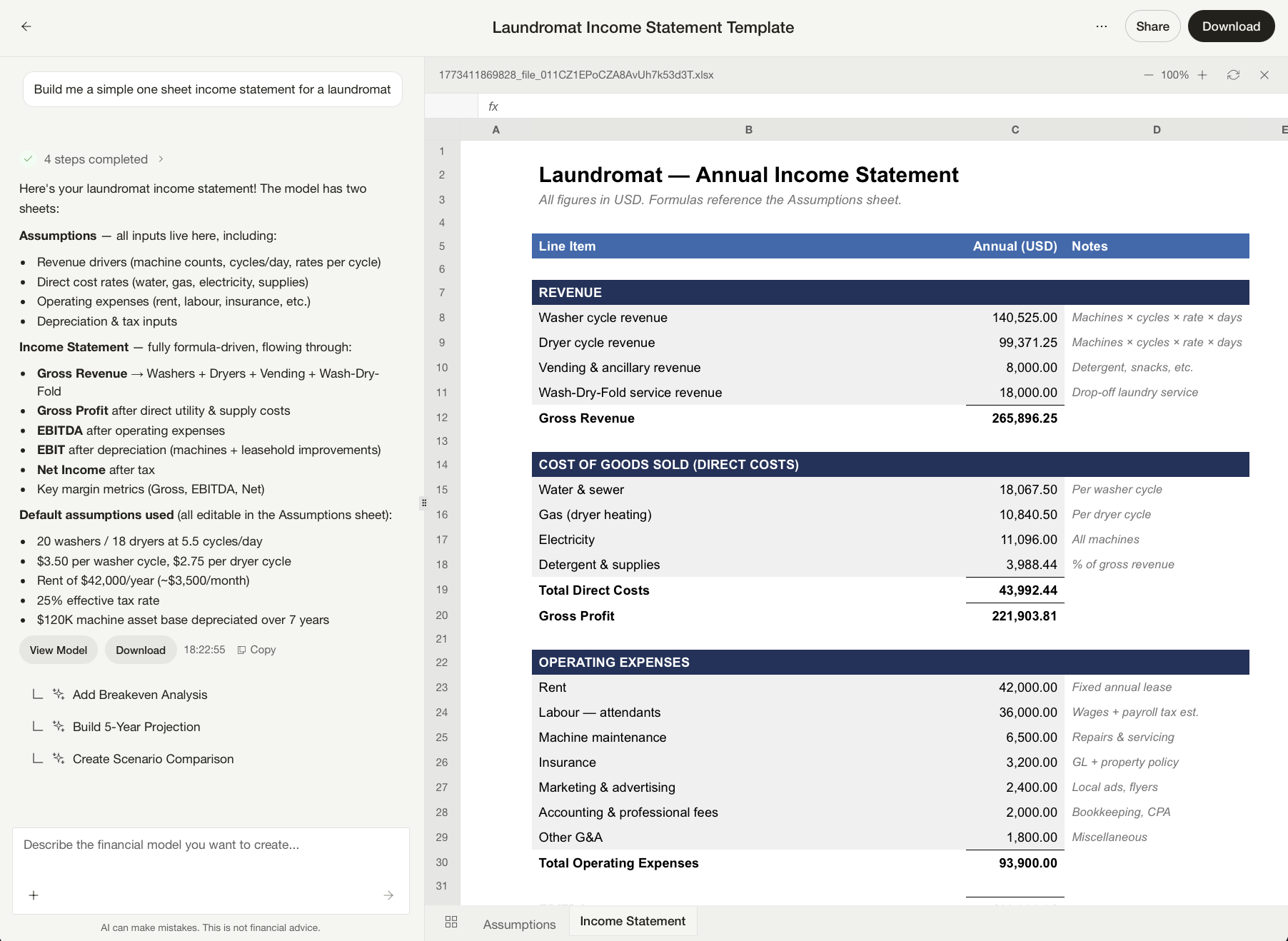
Finamodel is a library of ready Excel financial models with an AI assistant called Fina. You pick a model, such as a startup or SaaS model, and Fina changes it for your company. You do it yourself, with AI help, and download the file.
A typical session starts with a startup model from the library. You tell Fina chat your plan in plain words: the pricing, the hires by quarter, the marketing budget, the round you plan to raise. Fina edits the model, explains a formula when you ask, and fixes errors. You stay in charge of every assumption. Version history keeps every earlier file, so you can try a bold scenario and roll back. A voice walkthrough of the model helps you prepare to present it to an investor, because you hear how each part of the model connects.
You download a real .xlsx file with every formula visible. Investors and advisers can open it in Excel, Google Sheets or Numbers and check each number, and the file works without Finamodel. The plans are self-serve, with no demo, no waitlist and no onboarding call, and you can cancel at any time. The first paid plan has a 14-day money-back guarantee, and 30 full models and a sample of every other model are free.
Next to Forecastr, Finamodel trades the analyst for speed and a lower price. Nobody builds the model for you or reviews it, and support is by email. There are no live accounting syncs for budget vs actuals, only read-only links to QuickBooks, Google Sheets, Google Drive and 42 other apps, and no live investor links: you share a file. If you want a finance expert who knows your company, Forecastr or Pilot is the better choice. If you can describe your plan and want an investor-ready Excel model today, Finamodel fits.
How it works
- Pick a ready model, such as a DCF or a 3-statement model, from a library of more than 500.
- Ask Fina chat to change, explain or fix it for your case and your numbers.
- Download a real .xlsx file. Every formula is visible, and it works without Finamodel. It opens in Excel, Google Sheets and Numbers.
- Price
- Models plan: $20 a month or $120 a year. All Templates: $30 a month or $144 a year. You can cancel at any time.
- Free option
- 30 free models with live formulas, and a free sample of every other model, with values but no formulas. Both are sent by email link, one model email per email address per day. The library is free to browse.
Better than Forecastr at
- Start today, with no waitlist or onboarding call
- An Excel file you own and can share
- A much lower price than an analyst service
Worse than Forecastr at
- No dedicated analyst or expert review
- No live budget vs actuals or investor links
- Support is by email
Models that fit: Startup Financial Model, SaaS MRR/ARR Forecast Model, Pre-Seed Startup Financial Projection Model.
Pick it if you can describe your plan and want an investor-ready model today.
5.Pilot
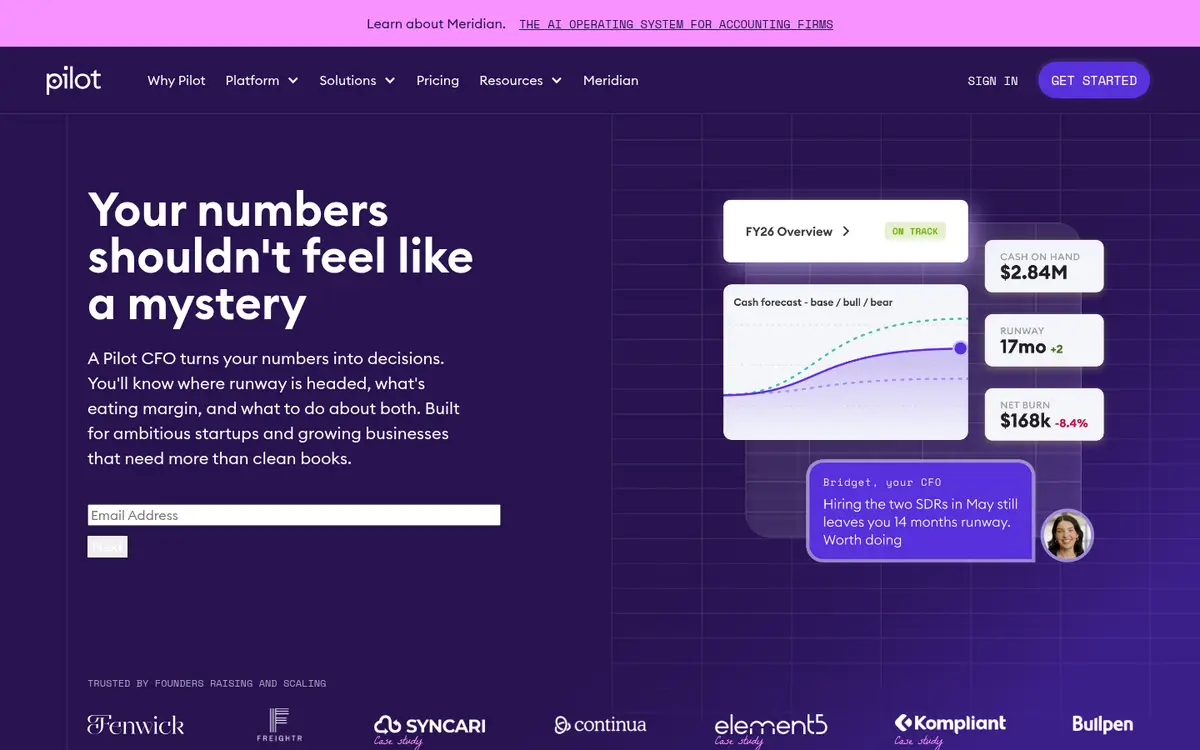
Pilot is an outsourced finance service for startups and small businesses. It offers bookkeeping, tax, operations and human CFO engagements, and every CFO engagement starts with a financial and operating model built around the business.
A Pilot CFO builds your operating model and annual budget, a revenue forecast with base, bull and bear cases, and holds a monthly review with you. Every CFO plan includes a budget and forecast model with a profit and loss, balance sheet and cash flow. Pilot can also run your books: its AI Accountant handles bookkeeping in QuickBooks Online, and the team finalizes every close.
The service is for startups and growing businesses that need more than clean books. Pilot says its CFO clients have raised more than $10B, and its CFOs come from operating finance roles. It makes the most sense when you want one firm to own the books, the tax and the forecast. Its pricing page also lists instant AI answers about past transactions and current cash, plus scenarios to plan ahead.
Pilot is the closest match to Forecastr's human model, and it goes further, because the same team does your bookkeeping and tax. It is also more expensive: CFO services start at $2,450 a month, close to $30,000 a year, against $5,000 to $10,000 for Forecastr's plans. Two things are not clear from Pilot's pages. The file format of the CFO model is not stated, so ask whether you get an Excel file. And its AI sits mainly in bookkeeping, not in the model, so there is nothing like Vibe for building a forecast yourself.
- Price
- CFO services from $2,450 a month.
- Free option
- No free plan or trial noted.
Pros
- Human CFOs from operating finance roles
- Books, tax and forecast from one firm
- Base, bull and bear revenue forecasts
Cons
- CFO services from $2,450 a month
- Model file format not stated
Pick it if you want a human CFO and one firm for books, tax and forecast.
6.Clockwork
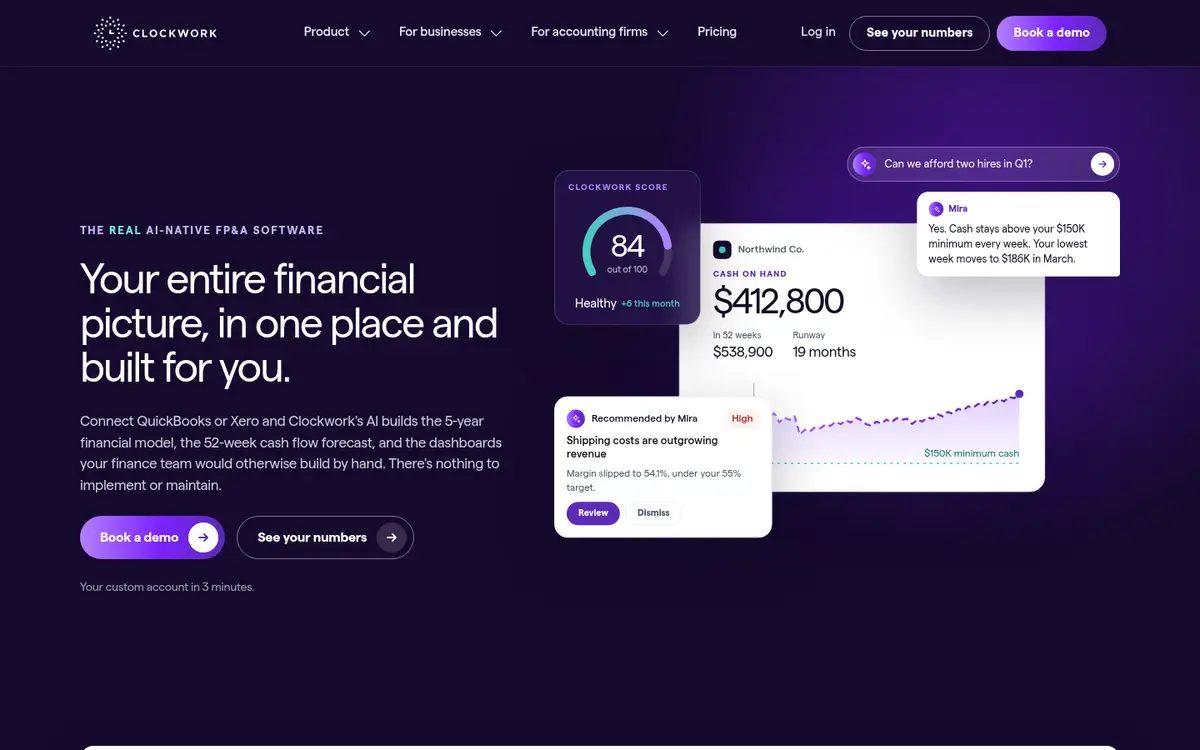
Clockwork is AI-native FP&A software. You connect QuickBooks, Xero or a spreadsheet, and its AI builds a 5-year three-statement model, a 52-week cash forecast and dashboards.
Setup is the main idea: Clockwork says your account is ready in minutes and there is nothing to implement or maintain. After that, Mira, its AI assistant, answers questions against the model and flags issues, for example when costs grow faster than revenue. Excel and Google Sheets files are accepted as inputs. Accounting and CFO firms get a client portal and unlimited users.
Clockwork sells to businesses directly and to accounting, CPA and fractional CFO firms that do advisory work. For a founder, it is a way to get a working model from the books you already keep, without an analyst and without building it yourself. The 52-week cash forecast is useful when runway is short and you need to watch cash week by week. It calls itself an official Thomson Reuters FP&A partner and says it has more than 1,000 users.
Against Forecastr, Clockwork is self-serve: there is a 14-day free trial and no waitlist. It is not cheaper, though. Business plans start at $719 a month, and firm plans at $1,499 a month billed yearly, which is 25% less than monthly billing. Firms also get a 90-day guarantee: Clockwork is free until they sign their next advisory client. Two gaps matter for a fundraise. There is no human analyst, and the model lives in Clockwork's web app, where Excel is an input, not the file you hand to investors.
- Price
- Business plans from $719 a month. Firm plans from $1,499 a month billed yearly.
- Free option
- A 14-day free trial; a 90-day client guarantee for firms.
Pros
- Model and cash forecast built from your books
- Self-serve start with a free trial
- Unlimited users on firm plans
Cons
- From $719 a month
- No Excel file as the output
Pick it if you want AI to build a model from your books, with no setup.
Who should pick what
The real choice is who builds the model. Forecastr's answer is an analyst. The alternatives answer with an AI, a human CFO, or you with a template. Each step away from a person saves money but asks more of you. Start with your budget and how much modelling you know.
- An AI that builds the model from live data: cfo.ai, or Clockwork if your books are in QuickBooks or Xero.
- A human CFO who also runs the books: Pilot.
- Build it yourself for little or nothing: Hemrock, or LivePlan for a simple plan.
- A ready startup model in Excel, changed for you by AI: Finamodel.
If you are on Forecastr's waitlist, use the free templates while you wait, or start on a template or trial elsewhere. Whatever you pick, keep the model in a form you can send to investors. Before a round, an investor will ask to see the assumptions, so make sure you can show them.
Frequently asked
How much does Forecastr cost?+
Forecastr Essentials is $5,000 a year and Growth is $10,000 a year. CFO Services is priced on request. The Vibe beta has a do-it-yourself tier at $67 a month, and beta prices may change.
Is there a free version of Forecastr?+
There is no free plan. Forecastr gives away Excel and Google Sheets startup templates for 12 business models after an email sign-up.
What are the main Forecastr alternatives?+
AI software: cfo.ai and Clockwork. A human CFO service: Pilot. Templates you fill in: Hemrock. Low-cost plan software: LivePlan. A ready Excel model changed by AI: Finamodel.
Can I sign up for Forecastr today?+
Not directly on 10 Nov 2026: every plan button read Join the Waitlist. On 19 Nov 2026 the Vibe beta ran through booked onboarding calls.
Forecastr vs Finamodel: which should I pick?+
Pick Forecastr if you want a finance expert to build the model with you and can pay $5,000 a year or more. Pick Finamodel to build the model yourself with AI and keep the Excel file. Finamodel's Models plan is $20 a month or $120 a year.
Sources for Forecastr (4), last checked 19 Nov 2026+
- forecastr.com · Plan prices and waitlist CTAs · 10 Nov 2026
- forecastr.com · Vibe AI model builder · 10 Nov 2026
- forecastr.com · Free Excel/Sheets templates · 10 Nov 2026
- forecastr.com · Vibe open beta, $67/month DIY tier · 19 Nov 2026
Each alternative's own page lists its sources.


