 By Alex Tapio
 Fuel Finance alternatives
People look for Fuel alternatives for three reasons. Fuel shows no prices: every plan is tailored, and the first step is a 30-minute call or a demo. It is an implemented system built with an engineer, not a product you can sign up for and try alone. And a small company without its own finance staff may have no one to approve the agents' work, which makes a done-for-you service a better fit.
What is Fuel Finance?
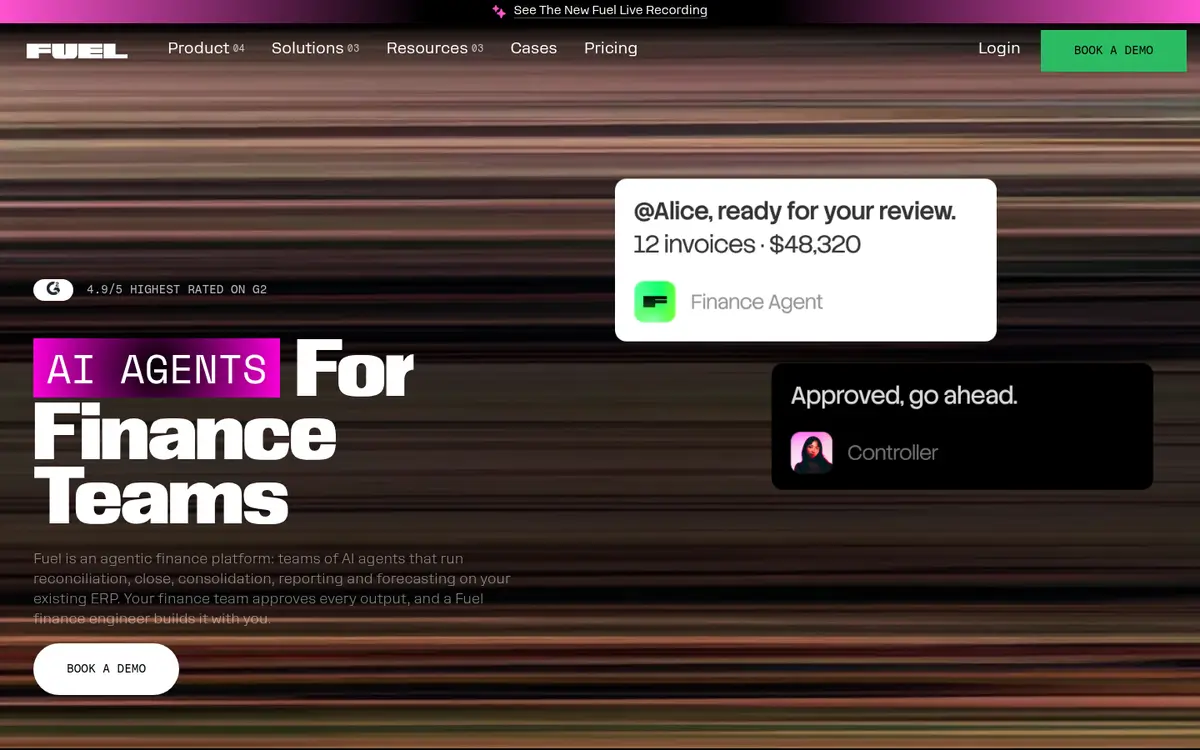
Fuel, also called Fuel Finance, is an agentic finance platform. Teams of AI agents run reconciliation, close, consolidation, reporting and forecasting on a company's existing ERP, and a Fuel finance engineer builds the system with the customer. The agents are grouped into Analysis, Forecasting, Controlling and Treasury teams, and Fuel says your finance team approves every output. Results come in the formats people already use: Excel, PDF, a link, PowerPoint or Google Sheets. A dedicated FP&A manager or CFO can be added for forecasting, scenario planning and financial modelling. Fuel says it exists to help startups and small businesses manage their finances better.
Fuel Finance at a glance
Fuel publishes no dollar prices. Its pricing page says every plan is tailored to your business needs and asks you to book a 30-minute, obligation-free call or a demo. The same page lists Fuel AI Copilot, an AI dashboard and metrics builder and AI anomaly detection. No free plan or trial is listed. What you buy is the agent system, the engineer who builds it, and optional FP&A or CFO support.
Quick picks
Fuel is the first row. The alternatives are another agent platform, two finance services, two FP&A tools that work in spreadsheets, and a model library. Most are sold through a demo, so compare what each one delivers rather than price alone. The Excel column matters here, because Fuel's outputs in Excel and Google Sheets are one of its strengths.
| Tool | Best for | Type of tool | Price (entry plan) | Works in | Free option | Builds the model for you | Excel file you keep | AI edits your file | Templates library |
|---|---|---|---|---|---|---|---|---|---|
| Agents on your ERP, expert-built | Agentic finance platform | Tailored, demo first | Your ERP, web | No: None listed | Yes: Agents plus finance engineer | Yes: Excel and Sheets outputs | Yes: Outputs in your formats | Not stated: Not stated |
 | In-house teams wanting traceable AI | AI agents for finance | Quote, 12-month term | Web app | No: Proof of Value first | Yes: Agents draft reports, forecasts | Not stated: Export not stated | No: Reports in its app | Not stated: Not stated |
 | A human CFO with a model | Outsourced finance service | CFO from $2,450/mo | QuickBooks Online | No: None listed | Yes: Your CFO builds it | Not stated: Model format not stated | No: AI on bookkeeping only | Not stated: Not stated |
 | A model file, self-serve | Ready models + AI | $20/mo or $120/yr | Web app, Excel file | Yes: 30 models + free samples | Yes: Fina chat builds it | Yes: .xlsx, formulas visible | Yes: Fina chat edits it | Yes: 500+ models |
 | Done-for-you books with review | AI bookkeeping service | From $549/mo | QuickBooks Online, NetSuite | No: None listed | Yes: AI CFO forecasts | Not stated: Export not re-verified | No: AI CFO answers questions | Not stated: Not stated |
 | Excel teams consolidating data | Finance platform | Custom quote | Excel, Google Sheets, web | Yes: Templates, Academy courses | No: Keeps your models | Yes: Your own Excel models | Not stated: Not stated | Yes: Free Excel templates |
 | Mid-market FP&A in spreadsheets | FP&A platform | Quote by entity count | Excel, Sheets, web, PowerPoint | Yes: Free templates | No: You build, agents assist | Yes: Two-way Excel sync | Yes: Agents propose changes | Yes: Free finance templates |
yes · no · not stated in the vendor's sources. Hover a mark for details. From each vendor's own site; prices change, so check before you buy.
1.Pluvo
Pluvo provides AI agents for in-house finance teams. They connect finance systems and produce reports and forecasts in which every number traces to its source, and fractional CFOs and outsourced finance leaders can use Pluvo through a partner programme.
Named agents handle the monthly close, board narrative, variance drivers, runway scenarios and audit support. You ask in plain language and get a report whose numbers trace back to source, with a policy and audit trail on each answer. Integrations run from QuickBooks or Xero, CRM, billing and spreadsheets up to ERPs, HR systems and data warehouses, and a plugin or API lets other AI tools answer from Pluvo's data. Growth includes unlimited users, reports and dashboards; Scale adds role-based access and single sign-on.
It fits a finance team that wants answers it can defend to a board or an auditor, and that is ready to commit for a year.
Pluvo is the closest match to Fuel. Both put AI agents across your finance processes and keep people in control. Pluvo is clearer about terms: its tiers are named, plans are quoted and billed annually, and a Proof of Value, credited toward year one, comes before a 12-month agreement. Fuel only says its plans are tailored. Fuel goes further on delivery formats, naming Excel, PDF, PowerPoint and Google Sheets, while Pluvo's output is reports and dashboards in its app, with no Excel export stated. Fuel also builds the system with an engineer and can add a human CFO; Pluvo describes no such service. Neither shows a dollar price.
- Price
- No public price. Growth, Scale and Enterprise are quoted and billed annually.
- Free option
- None listed. A Proof of Value comes first and is credited toward year one.
Pros
- Every number traces to its source
- Policy and audit trail on answers
- Unlimited users on Growth
Cons
- 12-month agreement
- No Excel export stated
Pick it if you want agents with traceable answers and can sign for a year.
2.Pilot
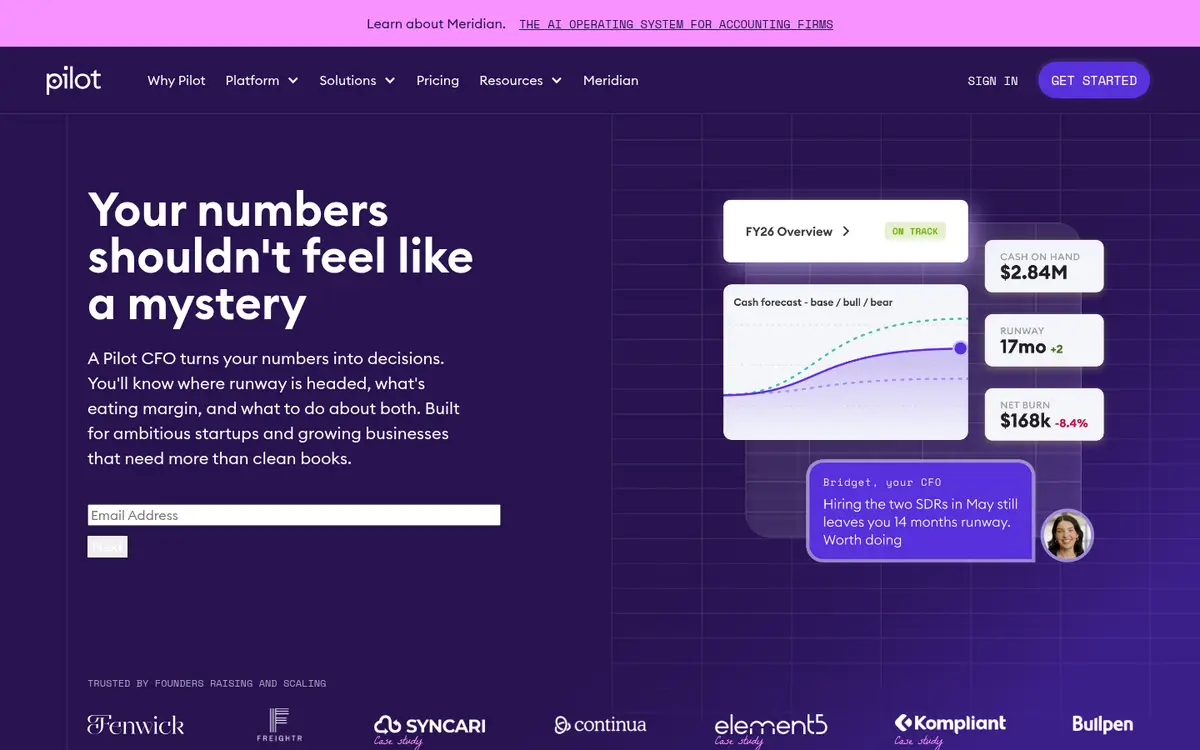
Pilot is an outsourced finance service for startups and small businesses, covering bookkeeping, tax, operations and human CFO engagements. Every CFO engagement starts with a financial and operating model built around the business.
A Pilot CFO builds the operating model and annual budget and a revenue forecast with base, bull and bear cases, then runs a monthly review. Every CFO plan includes a Budget & Forecast Model with a profit and loss statement, balance sheet and cash flow. On the books, software handles the volume and Pilot's team finalises every close. The AI Accountant works in QuickBooks Online, and the pricing page lists instant AI answers on past transactions and current cash flow.
Pilot suits startups that want to hand off finance entirely, with a person who owns the plan. Its CFOs come from operating finance roles, and Pilot says its CFO clients have raised more than $10 billion.
The split with Fuel is who does the work. Fuel's agents work for your finance team, which approves each output; Pilot's people do the work for you. If you have no finance staff, Pilot is easier to run. If you have a team and an ERP, Fuel automates more of what that team already does. Pilot publishes a starting price, $2,450 a month for CFO services, where Fuel shows none. Pilot does not state the file format of its CFO model, while Fuel names Excel and Google Sheets. Pilot's AI sits mainly on bookkeeping, not on the CFO work. Neither lists a free plan.
- Price
- CFO services from $2,450 a month. Bookkeeping and tax priced separately.
- Free option
- None listed.
Pros
- A human CFO who owns the plan
- Every engagement starts with a model
- A published starting price
Cons
- CFO services start at $2,450 a month
- Model file format not stated
Pick it if you have no finance staff and want people to run it for you.
3.Finamodel
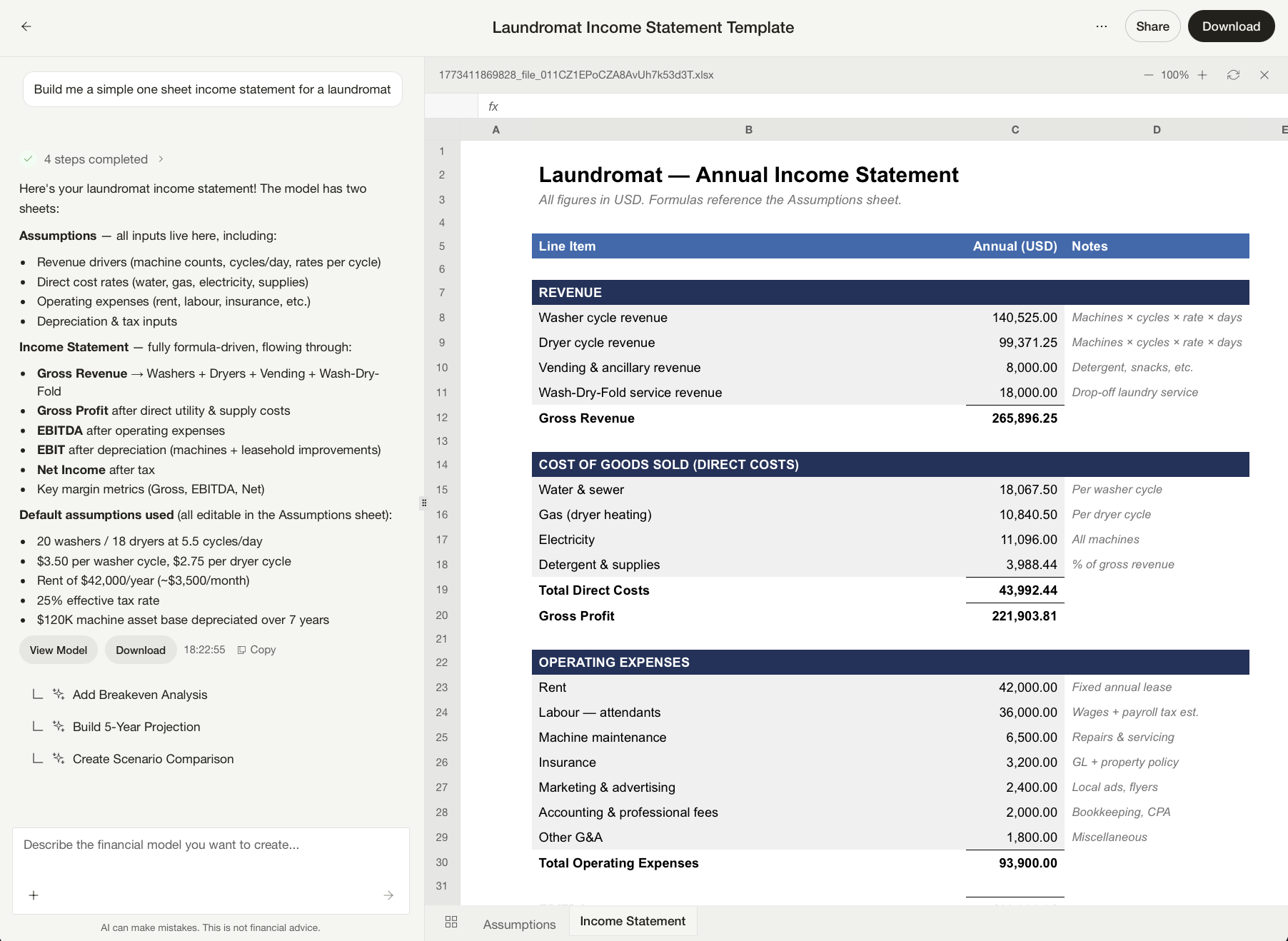
Finamodel is a library of ready Excel financial models with an AI assistant called Fina. It does not run on your ERP or close your books: it gives you a model file to plan with.
You pick a model, such as a three-statement model, a cash flow model or a group consolidation and eliminations workbook, and tell Fina what to change. Fina builds, edits, explains and fixes the model for your case: new entities, a funding round, a different growth rate. Version history lets you restore any earlier file. You download a normal .xlsx file with every formula visible, which works without Finamodel and opens in Excel, Google Sheets and Numbers.
It suits a finance lead at a startup or small business who needs a model now and is not ready for an implemented system. Read-only links to QuickBooks, Google Sheets, Google Drive and 42 other apps can bring in figures, and a voice walkthrough helps a founder or board member follow the model. It is self-serve, with prices on the site and a library that is free to browse, and you can try one of 30 free models with live formulas, or a free sample of any other model without formulas, sent by email link.
Next to Fuel, Finamodel does far less. There are no agents for reconciliation, close or treasury, no finance engineer, no human FP&A manager or CFO, and no approval workflow; support is by email. It is not an Excel add-in: you work in the Finamodel app, then download. You also need to know which model you want. Fuel delivers recurring outputs from your live systems, while Finamodel gives you one model at a time. The upside is speed and cost: you can have a working .xlsx model today, with no call, while you decide whether a full agent platform is worth it.
How it works
- Pick a ready model, such as a DCF or a 3-statement model, from a library of more than 500.
- Ask Fina chat to change, explain or fix it for your case and your numbers.
- Download a real .xlsx file. Every formula is visible, and it works without Finamodel. It opens in Excel, Google Sheets and Numbers.
- Price
- Models plan: $20 a month or $120 a year. All Templates: $30 a month or $144 a year. You can cancel at any time.
- Free option
- 30 free models with live formulas, and a free sample of every other model, with values but no formulas. Both are sent by email link, one model email per email address per day. The library is free to browse.
Better than Fuel Finance at
- Published prices and self-serve sign-up
- A free model to try, with no call
- A real .xlsx file you keep
Worse than Fuel Finance at
- No agents on your ERP or close
- No finance engineer or human CFO
- Support is by email only
Models that fit: 3 Statement Model, Cash Flow Model, Group Consolidation and Eliminations Excel Model.
Pick it if you need a model file today and are not ready for an implemented system.
4.Zeni
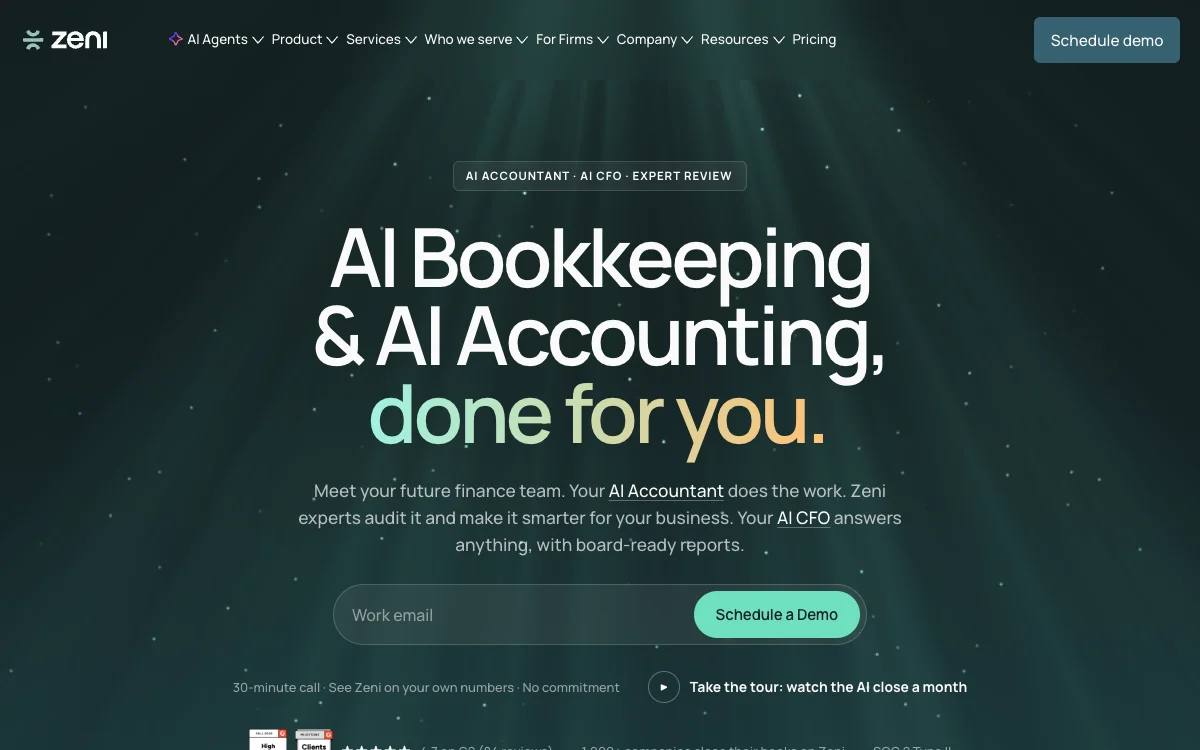
Zeni is an AI bookkeeping and finance service for growing businesses and startups. It runs on QuickBooks Online or NetSuite, with an AI accountant, a reviewing finance team, an AI CFO for questions and reports, and a human fractional CFO add-on.
The AI does the bookkeeping and the close, and Zeni experts audit the result. The AI CFO answers questions from the closed books with board-ready reports, flux analysis and forecasts. When you need more, a human fractional CFO handles modelling, budgeting, fundraising and board preparation. Zeni states SOC 2 Type II and says more than 1,000 companies close their books on it.
Zeni fits companies that want finance done for them rather than tools for their own team. It is a service, so you do not need a controller to approve agent work, and the AI CFO gives quick answers between monthly closes.
Against Fuel, Zeni is the clearer buy. Prices are on its site: AI Bookkeeping costs $549 a month on Starter and $799 on Growth, or $494 and $719 billed annually, and the CFO add-on runs from $1,599 to $4,990 or more a month. Fuel asks for a call before it shares any price. Fuel is the stronger choice for a company with an ERP and its own finance staff, since its agents cover consolidation and treasury and deliver in Excel, PowerPoint and Google Sheets. Zeni's Excel export could not be confirmed, and it lists QuickBooks Online and NetSuite only. Neither lists a free plan or trial.
- Price
- AI Bookkeeping from $549 a month ($494 billed annually). CFO add-on from $1,599 a month.
- Free option
- None listed.
Pros
- Published prices
- Experts review the AI's work
- Human CFO add-on
Cons
- QuickBooks Online or NetSuite only
- Excel export not confirmed
Pick it if you want finance done for you at a published price.
5.Datarails
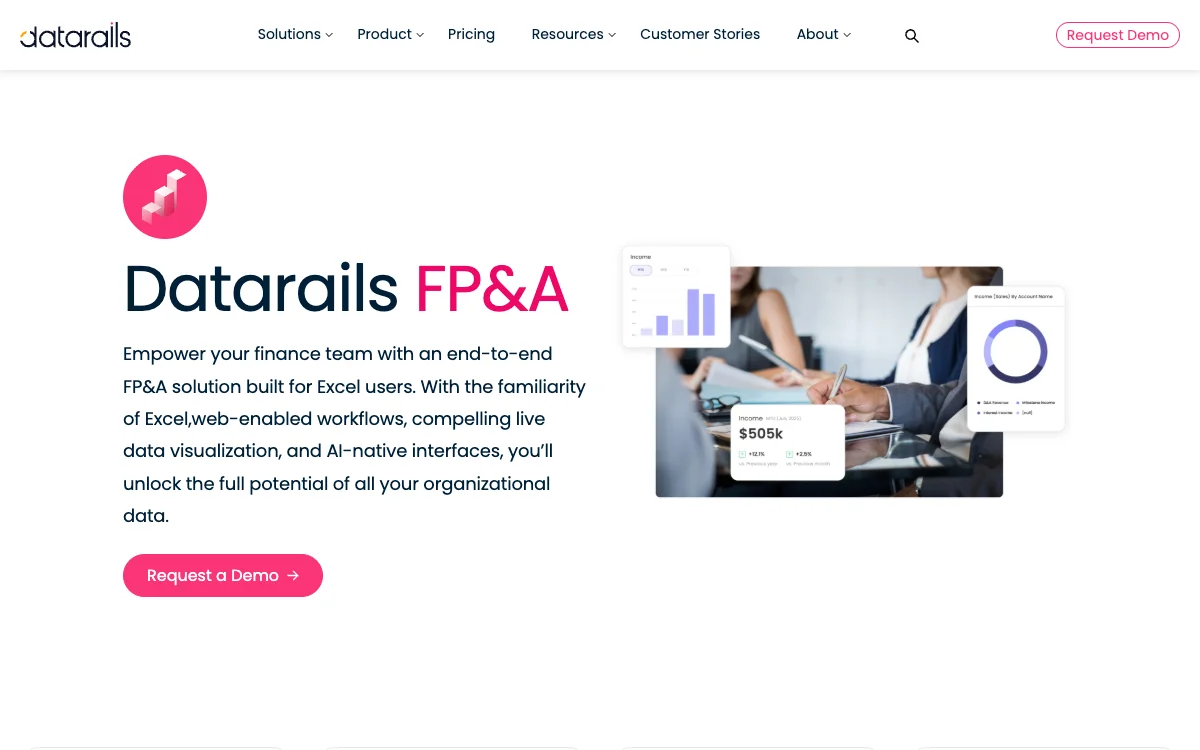
Datarails sells FinanceOS, a platform connected to Excel and Google Sheets that consolidates data for FP&A, reporting, month-end close, cash forecasting and spend. It has built-in AI agents and is aimed at the office of the CFO at small and mid-market firms.
Your Excel models stay as they are; Datarails consolidates data from systems, entities and spreadsheets underneath them and refreshes it in one click or on a schedule. It says it connects to more than 600 sources. Google Sheets has had native support with Datarails formulas since 1 Oct 2026. Month-end close, cash with bank sync and a 13-week forecast, and spend each have their own module. Datarails AI includes Strategy, Reporting and Planning agents with scheduled insights, Storyboards turn data into presentations, and a connector links Claude, ChatGPT, Copilot and other assistants.
It fits a finance team that has its process in Excel and wants automation without a rebuild. Free Excel templates and three free FinanceOS Academy courses let you learn the product first.
Datarails and Fuel cover much of the same ground: close, cash, reporting and forecasting with AI on top. The working style differs. Datarails keeps your team in its own Excel models, while Fuel's agents do the work and send outputs for approval, with an engineer building the system. Both sell through a quote, but Datarails at least names its tiers by users and integrations, from 2 users and 1 integration up to 15 users, 50 viewers and 3 integrations. Its pages give no dates for its AI agents or Claude Code plugin, so confirm in the demo which features are live.
- Price
- Custom quote. Tiers by users and integrations, from 2 users and 1 integration.
- Free option
- Free Excel templates and three free FinanceOS Academy courses.
Pros
- Keeps your existing Excel models
- Close, cash and spend modules
- Free templates and courses
Cons
- No public price
- No dates given for its AI agents
Pick it if your team wants to stay in its own Excel models while the data updates itself.
6.Cube
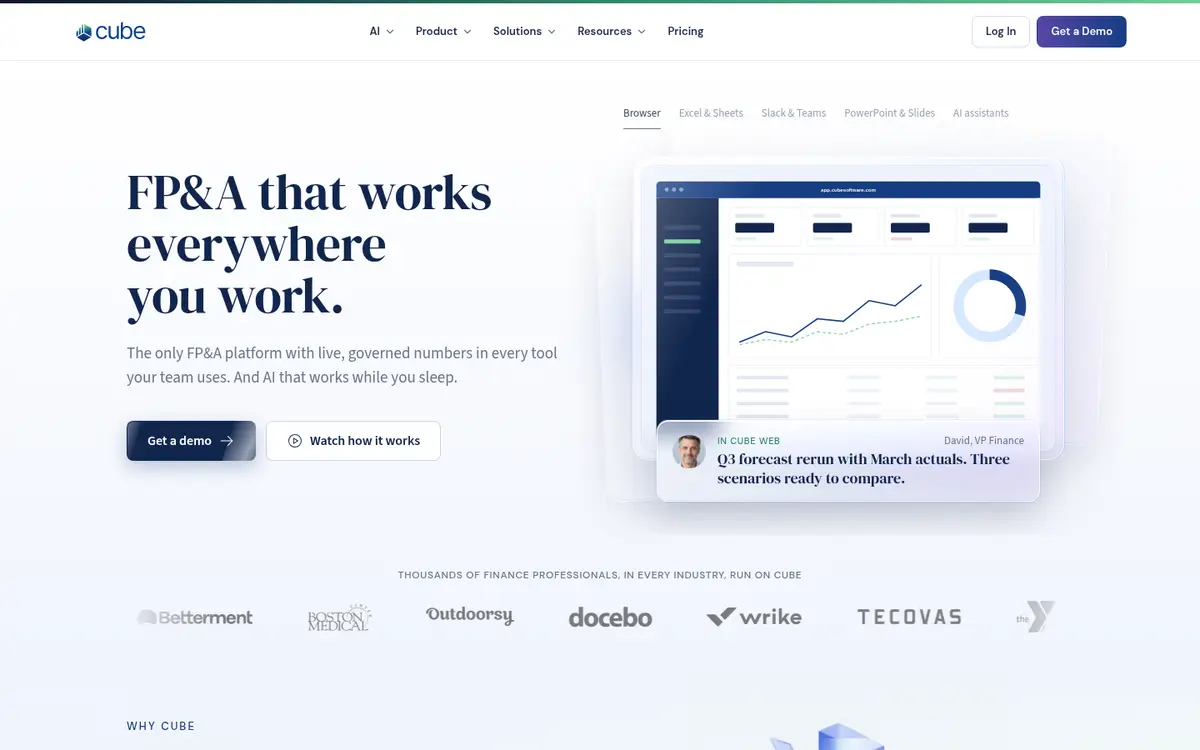
Cube is an FP&A platform with two-way sync to Excel and Google Sheets, modules for planning, reporting and consolidation, and AI agents. It calls itself an agentic FP&A platform and is built for mid-market and enterprise finance teams.
Planning covers revenue, headcount, expenses, cash and scenarios, with variance analysis, reporting and multi-entity eliminations. Data arrives from ERP, CRM and HR connectors, and PowerPoint and Google Slides decks refresh from the same numbers. Four agent teams, Data Managers, Analysts, Planners and Business Partners, run on schedules or triggers and propose changes that finance must approve. Slack and Teams apps and a connector for Claude, ChatGPT, Copilot and Gemini let people ask questions where they already work.
It suits a mid-market team that wants planning to stay in spreadsheets, with governed numbers and an audit trail of every query, edit and approval. Unlimited users on every plan helps companies with many budget owners. Free templates for Excel, Sheets, PowerPoint and Slides are on the site.
Cube's agent teams look a lot like Fuel's, and both need finance to approve what the agents propose. The difference is scope and service. Cube is planning and reporting software your team runs, while Fuel also covers reconciliation, close and treasury and sends an engineer to build the system. Cube is quoted per company by legal entity count: Bronze for 1, Silver for up to 10 and Gold for up to 50. Fuel gives no pricing structure at all. Cube aims at mid-market and enterprise teams, while Fuel names startups and small businesses. Cube's vendor-run accuracy study is unverified.
- Price
- Custom quote by tier: Bronze (1 entity), Silver (up to 10), Gold (up to 50). Unlimited users.
- Free option
- Free Excel, Google Sheets, PowerPoint and Google Slides templates.
Pros
- Two-way Excel and Google Sheets sync
- Unlimited users on every plan
- Every query, edit and approval logged
Cons
- No public price
- No close or treasury agents described
Pick it if you want governed FP&A in spreadsheets for a mid-market team.
Who should pick what
Fuel combines software with people who build it. The right alternative depends on which half you value more: agents that serve your own finance team, or people who do the work for you. Decide that first, then compare how each option delivers its results and what you keep.
- AI agents with traceable answers, under an annual agreement: Pluvo.
- Finance done for you by people, with or without heavy AI: Pilot or Zeni.
- FP&A automation that keeps your team in Excel and Google Sheets: Datarails or Cube.
- A ready Excel model without a sales call: Finamodel.
Fuel, Pluvo, Datarails and Cube all quote on request, so ask each for a written quote for the same scope and the same month of work. Ask too what happens to your agents, reports and files if you leave, because an implemented system is harder to move away from than a spreadsheet.
Frequently asked
How much does Fuel Finance cost?+
Fuel shows no public prices. Its pricing page says every plan is tailored to your business needs and asks you to book a 30-minute, obligation-free call or a demo. We checked on 22 Nov 2026.
Is there a free version of Fuel Finance?+
No free plan or trial is listed. Among the alternatives, Datarails and Cube offer free templates, and Finamodel gives 30 free models with live formulas and a free sample of every other model.
What are the main Fuel Finance alternatives?+
For AI agents on your finance systems: Pluvo. For finance done by people: Pilot and Zeni. For FP&A in Excel and Google Sheets: Datarails and Cube. For a ready Excel model that AI changes for your case: Finamodel.
What formats does Fuel deliver in?+
Fuel says outputs come in your formats: Excel, PDF, a link, PowerPoint or Google Sheets.
Does Fuel replace my finance team?+
No. Fuel says your finance team approves every output, and a Fuel finance engineer builds the system with you. A dedicated FP&A manager or CFO can be added if you need one.
Fuel Finance vs Finamodel: which should I pick?+
Pick Fuel if your finance team wants AI agents running on your ERP, built with an engineer. Pick Finamodel if you need an Excel model now, self-serve, at $20 a month or $120 a year.
Sources for Fuel Finance (2), last checked 22 Nov 2026+
- fuelfinance.me · Homepage: platform, formats · 22 Nov 2026
- fuelfinance.me · Pricing page: tailored plans · 22 Nov 2026
Each alternative's own page lists its sources.


