 By Alex Tapio
 Pluvo alternatives
People look for Pluvo alternatives mainly because of how it is sold. There are no public prices: every plan is quoted by sales and billed annually, and a Proof of Value comes before a 12-month agreement. That is a large commitment for a small team that wants to try first. The deliverable is reports and dashboards inside Pluvo, and we found no statement that you can export them to Excel. Fractional CFOs may also prefer a tool built for them, since Pluvo reaches them through a partner channel rather than its core product.
What is Pluvo?
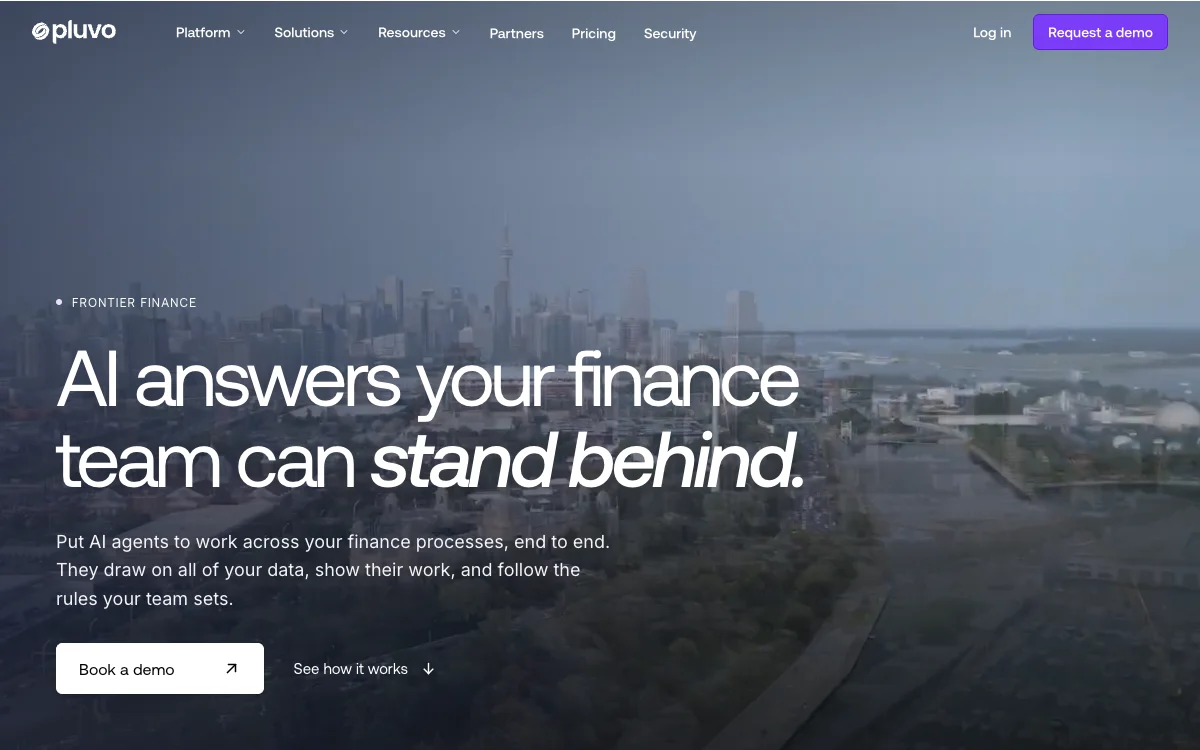
Pluvo sells AI agents for in-house finance teams, which it calls the office of the CFO. The agents connect to a company's finance systems and produce reports and forecasts in which every number traces back to its source. Named agents cover the monthly close, board narrative, variance drivers, runway scenarios and audit support. Integrations run from QuickBooks or Xero, CRM, billing and spreadsheets up to ERPs, HR systems and data warehouses, and other AI tools can answer from Pluvo's data through a plugin or API. Fractional CFOs and outsourced finance leaders can use it through a partner programme.
Pluvo at a glance
Pluvo has three plans, Growth, Scale and Enterprise, and each one says Contact sales. Plans are quoted by Pluvo's team and billed annually. A Proof of Value comes before a 12-month agreement, and Pluvo credits it toward the first year. Growth includes unlimited users, reports and dashboards, and Scale adds role-based access control and single sign-on. Answers carry a policy and audit trail.
Quick picks
Pluvo is the first row. Most tools below are sold the same way, through a demo and a quote, so few price cells hold a number. What separates them is where the work happens: in a web app, inside your own Excel and Google Sheets files, or in a file you download. The Excel and works columns show that difference.
| Tool | Best for | Type of tool | Price (entry plan) | Works in | Free option | Builds the model for you | Excel file you keep | AI edits your file | Templates library |
|---|---|---|---|---|---|---|---|---|---|
| In-house teams wanting traceable AI | AI agents for finance | Quote, 12-month term | Web app | No: Proof of Value first | Yes: Agents draft reports, forecasts | Not stated: Export not stated | No: Reports in its app | Not stated: Not stated |
 | Agents on your ERP, expert-built | Agentic finance platform | Tailored, demo first | Your ERP, web | No: None listed | Yes: Agents plus finance engineer | Yes: Excel and Sheets outputs | Yes: Outputs in your formats | Not stated: Not stated |
 | Mid-market FP&A in spreadsheets | FP&A platform | Quote by entity count | Excel, Sheets, web, PowerPoint | Yes: Free templates | No: You build, agents assist | Yes: Two-way Excel sync | Yes: Agents propose changes | Yes: Free finance templates |
 | Excel teams consolidating data | Finance platform | Custom quote | Excel, Google Sheets, web | Yes: Templates, Academy courses | No: Keeps your models | Yes: Your own Excel models | Not stated: Not stated | Yes: Free Excel templates |
 | VC- and PE-backed finance teams | Spreadsheet-native FP&A | Not public | Excel, Sheets, web, Slack | Yes: Trial link, free templates | Yes: Agents draft budgets | Yes: Two-way Excel add-in | Yes: Writes after you confirm | Yes: Free templates, guides |
 | A model file, no contract | Ready models + AI | $20/mo or $120/yr | Web app, Excel file | Yes: 30 models + free samples | Yes: Fina chat builds it | Yes: .xlsx, formulas visible | Yes: Fina chat edits it | Yes: 500+ models |
 | Startups wanting an AI CFO | AI CFO software | From $375/mo, yearly | Web app, Slack | Yes: 14-day trial | Yes: Ari builds the model | Not stated: Not confirmed | No: Builds in its app | No: Built from your actuals |
yes · no · not stated in the vendor's sources. Hover a mark for details. From each vendor's own site; prices change, so check before you buy.
1.Fuel Finance
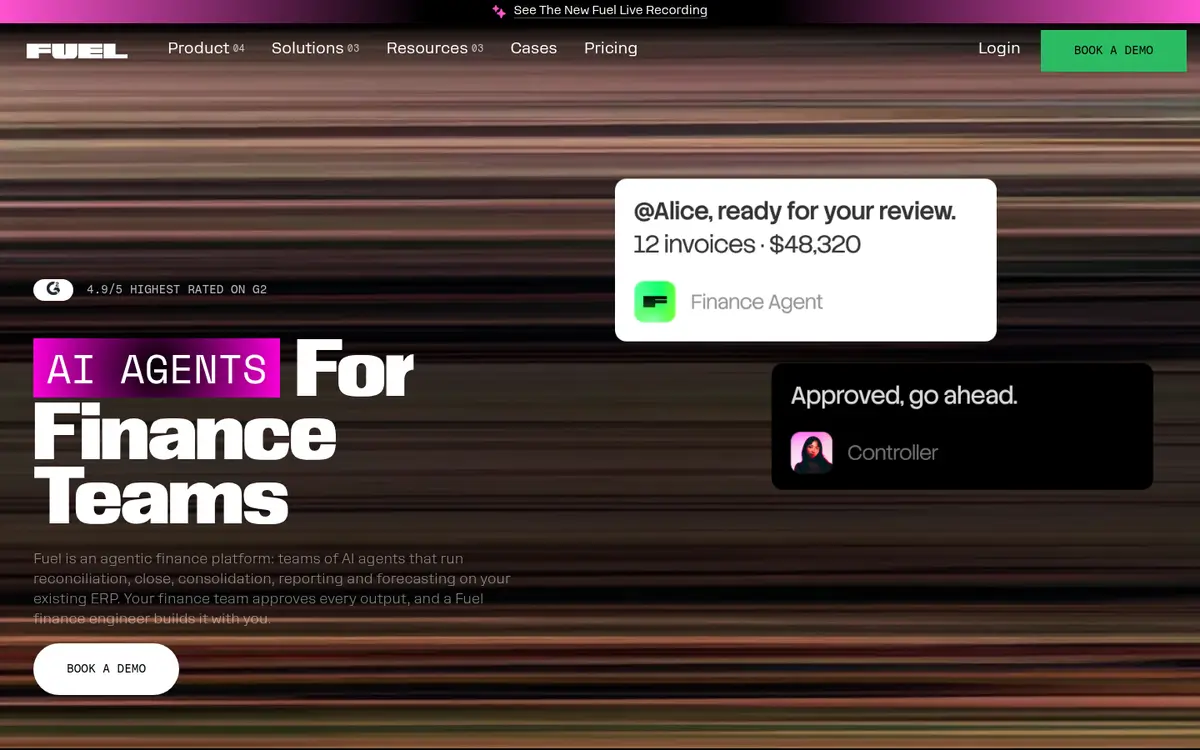
Fuel, or Fuel Finance, is an agentic finance platform. Teams of AI agents run reconciliation, close, consolidation, reporting and forecasting on a company's existing ERP, and a Fuel finance engineer builds the setup with the customer.
Fuel groups its agents into four teams: Analysis, Forecasting, Controlling and Treasury. The finance team approves every output before it goes anywhere. Results come back in the formats people already use: Excel, PDF, a link, PowerPoint or Google Sheets. The pricing page also lists Fuel AI Copilot, an AI dashboard and metrics builder and AI anomaly detection, and a dedicated FP&A manager or CFO can be added for forecasting, scenario planning and financial modelling.
Fuel says it helps startups and small businesses manage their finances, so its buyer is a finance team that wants agents on top of its current systems, with experts doing the build. A company without a senior finance person can add one through Fuel.
Fuel and Pluvo are close substitutes. Both put AI agents on top of your finance systems, keep a person approving the output, and sell through a demo with no public price; Fuel says every plan is tailored to your business. Fuel goes further on file outputs, since Excel and Google Sheets are named formats, and on people, since a finance engineer builds the system and a human CFO is available. Pluvo is more open about its terms: it names its plan tiers and the Proof of Value step, while Fuel's pricing page asks you to book a 30-minute call. Ask both for the same deliverable and compare.
- Price
- No public price. Plans are tailored; book a call or demo.
- Free option
- None listed.
Pros
- Outputs in Excel, PDF, PowerPoint and Google Sheets
- A finance engineer builds it with you
- Your team approves every output
Cons
- No public price
- A custom build, not a product you try alone
Pick it if you want agents on your ERP, built by experts, with outputs in Excel.
2.Cube
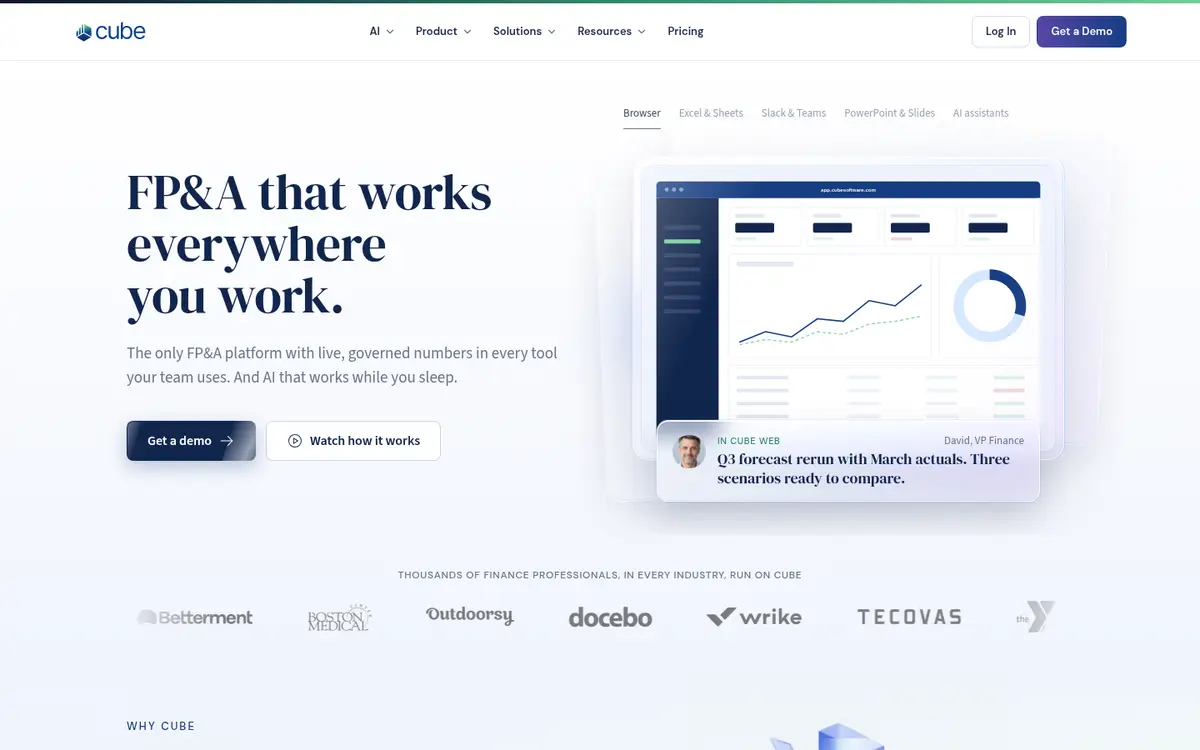
Cube is an FP&A platform with two-way sync to Excel and Google Sheets, planning, reporting and consolidation modules, and AI agents. It now calls itself an agentic FP&A platform, and it is built for mid-market and enterprise finance teams.
Planners keep working in Excel or Google Sheets while Cube holds the governed numbers. Planning modules cover revenue, headcount, expenses, cash and scenarios, with variance analysis, reporting and multi-entity eliminations on top. ERP, CRM and HR connectors feed the data, and PowerPoint and Google Slides decks refresh from it. Four agent teams, called Data Managers, Analysts, Planners and Business Partners, run on schedules or triggers and propose changes that finance must approve. Slack and Teams apps, plus a server that connects Claude, ChatGPT, Copilot and Gemini, extend it further.
It fits a mid-market finance team that lives in spreadsheets and wants one source of truth under them. Unlimited users on every plan helps when budget owners across the company need access, and every query, edit and approval is logged.
Against Pluvo, Cube's big difference is the spreadsheet. Pluvo's output lives in its own app, while Cube writes into the Excel and Google Sheets files your team already uses. Both rely on finance approving what the agents propose. Pricing works in a similar way: Cube is quoted per company, with Bronze for one legal entity, Silver for up to 10 and Gold for up to 50. Cube also gives away Excel, Sheets, PowerPoint and Slides templates. Treat its vendor-run study on AI accuracy with care, because nobody outside Cube has verified it.
- Price
- Custom quote by tier: Bronze (1 entity), Silver (up to 10), Gold (up to 50). Unlimited users.
- Free option
- Free Excel, Google Sheets, PowerPoint and Google Slides templates.
Pros
- Two-way sync with Excel and Google Sheets
- Unlimited users on every plan
- Agent changes need finance approval
Cons
- No public price
- Built for mid-market and larger teams
Pick it if your team plans in spreadsheets and wants governed data under them.
3.Datarails
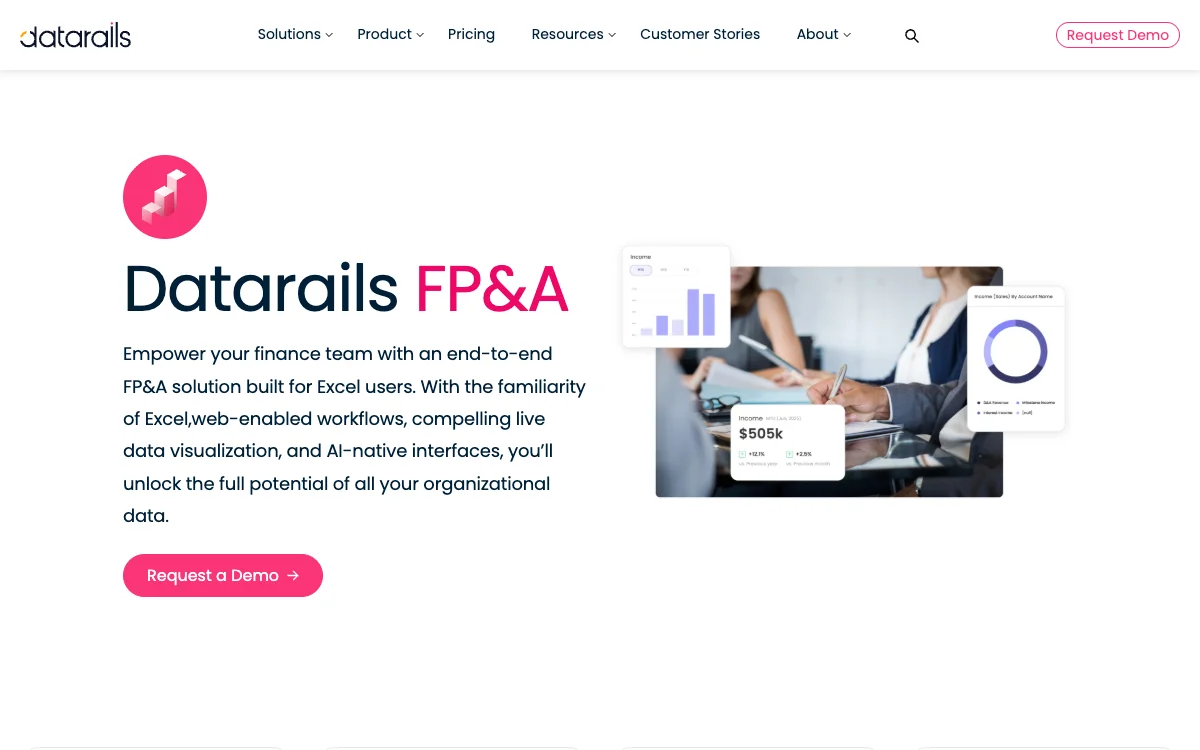
Datarails sells FinanceOS, a finance platform connected to Excel and Google Sheets. It consolidates data for FP&A, reporting, month-end close, cash forecasting and spend, with built-in AI agents, and it is aimed at the office of the CFO at small and mid-market firms.
Datarails calls itself 100% Excel-native: your models stay as they are, and Datarails refreshes the data underneath, in one click or on a schedule. It says it draws live data from more than 600 sources across systems, entities and spreadsheets. Since 1 Oct 2026 Google Sheets is supported natively with Datarails formulas. Modules cover month-end close, cash with bank sync and a 13-week forecast, and spend. Datarails AI adds Strategy, Reporting and Planning agents and scheduled insights, and Storyboards turn data into presentations.
The natural buyer is a finance team that has years of Excel models and does not want to rebuild them in new software. Free Excel templates and three free FinanceOS Academy courses help before you talk to sales. The product page puts the average time to go live at four to six weeks.
Next to Pluvo, Datarails covers more of the finance function, including close, cash and spend, and keeps the work in Excel. Pluvo leads on traceable answers, with every number tied to its source and a policy and audit trail. Both sell through a custom quote. Datarails prices its tiers by users and integrations, from 2 users and 1 integration up to 15 users, 50 viewers and 3 integrations. Its AI and connector pages give no dates for the agents or its Claude Code plugin, so ask what is live today.
- Price
- Custom quote. Tiers by users and integrations, from 2 users and 1 integration.
- Free option
- Free Excel templates and three free FinanceOS Academy courses.
Pros
- Keeps your existing Excel models
- Covers close, cash and spend as well as FP&A
- Free templates and courses
Cons
- No public price
- No dates given for its AI agents
Pick it if your team wants to keep its Excel models and automate the data under them.
4.Aleph
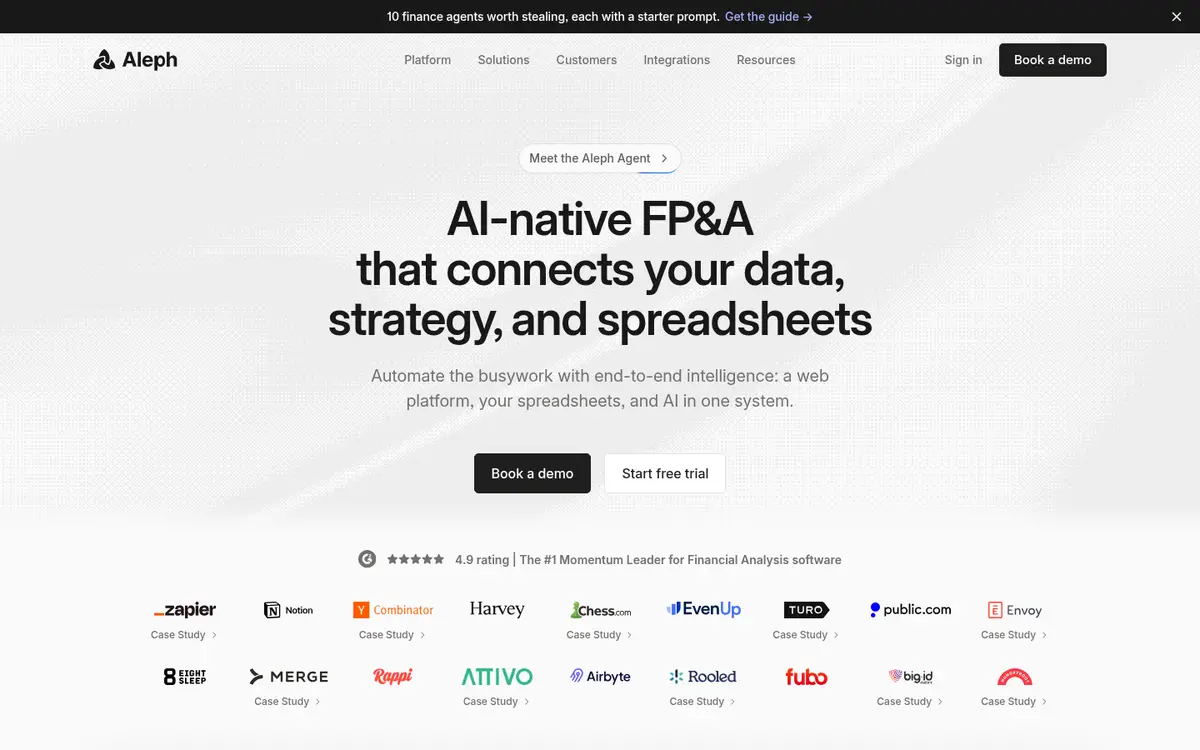
Aleph is a spreadsheet-native FP&A platform: a data consolidation layer with two-way Excel and Google Sheets add-ins, plus AI agents. It serves CFOs and finance teams at VC- and PE-backed mid-market companies, PE funds and fractional CFO firms.
Aleph pulls data in through 150 or more no-code connectors, then exposes it in your spreadsheets through custom functions such as GETDATA, with scheduled refreshes, event triggers and drill-down to transactions. Scan explains variance and flux in plain language. The Aleph Agent works in Slack, Teams and the web app, inherits each user's permissions and cites its sources, and Agentic Budgeting builds a starting point for each budget owner. Writes from outside AI tools go through a preview-and-confirm step, with commit-level audit and rollback.
It suits teams that want to keep their reporting packages and planning sheets as they are. Aleph says anyone who knows Excel or Google Sheets will be a power user on day one. Headcount planning, 13-week cash flow and portfolio rollups cover the growth-company and PE use cases.
Compared with Pluvo, Aleph keeps the work in your spreadsheets while Pluvo keeps it in its own app; both stress sources and audit trails. Aleph also serves fractional CFO firms and PE funds directly rather than through partners. Neither shows a price, and Aleph has no pricing page at all. Its homepage offers a free trial link instead, which is an easier start than Pluvo's Proof of Value. Free guides and templates, including six downloadable Claude skill files, are on the site.
- Price
- No public price.
- Free option
- A free trial link on the homepage, plus free templates and guides.
Pros
- Two-way Excel and Google Sheets add-ins
- Agent cites sources and inherits permissions
- Audit and rollback on every write
Cons
- No pricing page
- Aimed at funded mid-market companies
Pick it if you want AI FP&A that keeps your Excel and Sheets files in charge.
5.Finamodel
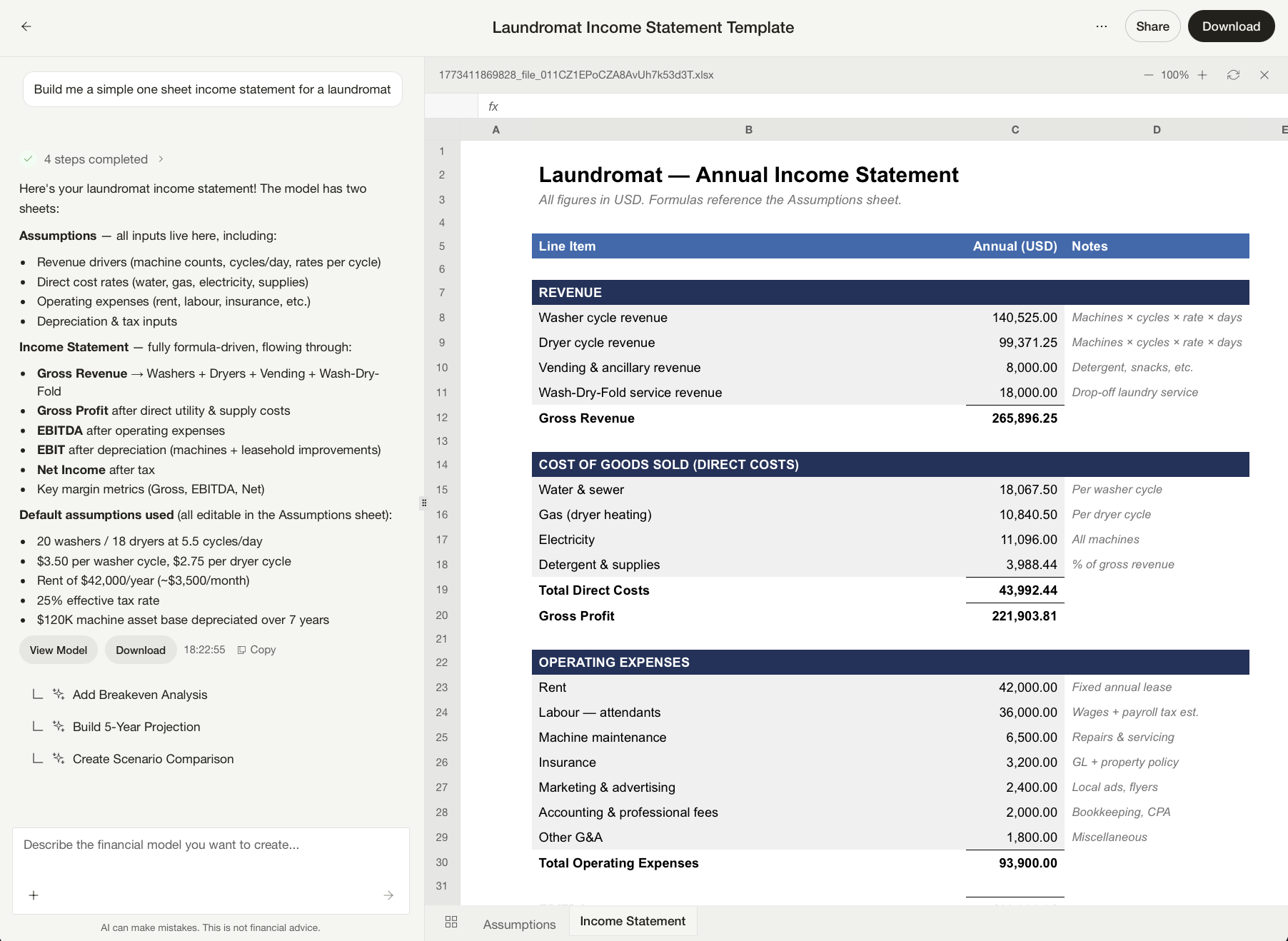
Finamodel is a library of ready Excel financial models with an AI assistant called Fina. It is not connected finance software: you get a model file to fill in and change, not agents that run on your systems.
You choose a model, such as a three-statement model, a budget vs actuals tracker or a board reporting pack, and ask Fina to adapt it: change the drivers, add a scenario, or explain a formula. Fina builds, edits, explains and fixes the model for your case. Version history restores any earlier file. You download a normal .xlsx file with every formula visible, which works without Finamodel and opens in Excel, Google Sheets and Numbers.
A finance lead might use it for work that sits outside the monthly cycle: a one-off board scenario, a plan for a new entity, or a model for a lender. Read-only links to QuickBooks, Google Sheets, Google Drive and 42 other apps can bring figures in, and a voice walkthrough helps a board member or colleague follow the logic. It is self-serve with no demo, and you can try one of 30 free models with live formulas, or a free sample of any other model without formulas, sent by email link.
Set beside Pluvo, Finamodel lacks almost everything an in-house team buys Pluvo for. There are no agents on your systems, no close or audit support, no role-based access, no single sign-on and no policy trail on answers, and support is by email. It is not an Excel add-in: you work in the Finamodel app, then download, and you need to know which model you want. What it offers instead is a low monthly price with no 12-month agreement, and a file you own. For a team still deciding whether it needs a platform at all, that is a cheap way to cover the model work first.
How it works
- Pick a ready model, such as a DCF or a 3-statement model, from a library of more than 500.
- Ask Fina chat to change, explain or fix it for your case and your numbers.
- Download a real .xlsx file. Every formula is visible, and it works without Finamodel. It opens in Excel, Google Sheets and Numbers.
- Price
- Models plan: $20 a month or $120 a year. All Templates: $30 a month or $144 a year. You can cancel at any time.
- Free option
- 30 free models with live formulas, and a free sample of every other model, with values but no formulas. Both are sent by email link, one model email per email address per day. The library is free to browse.
Better than Pluvo at
- Published prices, no 12-month agreement
- A real .xlsx file you keep
- Self-serve, with a free model to try
Worse than Pluvo at
- No agents on your finance systems
- No close, audit support or access controls
- Support is by email only
Models that fit: 3 Statement Model, Budget vs Actuals Tracker, Board Reporting Pack.
Pick it if you need a model file now and are not ready for a platform contract.
6.cfo.ai
cfo.ai, formerly Runway FP&A, sells Ari, an AI CFO that builds a company financial model from chat and keeps it up to date. Founders, chiefs of staff and finance teams are the main users, and fractional CFO practices get a per-client partner rate.
Ari connects to accounting, billing, CRM and payroll systems such as QuickBooks, Xero, Stripe, Salesforce and Rippling, plus Google Sheets, Drive and CSV files. Ask a question and it builds the model from actuals and shows what changes. It can import an existing Excel or Sheets model and build a tie-out page that bridges the old workbook to the new model. Scenarios, Canvas blocks for visual what-ifs, board-deck drafts and scheduled Triggers sit on top, and the Startup plan includes a Slack app.
Its fit is a startup or growth company without a large finance team, where the founder or a finance lead wants a model that maintains itself. The tie-out page makes the move from an old spreadsheet easier to check.
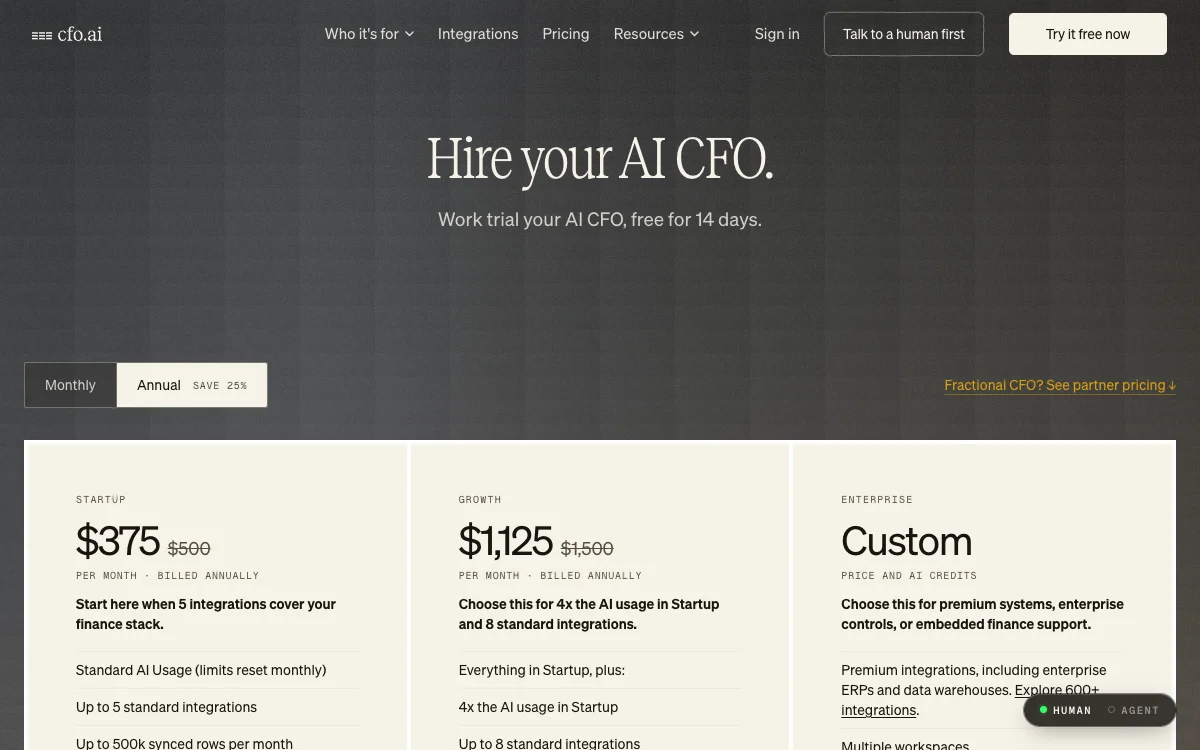
On traceability it matches Pluvo's pitch closely: every figure traces back to its formula inputs and source rows, and every write is logged and can be undone. The difference is buying. cfo.ai lists prices and a 14-day free trial: Startup is $375 a month billed annually or $500 monthly, Growth is $1,125 a month billed annually or $1,500 monthly, and only Enterprise is custom. Pluvo asks for a quote and a 12-month agreement. Pluvo's agents also cover the close and audit support, which cfo.ai does not describe, so a larger team may still need Pluvo's scope.
- Price
- Startup $375 a month billed annually ($500 monthly). Growth $1,125 a month billed annually ($1,500 monthly).
- Free option
- A 14-day free work trial.
Pros
- Listed prices and a free trial
- Figures trace to source rows
- Writes logged and reversible
Cons
- No close or audit support described
- Starts at $375 a month billed annually
Pick it if you want a traceable AI model with listed prices and no sales process.
Who should pick what
Pluvo is a platform decision with a 12-month term, so compare it with other platforms on the same task before you sign. The first split is where the work should live: in a web app, or in the spreadsheets your team already trusts. That question divides this list in two.
- AI agents on your ERP, built with you and delivered in your formats: Fuel Finance.
- FP&A that stays in Excel and Google Sheets: Cube, Datarails or Aleph.
- An AI CFO with listed prices and a free trial: cfo.ai.
- A ready Excel model without a platform contract: Finamodel.
Use Pluvo's Proof of Value the way it is meant: give it, and any rival, the same month of real data and the same board question, then compare the answers and the trail behind them. Ask each vendor what you can export if you leave, because reports inside an app do not travel with you.
Frequently asked
How much does Pluvo cost?+
Pluvo shows no dollar prices. Its Growth, Scale and Enterprise plans are all quoted by sales and billed annually, and a Proof of Value comes before a 12-month agreement. We checked on 22 Nov 2026.
Is there a free version of Pluvo?+
No free plan or trial is listed. Pluvo starts with a Proof of Value, which it credits toward the first year. Among the alternatives, cfo.ai has a 14-day free trial, Aleph has a trial link, and Finamodel gives 30 free models with live formulas and a free sample of every other model.
What are the main Pluvo alternatives?+
For AI agents on your systems: Fuel Finance. For FP&A inside Excel and Google Sheets: Cube, Datarails and Aleph. For an AI CFO with listed prices: cfo.ai. For a ready Excel model that AI changes for your case: Finamodel.
Can Pluvo show where a number comes from?+
Yes. Pluvo says every number in its reports traces back to its source, and answers carry a policy and audit trail.
Does Pluvo work for fractional CFOs?+
Through its partner programme. Pluvo's core product is built for in-house finance teams, and fractional CFOs and outsourced finance leaders join as partners.
Pluvo vs Finamodel: which should I pick?+
Pick Pluvo if your in-house team wants AI agents across its finance systems and can sign a 12-month agreement. Pick Finamodel if you need an Excel model now, at $20 a month or $120 a year.


