 By Alex Tapio
 Oria alternatives
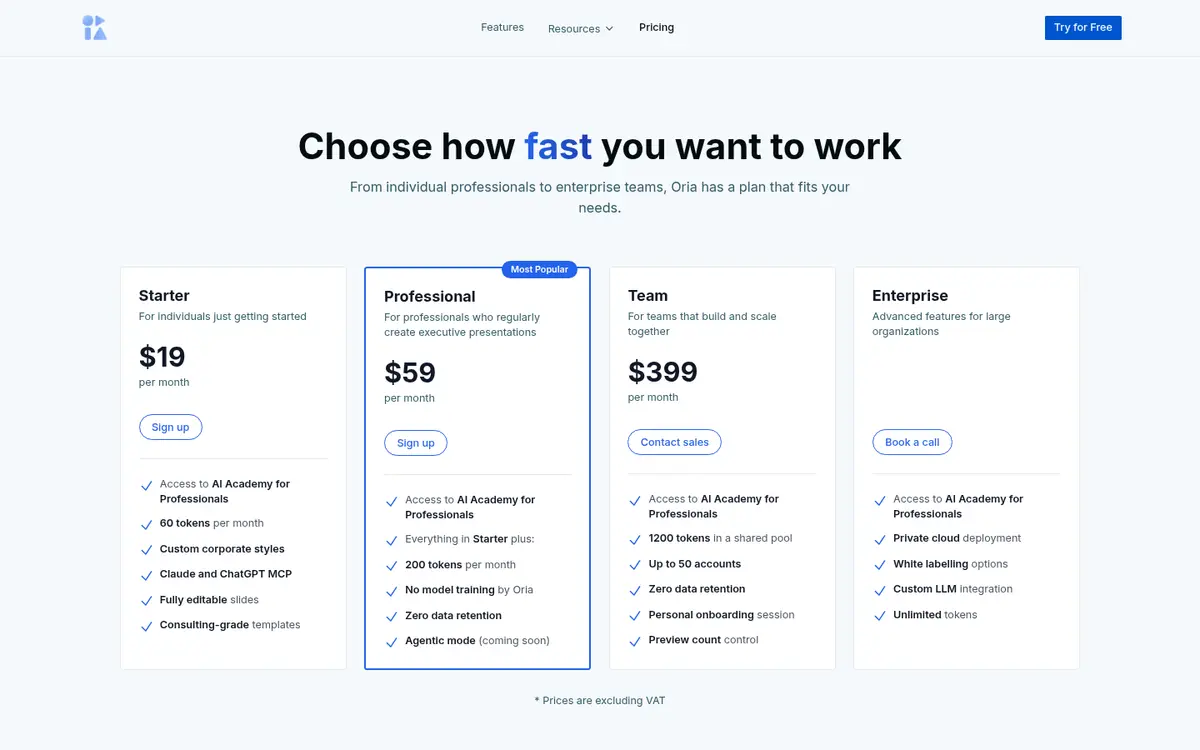
People look for Oria alternatives for three main reasons. There is no free plan, only a 7-day trial, and the jump from Professional at $59 a month to Team at $399 is steep for a small group. The agentic mode on its pricing page is still marked coming soon, and we found no changelog or dated feature news, so it is hard to see where the product is going. And Oria makes slides only, so it does nothing for the model behind them.
What is Oria?
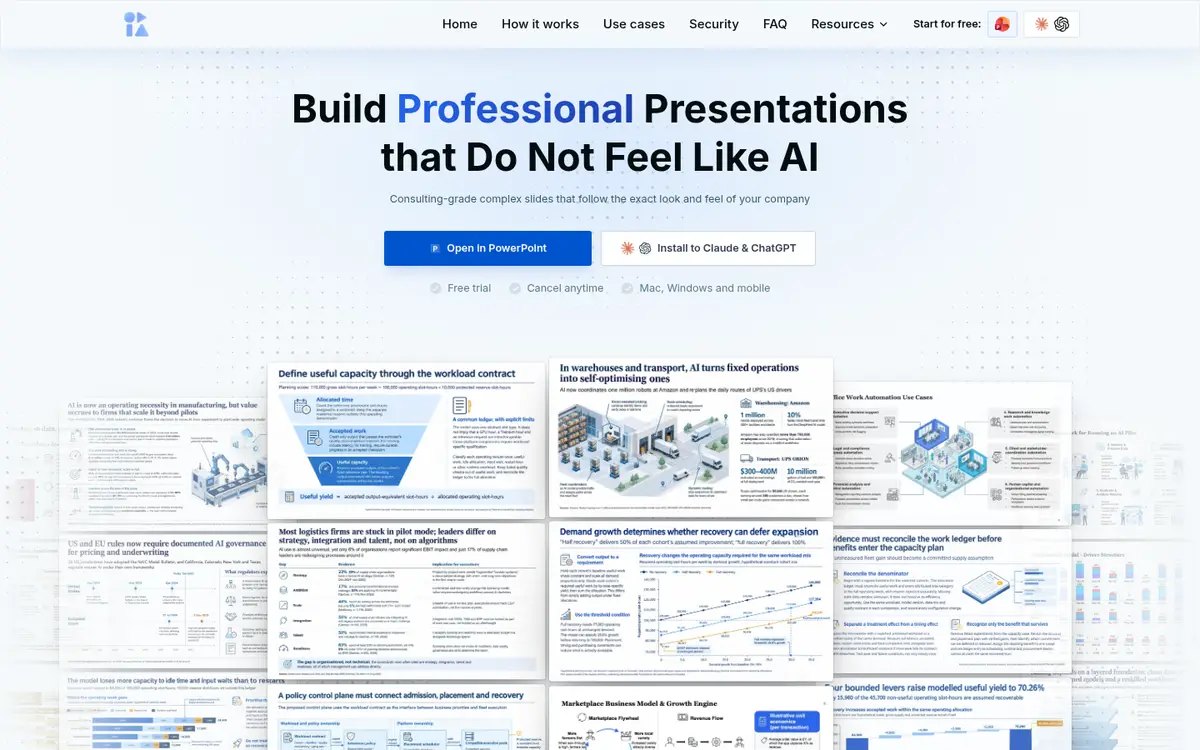
Oria is a PowerPoint add-in for Mac and Windows, with apps inside Claude and ChatGPT, that makes complex consulting-style slides in your company's own look. Output is native PowerPoint shapes you can edit, never images. You can feed it audio notes, text pasted from another AI tool, existing slides or a photo of a sketch, and get an alternative design in one click. Oria says it is made for consultants, bankers and strategy teams who build boardroom-style decks inside PowerPoint.
Oria at a glance
Oria publishes four plans, all excluding VAT. Starter costs $19 a month and Professional $59 a month. Team costs $399 a month for a shared pool across up to 50 accounts, and Enterprise is arranged through a call. Every plan includes the Claude and ChatGPT apps on desktop and mobile. A 7-day trial lets you test it, and the resources library has free Claude skill packs for consulting, banking and finance.
Quick picks
Oria is the first row, for reference. Every tool here except Finamodel makes slides or documents, so focus on the "Works in" and "Free" columns: some run inside PowerPoint, some on the web, and only some have a free plan. The Excel columns matter only if you also need the model. Prices are in each vendor's own currency.
| Tool | Best for | Type of tool | Price (entry plan) | Works in | Free option | Builds the model for you | Excel file you keep | AI edits your file | Templates library |
|---|---|---|---|---|---|---|---|---|---|
| Native consulting slides in your style | PowerPoint add-in | $19 to $399/mo | PowerPoint, Claude, ChatGPT | Yes: 7-day trial | No: Slides only | No: Slides only | No: Edits slides, not models | No: No model templates |
 | Checked slides on your master | PowerPoint add-in | Free; €25 to €100/mo | PowerPoint (Windows, Mac) | Yes: 200 credits free | No: Slides only | No: Reads Excel, makes slides | No: Edits slides, not models | No: No model templates |
 | Fast general decks | AI design tool | Paid prices not stated | Web, Claude, ChatGPT | Yes: Free plan | No: Slides only | No: Slides and documents | No: No modeling | Not stated: Not stated |
 | Sourced consulting storylines | AI deck generator | Free; $29 to $390/mo | Web, PowerPoint add-in (beta) | Yes: 10 slides a month | No: Slides only | No: Exports .pptx | No: Edits decks, not models | No: No model templates |
 | The numbers behind the slides | Ready models + AI | $20/mo or $120/yr | Web app, Excel file | Yes: 30 models + free samples | Yes: Fina chat builds it | Yes: .xlsx, formulas visible | Yes: Fina chat edits it | Yes: 500+ models |
 | Decks from company documents | AI knowledge platform | €27 a user/mo | Web app, .pptx export | Yes: 14-day trial | No: Slides only | No: PowerPoint and Word | No: No modeling | No: No model templates |
 | Slides plus an Excel agent | Office add-in | From $10/mo | PowerPoint, Excel, Word, web | Yes: 14-day trial | Yes: Excel agent | Yes: Your own workbook | Yes: Excel agent builds, audits | Not stated: Not stated |
yes · no · not stated in the vendor's sources. Hover a mark for details. From each vendor's own site; prices change, so check before you buy.
1.Decky
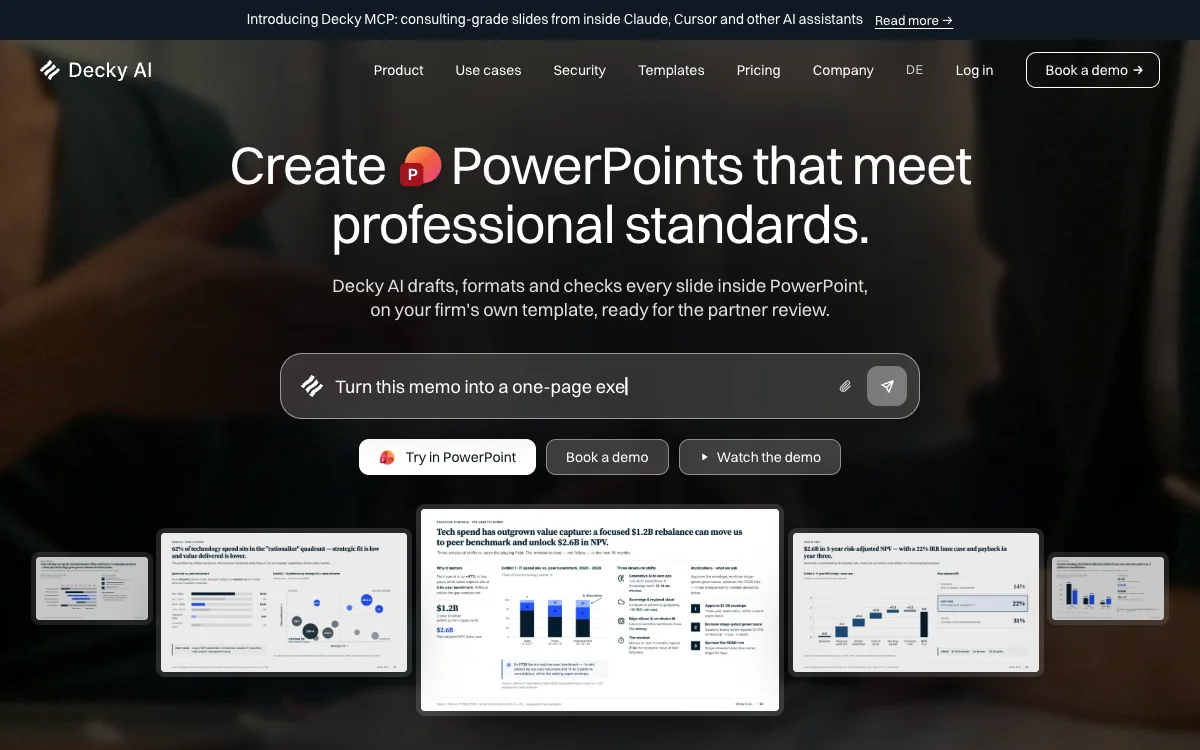
Decky, sold as Decky AI, is a PowerPoint add-in for Windows and Mac that drafts, formats and checks slides on your firm's own master. Its pricing page says it is built for consulting firms, banks and corporates.
Decky writes the storyline and action titles first, then the slides. It reads Word, PDF and Excel files down to the tab, the cell and the page, and its drafts can use cited web search. Formatting tools snap shapes to the grid and apply the theme. A content check covers typos, number formats, units, citations and tone, and every edit waits in a change panel until you accept it. A Slide Library with semantic search restyles old slides to the current master, and a Versions feature shows two or three takes of a slide side by side.
Its use-case pages cover management consulting, investment banking and M&A, private equity and corporate strategy, which is the same crowd Oria targets. Teams that want a human to approve every change will value the change panel most.
Decky and Oria are close rivals. Decky has a free plan with 200 credits, which Oria lacks, and stronger review tools. Oria has the Claude and ChatGPT apps, including on mobile, while Decky works only in desktop PowerPoint; Decky reaches assistants through its own MCP server instead. Paid prices are in euros and metered in credits: Starter €25, Pro €50 and Max €100 a month, with Business and Enterprise on request. Oria's Professional plan at $59 sits close to Decky Pro.
- Price
- Starter €25, Pro €50, Max €100 a month. Business and Enterprise on request.
- Free option
- A free plan with 200 credits.
Pros
- Free plan
- Change panel for every edit
- Content check for units, numbers and citations
Cons
- Desktop PowerPoint only
- Credit-metered euro plans
Pick it if you want a free plan and more review control than Oria gives.
2.Gamma
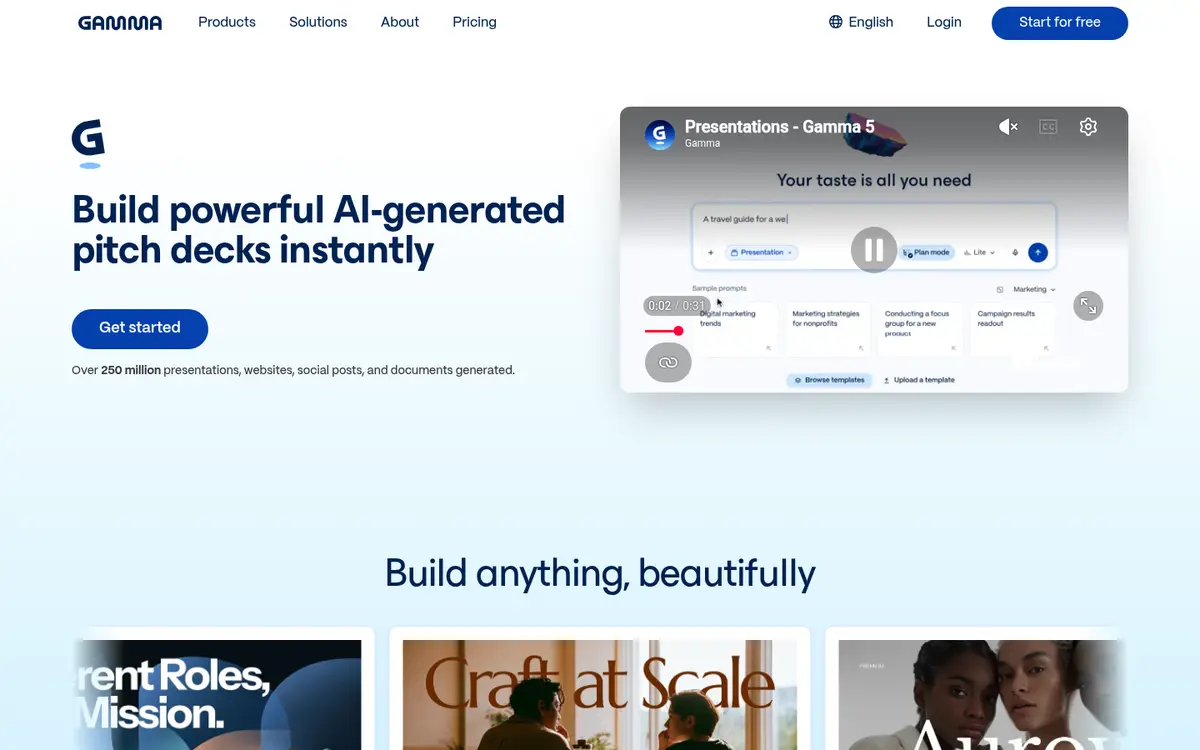
Gamma is a general AI design tool for presentations, documents, webpages and social posts. It runs on its own web canvas and exports to PowerPoint, PDF, Google Slides and PNG.
Its current version, Gamma 5, went live on 6 Oct 2026. An agent works through the story before designing and keeps context as you edit, and you can switch between prompting and freeform canvas editing. Connectors pull Slack threads and Granola transcripts into a deck. A public REST API lets developers generate, edit and export branded content.
Gamma also has apps for Claude, ChatGPT and Slack. A ChatGPT plugin, announced around 18 Nov 2026, builds the deck in a side panel and lets you edit one slide at a time before exporting to PDF or PowerPoint. It aims at individuals and businesses of all kinds, so it suits anyone who needs a decent deck fast. Its careers page claims more than 1 million gammas are made each day.
Like Oria, Gamma works from inside Claude and ChatGPT, but it is not made for consulting or banking slides. It is not framed around finance, and you design on Gamma's canvas, then export, instead of building native shapes in your firm's PowerPoint style. In return it has a free plan: up to 10 slides per prompt, PowerPoint and PDF import, and export to PDF, PowerPoint, PNG and Google Slides. The paid plans are Plus, Pro and Ultra; we could not see their prices on its pricing page. For boardroom slides in a corporate style, Oria fits better.
- Price
- Plans named Free, Plus, Pro and Ultra. Paid prices not stated in our sources.
- Free option
- A free plan: up to 10 slides per prompt, with PowerPoint, PDF and Google Slides export.
Pros
- Free plan
- Apps for Claude, ChatGPT and Slack
- Exports to PowerPoint and Google Slides
Cons
- Not framed around finance or consulting
- Paid prices not confirmed
Pick it if you need fast general decks and a free plan matters more than house style.
3.Perceptis
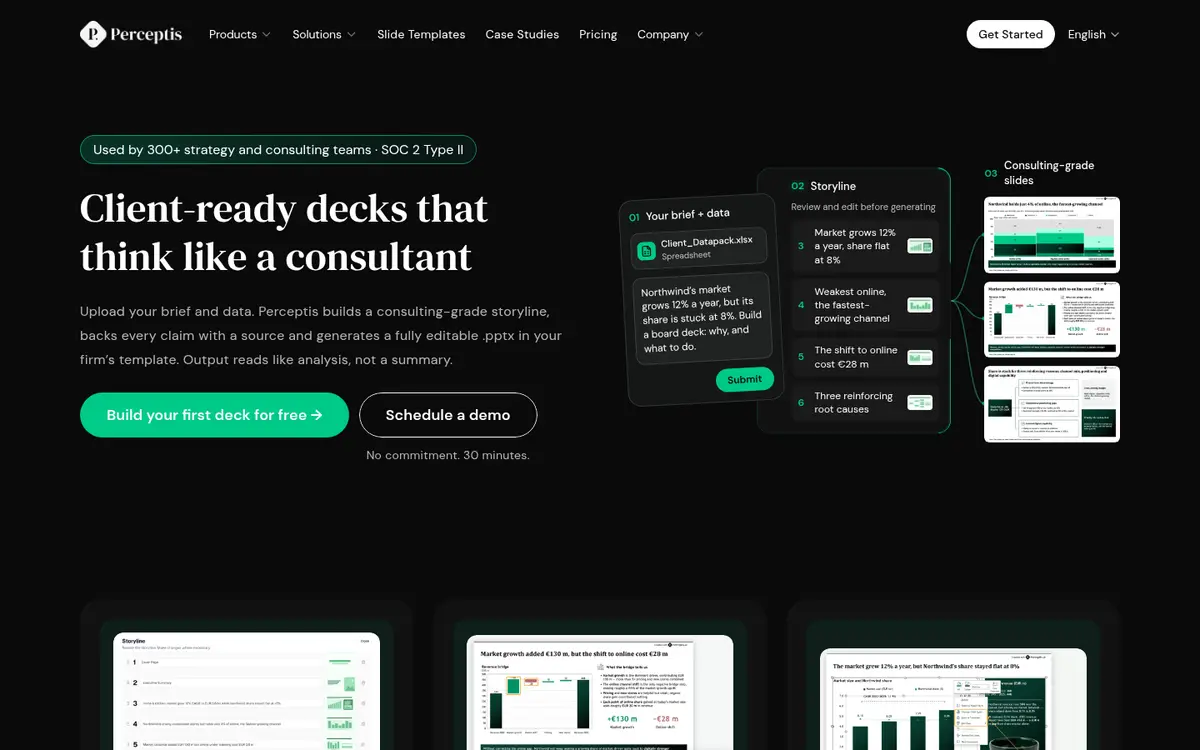
Perceptis is an AI deck generator with a web app, Slidekick, and a PowerPoint add-in. It builds a consulting-grade storyline, backs every claim with a source and generates an editable .pptx in your firm's template.
The work starts from a brief and your data. Perceptis drafts the storyline in the situation, complication and resolution pattern, with insight headlines you can edit before any slide is made. It then generates editable charts, tables, maps, Gantts, roadmaps and funnels in your uploaded master. A knowledge base connects past decks and research, and since September 2026 it can edit a .pptx you upload.
Strategy, consulting and advisory firms and private equity teams are the named buyers, and the homepage says more than 300 strategy and consulting teams use it. Business and Enterprise plans include a REST API, and Enterprise adds a document service with human quality checks. That service is the main extra for firms that send decks straight to clients.
Both tools output editable PowerPoint in your style, so the difference is the workflow. Oria works slide by slide inside PowerPoint or an AI assistant. Perceptis plans the whole argument first and adds citations, mostly on the web, since its add-in is still in beta. Perceptis has a free plan with 10 slides a month. Its Starter at $29 a month costs more than Oria's $19, Pro at $129 is more than double Oria's Professional, and Business is $390 a month for up to 20 seats. Its benchmark claims are its own.
- Price
- Starter $29 a month, Pro $129 a month, Business $390 a month for up to 20 seats. Enterprise custom.
- Free option
- A free plan with up to 10 slides a month.
Pros
- Whole-deck storyline you can review first
- Citations on factual claims
- Free plan
Cons
- PowerPoint add-in in beta
- Pro costs more than double Oria Professional
Pick it if you build whole decks from a brief and need sources on the claims.
4.Finamodel
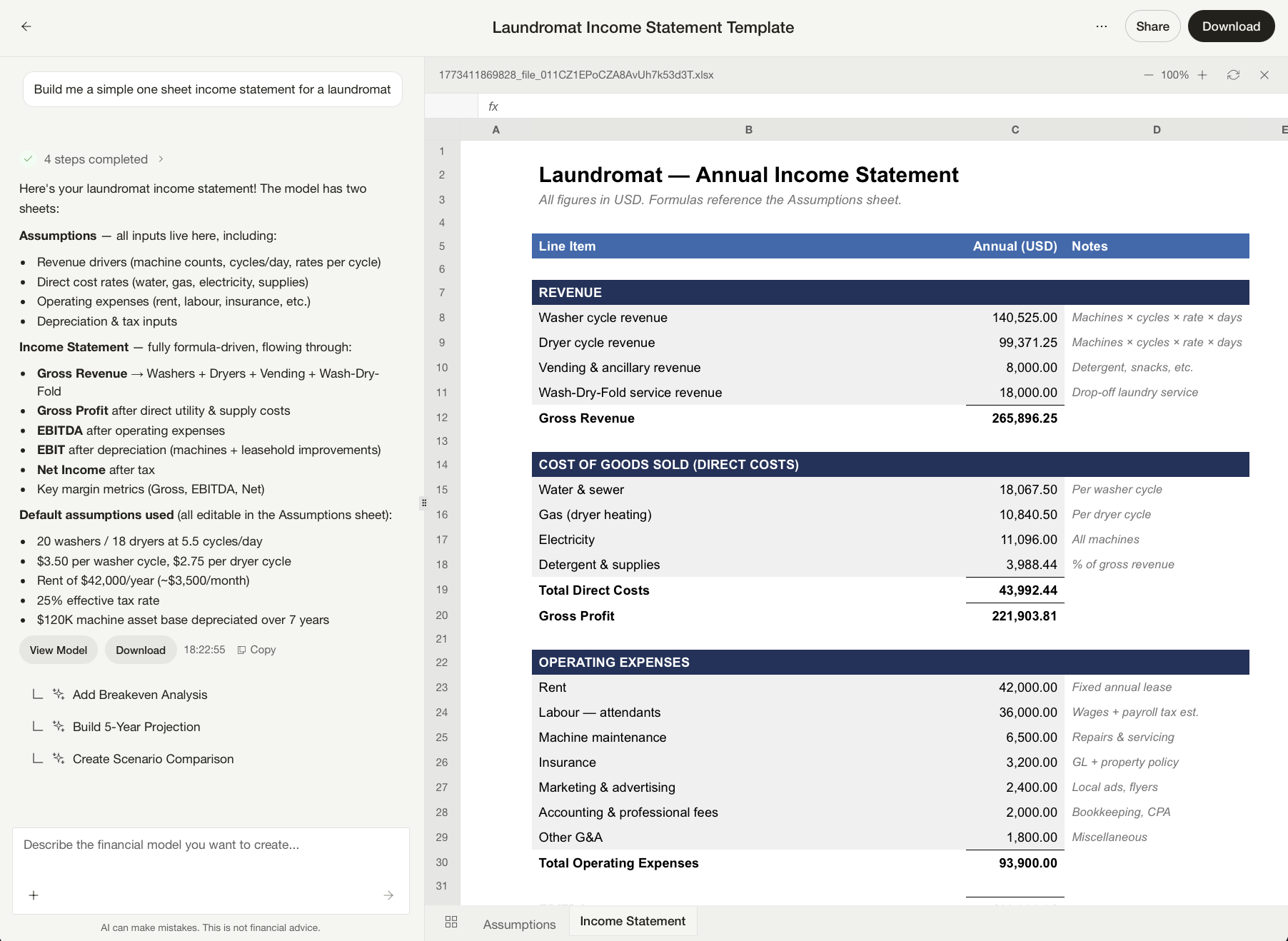
Finamodel is a library of ready Excel financial models with an AI assistant called Fina. It is not a slide tool. Where Oria turns your thinking into slides, Finamodel gives you the model whose numbers go on those slides.
You start by picking a model, such as an LBO, a comparable company analysis or a 3-statement model, and describe your case to Fina chat. Fina builds, edits, explains and fixes the model, and version history lets you go back to any earlier file. The download is a real .xlsx file with every formula visible. It works without Finamodel and opens in Excel, Google Sheets and Numbers, so you can copy the outputs into an Oria brief or paste them into a slide.
Bankers and consultants often need a model before they can make the deck, and Finamodel fits that step. Read-only links to QuickBooks, Google Sheets, Google Drive and 42 other apps can pull in your figures, and a voice walkthrough explains how the model works. The library is free to browse, and 30 full models and a sample of every other model cost nothing. After that, the Models plan is $20 a month or $120 a year, with a 14-day money-back guarantee on the first paid plan.
Next to Oria, the gaps are clear. Finamodel makes no slides, offers no corporate styles or alternative designs, and has no app inside Claude or ChatGPT. It is not a PowerPoint or Excel add-in: you work in the Finamodel app and download the file. Support is by email. You still need Oria or another slide tool to present the numbers. Fina also does not replace your own review: check the numbers before they go on a slide. If the model is the part that holds up the deck, Finamodel gets it done quickly; if the slides are the problem, stay with a slide tool.
How it works
- Pick a ready model, such as a DCF or a 3-statement model, from a library of more than 500.
- Ask Fina chat to change, explain or fix it for your case and your numbers.
- Download a real .xlsx file. Every formula is visible, and it works without Finamodel. It opens in Excel, Google Sheets and Numbers.
- Price
- Models plan: $20 a month or $120 a year. All Templates: $30 a month or $144 a year. You can cancel at any time.
- Free option
- 30 free models with live formulas, and a free sample of every other model, with values but no formulas. Both are sent by email link, one model email per email address per day. The library is free to browse.
Better than Oria at
- Gives you the Excel model, not just slides
- You keep a real .xlsx file with every formula visible
- 30 full models free, plus samples of the rest
Worse than Oria at
- Makes no slides or decks
- No app inside Claude or ChatGPT
- Not a PowerPoint or Excel add-in: you work in the Finamodel app
Models that fit: LBO Model, Comparable Company Analysis, 3 Statement Model.
Pick it if you need the model behind the deck before you make the slides.
5.Elqano
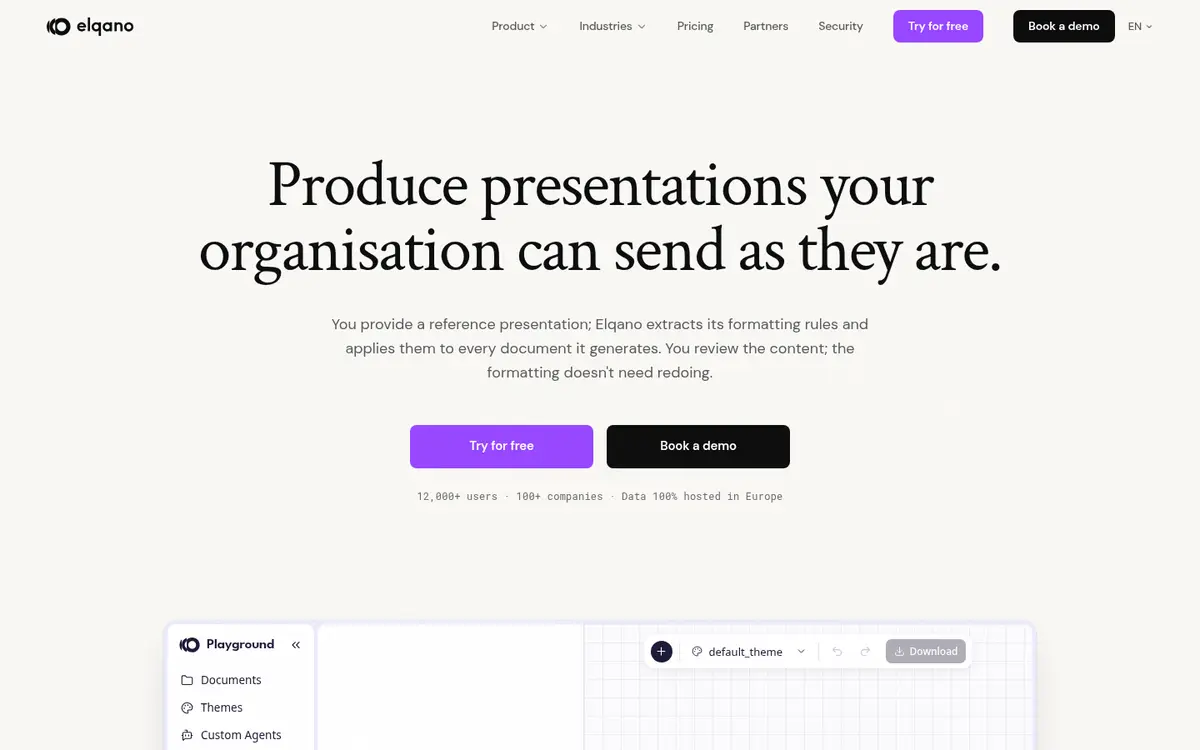
Elqano is a European AI knowledge platform for document search and no-code agents. Its Slide Studio module generates on-brand PowerPoint and Word documents from a firm's own sources. It serves organisations in engineering and infrastructure, consulting and financial services.
In Slide Studio, one reference presentation acts as the template for all the others: Elqano takes its formatting rules and applies them to every deck it makes. Decks are built from connected sources and exported as editable .pptx files with the masters kept, and you can change them in plain language. Elqano claims 50 slides in 5 minutes on average. Around it, Document Intelligence searches hundreds of documents and cites answers to the document and page, with connectors to SharePoint, Teams, Google Drive, Outlook, HubSpot, Confluence and Notion.
It fits a European firm that wants decks grounded in its own files, with data hosted in France and Sweden and no training on customer data. It uses several AI models, including Claude, GPT, Mistral and Gemini. No-code agents on the same platform can automate other document work, so slides are only part of what you buy.
Oria works from what you give it in the moment; Elqano works from your company's library of documents. That makes Elqano stronger when the content already exists in reports and past decks, and weaker for one-off slide design. Pro costs €27 per user per month, with Enterprise on quote and 14 days free. There is no blog or changelog, its template-fidelity benchmark is a claim on its own page, and slides are one module of a larger platform.
- Price
- Pro €27 per user per month. Enterprise on quote.
- Free option
- A 14-day free trial.
Pros
- Decks grounded in your own documents, with citations
- Data hosted in Europe
- Keeps your masters in the .pptx
Cons
- Slides are one module of a larger platform
- No changelog or blog
Pick it if your decks should come from your company's own documents.
6.Deckary
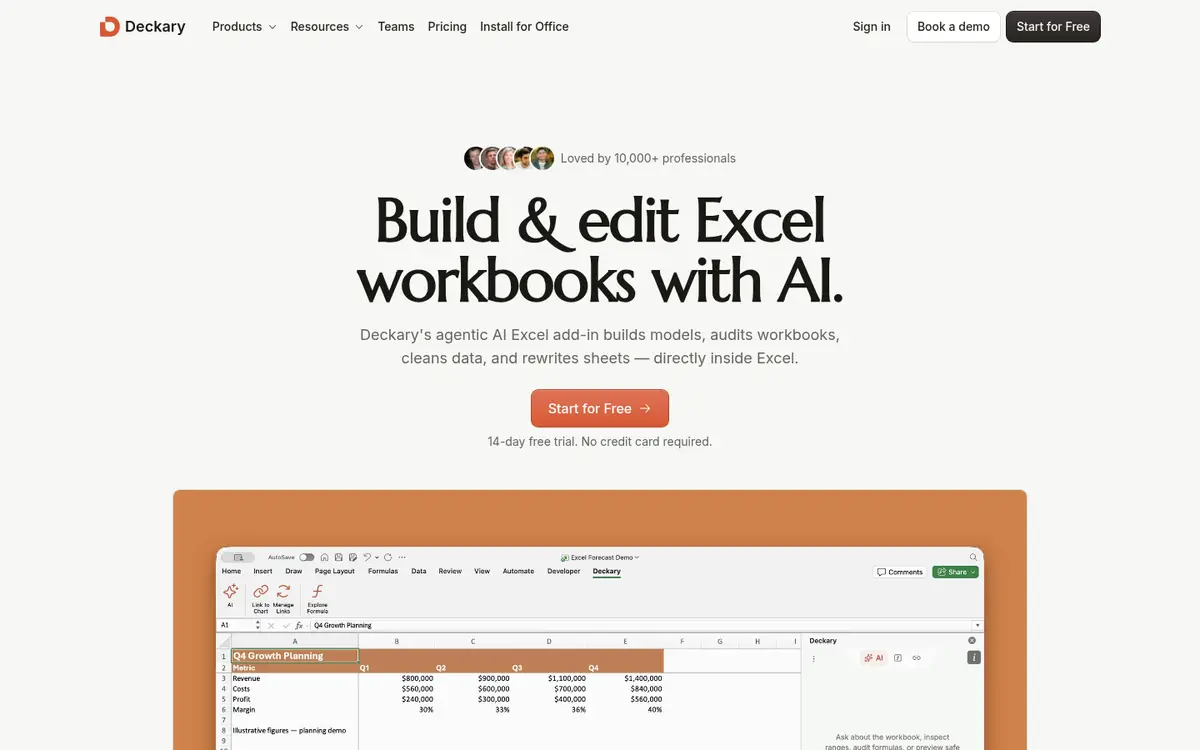
Deckary is an Office add-in with a PowerPoint slide agent, an Excel agent that builds and audits models, and a Word agent. It runs on Mac, Windows and the web, for boutique consultancies, corporate strategy and finance teams, and programme offices.
Its slide agent drafts on your open deck's master from briefs, Excel models, PDFs and notes, and builds native consulting exhibits such as waterfalls, Mekkos, football fields and Gantt charts. Charts link to Excel, so a change in the model can flow into the slide. The Excel agent builds three-statement, DCF, ROI, sensitivity and unit economics models from a description, keeping assumption cells apart from formulas, and an audit agent flags broken formulas and hidden hardcodes.
Deckary suits the person who builds the numbers and the slides, and wants one low-cost tool for both. Its browser builder exports editable PowerPoint, and its MCP server lets Claude, ChatGPT, Codex and Cursor edit the live file.
The Excel agent is the big difference from Oria, which has no model tools. Deckary is also cheaper: Starter is $10 a month, and Premium, with the Excel and Word agents, is $15 a month billed yearly or $19 monthly. Team is $19 a seat per month from 5 seats, far below Oria's $399 Team plan for a small group. There is a 14-day trial with no card and no free plan. Oria still has the edge for people who work from Claude or ChatGPT on a phone, and Deckary has no changelog to date its releases.
- Price
- Starter $10 a month. Premium $15 a month billed yearly or $19 monthly. Team $19 a seat per month, from 5 seats.
- Free option
- A 14-day free trial, no card.
Pros
- Excel agent builds and audits models
- Cheaper than Oria at every level
- Web version
Cons
- No free plan
- No changelog
Pick it if you want slides and an Excel model agent for less than Oria costs.
Who should pick what
Oria is a focused slide tool with good reach into AI assistants but no free plan. Your best alternative depends on whether you want a free plan, a different way of working, slides grounded in company documents, or help with the numbers before the slides.
- Slides in PowerPoint with a free plan and edit approval: Decky. Fast general decks: Gamma.
- Whole decks from a brief, with sources: Perceptis. Decks from your own company documents: Elqano.
- Slides plus an Excel model agent at a low price: Deckary.
- The Excel model behind the deck, built and changed by AI: Finamodel.
Oria's 7-day trial is short, so plan your test before you start: pick one real deck, make it in Oria, then make it again in the alternative. Count the minutes you spend fixing each result. If small teams are the issue, compare Oria's Team plan with per-seat prices elsewhere.
Frequently asked
How much does Oria cost?+
Starter is $19 a month, Professional $59 a month and Team $399 a month for up to 50 accounts, all excluding VAT. Enterprise is arranged through a call. We read the pricing page on 10 Nov 2026.
Is there a free version of Oria?+
No. Oria has a 7-day trial but no free plan. Its resources library offers free Claude skill packs for consulting, banking and finance. Decky, Gamma and Perceptis have free plans.
What are the main Oria alternatives?+
For slides inside PowerPoint: Decky and Deckary. For web-based decks: Gamma and Perceptis. For decks from company documents: Elqano. For the Excel model behind the deck: Finamodel.
Oria vs Finamodel: which should I pick?+
They solve different problems. Pick Oria to make consulting-style slides in PowerPoint, Claude or ChatGPT. Pick Finamodel for a ready Excel model that Fina chat changes for your case; it does not make slides. Finamodel's Models plan is $20 a month or $120 a year.
Does Oria work in Claude and ChatGPT?+
Yes. Oria has Claude and ChatGPT apps on desktop and mobile on every plan, next to its PowerPoint add-in for Mac and Windows.
Does Oria have an agentic mode?+
Not yet. Oria's pricing page lists agentic mode as coming soon on the Professional plan. We found no date for it.


