 By Alex Tapio
 Pitchcrow alternatives
People look for Pitchcrow alternatives for three main reasons. There is no public price, and every path leads to a demo, so a small team cannot test it alone. Models live in Pitchcrow's own editor, and its pages do not say whether you can download a normal .xlsx file. And it is made for banks only: buy-side teams, consultants and analysts outside banking may want a tool built for their work. Its SOC 2 and ISO 27001 audits were also listed as underway, which some compliance teams will want finished first.
What is Pitchcrow?
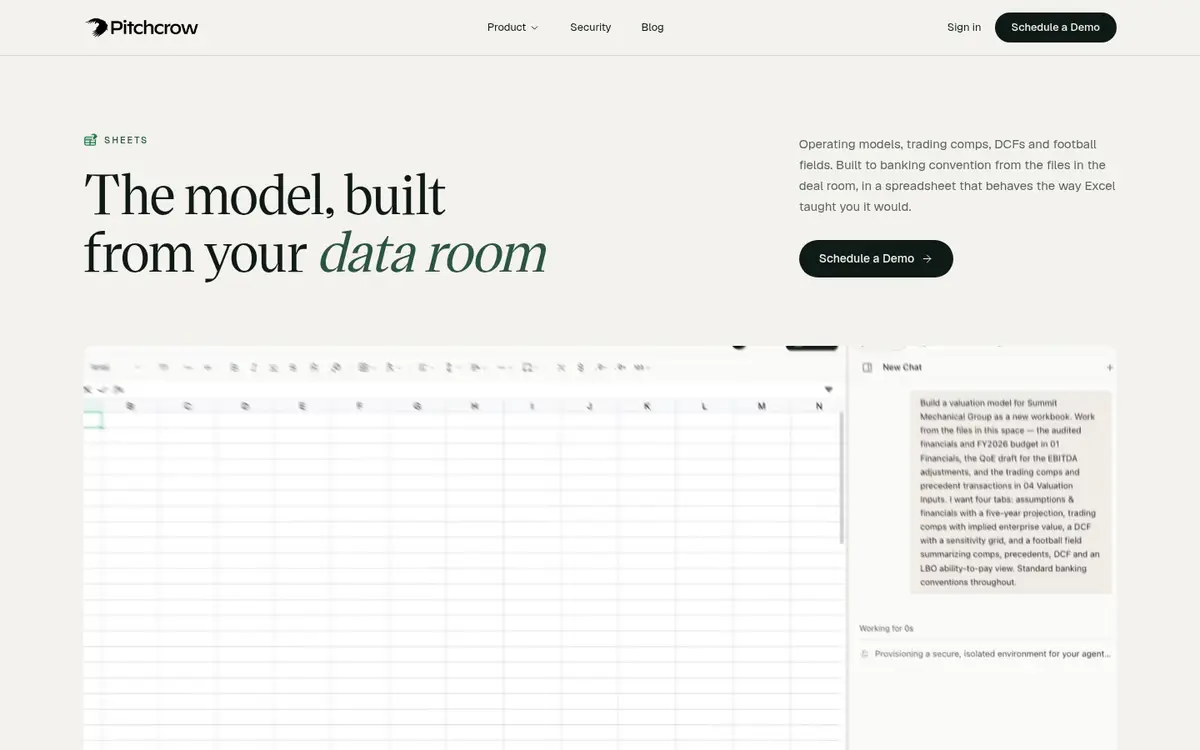
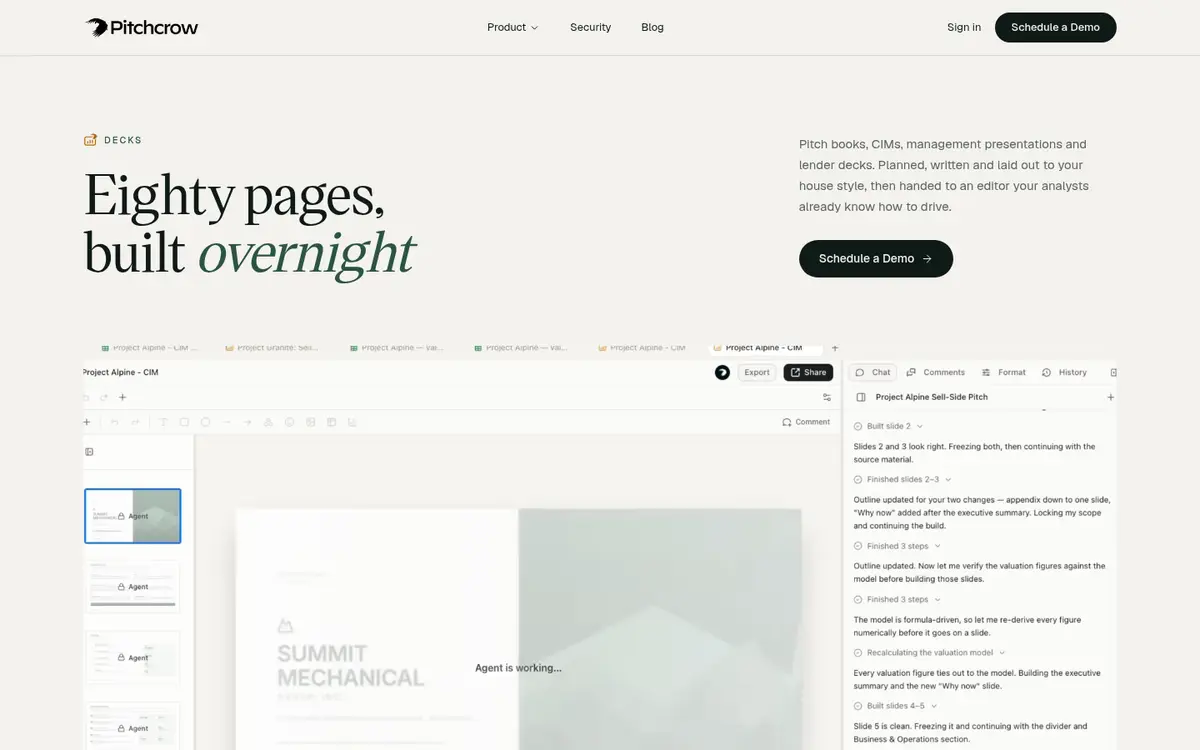
Pitchcrow is an AI product built only for investment banking. It builds sell-side models and decks in its own spreadsheet and slide editors. On the model side, it makes operating models, trading comps, DCFs and football fields from the files in the deal room, plus sources and uses, debt schedules, returns and sensitivities. On the deck side, it drafts pitch books, CIMs, management presentations and lender decks in the bank's house style from an approved outline. Each firm gets its own sealed environment.
Pitchcrow at a glance
Pitchcrow shows no price and has no pricing page; you schedule a demo to get access. What you can see before then are three sample documents for a fictional mandate, each made in a single generation run. The product has two halves, Sheets and Decks, with co-editing, threaded comments, version history and a mobile review view. Charts are backed by model ranges, and exports go to PowerPoint and PDF.
Quick picks
Pitchcrow is the first row, for reference. Most tools in this group use AI to build the model, so the "AI edits it" and "Builds it" columns look alike. Look instead at the price and "Excel file" columns: several vendors sell only through a demo, and they differ on whether you end up with a normal Excel file or work inside their own editor.
| Tool | Best for | Type of tool | Price (entry plan) | Works in | Free option | Builds the model for you | Excel file you keep | AI edits your file | Templates library |
|---|---|---|---|---|---|---|---|---|---|
| Sell-side banking models and decks | AI banking platform | Demo only | Own editors; PPT, PDF export | Yes: Three sample documents | Yes: From deal room files | Not stated: .xlsx download not stated | Yes: Agent builds models | Not stated: Not stated |
 | Banks and funds buying firmwide | AI platform | Demo only | Web; Excel, PowerPoint, Word | No: None listed | Yes: From one prompt | Yes: Excel output | Yes: Agents build models | Not stated: Not stated |
 | Buy-side deal teams | AI agent workspace | Free tier; Plus $60/mo | Web, Excel add-in | Yes: $0 starting tier | Yes: 3-statement, DCF, LBO | Yes: .xlsx with live formulas | Yes: Agents build models | Not stated: Your firm's templates |
 | One agent across Office apps | AI agent | Demo only | Excel, PowerPoint, Word, Teams | No: None listed | Yes: Models and decks | Yes: Excel add-in | Yes: Builds DCFs, comps | Not stated: Not stated |
 | A ready deal model, listed price | Ready models + AI | $20/mo or $120/yr | Web app, Excel file | Yes: 30 models + free samples | Yes: Fina chat builds it | Yes: .xlsx, formulas visible | Yes: Fina chat edits it | Yes: 500+ models |
 | Linked model and deck in Office | AI add-ins | Pro $40/mo | Excel, PowerPoint, Word, web | Yes: Free trial | Yes: In plain English | Yes: Your own workbook | Yes: Builds and audits | Not stated: Not stated |
 | Bank decks on your master | PowerPoint add-in | Free; from €25/mo | PowerPoint, Windows and Mac | Yes: 200 credits | No: Builds slides, not models | No: Slides only | No: No models | Not stated: Slide Library, not models |
yes · no · not stated in the vendor's sources. Hover a mark for details. From each vendor's own site; prices change, so check before you buy.
1.Rogo
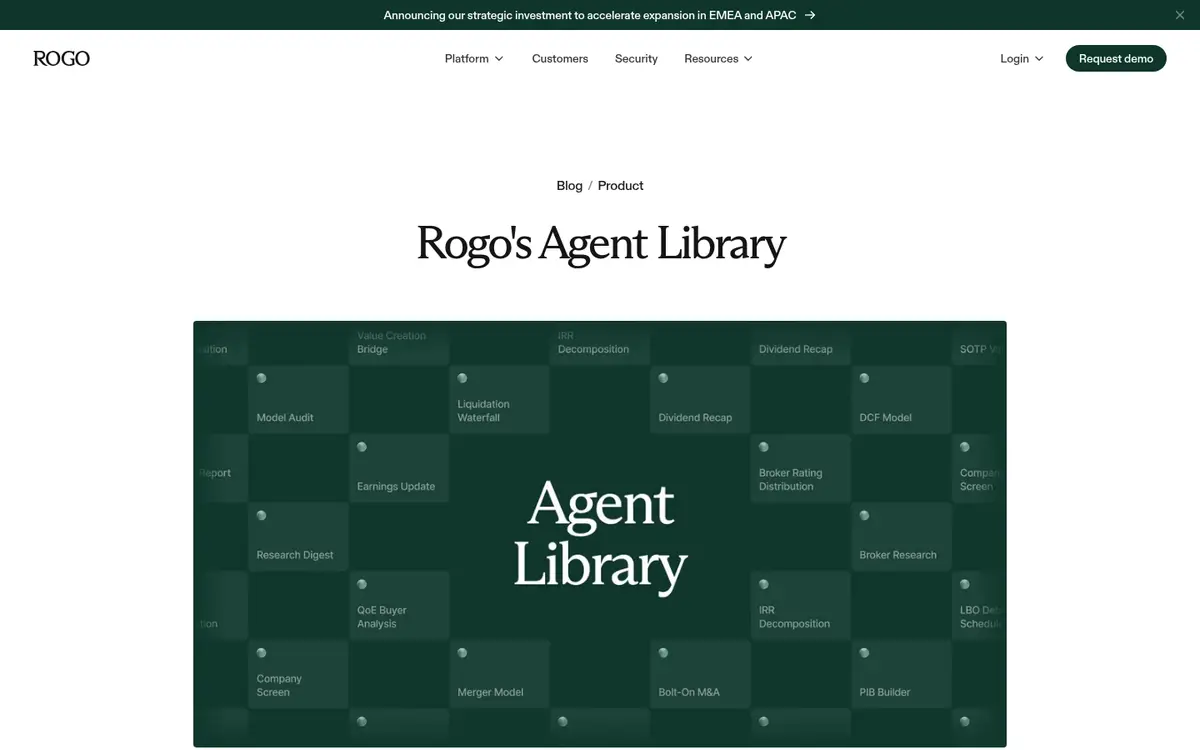
Rogo is an enterprise AI platform for banks, private equity, private credit and public-markets investors. Its library of hundreds of finance agents returns Excel models, PowerPoint decks, Word documents and research from a single prompt.
Banking agents cover fairness-opinion-style DCFs and LBOs, public comps, precedent transactions, CIM analysis and PIBs. Private credit agents review credit agreements, structure covenants and run recovery and waterfall analysis. Answers cite the filing, model or document they came from, so a reviewer can check them line by line. Custom agents learn a firm's templates and conventions, and a router called Watchtower picks an AI model for each task by quality, cost and speed.
Rogo is bought by whole firms. Former bankers and investors embed with client teams during rollout, and data partners include PitchBook, Preqin, Intralinks, Datasite and Octus. Rogo says more than 450 finance firms use it. Modules for firm memory, projects, notes and data sit next to the agents, so it covers research and monitoring as well as deliverables. That makes it a platform decision for the firm, not a tool one analyst picks up.
Next to Pitchcrow, Rogo is broader. Pitchcrow is built only for investment banking and ties one model to one deck; Rogo also serves funds, credit teams and equity research. Pitchcrow's main idea, charts that are marked stale when the model changes, is not something Rogo's pages describe. On buying, the two are alike: no public price, no free plan and a demo first. A bank comparing them should run both on the same live mandate.
- Price
- No public price. Demo first.
- Free option
- None listed.
Pros
- Agents for banking, credit and equity research
- Cited answers you can check line by line
- Hands-on rollout with former bankers
Cons
- No public price
- No free plan or trial listed
Pick it if your firm wants one AI platform for banking and investing teams, not only sell-side work.
2.Compound
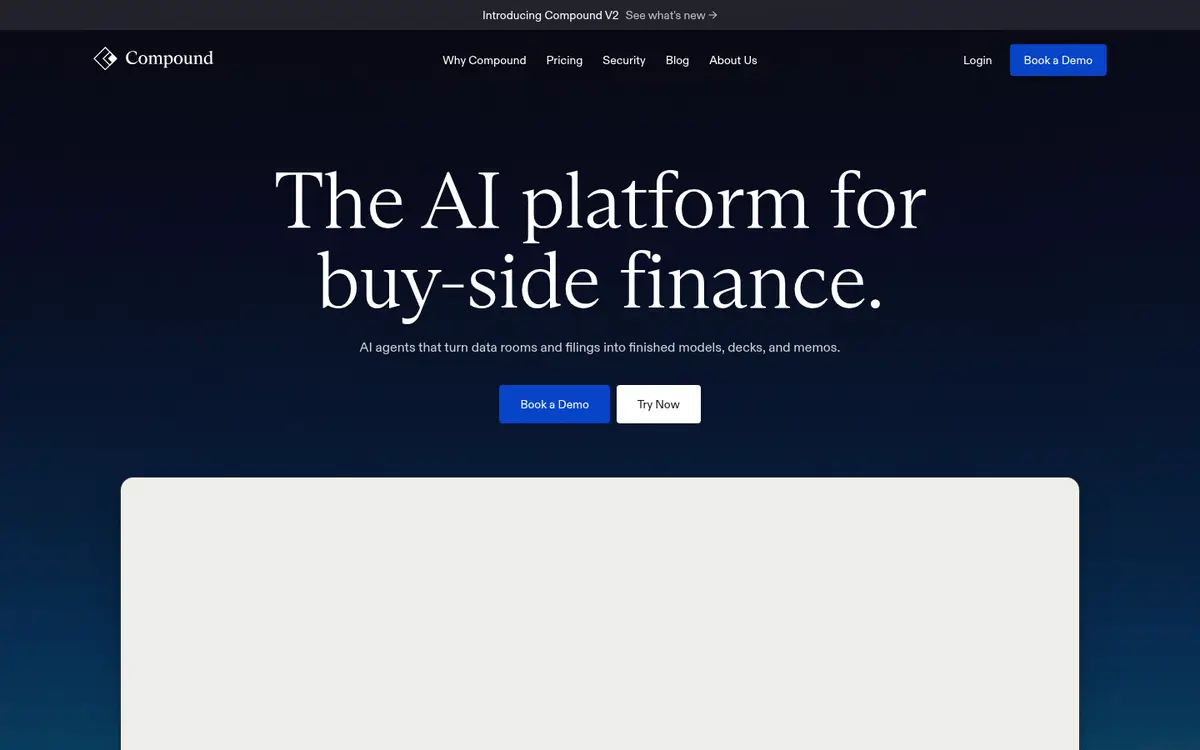
Compound is a cloud AI workspace for buy-side deal teams in private equity, venture capital, growth equity, real estate and hedge funds. Its agents turn data rooms and filings into finished models, decks and memos, using its own Excel, PowerPoint and Word engines.
You upload a data room, and agents build three-statement, DCF and LBO models as Excel workbooks with live formulas. Citations chain each deck number to a model cell and then to the filing passage, and they stay as cell notes in the file you download. It has SEC filings, financials, transcripts, prices and macro data built in, works in your firm's templates and lets you comment on a cell or slide to ask for an edit. Models are recalculated and read cell by cell, which catches pasted values and broken formulas.
Teams can give agents their own email addresses and run tasks in the background, in parallel. Since 16 Nov 2026, other assistants such as Claude, ChatGPT and Microsoft 365 Copilot can send work to Compound agents.
Compound does what Pitchcrow does, models and decks from deal files, but for the buy side, and you can start without a demo. Plus is $60 a month and Pro starts at $150 a month; Teams and Enterprise go through a demo. You also get a real .xlsx file. The limits: filings outside the SEC and private-company datasets are not built in, so a private target is modeled from the data room you upload, and its quality claims rest on its own PE Bench.
- Price
- Plus $60 a month. Pro from $150 a month. Teams and Enterprise through a demo.
- Free option
- A $0 starting tier; the pricing page showed it as a 14-day free trial on 22 Nov 2026.
Pros
- Published prices and a $0 way in
- .xlsx files with live formulas and cell-note citations
- Decks and memos from the same data room
Cons
- Private-company data not built in
- Quality claims rest on its own benchmark
Pick it if you work on the buy side and want models and decks from a data room without a sales call.
3.Model ML
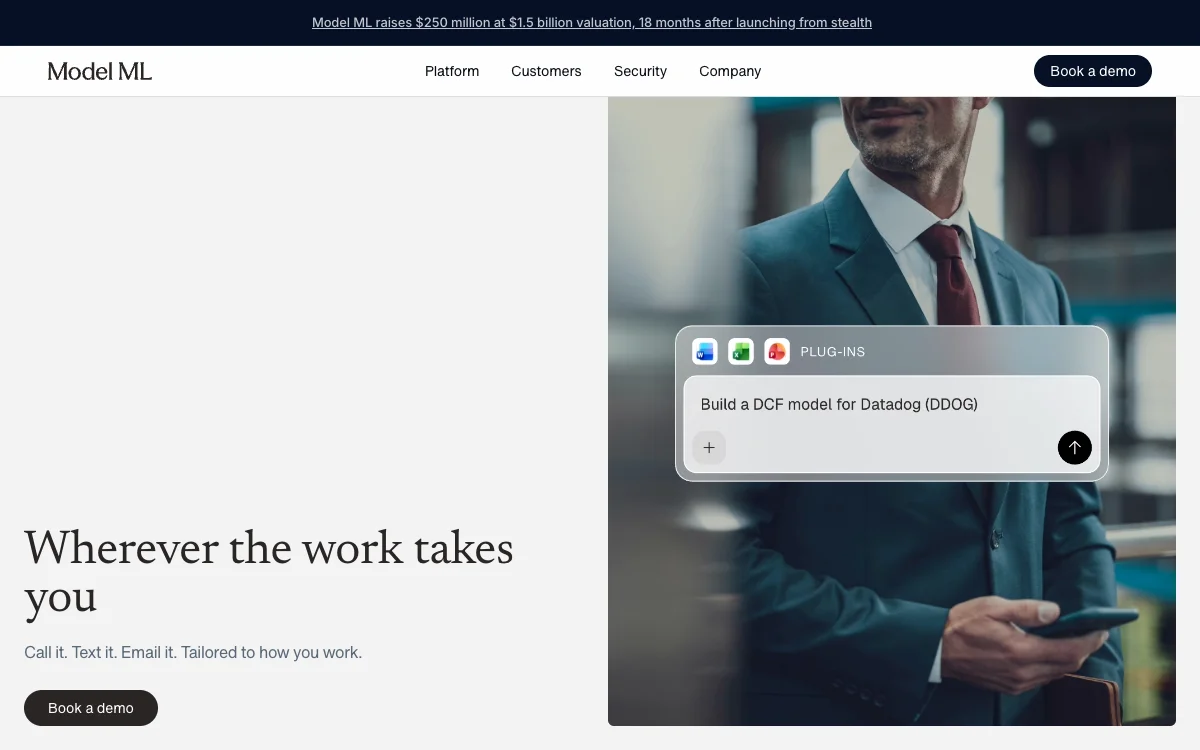
Model ML is an enterprise AI finance agent for investment banking, consulting, private equity, credit and asset management. It works inside Excel, PowerPoint, Word, Outlook and Teams, and turns out memos, tearsheets, comps, pitch books, diligence material, decks and models.
Bankers give it work by voice, chat, email or automatic triggers. Its chat page describes handing over a whole workflow, such as a pitch deck in PowerPoint or a DCF in Excel from scratch. Figures can carry source footnotes that you hover over and click, and a Document Review agent checks documents for details and risks. Connectors reach mail, SharePoint and Drive, calendars, CRMs and licensed data such as Capital IQ, FactSet, PitchBook and Preqin.
The buyer is a large bank or advisory firm that wants one agent across the Office apps its people already use, and that will teach it the firm's business, style and delivery format. Other surfaces include Workflows, Grids, a Notetaker and Sites, so it reaches meetings and client follow-up as well as the model.
Compared with Pitchcrow, the big difference is where the work happens. Pitchcrow keeps the model and deck in its own editors; Model ML works in your Excel and PowerPoint files, so there is no question about getting a normal workbook. Pitchcrow is narrower and goes deeper on the sell-side link between model and deck, with stale-chart warnings. Neither shows a price, and both start with a demo. Ask each vendor to build the same comps page from the same deal files.
- Price
- No public price. Demo first.
- Free option
- None listed.
Pros
- Works in your own Office files
- Licensed data from Capital IQ, FactSet and PitchBook
- Takes tasks by email, voice or chat
Cons
- No public price
- Sold to large firms through demos
Pick it if you want the agent inside the Excel and PowerPoint your bankers already use.
4.Finamodel
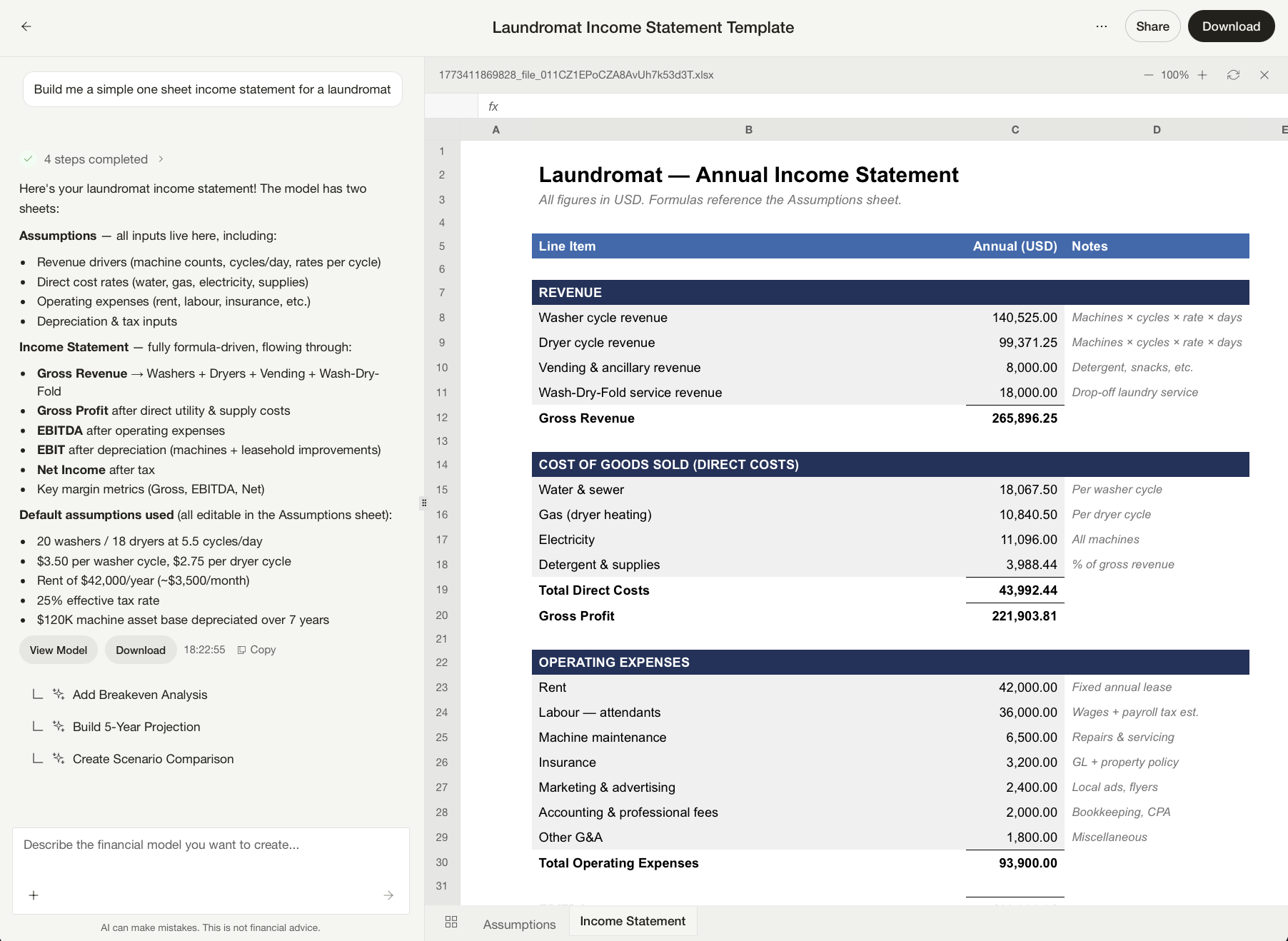
Finamodel is a library of ready Excel financial models with an AI assistant called Fina. Pitchcrow builds a deal's model and deck from the data room; Finamodel gives you a finished Excel model to start from and changes it for your case.
You open a ready model, such as a DCF, an LBO, an M&A model or a comparable company analysis, and tell Fina what the deal needs: new assumptions, an extra case, a different debt structure. A typical request is "add a second debt tranche and show returns at a five-year exit". Fina builds, edits, explains and fixes the model, and version history lets you restore any earlier file. When you are done, you download a real .xlsx file with every formula visible. It works without Finamodel and opens in Excel, Google Sheets and Numbers.
That answers the open question with Pitchcrow: the file is yours, and you can send it to a client or a lender as a normal workbook. Read-only links to QuickBooks, Google Sheets, Google Drive and 42 other apps can bring in figures, and a voice walkthrough helps a colleague follow a model they did not build. You can try one of 30 free models with live formulas, or a sample of any other model, with no demo.
Finamodel does far less than Pitchcrow. It does not read a data room, it does not draft pitch books, CIMs or lender decks, and it has no co-editing workspace or sealed environment for a bank. Support is by email, and you work in the Finamodel app before you download. It suits a boutique banker, a corporate development analyst or a student who needs one valuation model now and does not want a sales process. A bank that wants the model and the deck built together should look at Pitchcrow, Rogo or Compound.
How it works
- Pick a ready model, such as a DCF or a 3-statement model, from a library of more than 500.
- Ask Fina chat to change, explain or fix it for your case and your numbers.
- Download a real .xlsx file. Every formula is visible, and it works without Finamodel. It opens in Excel, Google Sheets and Numbers.
- Price
- Models plan: $20 a month or $120 a year. All Templates: $30 a month or $144 a year. You can cancel at any time.
- Free option
- 30 free models with live formulas, and a free sample of every other model, with values but no formulas. Both are sent by email link, one model email per email address per day. The library is free to browse.
Better than Pitchcrow at
- A real .xlsx file you keep
- Listed prices and self-serve sign-up
- One free model to try, no demo
Worse than Pitchcrow at
- Does not draft pitch books, CIMs or decks
- Does not read a data room
- No team workspace; support is by email
Models that fit: DCF Model, LBO Model, M&A Model.
Pick it if you need one deal model in Excel now and do not need the deck built with it.
5.Tracelight
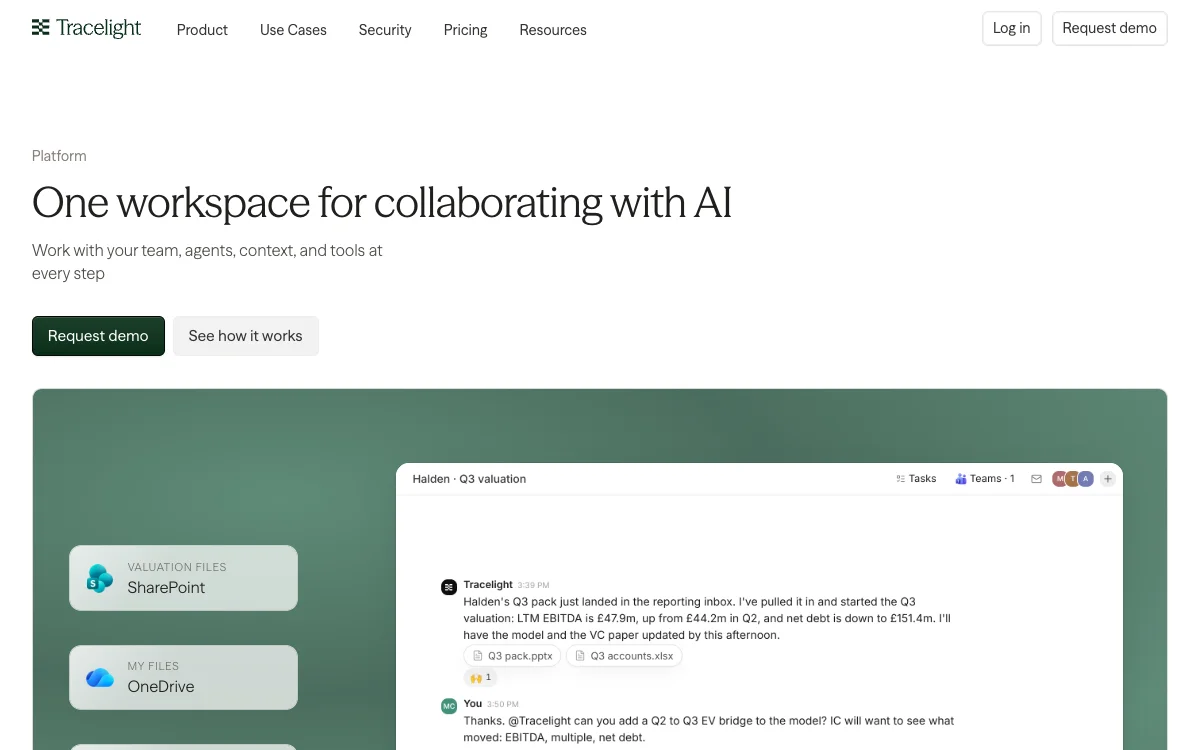
Tracelight is an AI platform for consultancies and finance firms, with add-ins for Excel, PowerPoint and Word. It builds, formats, reviews and audits models in plain English and builds decks from the workbook.
In Excel, a side panel has three tabs: Chat to build and format, Audit to check for formula issues and Trace to explain how a number is calculated. Every edit is checked in Tracelight's own spreadsheet engine before it lands in your workbook. Values taken from a PDF carry a comment that links to the source location. The PowerPoint and Word add-ins build slides in the firm template and keep them live as the model changes.
Its use-case pages cover operating models, DCFs, LBOs, merger models, quality of earnings and databooks, which suits due diligence, M&A and valuation teams. Firms can also save a formatting playbook and reusable skills that the AI applies on each model. A web platform adds a project space per deal with version control, a spreadsheet compare tool and connectors to Capital IQ, FactSet, PitchBook and SharePoint.
Tracelight gives you the closest match to Pitchcrow's model-plus-deck idea, but inside Office rather than in a separate editor, so the workbook stays yours. It is not built only for banking, and its pages do not mention CIM or lender-deck drafting from an outline. The big gap is on price: Pro is $40 a month and Max $200 a month, both self-serve, with a free trial that includes 3 Model Review runs. Enterprise goes through sales.
- Price
- Pro $40 a month, Max $200 a month. Enterprise through sales.
- Free option
- A free trial with 3 Model Review runs.
Pros
- Model and slides stay linked inside Office
- Each edit checked before it reaches your workbook
- Self-serve plans from $40 a month
Cons
- No CIM or lender-deck drafting described
- Max costs $200 a month
Pick it if you want model and deck linked, but in your own Excel and PowerPoint files.
6.Decky
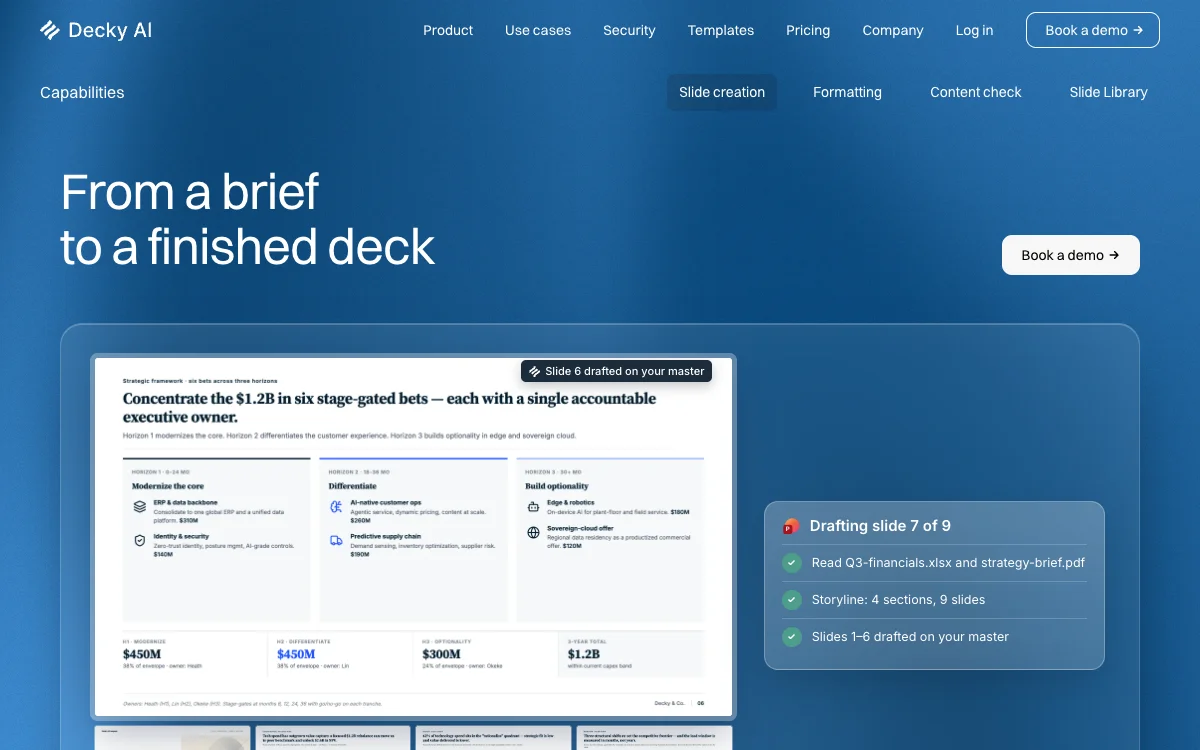
Decky AI is a PowerPoint add-in for Windows and Mac that drafts, formats and checks slides on a firm's own master. It is built for consultants, investment banking and M&A teams, private equity and corporate strategy.
You give it a topic, outline, memo or files, and it writes the storyline and action titles first, then the slides. It reads Word, PDF and Excel files down to the tab, cell and page. Formatting snaps shapes to the grid and applies type and theme colours, and a content check looks for typos, number formats, units, citations and tone. Every change waits in a panel until you accept it, and a Slide Library lets you search past slides and restyle them to the current master.
For a banking team, this covers the deck half of Pitchcrow inside the PowerPoint file you already have open. Since September 2026 it can show two or three versions of a slide side by side and turn a sketch into a slide. It also works from inside Claude, Cursor and other assistants through Decky MCP.
The trade-off is plain: Decky builds no models. You still need the Excel side from somewhere else, and nothing ties the charts back to a model the way Pitchcrow's stale-chart warnings do. It also has no web or mobile version, so drafting happens at a desk. In return, it shows its prices: a free plan with 200 credits, then Starter at €25, Pro at €50 and Max at €100 a month. Business and Enterprise plans are on request.
- Price
- Starter €25, Pro €50, Max €100 a month. Business and Enterprise on request.
- Free option
- A free plan with 200 credits.
Pros
- Works in the deck already open in PowerPoint
- Every edit waits for your approval
- Free plan, published prices
Cons
- Slides only, no models
- No web or mobile version
Pick it if your bottleneck is the pitch book, not the model.
Who should pick what
Pitchcrow joins the model and the deck for sell-side banking. So ask first which half you need help with, and second whether you can live with a sales process. The answers point to quite different tools on this list, from firmwide platforms to a single add-in.
- A firmwide AI platform for banks and funds: Rogo or Model ML.
- Models and decks from a data room, without a demo: Compound. A linked model and deck inside Office: Tracelight.
- Bank decks on your own master, with no model: Decky AI.
- A ready Excel deal model that AI changes for your case: Finamodel.
Whichever tool you test, ask the same three questions: can you download a normal .xlsx file, where is your client data processed, and are the security audits finished? Pitchcrow lists its SOC 2 and ISO 27001 audits as underway. Then run each tool on the same past mandate and compare the output side by side.
Frequently asked
How much does Pitchcrow cost?+
Pitchcrow shows no public price and has no pricing page. You schedule a demo to get a quote. We last checked on 10 Nov 2026.
Is there a free version of Pitchcrow?+
No free plan or trial is listed. Pitchcrow publishes three sample documents for a fictional mandate, each made in one generation run, so you can judge the output before a demo.
What are the main Pitchcrow alternatives?+
For firmwide AI: Rogo and Model ML. For models and decks you can try without a demo: Compound and Tracelight. For decks only: Decky AI. For a ready Excel model that AI changes for your case: Finamodel.
Can you download Pitchcrow models as Excel files?+
Pitchcrow's pages do not say. Models live in its own spreadsheet editor, and decks export to PowerPoint and PDF. Ask about .xlsx export in the demo if you need to send the workbook on.
Pitchcrow vs Finamodel: which should I pick?+
Pick Pitchcrow if your bank wants the model and the deck built together from the data room, and can buy through a demo. Pick Finamodel if you need a ready Excel model you keep, at $20 a month or $120 a year.
Is Pitchcrow secure?+
Each firm gets its own sealed, single-tenant environment. Its SOC 2 and ISO 27001 audits were listed as underway, not complete, so ask for the current status.
Sources for Pitchcrow (4), last checked 15 Nov 2026+
- pitchcrow.com · Homepage positioning · 10 Nov 2026
- pitchcrow.com · Sheets product page · 10 Nov 2026
- pitchcrow.com · Decks product page · 10 Nov 2026
- pitchcrow.com · Recalculation quote · 15 Nov 2026
Each alternative's own page lists its sources.


