McDonald's (MCD) Financial Forecast Calculator
Interactive 5-year forecast and DCF for McDonald's. Adjust revenue growth, gross margin, capex intensity, WACC, and terminal growth - see revenue, free cash flow, and enterprise value update in real time. Seeded from McDonald's’s most recent SEC filings.
Assumptions
Need this as an Excel model?
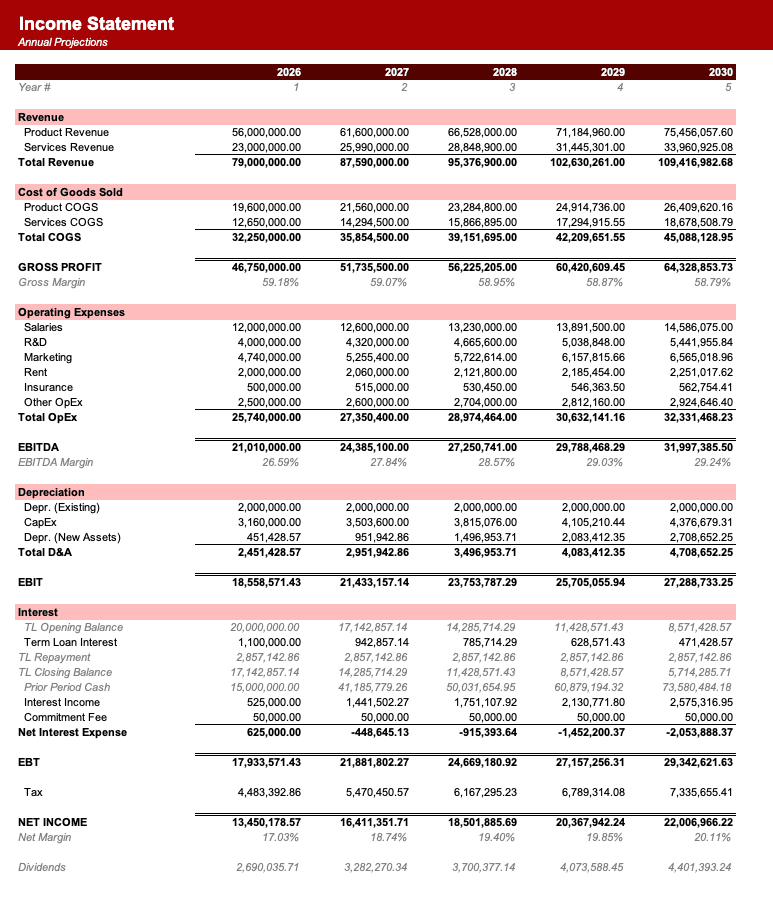
Keep iterating on the McDonald's forecast in Excel. The downloadable sample has every assumption you see here plus a fully integrated income statement, balance sheet, cash flow, and debt schedule - five years of SEC historicals and live formulas in a fully editable workbook.
Other Consumer forecasts
Run the same calculator on a peer.








Frequently asked
What is McDonald's business model and how does it generate revenue?+
McDonald's operates a highly franchised business model, with approximately 95% of its over 40,000 restaurants owned by independent local business owners. The company generates revenue through sales from its company-operated restaurants and various franchise fees, including rent, royalties, and initial fees from its franchisees. McDonald's also retains ownership or long-term leases on the underlying real estate for most of its franchised locations.
What are the primary revenue drivers for McDonald's Corporation?+
McDonald's revenue is primarily driven by sales from its company-operated restaurants and the fees collected from its vast network of franchised restaurants. These franchise fees encompass rent, royalties, and initial fees, reflecting the company's real estate-backed business model. The U.S. and International Operated Markets segments contribute the largest portions to total revenue.
What is McDonald's typical capital expenditure as a percentage of revenue?+
McDonald's typically allocates 9% to 11% of its revenue towards capital expenditures, amounting to approximately $2.4 billion to $2.7 billion annually. This capex is roughly split, with 40% going to maintenance and technology reinvestment, and 60% dedicated to growth initiatives like new restaurant openings. The company plans significant new restaurant development globally, which may push capex towards the higher end of this range.
What are the key financial assumptions used in the McDonald's financial model?+
Key assumptions in the McDonald's financial model include a revenue growth rate of approximately 4.5% and a Cost of Goods Sold (COGS) as a percentage of revenue around 55%. Selling, General, and Administrative (SGA) expenses are assumed to be about 11.7% of revenue, while the tax rate is forecast at approximately 21.15%. Capital expenditure is modeled at about 9.2% of revenue.
What is the purpose of the McDonald's financial model and its valuation focus?+
The McDonald's financial model aims to provide a comprehensive equity valuation and cash flow forecast for the company. Its primary purpose is to determine the intrinsic value of McDonald's Corporation and assess the sustainability of its dividends. The model specifically focuses on the company's highly franchised, real estate-backed business model.
Can I download an Excel financial model for McDonald's (MCD)?+
Yes, an Excel financial model for McDonald's (MCD) is available for download. This model provides a detailed forecast horizon from FY2026 to FY2030, offering insights into the company's financial performance and valuation. It is designed as a general corporate model for comprehensive analysis.
Have more financial modelling questions? Contact us