 Aether Financial Model
Crypto/Web3 Startup Financials (Free Excel Download)
Synthetic biology platform that builds searchable protein indexes to engineer novel molecular assemblers for high-value industrial products.



professionals from Deloitte
Used by professionals from






About this model
Aether uses high-throughput protein screening to create empirical protein-reaction indexes and identify patentable biocatalytic reactions. Its miniaturised platform can screen more than 20,000 samples daily per laser, detect over 10,000 reactions per screen, and claims lower cost than comparable technologies.
Three product lines address industrial problems: PFAS degradation for water and soil, proteins for ultra-high-performance polymers, and metal binding for lithium extraction. Aether has identified leads in defluorination, antiviral manufacturing, and aramid polymerisation; one optimisation programme achieved a 64x yield improvement and 190x enantioselectivity improvement.
The financial model should treat each product line as a separate R&D portfolio with milestone timing, programme cost, and commercial route. PFAS partnerships may produce co-development milestones and royalties, materials licensing follows MVP validation, and metals requires a licensing-versus-integration choice. Start with three active programmes, a $49 million raise, and quarterly cash runway.
A turnkey financial model
Live formulas, no hardcoded values
Outputs are driven by live formulas, so the workbook updates from its assumptions instead of relying on hardcoded results.
All assumptions in one tab
Inputs are clearly marked in the Assumptions tab and separated from calculations, making it clear what to change and what to leave intact.
Statements always balancing
For integrated-statement models, the balance sheet, cash flow, and supporting schedules tie through properly.
Distinct schedules for clarity
Debt, working capital, taxes, and cash flow can get messy quickly. We group calculations in clear schedules, not across disconnected tabs.
No hidden macros or external links
There are no unexplained external workbook links or macros to undermine auditability or portability.
Changes flow through the model
Update a key driver and see the impact carry through the forecast, financing, and return outputs. We never use hardcoded numbers in formulas.
About Aether
aetherbio.com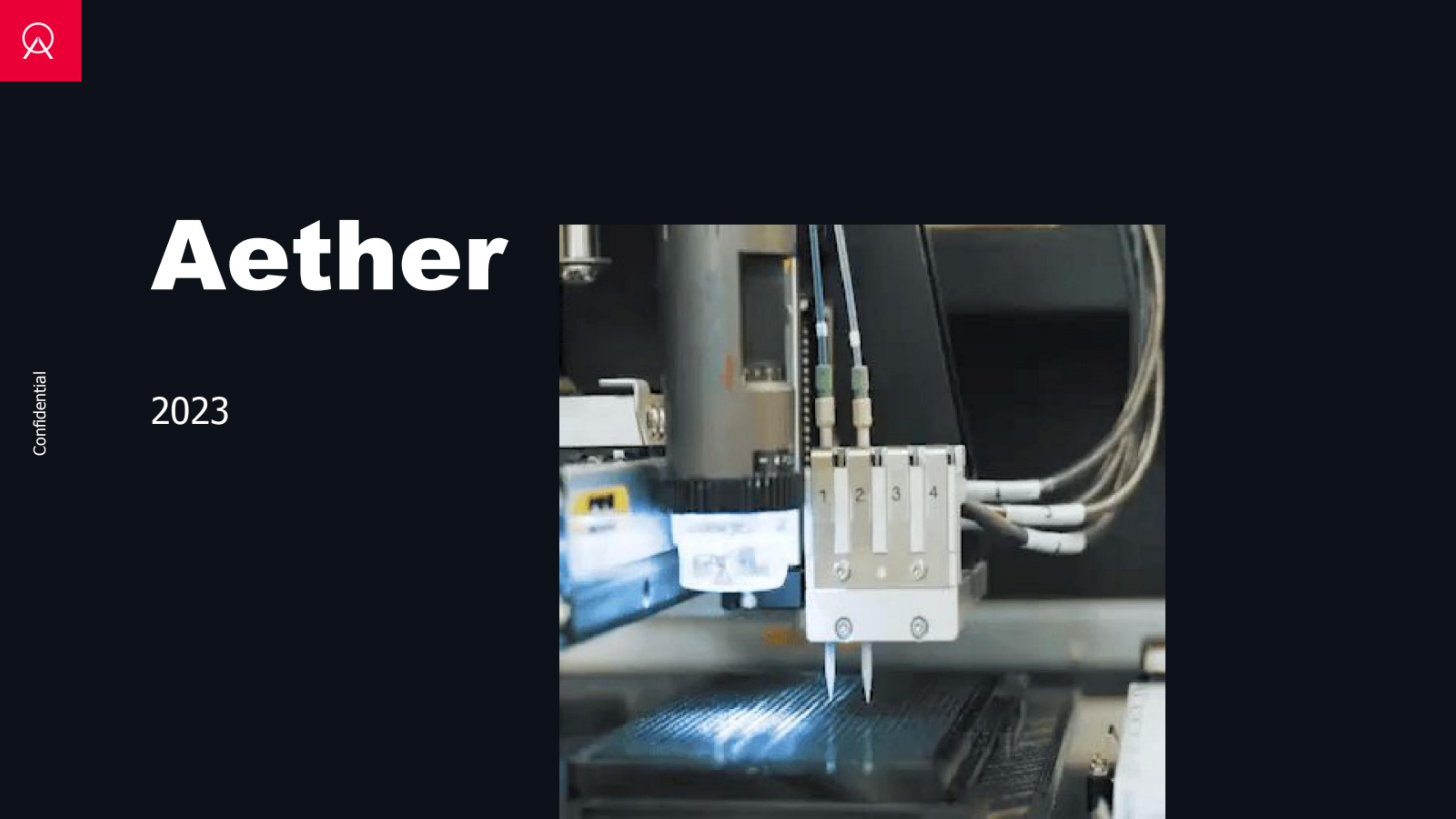
How to build a detailed financial model for Aether
A complete walkthrough of the business, drivers, and assumptions behind the downloadable Aether model - distilled from its pitch deck and publicly available information.
Product & value proposition
Aether has built a proprietary high-throughput protein screening platform that:
- Runs miniaturised enzymatic experiments on 1536-well micro-plates.
- Uses acoustic/piezoelectric printers to print thousands of molecules and test proteins at scale.
- Reads reactions via UV-laser mass spectrometry (MALDI-like) on metal chips.
- Screens >20,000 samples/day per laser (20× faster than state of the art).
- Detects >10,000 different reactions per screen.
- Costs up to 10× less per sample and 50× less CapEx than comparable tech.
The platform generates "protein indexes" - empirically tested protein-reaction combination databases - enabling identification of novel biocatalytic reactions (patentable IP). These reactions are then optimised to industrial specs using multi-parametric algorithms.
Three active product lines:
- Defluorination proteins to degrade PFAS in drinking water / soil.
- Aramidase/polymerase proteins to manufacture high-complexity ultra-high-performance polymers.
- Metal-binding proteins to extract strategic metals (lithium) from previously inaccessible brines.
Market
Per product line (slide 17 image confirmed):
- Product Line 1 (PFAS / defluorination): TAM $40bn
- Product Line 2 (ultra-high performance materials / HCP polymers): TAM >$20bn
- Product Line 3 (metal extraction / lithium): TAM $5bn
- Combined stated TAM: >$65bn
Revenue model
Three distinct go-to-market / monetisation strategies by product line:
| Product Line | Revenue mechanism |
|---|---|
| 1: PFAS defluorination | Co-development partnerships with PFAS filtering/concentration companies serving municipal water utilities and soil remediation. Revenue likely milestone payments + royalties / licensing fees. |
| 2: Ultra-high performance materials | Build MVPs to validate specs → license products and manufacturing process to advanced materials manufacturers. |
| 3: Metal extraction (lithium) | Build pilot-scale refineries to validate cost and generalisability → then either license or vertically integrate depending on metal and margins. |
Platform economics: standardised expression system and biocatalysis (not fermentation) allows fast, low-risk process scale-up. Stated capacity: 5+ new product lines started per year.
Traction & metrics
- Protein indexing: demonstrated capability to screen >30,000 molecules against individual proteins.
- Throughput advantage: >1,000× more functional labels per protein than state-of-the-art screening technologies.
- Product line leads: protein leads identified for defluorination, antiviral manufacturing, and aramid polymerisation - all generating potential novel IP.
- Protein optimisation case study (unnamed protein/substrate): 15 algorithm iterations over 4 months exceeded 6-month targets; demonstrated 64× product yield improvement and 190× enantioselectivity improvement.
Unit economics
- Platform CapEx: up to 50× lower CapEx than comparable technology.
- Per-sample cost: up to 10× lower than alternatives through miniaturisation.
- Industry benchmark for drug/molecule development: companies spend 3+ years and $15M+ before attempting to scale manufacturing.
- Aether claims to be able to start 5+ product lines per year and fail-fast / iterate rapidly, implying materially lower per-program cost (specific number not given).
Competition / moat
Competitive advantages stated:
- Index size: 1,000× more protein-reaction combinations tested than conventional technologies.
- Hypothesis-free screening: detects >10,000 reaction types per screen vs targeted assays used by competitors.
- IP moat: every indexed novel reaction type is patentable and owned by Aether.
- Reaction-first approach: derisk product lines early by mining indexes before committing to product development.
- Platform selectivity criteria: only pursues applications where Aether's proteins are strictly necessary for the final product (not marginal improvements), maximising value capture.
Team & funding ask / use of funds
- Funding ask: $49M
- Use of funds:
- Build out product line(s).
- Prototype Aether's second-generation technology.
- Build out Aether's executive team.
Recommended financial model
- Archetype + why: Multi-product-line deep-tech / platform R&D model with staged revenue recognition (milestone + licensing). This is not a recurring SaaS or DTC model - revenue arrives as lumpy partnership milestones, then licensing royalties once products scale. Best archetype: platform R&D + licensing P&L, structured as a project-portfolio model with one tab per product line. Secondary output: a 3-statement model once the first product line is commercially active.
- Forecast horizon & granularity: 5–7 years, quarterly for years 1–2, annual thereafter. Early years are spend-dominated; revenue begins in year 2–3 as the first partnership deal closes.
- Key drivers & assumptions:
| Driver | Value |
|---|---|
| Active product lines at raise close | 3 |
| New product lines started per year | 5+ |
| Time to first partnership revenue (PL1 PFAS) | 12–18 months post-close |
| Time to licensing revenue (PL2 materials) | 24–36 months |
| Time to pilot revenue / licensing (PL3 metals) | 36–48 months |
| First partnership deal size (milestone + royalty) | $5–20M upfront, royalty TBD |
| Licensing royalty rate (PL2, PL3) | 3–8% of product revenue |
| Per-program R&D cost (Aether) | $2–5M/year |
| Headcount growth (R&D + BD) | 10–20 FTE/year |
| Average FTE cost (US deep tech) | $180–220k fully loaded |
| Lab CapEx (platform build-out) | $5–15M in year 1 |
| Gross margin on licensing revenue | 70–85% |
| Gross margin on co-development / milestone | 40–60% |
| PFAS TAM (PL1) | $40bn |
| Materials TAM (PL2) | >$20bn |
| Metals TAM (PL3) | $5bn |
| SOM penetration at year 5 | 0.1–0.5% of relevant TAM per line |
| Raise size | $49M |
- Scenarios (Base / Bull / Bear - which variables flex):
- Bear: PL1 partnership delayed to month 24; only 1 deal closed by year 5; per-program costs run 30% over; licensing royalties at lower end (3%).
- Base: PL1 deal in month 18; PL2 licensing in year 3; $49M capital is sufficient; 2–3 partnerships signed by year 5.
- Bull: PL1 deal closes in month 12; PL2 and PL3 partnerships sign concurrently; Aether vertically integrates PL3 metals at year 4 capturing full margin; 5+ product lines generating pipeline value by year 5.
- Required sheets / outputs:
- Assumptions - all inputs centrally controlled
- Product Line 1 (PFAS) - timeline, milestones, partnership revenue, R&D opex
- Product Line 2 (Materials) - MVP timeline, licensing revenue ramp
- Product Line 3 (Metals) - pilot capex, licensing vs vertical integration toggle
- Platform Opex - headcount, lab costs, G&A, CapEx
- Consolidated P&L - revenue, gross profit, EBITDA, net burn
- Cash / Runway - $49M starting cash, quarterly burn, runway to break-even or next raise
- Sensitivity - runway vs deal timing; per-program cost vs deal size
- Dashboard - KPI summary (cash runway, active programs, cumulative revenue, burn rate)
Frequently asked
Is the Aether financial model free?+
Yes. The Aether model is a free Excel (.xlsx) download with live formulas. Sign up with your email and the workbook is yours to keep, review, and edit.
What's included in the model?+
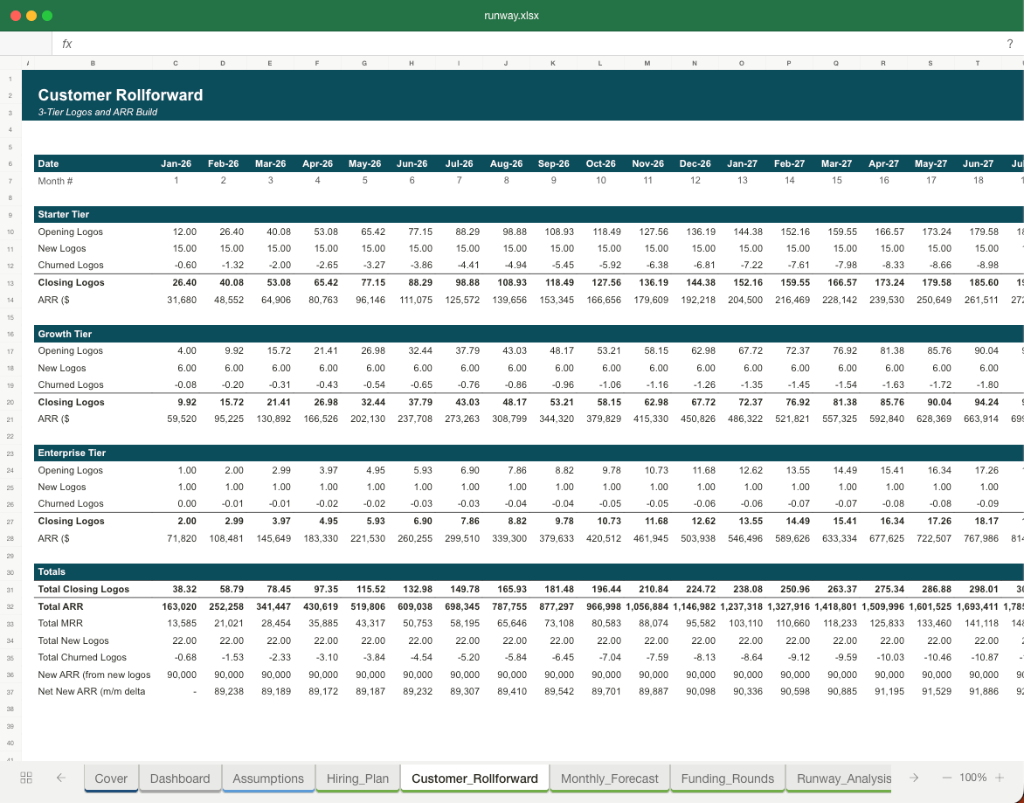
A 5-year monthly forecast with P&L, cash flow and runway, valuation (exit multiple plus a DCF cross-check), MOIC/IRR returns, and unit economics, with live formulas throughout.
How was this model built?+
It was built from Aether's pitch deck and publicly available information, then structured to investment-banking standards as a fully editable Excel model.
Can I change the assumptions?+
Yes. You can change assumptions and the live formulas will recalculate in the downloadable Excel model.
Have more financial modelling questions? Contact us

Created by ex-finance professionals
Hey, I’m Alex and I created Finamodel.
Over my years in the finance industry I kept building the same models over and over again. Same structure, same assumptions, different logo. So I started building frameworks to turn them into clean, reusable templates.
Every model here is one I’d actually use for a client, and I personally vet each one before it goes up.
I’m not an expert in every industry, but I’ve built enough models to know what belongs in one. And when something is completely foreign to me, I reach out to my network for experts to work on our models with us.
Having a template library on hand cuts a first build from hours to minutes.
Need help finding your model? You’ll find me in the Finamodel app!
Other Crypto/Web3 Startup Financial Models
Browse another startup in the same category.

0x Labs
0x Labs builds open exchange infrastructure (protocol, API, consumer app) for on-chain token trading across multiple blockchains.

1inch Network
DeFi aggregation protocol that routes crypto swaps across 100+ liquidity sources to deliver best rates and lowest gas fees.
Alto
Self-directed IRA platform enabling retail investors to invest in alternative assets (private equity, debt, real estate, crypto) via tax-advantaged retirement savings.
Auki Labs
Decentralized peer-to-peer spatial positioning SDK for social AR - building the infrastructure layer to replace GPS and enable a persistent AR metaverse.
Awesome People Ventures Fund 2
Awesome People Ventures is a community-driven, decentralized early-stage Web3 VC fund raising Fund II.

Axelar
Cross-chain blockchain overlay network enabling universal transfer of assets, transactions, and state across all blockchain ecosystems.
BRD
BRD is a non-custodial crypto wallet app (consumer) and blockchain infrastructure API platform (enterprise) targeting mass-market crypto adoption.

Calaxy
Creator economy mobile app where athletes and influencers issue personal tokens and sell fan perks (shoutouts, video calls, DMs, subscriptions) directly to their communities.